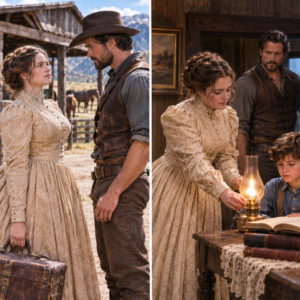
CHAPTER 6 – PART 6 – THE WIDOW THEY CALLED A THIEF HAD FED THE TOWN—UNTIL A QUIET RANCHER EXPOSED THE PAID DEBT
PART 6: THE RECEIPT THAT COULD NOT BE EXPLAINED AWAY
When Lucas returned to the ranch that evening, I was waiting in the kitchen.
I had tried to keep busy all afternoon, but every time I heard a horse outside, I looked toward the window.
The children had eaten supper.
Hazel was already preparing for bed, while Freddy sat near the stove reading an old book.
Lucas entered and removed his coat.
I immediately noticed the folded paper in his hand.
“What happened?”
He looked at me.
“Your debt was paid.”
I stared at him.
For a moment, I thought I had misunderstood.
“What?”
“Paul paid Dinsmore three years ago.”
I reached for the table.
Lucas unfolded the receipt and placed it before me.
I recognized Paul’s handwriting on the small note attached to the document, but the important part was Dinsmore’s signature at the bottom.
The amount was three hundred and forty dollars.
The words were clear.
Payment received in full satisfaction of the debt.
I read them again.
Then a third time.
I felt as though the room had tilted beneath my feet.
“Paul paid it?”
Lucas nodded.
“Yes.”
“But Dinsmore has been demanding the money from me.”
“I know.”
I looked at the receipt.
“Why would he do that?”
Lucas pulled out a chair and sat opposite me.
He explained that the paper had been kept among Paul’s old documents, but I had never understood that it was the final receipt for the entire debt.
When I had shown Lucas the collection letter, he had recognized the amount and remembered that Paul had once told him he had settled the obligation.
He had examined the old papers more carefully and found the signed receipt.
The evidence was simple.
Dinsmore had accepted the full payment.
He had signed a document confirming it.
Yet he had continued treating the debt as though it remained unpaid.
I sat down slowly.
For three years, I had believed that Paul’s unfinished business was still hanging over our home.
I had worked, saved, and sacrificed because I thought the debt was real.
I had even purchased the hogs with money I could barely afford to spend, knowing that winter preservation might help me survive until I could find enough work.
All that time, the money had already been paid.
I pressed my fingers against the receipt.
“Did you show it to everyone?”
Lucas nodded.
“What did Dinsmore say?”
“He claimed the payment had not been properly credited.”
I looked up.
“But he signed that it was paid in full.”
“Exactly.”
I felt tears gathering in my eyes.
Not because I was frightened anymore.
Because I was angry.
Three years of struggling.
Three years of worrying about losing Paul’s land.
Three years of wondering whether I could ever earn enough to settle an obligation that no longer existed.
And all because a man had decided he could continue demanding money after accepting it.
“Will he still auction the property?” I asked.
Lucas shook his head.
“He has no honest claim to it.”
I looked down at the paper.
I wanted to believe that the matter was finished, but I knew Dinsmore had not become a wealthy and influential trader by surrendering easily.
“He’s going to fight this.”
Lucas considered that.
“Perhaps.”
Then he reached across the table.
“But he won’t be fighting you alone.”
I looked at his hand.
For years, I had managed every problem by myself because I had believed that asking for help meant giving up my independence.
Lucas was showing me that those two things were not the same.
I could still make my own decisions.
I could still protect my home.
And I could accept the help of someone who respected me enough to stand beside me rather than take control.
The following morning, Lucas returned to town with the receipt.
This time, he did not go alone in the sense that the truth was no longer his to carry.
The paper belonged to Paul’s history, and I had decided I would not hide from what Dinsmore had done.
I wanted to look him in the face.
I wanted him to explain why he had demanded money that he had already received.
And I wanted every person who had called me a thief to hear the answer.
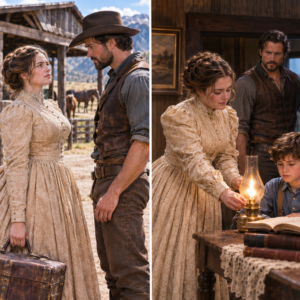
I dressed carefully, pinned my chestnut hair beneath my bonnet, and wrapped my worn shawl around my shoulders.
Then I stepped outside.
Lucas was waiting beside his horse.
He offered me his hand.
I took it.
Together, we rode toward Wolf Point.
CHAPTER 7 – PART 7 – THE WIDOW THEY CALLED A THIEF HAD FED THE TOWN—UNTIL A QUIET RANCHER EXPOSED THE PAID DEBT
PART 7: THE TOWN THAT HAD TO LOOK ME IN THE EYE
The general store porch was crowded when we arrived.
Mildred Yancy was standing near the entrance, speaking to several people about the stolen hogs.
She had apparently decided that the receipt had not changed anything.
When she saw me, she pointed toward the street.
“There’s the woman who stole from honest families.”
I stepped down from the wagon.
My legs felt unsteady, but I kept my shoulders straight.
Lucas remained beside me.
Mildred turned toward the others.
“She fed you stolen meat, and now she’s trying to escape the debt she owes.”
I looked at her.
“I paid for those hogs.”
“You expect us to believe that?”
“I paid cash to the freighter who sold them.”
Mildred shook her head.
“Those animals belonged to my husband’s pen.”
I had no receipt from the freighter to show her.
I had paid him in cash, and I had never imagined that anyone would later accuse me of stealing the animals.
But I knew what I had done.
I had bought them honestly.
I had prepared them honestly.
And I had shared the meat because I believed people deserved help when winter made life difficult.
Lucas placed Paul’s receipt on the counter.
“Before anyone says another word about Beulah’s character, I want you to read this.”
Dinsmore stood nearby.
He looked tired, but his expression remained hard.
“I’ve already explained that payment.”
Lucas turned toward him.
“Then explain it again.”
The receipt was unfolded.
Several people moved closer to read the writing.
Lucas pointed to the date.
Then the amount.
Then the words confirming that the entire debt had been paid.
Mildred looked at Dinsmore.
“What does that mean?”
Dinsmore ignored her.
He claimed that the receipt did not settle the matter because the payment had not been properly entered into his records.
Lucas asked why he had signed a document stating that it had been received in full.
Dinsmore answered that Paul had owed the money, and that the bank had transferred the debt to him.
Lucas reminded him that purchasing the debt did not give him the right to collect it twice.
Dinsmore’s face tightened.
I stepped closer.
“Paul paid you three years ago.”
He looked at me.
“You don’t understand these matters.”
I felt the old familiar embarrassment rise in my cheeks.
But this time, I did not lower my eyes.
“I understand that you sent me a letter demanding money I no longer owed.”
He said nothing.
“I understand that you threatened to take my home.”
I pointed toward the receipt.
“And I understand that you signed your own name beneath the words saying the debt was paid.”
A man standing near the door looked down.
Another quietly asked Dinsmore whether the signature was his.
The trader did not answer immediately.
His silence told me more than his excuses had.
Then he tried to return to the accusation about the hogs.
He claimed that even if the debt had been paid, I still had questions to answer about the meat.
I looked around at the people who had once accepted my food.
“Did any of you ask where the meat came from before you accepted it?”
Nobody answered.
“Did I ever ask you for money?”
Again, silence.
“I gave you what I had because your children needed food.”
My voice shook, but I continued.
“I did not do it because I wanted praise or because I expected you to owe me anything.”
I looked toward Mildred.
“But I will not stand here and let you turn kindness into a crime.”
For the first time, Mildred seemed unsure of what to say.
The people around her were no longer laughing.
They were looking at the receipt.
And they were beginning to understand that the woman they had accused of stealing might have been the one person in town who had given them something without expecting payment.
Lucas stood beside me.
He did not interrupt.
He did not speak over me.
He simply remained there, making sure I did not have to face them alone.
Then Dinsmore reached for the receipt.
Lucas moved it out of his reach.
“That belongs to Beulah.”
Dinsmore stared at him.
For several seconds, the two men said nothing.
Then Lucas placed the receipt back on the counter.
“Her home will not be auctioned on a debt you already collected.”
The words carried across the porch.
And this time, nobody laughed.
CHAPTER 8 – PART 8 – THE WIDOW THEY CALLED A THIEF HAD FED THE TOWN—UNTIL A QUIET RANCHER EXPOSED THE PAID DEBT
PART 8: THE MAN WHO HAD NOTHING LEFT TO HIDE BEHIND
Dinsmore looked at the receipt again.
He knew the signature was his.
He knew the amount was correct.
And he knew that everyone standing outside the general store had just heard the words confirming that Paul’s debt had been paid in full.
Still, he tried to defend himself.
“The bank transferred that obligation to me,” he said.
Lucas nodded.
“And you collected the money.”
“That was three years ago.”
“Exactly.”
Dinsmore looked toward the people gathered on the porch.
He seemed to be searching for someone who would agree that a signed receipt meant less than his word.
Nobody spoke.
I stepped closer to the counter.
“Mr. Dinsmore, you sent me a letter saying I had until March first to pay three hundred and forty dollars.”
He looked at me.
“I was acting on the account as it stood.”
“Then why did you sign this?”
He glanced at the receipt.
I continued.
“You knew Paul had paid you, didn’t you?”
Dinsmore’s jaw tightened.
For a moment, I thought he might deny the signature altogether.
But he could not.
It was his handwriting, his name, and his own acknowledgment of the payment.
Lucas placed one hand on the counter.
“You cannot demand the same money twice and then take a widow’s home because she cannot pay it.”
Dinsmore finally looked away.
The silence became uncomfortable.
Mildred Yancy stood a few feet behind him, no longer pointing at me.
She had arrived prepared to watch a woman she disliked lose her property.
Instead, she was watching the man who had encouraged the auction struggle to explain a receipt he could not dismiss.
One of the townspeople asked whether the auction would still take place.
Dinsmore did not answer immediately.
Lucas waited.
I waited too.
Finally, Dinsmore said there would be no auction while the receipt established that the obligation had been satisfied.
I felt my knees weaken.
Three years.
Three years of worrying about that cabin.
Three years of wondering whether I could somehow earn enough to save the land.
And now, in a few words, the threat that had followed me through every winter seemed to disappear.
I looked at Lucas.
He gave me a small nod.
There was no grand celebration.
Nobody applauded.
The people who had accused me were still standing there, and the damage they had done could not be undone by a single piece of paper.
But I had my home.
Paul’s land would not be auctioned on March fourth.
And I would not have to spend another night wondering where I would go if Dinsmore took everything.
Mildred eventually stepped closer.
“That doesn’t prove anything about the hogs,” she said.
I looked at her.
“No, it doesn’t.”
She seemed surprised that I did not argue.
I continued.
“I know what I paid for, and I know who sold those animals to me.”
I had no desire to invent evidence or claim that the receipt proved something it did not.
It proved the debt was paid.
That was enough.
The accusation about the hogs was still an accusation, but nobody had produced proof that I had stolen them.
I turned toward the townspeople.
“I fed your families because I knew what it was like to struggle through winter.”
I paused.
“I will not apologize for that.”
Then I stepped away from the counter.
Lucas followed.
Outside, the snow had begun falling again.
He helped me into the wagon and climbed onto the seat beside me.
For several minutes, neither of us spoke.
Then he asked whether I was all right.
I looked toward the road leading out of Wolf Point.
“No,” I said honestly.
“Not yet.”
He nodded.
“That’s fair.”
I looked at him.
“But I think I will be.”
He reached over and gently covered my hand with his.
And for the first time since Paul’s death, I allowed myself to believe that the future might contain something besides work, worry, and the fear of losing everything.
CHAPTER 9 – PART 9 – THE WIDOW THEY CALLED A THIEF HAD FED THE TOWN—UNTIL A QUIET RANCHER EXPOSED THE PAID DEBT
PART 9: THE HOME THAT WAS STILL MINE
When we returned to the ranch, Hazel came running toward the wagon.
“You’re back!”
She nearly stumbled in the snow as she hurried toward me.
I climbed down and caught her in my arms.
Lucas watched us from beside the wagon.
Freddy appeared at the doorway, trying to look as though he had not been waiting for our return.
I smiled at him.
“Everything is all right.”
He looked at Lucas.
Lucas nodded.
“Beulah’s home is safe.”
Freddy’s expression softened.
Hazel immediately asked whether that meant I could make plum pie.
I laughed.
“I believe we can arrange that.”
Inside, the kitchen was warm.
The stove was burning, supper was nearly ready, and the familiar smell of coffee filled the room.
I removed my shawl and sat beside the table.
For the first time in months, I was not calculating how much money I needed to save before March.
The debt had been paid.
The receipt had proved it.
And Paul’s home was still mine.
Lucas placed the folded paper carefully on the table.
“You should keep this somewhere safe.”
I picked it up.
My husband’s name was written across the document, and beneath it was Dinsmore’s signature.
I ran my finger over the words confirming payment.
Paul had managed to settle the debt before he died.
I had spent three years believing that he had left me with an obligation I could never fulfill.
But he had done what he promised.
He had paid for the home we built together.
I wished he had been there to tell me.
I wished I could have shown him that the cabin was still standing and that the land he loved had not been taken from us.
Instead, I folded the receipt carefully and placed it inside my small wooden chest.
That evening, Lucas and I sat near the stove after the children had gone to bed.
He poured coffee into two cups.
I wrapped my hands around mine.
“Why did you help me?” I asked.
He looked up.
“You needed help.”
“Lots of people needed help this winter.”
He considered that.
“Perhaps.”
“Then why did you ride into town for me?”
Lucas looked toward the window.
For a moment, I thought he might avoid the question.
Then he spoke.
“Because you mattered.”
I lowered my eyes.
I had not heard those words in a long time.
After Paul died, people had been kind for a little while.
They had brought food, offered sympathy, and told me I was strong.
Then they had returned to their own lives.
I had become the woman who lived alone in a small cabin, the widow who needed work, the person people discussed when they had nothing better to do.
But Lucas had never treated me as though my circumstances made me less worthy of respect.
He had hired me because I could work.
He had listened when I spoke.
He had trusted me with his kitchen and the children under his roof.
And when I was accused, he had not asked whether helping me might damage his reputation.
He had simply stepped forward.
“I didn’t want you thinking I needed rescuing,” I said.
Lucas looked at me.
“I know.”
“I can take care of myself.”
“I know that too.”
“Then you understand why I didn’t want pity.”
He nodded.
“I’m not offering pity, Beulah.”
The words were familiar.
He had said something similar in the smokehouse.
This time, however, I understood more clearly what he meant.
He was not trying to become the owner of my future.
He was offering to stand beside me while I decided what to do with it.
I looked toward the hallway.
Hazel’s small shoes were beside the bedroom door.
Freddy’s coat hung near the kitchen.
The house had become a place where I was expected, where someone noticed when I was absent, and where my presence made a difference.
“I don’t know what happens next,” I admitted.
Lucas leaned back in his chair.
“Neither do I.”
Then he smiled faintly.
“But we can figure it out.”
The following days were quieter.
Word spread through Wolf Point that Dinsmore had received the full payment from Paul and that the auction would not proceed.
Some people came to the ranch with apologies.
One woman returned an empty crock she had previously refused to acknowledge.
She told me she had believed Mildred because she had heard the accusation from several people.
I listened.
I did not argue.
But I also did not pretend that everything was suddenly the same.
Trust was not a crock that could be returned to its shelf without anyone noticing it had been broken.
I accepted the apology.
I accepted the empty crock.
And I decided that I would continue treating people according to my own values rather than their opinions of me.
Mildred did not come to apologize.
Perhaps she believed she had been right all along.
Perhaps she simply could not admit that she had been wrong.
I stopped wondering about it.
I had spent enough of my life trying to earn approval from people who were determined not to give it.
My attention belonged elsewhere.
I returned to my own cabin once the weather allowed.
I opened the windows, checked the roof, and walked through the rooms where Paul and I had once lived together.
Everything was still there.
The table.
The chairs.
The old stove.
The two cows in the small pasture.
The land had not changed.
And neither had my determination to keep it.
Lucas rode out with me that afternoon.
He helped check the fence and carried a few supplies to the cabin.
Before leaving, he stood near the doorway.
“Will you come back to the ranch tomorrow?”
I smiled.
“Are you asking because you need breakfast?”
He gave a quiet laugh.
“Breakfast would be welcome.”
“And the kitchen?”
“Could use your hands.”
I looked at him.
He was not smiling broadly, but there was warmth in his expression that had not been there when I first arrived.
“I’ll come,” I said.
Then he offered me his hand.
I took it.
For the first time, returning to someone’s home did not feel like returning to a place where I owed them something.
It felt like a choice.
CHAPTER 10 – PART 10 – THE WIDOW THEY CALLED A THIEF HAD FED THE TOWN—UNTIL A QUIET RANCHER EXPOSED THE PAID DEBT
PART 10: THE WOMAN WHO NO LONGER NEEDED TO PROVE HER WORTH
Spring arrived slowly in the valley.
The snow melted along the fence lines, the roads became passable again, and the fields began showing patches of green.
The threat of losing my home was behind me.
I had kept Paul’s land, the cabin, and the two cows.
Dinsmore no longer had an unpaid debt to use against me, and the auction that had once seemed inevitable never took place.
The receipt remained safely stored with Paul’s other papers.
I kept it not because I wanted to remember Dinsmore, but because I wanted to remember that my husband had fulfilled his promise.
He had paid what he owed.
And I had managed to keep what we built together.
My work at Lucas’s ranch continued, although something about our arrangement had changed.
I no longer came there because I was desperate for a place to sleep.
I came because I liked the kitchen.
I liked preparing breakfast while Freddy sat at the table reading.
I liked Hazel following me around with questions that seemed to multiply every morning.
And I liked the quiet company of a man who had gradually become important to me.
Lucas never demanded that I stay.
He never treated my independence as an inconvenience.
Sometimes I spent the evening at my own cabin, and sometimes I remained at the ranch when the weather turned bad.
He allowed me to make those choices without complaint.
One afternoon, I was preparing biscuits when Hazel appeared beside me.
“Are you going to stay forever?”
I looked down.
“What makes you ask that?”
She shrugged.
“Because I like when you’re here.”
I brushed a little flour from her cheek.
“I like being here too.”
She smiled and returned to the table.
Freddy looked up from his book.
He had become more talkative during the winter, and I had noticed that he no longer spent so much time watching the road.
He asked whether I would teach him to prepare the meat for next winter.
I told him I would.
Lucas stood near the doorway listening.
When the children went outside, he approached the counter.
“You’ve done something good for this house.”
I continued kneading the dough.
“The biscuits?”
He smiled.
“More than the biscuits.”
I looked at him.
He seemed uncertain about what to say next.
I waited.
“I had gotten used to the house being quiet,” he finally admitted.
I nodded.
“I know.”
“I thought that was easier.”
He looked toward the doorway where the children had disappeared.
“But it wasn’t.”
I placed the dough on the board.
“Sometimes a quiet house can feel heavier than a full one.”
Lucas looked at me.
“That’s exactly it.”
For a moment, I remembered the night Hazel had become ill.
I remembered sitting beside her bed, holding her hand while Lucas stood in the hallway with his lantern.
I remembered the way he had looked when she called me Mama.
He had not said anything then.
But I had seen the loneliness in his face.
I had also seen the hope.
I stepped closer.
“You don’t have to keep everything inside, Lucas.”
He lowered his eyes.
“I know.”
Then he reached for my hand.
This time, I did not hesitate.
We stood there quietly while the afternoon light moved across the kitchen floor.
There was no grand promise.
No declaration that either of us had forgotten the people we had lost.
I still missed Paul.
Lucas still carried the memory of his wife.
Those things were part of us, and neither of us wanted to pretend otherwise.
But I was beginning to understand that remembering someone did not mean refusing to live again.
A few weeks later, I invited Lucas to my cabin for supper.
I prepared roasted meat, vegetables, and fresh biscuits.
We ate at the table Paul and I had once shared.
Lucas looked around the room.
“It’s a good home.”
I smiled.
“It always was.”
He nodded.
“Paul built it well.”
I appreciated that he had mentioned my husband without making the moment uncomfortable.
We talked about the ranch, the coming summer, and the work that needed to be done before the next winter.
Then Lucas looked at me.
“I’d like you to have a place at my table, Beulah.”
I looked down at my hands.
“You already have one at mine.”
He smiled.
“I know.”
He paused.
“But I want you to know you don’t have to earn it.”
I felt my eyes grow warm.
For so long, I had believed that my place in the world depended on how much work I could do, how little trouble I caused, and how carefully I avoided giving people a reason to criticize me.
Lucas was offering something different.
Not a wage.
Not a room.
Not charity.
A place beside him because he wanted me there.
I reached across the table.
“I’d like that.”
He took my hand.
And for the first time, I allowed myself to imagine a future that did not depend entirely on surviving the next difficult season.
Summer came.
The smokehouse filled again.
This time, when I prepared meat for the coming winter, nobody laughed about the amount of salt.
Freddy helped arrange the crocks.
Hazel stood beside me, carefully handing over small bundles of herbs.
Lucas checked the wood supply and made sure the roof over the smokehouse was in good condition.
The work felt different because I was no longer doing it out of desperation.
I was preparing for a future I expected to enjoy.
Some of the townspeople who had accused me began asking whether I would sell them preserved meat.
I agreed to sell portions when I had enough.
I did not refuse them simply because they had once treated me badly.
But I also stopped giving away so much that I endangered my own household.
Lucas noticed the change.
One evening, he found me counting the remaining crocks.
“You’re keeping more this year.”
I smiled.
“That’s the plan.”
He nodded.
“Good.”
I looked toward the valley.
“I learned something last winter.”
“What?”
“Helping people doesn’t mean I have to forget about myself.”
Lucas leaned against the doorway.
“That’s a good lesson.”
I laughed.
“It took me long enough.”
He came closer and gently brushed a loose strand of chestnut hair away from my cheek.
Then he kissed me.
It was a quiet kiss, without grand promises or demands.
When he stepped back, I found myself smiling.
I had not expected love to return to my life in that form.
I had expected to spend my remaining years protecting Paul’s land, working hard, and making the best of whatever circumstances remained.
Instead, I had found a man who understood that I could be strong and still need tenderness.
I could be independent and still want companionship.
I could be a widow and still have room in my heart for something new.
And none of those things diminished the love I had once shared with Paul.
On the anniversary of the day I bought the two hogs, I stood outside the smokehouse watching the afternoon sun settle over the valley.
I remembered the men laughing at me.
I remembered Mildred asking how a woman alone could afford two whole hogs.
I remembered Lucas saying that nobody salted that much meat before the first freeze.
And I remembered the way the entire town had turned against me when Mildred called me a thief.
I had almost lost everything.
But the truth had been sitting in a folded receipt all along.
Paul had paid the debt.
Dinsmore had signed the paper.
And the man who had threatened to auction my home had no honest claim to it.
Lucas came to stand beside me.
He looked toward the smokehouse and then at me.
“Thinking about last winter?”
I nodded.
“Just remembering.”
He slipped his hand into mine.
I leaned against his shoulder.
For years, people had looked at my body and decided they knew everything about me.
They saw a heavy woman and assumed she was foolish.
They saw a widow and assumed she was helpless.
They saw someone who needed work and assumed she could be treated without respect.
But they had been wrong.
My strength had never depended on being thin, wealthy, or admired.
It had been there when I bought those hogs with the little money I had left.
It had been there when I fed families who had laughed at me.
It had been there when I stood in the smokehouse crying and still found the courage to keep going.
And it had been there when I finally accepted that I deserved more than survival.
I looked toward the ranch house.
Hazel was calling for me from the kitchen.
Freddy was helping Lucas bring in the last of the wood.
The smokehouse smelled of applewood and salted meat.
The home I had once feared losing was still standing.
And beside me was a man who had never asked me to become someone else to deserve his kindness.
I had not needed to become smaller to earn respect.
I had not needed to become wealthy to deserve love.
And I had not needed to prove my worth to the people who had already decided not to see it.
The widow they called a thief had fed their families.
The home they expected to see auctioned remained hers.
And the quiet rancher who had once stood apart from the laughter had become the man who stood beside her when it mattered most.
I had entered that winter believing I was fighting simply to keep a piece of land.
I came out of it understanding that I had been fighting for something much greater.
My dignity.
My independence.
And the right to build a life filled with kindness without allowing anyone to mistake that kindness for weakness.
THE END