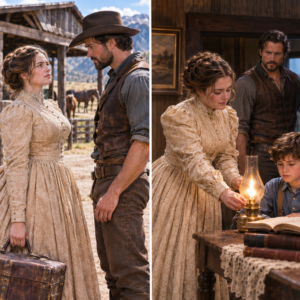
CHAPTER 6 – PART 6 – THE MOUNTAIN MAN SAVED A PREGNANT WIDOW. THEN HE STOPPED ONE MILE FROM FORT LARAMIE AND REFUSED TO TAKE HER INSIDE.
PART 6: THE WOMAN WHO REFUSED TO WALK AWAY
The next morning, I woke with another ache in my lower back.
It was not as severe as the contractions during the storm, but it was enough to remind me that I could not delay getting medical attention.
Boon noticed my discomfort immediately.
“We need to get you to the fort.”
I looked at him.
“Then come with me.”
He shook his head.
“Martha, listen.”
“I have been listening for five days.”
He sat on the wagon step.
“I don’t want you caught in the middle of my trouble.”
I understood what he meant.
He believed that the moment the soldiers recognized him, I would become part of a dispute I knew almost nothing about.
He was trying to protect me.
But I was tired of people deciding what I could endure.
“Silas, I am already in the middle of it.”
He looked at me.
“You have done nothing wrong,” I continued.
“You saved me. You helped me through the storm. You carried my husband’s books and kept my animals alive.”
I paused.
“Why should I be ashamed to tell the truth?”
He did not answer.
I asked whether he would at least let me speak to someone inside the fort.
He hesitated.
Finally, he agreed.
He would bring me as close as possible, but he would remain outside until he understood what awaited him.
We continued toward the entrance.
The closer we came, the more nervous he became.
I could see it in the way he watched the soldiers.
He kept his rifle secured and his hands visible.
He did not want anyone to mistake his intentions.
When we reached the outer road, he stopped again.
A soldier approached and asked our business.
I explained that I was pregnant, that my husband had died, and that I needed medical assistance.
The soldier looked at my condition and immediately called for help.
Boon remained beside the wagon.
He did not attempt to enter.
I turned toward him.
“Will you wait?”
He nodded.
“I’ll be here.”
The soldier helped me down carefully.
Before I walked away, I turned back.
“Silas?”
He looked at me.
“I haven’t forgotten what you did.”
His expression softened.
Then I followed the soldier toward the fort.
Inside, I was given water and a place to rest.
The medical attendant examined me and explained that the earlier contractions could have been brought on by exhaustion and the strain of the journey.
He advised me to rest and remain under observation.
I was relieved.
But I was still thinking about Boon.
I asked whether the soldiers knew a man named Silas Boone.
The attendant’s expression changed.
He told me that the name was familiar.
There had been an old military complaint involving a wagonmaster who had left his assigned post during the cholera outbreak.
I explained that the man had saved my life.
The attendant listened but warned me that the matter was not something he could settle.
I understood.
I was not asking anyone to ignore the past.
I simply wanted the truth to be heard.
Later, I was allowed to speak with the officer responsible for the old records.
I explained how Boon had found me, rescued me, and brought me to the fort.
I also told him about Jeb.
The officer listened carefully.
He did not promise anything.
But he agreed that Boon should have an opportunity to explain what had happened during the outbreak.
When I returned to the wagon, Boon was still waiting.
He looked at my face.
“Are you all right?”
I nodded.
“The baby is all right.”
He released a breath.
Then I told him what the officer had said.
For the first time, Boon looked toward the gates without immediately turning away.
CHAPTER 7 – PART 7 – THE MOUNTAIN MAN SAVED A PREGNANT WIDOW. THEN HE STOPPED ONE MILE FROM FORT LARAMIE AND REFUSED TO TAKE HER INSIDE.
PART 7: THE MAN THE ARMY REMEMBERED
Boon did not immediately agree to speak with the officer.
He sat beside the wagon and looked toward the fort for a long time.
I could see that the decision was difficult.
He had spent years avoiding the place.
Now I was asking him to walk toward the very people he believed would arrest him.
“You don’t have to do this for me,” I told him.
He looked at me.
“I’m not doing it for you.”
I waited.
“I’m doing it because I’m tired of running.”
Those words surprised me.
He explained that he had never considered himself a criminal.
He had disobeyed an order, yes.
He had taken a wagon and supplies that did not belong to him, yes.
But he had done so because people were dying and he believed leaving them without help would be wrong.
He had accepted the consequences.
What he had never accepted was the idea that helping the sick made him a dishonorable man.
I told him that I understood.
He looked at me.
“You don’t know everything that happened.”
“Then tell me.”
He was quiet for a while.
Then he explained that during the cholera outbreak, he had been responsible for transporting supplies along the river.
Several travelers became sick.
The Army authorities feared that allowing them near the fort would spread the disease.
Boon had been ordered to continue his assigned route.
He refused.
He stayed behind with the sick families.
He used the freight wagon to transport food and other necessities.
When his commanding officers discovered what he had done, they considered him a deserter and accused him of taking government property.
He never returned to answer the charges.
Not because he believed he had done something shameful.
Because he knew he would be punished before anyone listened to his explanation.
I asked whether he had ever wanted to return.
He looked down at his hands.
“Every winter.”
I understood then that the mountains had not necessarily been his first choice.
They had become the place where he could live without constantly looking over his shoulder.
The following day, the officer sent word that he wanted to speak with Boon.
Boon spent a long time preparing himself.
He cleaned his coat, checked his rifle, and secured the horses.
He looked at me.
“If this goes badly, I want you to go inside and stay there.”
I shook my head.
“I will not interfere with your choices.”
He nodded.
“But I won’t lie about what you did for me.”
He looked away.
That afternoon, he finally walked toward the fort.
He did not carry his rifle.
He left it secured in the wagon.
I followed him slowly.
A soldier recognized him.
Another went to notify the officer.
Boon stopped several feet from the entrance.
He did not attempt to run.
He did not argue.
He simply waited.
When the officer arrived, he studied Boon’s face for a long moment.
Then he spoke his full name.
“Silas Boone.”
Boon nodded.
“Yes, sir.”
The officer asked whether he understood why he had been summoned.
Boon answered that he did.
I watched them carefully.
This was the moment he had feared for years.
The officer asked him to explain why he had abandoned his assigned route during the cholera outbreak.
Boon looked toward me.
Then he began.
CHAPTER 8 – PART 8 – THE MOUNTAIN MAN SAVED A PREGNANT WIDOW. THEN HE STOPPED ONE MILE FROM FORT LARAMIE AND REFUSED TO TAKE HER INSIDE.
PART 8: THE TRUTH ABOUT THE WAGON
Boon did not try to make himself look innocent.
He admitted that he had disobeyed orders.
He admitted that he had taken the freight wagon and supplies.
He also explained why.
People had been dying along the Platte River.
Some were too sick to travel.
Others had no food or clean water.
He had been ordered to leave them behind, and he had refused.
The officer listened without interrupting.
Then he asked why Boon had never returned to explain himself.
Boon answered honestly.
He had believed that no one would listen.
He had spent years expecting the moment he entered the fort to be the moment he lost his freedom.
The officer looked toward me.
I explained that Boon had rescued me from a broken wagon and brought me through dangerous weather.
I told him about the premature contractions and the way Boon had stayed beside me through the storm.
I also explained that my husband had died of cholera and that Boon had known him during the outbreak.
The officer looked at Boon again.
“Your husband was Jeb?”
I nodded.
Boon lowered his eyes.
The officer seemed to remember something.
He explained that the records from the outbreak had never fully settled what happened to the sick travelers.
The old complaint against Boon had been based largely on his failure to follow orders and the disappearance of the assigned freight wagon.
But the reason for his actions had never been properly examined.
The officer did not promise that the charges would disappear.
He did, however, agree that Boon should have an opportunity to explain the circumstances and provide the information he remembered.
For the first time, the matter was no longer being treated as a simple case of desertion.
Boon remained calm.
He did not ask for praise.
He did not demand an apology.
He simply wanted the truth recorded.
After the discussion, the officer allowed him to remain outside the immediate grounds while the matter was reviewed.
That was not the complete freedom Boon had hoped for.
But it was more than he had expected.
When we returned to the wagon, he looked exhausted.
I sat beside him.
“How do you feel?”
He gave a faint smile.
“Like a man who finally said something he should have said years ago.”
I looked toward the fort.
The medical attendant had advised me to remain there until the baby arrived.
I was worried about Boon.
He insisted that I stay.
“You need that doctor more than you need me.”
I shook my head.
“I need both.”
He laughed softly.
It was the first time I had heard him laugh without restraint.
That evening, he secured the wagon outside the fort.
He made certain the horses had water and that my belongings were protected.
Then he sat nearby.
I watched him through the window.
For the first time, the mountain man did not look like someone preparing to disappear.
He looked like someone who might finally be willing to stay.
CHAPTER 9 – PART 9 – THE MOUNTAIN MAN SAVED A PREGNANT WIDOW. THEN HE STOPPED ONE MILE FROM FORT LARAMIE AND REFUSED TO TAKE HER INSIDE.
PART 9: THE CHILD WHO ARRIVED EARLY
I had been inside Fort Laramie for several days when the pain returned.
This time, it was different.
The medical attendant examined me and explained that the baby might be coming sooner than expected.
I was frightened.
I had imagined giving birth beside Jeb.
I had imagined him holding my hand, hearing the first cry, and smiling at the child he had waited so long to meet.
Instead, I was alone in a strange place.
Boon was outside.
I asked the attendant whether someone could send word to him.
He agreed.
When Boon arrived, he looked as though he had ridden through the worst storm of his life.
He came to the doorway and stopped.
“How are you?”
I tried to smile.
“Apparently, this child has decided to meet the world early.”
He looked toward the attendant.
Then back at me.
“You’re going to be all right.”
I wanted to believe him.
The hours that followed were difficult.
The attendant and the women helping with the birth remained close.
Boon waited outside.
I knew he wanted to come in.
But he did not cross the threshold without permission.
Whenever I became frightened, I remembered his words during the storm.
You’re too stubborn to die.
And so is that young one.
I held onto those words.
The birth was long and exhausting.
At one point, I thought I could not continue.
Then I heard a small cry.
A baby’s cry.
I began crying too.
The attendant smiled and told me the child was alive.
I could hardly believe it.
They placed the baby in my arms.
I looked down at the tiny face.
Jeb would never hold this child.
But the child was here.
And that meant something.
When Boon was finally allowed to see us, he stood beside the bed without speaking.
His eyes moved from my face to the baby.
For a moment, the enormous mountain man looked completely helpless.
Then he reached out one finger.
The baby curled a tiny hand around it.
Boon swallowed.
“Well,” he whispered.
I smiled through my tears.
“Would you like to meet the child?”
He nodded.
He sat beside the bed and held the baby with a care that surprised nobody who had watched him handle the horses.
For several minutes, he said nothing.
Then he looked at me.
“Jeb would have been proud.”
I closed my eyes.
“Yes.”
He looked down at the child again.
“I wish he could have seen this.”
“So do I.”
We sat quietly.
The child slept.
Outside, the day was fading.
Boon finally told me that the officer had agreed to continue reviewing his old case.
He was not yet completely free of the consequences of his desertion.
But he no longer had to hide from every soldier who recognized his name.
He had chosen to face the matter.
And whatever happened next, he would no longer be running.
I looked at him.
“You brought me here because you wanted my child to have a chance.”
He nodded.
“That was the promise.”
I smiled.
“You kept it.”
CHAPTER 10 – PART 10 – THE MOUNTAIN MAN SAVED A PREGNANT WIDOW. THEN HE STOPPED ONE MILE FROM FORT LARAMIE AND REFUSED TO TAKE HER INSIDE.
PART 10: THE PROMISE THAT DID NOT END
The weeks following the birth passed more quietly than I expected.
My strength slowly returned.
The baby grew stronger.
And Boon remained close enough to help whenever I needed him.
He spent much of his time outside the fort, tending the horses and maintaining his wagon.
The officer continued reviewing the old matter involving the cholera outbreak.
Boon answered the questions put to him and explained what he remembered.
He did not pretend that he had followed orders.
He simply wanted the circumstances of his decision understood.
Eventually, he was given permission to remain in the area while the matter was settled.
It was not a complete restoration of his former position.
But it meant he no longer had to disappear into the mountains every time he saw an Army patrol.
When I was strong enough to leave the medical quarters, Boon helped me prepare the wagon.
He had kept all my belongings safe.
Jeb’s books were still wrapped carefully in their canvas covering.
My skillet was where he had placed it.
My quilts were clean and dry.
Even the little things I thought I had lost on that broken trail had survived.
I looked at him.
“You saved everything.”
He shrugged.
“Wasn’t much to it.”
I smiled.
“You always say that.”
He looked toward the baby.
“Some things are worth keeping safe.”
Before leaving, I visited the place where the fort’s road divided toward the northern settlements.
I thought about Jeb.
I thought about the promise I had made beside his grave.
I had promised our child that we would keep going.
I had not known how.
I had not known where we would sleep or how we would survive.
But somehow, we had made it.
Boon stood beside the wagon.
I asked him where he intended to go now.
He looked toward the mountains.
“Back to my place, I suppose.”
“Alone?”
He did not answer immediately.
Then he looked at me.
“I’ve been alone a long time.”
I understood that he was not asking me for anything.
He had fulfilled the promise he made to Jeb.
He had brought me to safety.
He had no reason to expect that I would remain with him.
But I also knew something about myself.
I did not want to spend the rest of my life believing that accepting kindness meant surrendering my independence.
And I did not want to confuse being grateful with owing someone my future.
I wanted a choice.
So I asked him whether there was room at his place for a mother and a baby.
He looked at me carefully.
“There’s room.”
“And would we be welcome?”
His expression softened.
“Yes, Martha.”
I nodded.
“Then perhaps we should talk about it.”
He smiled.
It was not a grand declaration.
There was no promise that life would become easy.
There was only a man who had spent years hiding from his past and a woman who had spent months trying to survive hers.
We both knew what loss felt like.
We both knew what it meant to keep going when the future seemed uncertain.
And perhaps that was enough to begin with.
Several weeks later, we left the fort together.
Boon drove the wagon.
I sat beside him with the baby wrapped in Jeb’s old quilt.
The road stretched ahead through the Wyoming country.
For the first time in months, I was not traveling because I had nowhere else to go.
I was traveling toward a place where I had been invited to stay.
As the sun began setting, I looked at Boon.
“Silas?”
He turned slightly.
“Yes?”
“Thank you for keeping your promise to Jeb.”
He looked toward the road.
“I wish I could have done more for him.”
“So do I.”
I reached down and touched the baby’s small hand.
“But you did something for us.”
Boon nodded.
He did not say anything more.
And I did not need him to.
I had once believed that the worst thing that could happen to a woman was losing the man she loved.
Then I lost Jeb.
I lost my home.
I nearly lost my wagon.
And for a while, I believed I might lose the child I carried.
But the journey taught me that life could still offer kindness after terrible loss.
Sometimes it came in the form of a stranger who stopped beside a broken wagon.
Sometimes it came from a man who had spent years believing he was no longer welcome anywhere.
And sometimes it came from a promise made beside a river, long after the person who made it was gone.
Boon had saved me twice.
First, when he lifted me into his wagon.
And again, when he finally trusted me with the truth about himself.
I never forgot the afternoon he stopped one mile from Fort Laramie.
At the time, I believed he was refusing to take me to safety.
Now I understood something different.
He had been afraid that his past would destroy the future he was trying to give us.
But the truth had not destroyed us.
It had given us the chance to begin honestly.
**Jeb had not lived long enough to meet his child, but the promise he left behind had brought two lonely people together when both had nearly given up on finding a place in the world.**
And as the wagon rolled toward the mountains, I finally understood that surviving was only the beginning.
Sometimes, the hardest part was allowing yourself to live again.
THE END