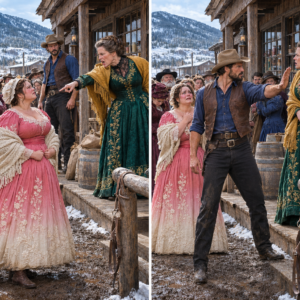
CHAPTER 6 – PART 6 – THE SCARS SHE HID, THE FIRE HE COULD NOT FORGET
PART 6: THE BOY WHO ASKED ABOUT HIS MOTHER
Wesley came into the kitchen that evening carrying his schoolbook.
He looked toward the stove, then toward my sleeves.
“Does your arm hurt?”
“Sometimes.”
“All the time?”
“Not anymore.”
He sat down.
For a while, he watched me prepare bread.
Then he asked whether I remembered everything about the night of the fire.
I stopped working.
“Most of it.”
“Even the bad parts?”
I nodded.
He looked at the table.
“I remember the night Mother died.”
His voice was so quiet that I almost missed the words.
I sat opposite him.
He explained that he had been told his mother had gone to help the mare in the barn.
He remembered waiting for her to come back.
He remembered his father returning without her.
And he remembered how the house had changed afterward.
I listened without interrupting.
“Father doesn’t like talking about it,” Wesley said.
“I know.”
“Sometimes I think he doesn’t want to remember her.”
I reached across the table and gently touched his hand.
“I don’t think that’s true.”
“Then why doesn’t he talk?”
“Because remembering someone can hurt.”
Wesley looked toward the front room.
“Does it hurt you?”
“Yes.”
He studied my face.
“Then why do you remember?”
I thought about the two people in the Vanning boarding house.
I thought about Elizabeth.
I thought about every person who had ever been lost in a fire.
“Because forgetting them would hurt too.”
He lowered his head.
Then he asked whether my scars would ever disappear.
I shook my head.
“Probably not.”
He looked troubled.
I smiled.
“But that doesn’t mean I have to hide them forever.”
He seemed to consider that.
Then he returned to his schoolbook.
Silas entered a little later.
He stopped when he saw us sitting together.
Wesley looked up.
“Father, Maren told me something.”
Silas raised an eyebrow.
“What?”
“That remembering someone can hurt, but forgetting them can hurt too.”
Silas looked at me.
I lowered my eyes.
Wesley continued.
“I think we should talk about Mother sometimes.”
Silas remained silent.
Then he pulled out a chair.
“All right.”
It was the beginning of a conversation the household had avoided for two years.
Silas told Wesley about Elizabeth’s kindness.
He remembered how she had cared for the animals and how she had insisted that the ranch hands eat properly before going out into the fields.
He remembered her sitting by the front window in the evenings.
He remembered how she had laughed when Wesley was small.
Wesley listened.
Sometimes he asked questions.
Sometimes he simply sat quietly.
I remained at the table, mending a shirt while father and son spoke.
For the first time, Elizabeth’s name was not treated like something dangerous.
Later that night, Silas came into the kitchen.
He found me putting away the dishes.
“I owe you an apology.”
I turned.
He looked uncomfortable.
“I saw those scars and remembered the barn.”
I waited.
“I didn’t know what happened to you, and I let my fear decide what I thought.”
I looked at him.
“You were frightened.”
“That doesn’t make it fair.”
I had no answer.
He glanced toward the front room.
“Wesley hasn’t spoken about his mother like that in a long time.”
“He misses her.”
“I know.”
Silas paused.
“Thank you for listening to him.”
I nodded.
But there was still something unresolved.
The ranch hands continued treating me differently.
Some were polite, but several refused to enter the kitchen when I was working.
Ollie was the only one who seemed entirely unchanged.
He still ate his meals at the table and spoke to me as he always had.
One afternoon, he found me cleaning the stove.
“You know, I’ve seen a lot of things in my years.”
I smiled faintly.
“I imagine you have.”
“I’ve seen men judged by rumors and good people judged by one bad day.”
He leaned against the counter.
“Never did understand why folks find it easier to believe the worst.”
I kept cleaning.
“Sometimes it’s easier than admitting you don’t know.”
Ollie nodded.
“That’s the trouble.”
He looked toward the front door.
“The boys need to hear the truth from someone other than a newspaper.”
I said nothing.
I had no desire to stand before the ranch hands and defend myself again.
But Ollie seemed to believe that the matter could not be allowed to remain as it was.
That evening, Silas called the men together.
He did not make a grand speech.
He simply told them that I had been hired to cook, that I had performed my duties faithfully, and that he would not allow anyone to insult me in his house.
Some of the men looked uncomfortable.
Others remained stubborn.
But nobody argued.
When the meeting ended, Silas returned to the kitchen.
“You’re staying,” he said.
I looked at him.
“Are you certain?”
“Yes.”
He paused.
“And the men will learn to behave accordingly.”
For the first time since the newspaper had arrived, I allowed myself to breathe without feeling that I was waiting to be dismissed.
But there was still one person whose opinion mattered more than I wanted to admit.
Wesley.
And the boy had begun asking questions about the scars I had spent years hiding.
CHAPTER 7 – PART 7 – THE SCARS SHE HID, THE FIRE HE COULD NOT FORGET
PART 7: THE TRUTH THE RANCH HAD AVOIDED
The following days were not easy.
Silas had made his decision, but the ranch hands did not all agree with it.
Some continued to eat outside.
Others spoke to me only when necessary.
I did not expect everyone to become friendly simply because Silas had ordered them to behave.
Trust could not be demanded.
It had to be earned.
I continued preparing meals and keeping the kitchen clean.
I also continued helping Wesley with his schoolwork.
The boy had begun spending more time with his father, and the two of them were slowly learning how to speak about Elizabeth without turning away from the subject.
One evening, Wesley asked whether he could see my arm.
I hesitated.
Then I unbuttoned my sleeve.
The scar ran from my wrist toward my elbow, pale and uneven against my skin.
Wesley studied it carefully.
“Does it make you sad?”
“Sometimes.”
“Because of the fire?”
“Because of what happened.”
He looked at me.
“Do you think you could have saved them?”
The question was so direct that I could not answer immediately.
I thought about the two people trapped upstairs.
I thought about the smoke and the burning staircase.
I thought about how many times I had wished I could return to that night and do something differently.
“I tried, Wesley.”
He nodded.
“I know.”
“I wanted to save them.”
He reached across the table and touched my hand.
“I think that’s what matters.”
I looked at him.
He had lost his mother in a fire.
I had lost two people in another.
Neither of us could change what had happened.
But perhaps we could stop treating every memory as something that had to be hidden.
Later that week, Ollie told me that several of the ranch hands had begun asking questions about the Vanning fire.
They wanted to know whether I had ever been formally accused.
I told him the newspaper had named me, but I had never deliberately started the fire.
Ollie listened.
Then he said he believed me.
I thanked him.
He shrugged.
“I’ve watched you work here for four months.”
He looked toward the main house.
“I’ve watched that boy come back to life a little at a time.”
He paused.
“That tells me more than a newspaper ever could.”
I did not know what to say.
The next morning, one of the men who had refused my cooking entered the kitchen.
He stood near the door.
I continued cutting vegetables.
He cleared his throat.
“Breakfast smells good.”
“Thank you.”
He looked at the table.
Then he sat down.
It was not an apology.
But it was a beginning.
The others followed slowly.
Some continued keeping their distance, but the kitchen was no longer divided into people who ate and people who refused.
Silas noticed.
He did not comment.
But that evening, he joined us for supper.
Wesley sat beside him.
Ollie sat across from them.
I placed the final dish on the table and prepared to return to the kitchen.
Silas looked up.
“Sit down, Maren.”
I hesitated.
“There’s still work to do.”
“It can wait.”
I looked around the table.
Nobody objected.
So I sat.
For a while, the conversation was ordinary.
The men discussed the weather, the cattle, and the condition of the fences.
Wesley talked about his lessons.
Ollie complained about the stiffness in his knees.
Then Silas looked toward me.
“I want to ask you something.”
I waited.
“Do you still believe you should have stayed in Cheyenne?”
I thought about it.
“No.”
“Why not?”
“Because I needed somewhere I could work without being reminded of what happened every time I walked down the street.”
He nodded.
“And do you believe you deserve to be here?”
I looked at the people around the table.
For three years, I had allowed the newspaper to define me.
I had believed that my scars made me a danger.
I had believed that surviving a tragedy meant I had to carry the blame for it.
But I had also spent four months proving to myself that I could build something beyond that night.
“Yes,” I answered.
Silas nodded.
“Good.”
That was all he said.
But the way he looked at me told me that he understood.
Later, after the men had left, I remained in the kitchen washing dishes.
Silas came in and stood beside the counter.
“I’ve been thinking about Elizabeth.”
I dried my hands.
“What about her?”
He looked toward the front room.
“I spent two years trying not to remember the barn.”
I waited.
“I thought if I kept everything dark and quiet, I could keep the past from happening again.”
He looked at the lamp.
“But Wesley was growing up in a house where nobody wanted to speak.”
I nodded.
“He’s missed his mother every day.”
Silas looked at me.
“And I’ve made it harder for him to remember her.”
He seemed to struggle with the admission.
Then he said something that stayed with me.
“I don’t want this house to be afraid of living anymore.”
I looked at the front room.
The lamp was burning.
Wesley’s schoolbook lay open on the table.
And the house no longer felt like a place where everyone was waiting for something terrible to happen.
For the first time, Silas was not merely allowing light into the room.
He was allowing life back into it.
But I still had one thing to learn.
The scars on my arms would remain.
And I would have to decide whether I was finally ready to stop hiding them.
CHAPTER 8 – PART 8 – THE SCARS SHE HID, THE FIRE HE COULD NOT FORGET
PART 8: WHEN THE HOUSE BEGAN TO LIVE AGAIN
The summer continued, and the changes at Bellion Ranch became impossible to ignore.
The front-room lamp was lit every evening.
Wesley began reading at the table with his father nearby.
The ranch hands returned to eating together, and the kitchen once again became the busiest room in the house.
Silas remained a reserved man.
He did not suddenly become cheerful or talkative.
But he no longer treated every conversation as an inconvenience.
Sometimes he asked about the meals.
Sometimes he asked whether Wesley needed anything for school.
Once, he even thanked me for repairing a torn curtain.
I never made a fuss about these small gestures.
I knew how much they had cost him.
One afternoon, Wesley came running into the kitchen.
“Father says I can help with the horses.”
I smiled.
“That’s wonderful.”
He looked delighted.
Then he paused.
“Do you think Mother would have liked that?”
I nodded.
“I think she would have been proud.”
He smiled again.
That evening, he spent a long time telling Silas about what he had learned.
His father listened without interrupting.
I watched them from the kitchen doorway.
The two of them were beginning to find a way forward without pretending that Elizabeth had never existed.
I was grateful for that.
I also began to feel differently about my own scars.
For months, I had buttoned my sleeves tightly because I did not want anyone asking questions.
I had believed that if people saw the marks, they would see only the fire.
But I was beginning to understand that the scars were part of my life, not the whole of it.
One particularly hot afternoon, I rolled my sleeves up while washing vegetables.
Ollie entered and noticed.
He did not stare.
He simply handed me the basket he was carrying.
“Need these cleaned?”
I smiled.
“Yes, thank you.”
He placed them beside the sink.
Then he went about his business.
It was an ordinary moment.
But I realized that I had not felt the need to hide my arms.
Silas noticed later.
He glanced at the exposed scars, then at me.
He said nothing.
And I was grateful that he no longer needed to ask.
A few days later, the ranch hands gathered around the supper table.
One of the men who had called me a firebug earlier in the summer looked uncomfortable.
He waited until the others had finished eating.
Then he approached me.
“I was wrong about you.”
I looked at him.
He rubbed the back of his neck.
“I shouldn’t have judged you by that paper.”
I nodded.
“Thank you.”
He did not offer a long apology.
I did not demand one.
We both returned to our work.
That evening, Silas remained in the front room after Wesley went upstairs.
I was preparing to put out the lamp when he spoke.
“Leave it.”
I turned.
“Wesley is finished reading.”
“I know.”
He looked at the light.
“I want it on.”
I nodded.
Then I returned to the kitchen.
For two years, the darkness had been something Silas believed he needed to protect himself from another loss.
Now he was beginning to understand that darkness could become another kind of loss.
I thought about Elizabeth.
I had never known her, but I was beginning to understand what she had meant to this family.
She had been the person who brought warmth into the house.
She had cared for the animals.
She had made sure the men were fed.
She had made the ranch feel like a home rather than a business.
And when she died, Silas had tried to preserve the place by removing everything that reminded him of her.
But in doing so, he had also removed the very things she had loved.
The realization was painful.
It was also necessary.
A week later, Silas asked me to sit with him after supper.
Wesley was upstairs.
The ranch hands had returned to their quarters.
The front room was quiet except for the lamp.
Silas looked at me.
“I never thanked you properly.”
“For what?”
“For helping Wesley.”
I smiled.
“He makes it easy.”
Silas shook his head.
“He’s been lonely.”
I nodded.
“So have you.”
He looked surprised.
Then he gave a faint, tired smile.
“Perhaps.”
He looked toward the window.
“I thought losing Elizabeth meant I had to keep everything exactly as it was when she was alive.”
He paused.
“But the house wasn’t the same anymore.”
I listened.
“Neither was I.”
He turned toward me.
“I don’t know how to make things right.”
I considered my answer.
“Perhaps you don’t have to make everything right.”
He waited.
“Perhaps you only have to let things become different.”
He looked at the lamp.
For a long time, he said nothing.
Then he nodded.
I left him sitting there.
The next morning, I found the front-room curtains open.
Sunlight filled the room.
And Wesley was sitting beside the window, reading.
Silas stood behind him.
Neither of them looked away when I entered.
I realized that the house had finally begun to remember Elizabeth without being afraid of what remembering might cost.
CHAPTER 9 – PART 9 – THE SCARS SHE HID, THE FIRE HE COULD NOT FORGET
PART 9: THE WOMAN BEHIND THE SCARS
By the end of summer, Bellion Ranch had become a different place.
The kitchen was no longer a room where people entered only to collect food.
It had become a place where the ranch hands gathered after work, where Wesley studied, and where Silas occasionally sat with a cup of coffee.
The men still worked hard.
The cattle still needed attention.
The fences still required repairs.
But the household no longer seemed to be waiting for another tragedy.
I had also stopped buttoning my sleeves quite so tightly.
The scars remained.
They would always remain.
But I no longer felt that I had to apologize for them.
One evening, Wesley came into the kitchen carrying his schoolbook.
He sat beside me.
“Can I ask you something?”
“Of course.”
“Do you ever think about the people who died in Cheyenne?”
I put down the dishcloth.
“Yes.”
“Every day?”
“Not every day.”
He looked relieved.
“Sometimes I worry that if I stop thinking about Mother, I’ll forget her.”
I moved my chair closer.
“You won’t.”
“How do you know?”
“Because the people we love become part of the way we live.”
He looked at me.
“Even when they’re gone?”
“Especially then.”
He considered this for a while.
Then he asked whether I had ever been angry about surviving the fire.
I did not answer immediately.
The question reached into a place I rarely allowed myself to visit.
“Yes,” I said.
He looked down.
“Why?”
“Because sometimes I wondered why I had been able to walk away when the others couldn’t.”
He was quiet.
I continued.
“Sometimes I thought I should have done more.”
“Could you have?”
I shook my head.
“I don’t know.”
He looked toward my arm.
“Do you still think it was your fault?”
I thought about the newspaper.
The people who had blamed me.
The years I had spent carrying the story as though it were a punishment.
Then I looked at Wesley.
“No.”
He smiled faintly.
I understood that he had needed to hear that answer.
A few days later, Silas asked me to accompany him to the barn.
I hesitated.
He noticed.
“We won’t go inside.”
I looked toward the building.
The barn had remained a place of quiet restrictions since Elizabeth’s death.
Silas explained that he wanted to show me the area where the mare had been kept.
I followed him to the entrance.
The doors were open, and daylight reached across the floor.
He stood for a while without speaking.
Then he told me again about the night Elizabeth died.
He explained that she had gone inside to help the mare deliver its foal.
The fire had spread before anyone understood how dangerous it had become.
He had been unable to reach her.
For two years, he had blamed himself.
He had wondered whether he should have forbidden her from entering.
He had wondered whether he should have been closer.
He had wondered whether there had been something he could have done differently.
I listened.
Then I told him that I understood the feeling.
“I spent three years asking myself why I couldn’t save those two people.”
Silas looked at me.
“Did you ever find an answer?”
“No.”
I touched my scar.
“I only learned that I couldn’t change what happened by hurting myself over it every day.”
He lowered his eyes.
We stood together in the sunlight.
Neither of us pretended that the past had become easy.
But for the first time, Silas was able to stand near the barn without immediately turning away.
He looked toward the stalls.
“Elizabeth loved this place.”
I nodded.
“Then perhaps it deserves to be remembered that way.”
He looked at me.
I continued.
“Not only as the place where she died.”
Silas closed his eyes briefly.
Then he nodded.
We returned to the house.
That evening, he asked Wesley to sit with him in the front room.
They spoke about Elizabeth again.
This time, Silas told his son about the mare she had been helping when the fire started.
He told him about her kindness and the way she always put the needs of others before her own.
Wesley listened.
Then he asked whether his father still missed her.
Silas answered honestly.
“Every day.”
Wesley reached for his hand.
I watched from the kitchen doorway.
I knew that neither of them would ever stop missing Elizabeth.
But perhaps they no longer needed to live as though loving someone who had died meant they had to stop loving the people who remained.
Later, Silas came into the kitchen.
He found me rolling dough for the next morning.
“How long do you intend to stay at Bellion Ranch?”
I looked up.
“That depends on whether you still need a cook.”
He gave a faint smile.
“I do.”
I waited.
“And Wesley needs you.”
I lowered my eyes.
Silas continued.
“I’d like you to stay, Maren.”
I looked at him.
For four months, I had obeyed his rules because I needed the work.
Now he was asking me to stay because I had become part of the household.
I nodded.
“I’d like that.”
He looked relieved.
Then he turned toward the front room.
The lamp was burning.
And for the first time, I realized that I no longer thought of Bellion Ranch as somewhere I was merely working.
It had become a place where I was allowed to belong.
CHAPTER 10 – PART 10 – THE SCARS SHE HID, THE FIRE HE COULD NOT FORGET
PART 10: WHAT THE FIRE COULD NOT TAKE
The summer of 1879 ended quietly at Bellion Ranch.
There was no grand announcement, no sudden transformation, and no moment when every sorrow disappeared.
Life continued as it always had.
The cattle needed feeding.
The men needed meals.
The kitchen needed cleaning.
Wesley still had lessons to finish, and Silas still rose before daylight.
But the house was no longer silent.
The front-room lamp remained lit in the evenings.
The curtains were opened during the day.
Wesley began spending more time with his father, and Silas no longer avoided every conversation about Elizabeth.
The ranch hands returned to eating together.
Even the men who had once refused my cooking began treating me with ordinary respect.
Ollie remained the same old rider who had first tasted my biscuits and returned for more.
He never made a grand speech about what I had endured.
He simply continued showing up for breakfast.
Sometimes, that kind of acceptance means more than a hundred apologies.
One evening, I was putting away the supper dishes when Silas entered the kitchen.
He looked at my sleeves.
They were rolled up.
The pale scars on my arms were visible beneath the lamplight.
He did not stare.
He did not ask how they had healed.
Instead, he pulled out a chair and sat down.
“Do you still think about Cheyenne?”
I nodded.
“Sometimes.”
“Does it still hurt?”
“Yes.”
He looked toward the front room.
“Does remembering Elizabeth still hurt?”
I considered the question.
“Probably.”
He nodded.
For a while, neither of us spoke.
Then he said something I had not expected.
“I used to think the only way to protect this house was to keep anything that reminded me of fire away from it.”
I listened.
“But I was protecting an empty room.”
He looked toward the lamp.
“Wesley needed more than that.”
I understood what he meant.
The fire had taken Elizabeth.
The fire at Vanning had taken two people I had tried to save.
Neither of us could change those losses.
But we could decide what happened afterward.
Silas looked at me.
“You were never the danger I thought you might be.”
I felt my throat tighten.
“I never wanted to be.”
“I know.”
He stood and moved toward the door.
Then he stopped.
“Thank you for staying.”
I smiled.
“Thank you for giving me somewhere to stay.”
He nodded.
And that was enough.
A few weeks later, Wesley came into the kitchen carrying a small piece of paper.
He had been practicing his writing.
He placed it on the table and asked me to read it.
The words were simple.
He had written about his mother, his father, the ranch, and the people who lived there.
He had also written about me.
He said that I made the kitchen feel warm.
He said that I listened when he wanted to talk.
And he said that he hoped I would stay for a long time.
I looked at the paper.
Then I looked at him.
“Did your father help you write this?”
Wesley shook his head.
“No.”
I smiled.
“Then you should be proud.”
He climbed onto the flour barrel and sat beside me.
After a while, he looked at my arms.
“Are you going to keep hiding those?”
I shook my head.
“No.”
“Why not?”
I thought about the woman I had been when I arrived at Bellion Ranch.
I had carried my trunk into the yard without waiting for help.
I had buttoned my sleeves tightly.
I had avoided anyone standing behind me.
I had believed that if nobody knew my past, nobody could use it against me.
But I had also learned something during those four months.
The scars had not made me dangerous.
They had not made me less deserving of kindness.
And they had not erased everything good I could still give.
“Because they’re part of my story,” I told him.
Wesley nodded.
Then he returned to his schoolbook.
That night, I stood alone in the kitchen after everyone had gone to bed.
The stove was cooling.
The counters were clean.
The front-room lamp was still burning.
I looked at my reflection in the dark kitchen window.
For three years, I had been known in Cheyenne as the woman whose name appeared in a newspaper after a deadly fire.
Some people had called me careless.
Others had called me a firebug.
They had looked at my scars and decided they understood what had happened.
But they had never known the woman who had run toward the staircase.
They had never known how desperately I had tried to reach the two people trapped upstairs.
They had never known how long I had carried the memory of that night.
Silas had also spent two years being defined by a fire.
He had been the man whose wife died in the barn.
The father who could no longer bear to light a lamp.
The rancher who had built walls around every memory because he believed that was the only way to survive.
But neither of us was only the worst thing that had ever happened to us.
I was still Maren Hale.
I was a cook.
I was a woman who knew how to make bread, care for a child, and keep a household running.
And I was someone who had survived.
Silas was still a father.
He was still a rancher.
And he was a man who was slowly learning that remembering his wife did not mean he had to remain trapped in the night she died.
The next morning, I prepared breakfast before daylight.
When Wesley entered, he smiled and climbed onto his usual place beside the flour barrel.
Ollie arrived shortly afterward.
Silas came in last.
He looked at the table, then at the people gathered around it.
For a moment, he simply stood there.
Then he pulled out a chair.
“Good morning, Maren.”
“Good morning, Mr. Crane.”
He smiled faintly.
And I realized that I had not heard him speak those words when I first arrived.
Back then, I had been a stranger with a trunk and a past nobody wanted to know.
Now I was part of a household that had finally learned to speak about the things it had spent years hiding.
My scars had not disappeared.
The people who died in Cheyenne had not returned.
Elizabeth was still gone.
And there were memories that would always hurt.
But the fire had not taken everything.
It had not taken my ability to care for others.
It had not taken Wesley’s chance to grow up in a home filled with warmth.
And it had not taken Silas’s ability to love the people who remained.
I once believed that the only way to survive was to keep my sleeves buttoned, my head lowered, and my past buried.
Bellion Ranch taught me something different.
Some wounds do not need to be hidden to heal.
Some memories do not need to disappear before life can begin again.
And sometimes the people who understand our scars are the ones who have spent years hiding their own.
That summer, Silas Crane hired a cook.
He thought he was bringing an ordinary woman into his house.
He never expected her to help him remember the wife he had lost, reconnect with the son he had nearly lost to silence, or understand that the past did not have to control every room in his home.
And I never expected that the ranch where I had promised myself to remain invisible would become the first place in three years where I could show my scars without being ashamed.
The scars remained beneath my sleeves.
But I no longer feared what people would see when they looked at them.
Because they were not proof that I had destroyed something.
They were proof that I had tried to save it.
And that was a truth I could finally live with.
THE END