CHAPTER 1 – A Trader Put a Price on a Chained Apache Woman—Then a Widowed Rancher Made a Decision That Silenced the Entire Trading Post
PART 1: THE PRICE OF A HUMAN LIFE
“Five hundred dollars! Surely somebody in this crowd can afford a strong young woman!”
The trader’s laughter rolled across the Arizona trading post, followed by the laughter of several men gathered around his wooden platform.
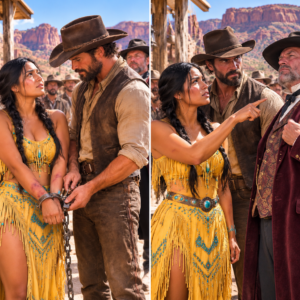
I stood near my horse, watching a young Apache woman with iron chains around her wrists.
She did not cry.
She did not beg.
She simply stood beneath the brutal afternoon sun, her chin raised despite the bruises on her arms and the dust covering her clothes.
Then the trader pointed at her and made another joke.
“Look at her! Strong enough to work, young enough to last, and stubborn enough to make a man regret buying her!”
More laughter followed.
I felt something tighten inside my chest.
“How much?” I asked.
The trader turned toward me.
I was not a wealthy man, although I owned a modest cattle ranch several miles outside the settlement.
My name was Caleb Turner, and I had spent the previous seven years learning how to live without the woman I loved.
My wife, Elizabeth, had died during a terrible winter fever, leaving me with an empty house, a quiet kitchen, and a bed that had seemed too large ever since.
I had no children.
No family nearby.
No particular reason to visit the trading post except to purchase supplies and occasionally exchange cattle for necessities.
But that afternoon, I could not ride away.
The woman on the platform was perhaps twenty-five years old.
Her long black hair fell loosely over her shoulders, and her traditional brown clothing was worn from a difficult journey.
Her wrists were swollen where the iron restraints had rubbed against her skin.
Yet she stood with a dignity that seemed to make the men around her uncomfortable.
The trader noticed me studying her.
“Interested, rancher?”
I ignored his smile.
“What is her name?”
He laughed.
“Names cost extra.”
Several men chuckled.
I looked at him.
“I asked you a question.”
The trader introduced himself as Silas Rourke, a man who had made a profitable business transporting supplies, horses, and other goods through the territory.
He wore a clean vest, polished boots, and a gold watch chain that caught the sunlight whenever he moved.
His smile never reached his eyes.
“She’s Apache,” he said dismissively.
“That much I can see.”
“Then you know she’s trouble.”
I looked back at the woman.
She was watching me now.
There was fear in her expression, but something stronger existed beneath it.
Pride.
She was not looking at me as though I were her rescuer.
She was studying me, trying to determine whether I was simply another man who believed money gave him the right to decide what happened to her.
That realization made me uncomfortable.
I had spent years avoiding trouble.
I knew what happened when a rancher involved himself in disputes between traders, settlers, and the Apache people.
I had cattle to protect, fences to repair, and a ranch that could not survive without my daily attention.
I also knew that I could lose everything if I challenged the wrong man.
But the sight of those chains brought back a memory I had spent years trying to bury.
My wife had once been sick enough that she could barely stand.
During that winter, I had watched her struggle to drink a glass of water while I stood helpless beside the bed.
I remembered how frightened she had been.
I remembered promising that I would never allow anyone to suffer alone if I could help it.
I had failed to keep that promise in more ways than I cared to admit.
Now a young woman stood before me, surrounded by men who treated her suffering as entertainment.
I could not pretend I had not seen her.
“How much?” I asked again.
Rourke’s eyebrows rose.
“Five hundred dollars.”
A murmur passed through the crowd.
Five hundred dollars was a considerable sum.
It represented several months of ranch income, money I had been saving to repair the northern water line and replace two aging cattle wagons.
One man laughed.
“Careful, Turner! You’ll spend your whole ranch trying to make a friend!”
Another called out that I ought to purchase a good horse instead.
Rourke enjoyed the attention.
“Well, rancher? That’s the price.”
I reached into my coat.
My fingers closed around the envelope containing most of my savings.
For a moment, I thought about Elizabeth.
I could almost hear her asking whether I had lost my mind.
Then I looked at the woman again.
“Take the money.”
I placed the envelope on the wooden table.
The laughter stopped.
Rourke stared at the payment.
“You’re serious?”
“Every dollar.”
He counted the money twice.
Then he smiled.
“Well, gentlemen, looks like we have ourselves a buyer.”
I stepped closer.
“There’s one condition.”
Rourke looked up.
“What condition?”
“Those chains come off before I leave this place.”
His smile weakened.
“Now, hold on.”
I placed both hands on the table.
“She’s not property.”
The entire trading post became silent.
Rourke glanced at the crowd, apparently embarrassed that I had spoken those words in front of everyone.
I continued.
“Your money is there. Remove the iron.”
The woman lifted her eyes.
For the first time, something changed in her expression.
It was not gratitude.
It was surprise.
And before Rourke could answer, she spoke in careful English.
“Do not pay him because you think I belong to you.”
I turned toward her.
Her voice was weak, but her words were clear.
“I do not belong to him.”
She looked directly into my eyes.
“And I will not belong to you.”
I stood quietly for a moment.
Then I nodded.
“You’re right.”
I turned back toward the trader.
“I’m paying to end this. Not to purchase her.”
Rourke’s expression hardened.
He reached for the envelope.
But before he could pocket it, the woman spoke again.
“Ask him why he has my father’s silver ring.”
I looked at Rourke.
His hand froze.
And suddenly, the trader who had laughed at an entire crowd was no longer smiling.
CHAPTER 2 – PART 2 – A Trader Put a Price on a Chained Apache Woman—Then a Widowed Rancher Made a Decision That Silenced the Entire Trading Post
PART 2: THE WOMAN WHO REFUSED TO BOW
For several seconds, nobody spoke.
I looked at the woman’s face, then at Rourke’s hand resting on the envelope.
“Your father’s ring?” I asked.
She nodded.
“Look at his right hand.”
Rourke immediately closed his fingers.
“Don’t listen to her, Turner.”
I held his gaze.
“Show me the ring.”
“That’s none of your business.”
“Then it should be easy to show me.”
A few men in the crowd shifted uncomfortably.
The trader’s two armed guards moved closer to the platform.
I noticed the woman’s expression change.
She had not spoken out of anger alone.
She was afraid of what Rourke might do.
“Please,” she whispered.
I stepped between her and the guards.
“Nobody touches her.”
Rourke finally removed his hand from his pocket.
A small silver ring was visible beneath his fingers.
The woman stared at it.
“My father wore that ring for many years,” she said.
Rourke laughed nervously.
“Found it among the belongings of a dead man.”
“Where?”
“Don’t remember.”
She shook her head.
“You remember everything that can be sold.”
The crowd grew quieter.
I had no way of knowing whether the ring truly belonged to her father, but I could see that Rourke did not want anyone examining it.
I turned toward him.
“Give it back.”
He looked at me with open hostility.
“You’ve paid for the chains to come off. Nothing more.”
“Then remove them.”
Rourke hesitated before ordering one of his guards to unlock the restraints.
The guard approached the woman with a key.
She pulled away when he reached for her wrists.
I raised my hand.
“Let her see the key.”
The guard stopped.
The woman watched him carefully before allowing him to unlock the first restraint.
The iron fell against the wooden platform with a heavy sound.
Then the second chain came loose.
She rubbed her swollen wrists.
I had expected her to collapse from exhaustion.
Instead, she stepped backward and stood on her own.
“Thank you,” she said.
I nodded.
“What is your name?”
She hesitated.
“Naya.”
I repeated it quietly.
“Naya.”
Her expression softened slightly.
Rourke interrupted us.
“Now that the transaction is finished, I’d advise you to leave.”
I turned toward him.
“There was no transaction involving ownership.”
His face reddened.
“You paid me five hundred dollars.”
“I paid to have those chains removed.”
“And she’s leaving with you.”
“Only if she chooses.”
Naya looked from me to the trader.
Then she spoke.
“I will leave.”
She stepped down from the platform.
The crowd parted.
For the first time in what appeared to be many days, she could walk without iron dragging against her ankles.
But Rourke was not prepared to let the matter end.
“Hold on.”
His voice became louder.
“You think you can walk away with her after paying me only once?”
I stopped.
“What?”
“Her transportation, her food, her lodging. You think those things come free?”
I looked at him.
“You named your price.”
“That price was for the chains. There’s another matter to settle.”
I understood then that the man had never intended to release her willingly.
He had simply expected me to pay whatever he demanded.
“You’re asking for more money?”
“I’m telling you what is owed.”
Naya suddenly spoke.
“I owe him nothing.”
Rourke turned toward her.
“Quiet!”
She did not lower her eyes.
“I worked for him because he chained me. He took my belongings and threatened the people traveling with me.”
One of the guards stepped forward.
I moved between them.
“That’s enough.”
Rourke looked at the crowd.
He was accustomed to being the loudest man in the trading post.
He was accustomed to people laughing at his jokes and accepting his decisions.
Now those same people were watching him carefully.
I picked up the silver ring from the table.
Rourke reached for it.
I pulled my hand away.
“She says it belongs to her father.”
“That ring belongs to me!”
“Then explain why.”
He said nothing.
I handed it to Naya.
She closed her fingers around it.
For a moment, her composure nearly broke.
Then she pressed the ring against her chest.
“Come on,” I said gently.
We walked toward my horse.
Nobody laughed.
Nobody made another joke.
But just as I reached the hitching post, Rourke called after us.
“Turner!”
I stopped.
He pointed toward me.
“You’ve made a serious mistake.”
I looked at him.
“Perhaps.”
“That woman is wanted.”
Naya went completely still.
Rourke smiled.
“Ask her why.”
I turned toward her.
She stared at the ground.
And I realized that the trader had not yet told me the most important reason he had been willing to sell her.
CHAPTER 3 – PART 3 – A Trader Put a Price on a Chained Apache Woman—Then a Widowed Rancher Made a Decision That Silenced the Entire Trading Post
PART 3: THE SECRET BEHIND THE SILVER RING
We left the trading post before Rourke could change his mind about the money.
Naya rode behind me, keeping a careful distance between us.
She had refused to let me help her onto the horse until I explained exactly where I intended to take her.
“My ranch is several miles north,” I told her.
“You will be safe there.”
She studied me.
“Why?”
The question caught me off guard.
“Why what?”
“Why would you spend so much money on someone you do not know?”
I considered giving her a simple answer.
But she deserved something more honest.
“Because I saw what was happening, and I could not walk away.”
She looked toward the distant mountains.
“Many men saw.”
I had no answer.
That sentence followed me for the rest of the journey.
Many men had seen.
Only one had acted.
The ride took nearly two hours.
When my ranch finally appeared beyond the low hills, I felt an unexpected nervousness.
It had been years since I had brought anyone home.
The house was modest, built from timber and stone, with a wide porch overlooking the cattle pasture.
The barn stood to the east.
A windmill turned slowly above the well.
Beyond the property, the desert stretched toward the mountains.
Naya dismounted before I could offer assistance.
She examined the house, the stable, and the surrounding land.
“Do you live here alone?” she asked.
“Yes.”
“Always?”
“Since my wife died.”
She looked at me.
“I’m sorry.”
I nodded.
“Thank you.”
I led her inside.
The house was clean but almost painfully quiet.
Elizabeth’s old rocking chair remained beside the window.
Her sewing basket sat on a shelf.
I had never found the courage to move it.
Naya noticed the objects but said nothing.
I showed her a spare bedroom.
“There are clean blankets and a washbasin.”
She remained near the doorway.
“Will you lock the door?”
“No.”
“Will you enter without asking?”
“No.”
“Will you expect me to work for the money you paid?”
I looked at her.
“No.”
She studied my face.
I understood why she was asking.
A promise from a stranger was not much protection after what she had experienced.
“You may leave whenever you wish,” I added.
She nodded slowly.
That evening, I prepared supper.
I made beans, cornbread, and a little beef stew.
Naya ate quietly.
She seemed exhausted, but she remained alert whenever a floorboard creaked or the wind struck the windows.
After the meal, she finally told me more about the trading post.
She and several members of her traveling group had been taken during a journey through the territory.
She had been separated from the others.
Rourke had taken her belongings and kept her chained while moving her between settlements.
She did not know where the others had been taken.
But she remembered one thing.
Before the capture, her father had given her a silver ring and told her to keep it safe.
She believed Rourke had taken it from their belongings.
I looked at the ring resting beside her plate.
“Do you know where your father is now?”
Her expression tightened.
“I do not know.”
I wanted to ask more.
But she had already told me enough for one evening.
The following morning, I rode into town to purchase medicine for her wrists.
The storekeeper, a man named Walter Briggs, looked surprised when I mentioned the woman staying at my ranch.
“Rourke’s prisoner?”
“Not anymore.”
Walter lowered his voice.
“You should be careful, Caleb.”
“Why?”
“That man has friends.”
“I noticed.”
Walter leaned against the counter.
“He claims she was being held because of a dispute involving property.”
“What property?”
He shook his head.
“Nobody knows.”
I looked at him.
“Then why repeat his story?”
Walter seemed embarrassed.
“Because people around here don’t want trouble.”
I purchased the medicine and returned home.
When I arrived, Naya was sitting on the porch.
She had washed her clothes and tied her hair back.
She looked stronger already.
But her eyes moved toward the road.
“Someone came,” she said.
I dismounted.
“Who?”
“A man.”
“What did he want?”
“He asked whether I was here.”
I felt my stomach tighten.
“What did you tell him?”
“That I was not a thing to be collected.”
I almost smiled.
Then I noticed something on the porch.
A small folded piece of paper.
I opened it.
There were only a few words written inside.
TURNER, RETURN WHAT YOU TOOK.
I looked toward the road.
Naya stood beside me.
Her face had become pale.
“Is it Rourke?”
She nodded.
Then she pointed toward the distant hills.
“He will come himself.”
CHAPTER 4 – PART 4 – A Trader Put a Price on a Chained Apache Woman—Then a Widowed Rancher Made a Decision That Silenced the Entire Trading Post
PART 4: THE PRICE OF DOING WHAT IS RIGHT
Rourke arrived two mornings later.
He brought three armed men and stopped outside my gate.
I was repairing a section of fence when I heard the horses.
I straightened and watched them approach.
Rourke wore the same clean vest and polished boots he had worn at the trading post.
He looked entirely too comfortable on another man’s property.
“Morning, Turner.”
“What do you want?”
He smiled.
“My property.”
I placed the hammer on the fence post.
“You’re mistaken.”
He glanced toward the house.
“I know she’s inside.”
“Then you know where she is.”
Rourke’s smile disappeared.
“You paid five hundred dollars, and I allowed you to leave with her.”
“You removed her chains.”
“Exactly.”
“That was the agreement.”
He leaned forward in his saddle.
“You seem to have forgotten something.”
I waited.
“That woman has obligations.”
“What obligations?”
“She owes me for transportation, food, and the cost of keeping her.”
I looked at him.
“She never agreed to any of that.”
Rourke laughed.
“Since when does a man need permission to collect a debt?”
“Since the debt belongs to nobody.”
His expression hardened.
One of his men moved his hand toward his revolver.
I noticed.
So did Rourke.
“Don’t make this difficult,” he said.
I glanced toward the house.
Naya stood just inside the doorway.
She was watching.
I stepped away from the gate.
“Go home, Rourke.”
He shook his head.
“You’re going to regret involving yourself.”
He turned his horse and rode away.
I knew he would return.
Men like Rourke did not accept being embarrassed in public.
Especially not by a rancher whose land was worth less than the money in their pockets.
That afternoon, I found Naya examining the old silver ring.
She turned it carefully in her hands.
“May I ask you something?” I said.
She looked up.
“Yes.”
“Why did Rourke say you were wanted?”
She was silent for a long time.
Then she explained that the trader had been searching for something connected to her father’s belongings.
She did not know exactly what he wanted.
But she remembered hearing him question another captive about an old family agreement.
Her father had once told her that certain promises should never be sold.
She believed Rourke had been trying to force her to reveal something.
I looked at the ring.
“Does this have something to do with it?”
She nodded.
“Perhaps.”
She showed me the inside of the silver band.
There was a tiny mark engraved beneath the surface.
I could barely see it.
“It is a family mark,” she explained.
“Not something a trader would understand.”
I handed it back.
“Then keep it safe.”
She closed her hand around it.
For the next several days, she slowly recovered.
She helped prepare meals when she wished.
She repaired a torn blanket.
She spent hours outside, watching the cattle and learning the shape of the land.
I never asked her to work.
But I noticed she seemed more comfortable when she had something useful to do.
One afternoon, she found me struggling to move a heavy feed barrel.
She approached and helped me roll it into the barn.
“You do not have to do that,” I told her.
“I know.”
She gave me a small smile.
“I wanted to.”
It was the first time I had heard her laugh.
And for a moment, the ranch did not feel quite so empty.
Then the sound of hoofbeats interrupted us.
A rider appeared on the northern trail.
He carried a message from town.
Rourke had filed a complaint claiming that I had interfered with his business and taken a woman who owed him money.
The local deputy wanted me to appear the following morning.
I read the message twice.
Naya watched my face.
“What does it say?”
I handed it to her.
She read the words slowly.
Then looked up.
“If you go, he will tell them I belong to him.”
I shook my head.
“No.”
She looked toward the mountains.
“Then I must speak.”
I studied her.
“Are you certain?”
She nodded.
“I have been silent long enough.”
And I realized that the woman I had freed was no longer willing to let anyone speak for her.
CHAPTER 5 – PART 5 – A Trader Put a Price on a Chained Apache Woman—Then a Widowed Rancher Made a Decision That Silenced the Entire Trading Post
PART 5: THE WOMAN WHO WOULD SPEAK FOR HERSELF
The following morning, Naya and I rode into town together.
She wore a clean brown dress that I had purchased from the general store.
Her hair was tied back, and the silver ring rested safely around her neck on a leather cord.
People stared as we passed.
Some recognized her from the trading post.
Others whispered about the rancher who had spent five hundred dollars to release an Apache woman.
I kept my eyes forward.
Naya did the same.
The deputy’s office was a small wooden building beside the general store.
Rourke was already waiting.
He stood with two men, speaking loudly enough for everyone outside to hear.
When he saw us, he smiled.
“Well, there she is.”
Naya stopped.
I stepped forward, but she touched my arm.
“Let me speak.”
I nodded.
Rourke turned toward the deputy.
“That’s the woman I told you about.”
The deputy looked at Naya.
“Do you understand why you’re here?”
“Yes.”
“Mr. Rourke claims you owe him money.”
Naya answered calmly.
“I owe him nothing.”
Rourke laughed.
“He transported you.”
“He chained me.”
“He fed you.”
“He took food from us before he took us.”
The deputy frowned.
“One at a time.”
Rourke stepped forward.
“She doesn’t understand the agreement.”
Naya looked directly at him.
“I understand your words very well.”
She removed the silver ring from beneath her dress.
“This belonged to my father.”
Rourke’s expression changed.
The deputy noticed.
“What is that?”
“My father’s ring,” she answered.
Rourke interrupted.
“That was among the belongings I purchased.”
Naya shook her head.
“No.”
She held it out.
“Look inside.”
The deputy examined the small engraving.
Rourke grew restless.
“That proves nothing.”
Naya spoke again.
“My father gave this to me before we traveled.”
She explained that the ring was a family possession and that Rourke had taken it after their capture.
She did not exaggerate.
She did not shout.
She simply described what had happened.
The deputy listened carefully.
Then he asked Rourke whether he had any written agreement proving that Naya owed him money.
Rourke hesitated.
“I have records.”
“Bring them.”
He looked uncomfortable.
“I don’t have them with me.”
The deputy turned toward Naya.
“Do you have any witnesses?”
She nodded.
“There were others.”
“Where are they?”
She looked at me.
“I do not know.”
That answer changed the room.
I realized then that the matter was larger than the two of us.
Rourke had not simply taken one woman.
He had separated her from other people and kept them under his control.
The deputy ordered Rourke to provide the names and locations of the people he claimed to have transported.
The trader protested.
But the deputy refused to dismiss the complaint.
He instructed both sides to return the following week.
Outside, Rourke approached me.
“You think you’ve won?”
“No.”
“Then why are you smiling?”
I looked at him.
“Because she spoke for herself.”
His eyes narrowed.
He turned toward Naya.
“You have no idea what you’re doing.”
She met his gaze.
“I know exactly what I am doing.”
Then she walked away.
That evening, we returned to the ranch.
Naya seemed exhausted.
She sat on the porch and watched the sun sink behind the mountains.
I brought her a cup of water.
“How are you?”
She considered the question.
“Afraid.”
I sat several feet away.
“That is understandable.”
“But I am no longer silent.”
I nodded.
For a long time, neither of us spoke.
Then she asked about Elizabeth.
I told her about my wife.
About the winter fever.
About the years of loneliness that followed.
Naya listened without interrupting.
When I finished, she said something I had not expected.
“You have kept her house alive.”
I looked toward the window.
“I suppose I have.”
“Perhaps one day you will live in it again.”
I smiled faintly.
Perhaps.
But before I could answer, we heard a distant bell.
It came from the northern pasture.
I stood immediately.
Something was wrong.
Don’t stop here—the ending will shock you. Continue reading Chapter 6 below.