CHAPTER 1 – THE CHILD HE CLAIMED, THE TRUTH SHE FEARED
PART 1: THE STRANGER AT THE CHURCH DOOR
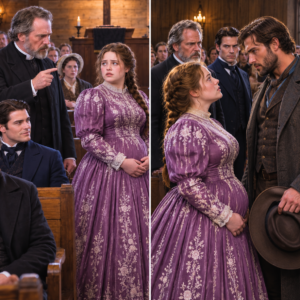
“That baby is mine.”
The stranger’s voice struck the sanctuary with such force that even the oldest men in Black Hollow seemed to forget how to breathe.
I stood before the pulpit, my hands trembling over the small curve of my stomach, while nearly every person in town turned to stare at the man who had just walked through the church doors.
My father, Reverend Elias Whitaker, looked as though someone had struck him.
Nathaniel Vale, sitting in the front pew beside his father, had finally stopped smiling.
And I knew the stranger.
I knew the shape of his shoulders beneath that dusty coat, the way he held his hat in one hand, and the small scar crossing the knuckle of his right thumb.
His name was Caleb Ward.
He was the man I had loved in secret, the man I had thought would never return, and the father of the child I had been terrified to name.
But before I could move toward him, my father stepped between us.
“Who are you?” he demanded.
Caleb didn’t look away from me.
“Caleb Ward, sir.”
“I asked who you are, not what you’re called.”
Caleb finally turned toward him.
“I’m the man who fathered Grace’s child.”
A murmur swept through the congregation.
Some women crossed themselves.
Others leaned toward their husbands, whispering behind gloved hands.
Augustus Vale, the owner of Silver Crest Mining Company, slowly stood from his pew.
His expensive black coat looked almost too fine for the crowded sanctuary, and his silver watch chain glinted beneath the lamplight.
“An extraordinary claim,” he said.
Caleb looked at him.
“It’s the truth.”
Nathaniel gave a short, mocking laugh.
“Father, this is ridiculous.”
He leaned back, attempting to recover the confidence he had lost when Caleb entered.
“This fellow disappears from town for months, returns on the morning of a public disgrace, and suddenly claims responsibility for a child he has never seen?”
I watched Nathaniel carefully.
His words sounded reasonable.
That was what made him dangerous.
He had always known how to make cruelty sound like common sense.
My father turned toward me.
“Grace, do you know this man?”
I swallowed.
“Yes.”
“How?”
I looked at Caleb.
He had not moved closer.
He was waiting for me to answer.
“He worked in Black Hollow during the summer,” I whispered.
“And you knew him?”
“Yes, Father.”
“How well?”
The question seemed to echo against every wall.
I felt the congregation leaning toward us.
My cheeks burned.
“Very well.”
My father closed his eyes.
For twenty-two years, Reverend Elias Whitaker had been the most respected man in Black Hollow.
He had baptized children, married couples, buried miners, and comforted families who had lost everything beneath the earth.
He had also raised me alone after my mother died when I was nine.
I had spent my entire life trying to be the daughter he could be proud of.
And now I stood before him carrying a child he knew nothing about.
“Why didn’t you tell me?” he asked.
I couldn’t answer.
Because the truth was not simply that I had fallen in love with a man who had no money, no family in town, and no promise of a secure future.
The truth was that someone had threatened to destroy everything my father had spent his life protecting.
And I had believed him.
Nathaniel rose from his seat.
“I think we’ve heard enough.”
Caleb turned toward him.
“No, Mr. Vale.”
Nathaniel’s jaw tightened.
“You should be careful how you speak to me.”
“I’ve been careful long enough.”
Augustus stepped forward.
“Young man, I own the company that employs most of the men in this town.”
“I know.”
“I have obligations to this community.”
“Then perhaps you should start honoring them.”
The congregation fell silent.
I saw several miners exchange glances.
Augustus had controlled their wages, their debts, and the opportunities available to their families for years.
Few people spoke to him that way.
Nathaniel took a step toward Caleb.
“You have no idea what you’re getting involved in.”
Caleb looked directly at him.
“Actually, Nathaniel, I know exactly what I’m getting involved in.”
My stomach tightened.
I remembered the harvest festival.
I remembered the music, the lanterns, and the moment Nathaniel had followed me behind the equipment shed.
I remembered the knife.
And I remembered the words he had whispered against my ear.
If I told my father what happened, the church would burn with Reverend Whitaker trapped inside it.
My father stepped closer.
“Grace, I will ask you one final time.”
His voice trembled.
“Is this man the father of your child?”
I looked at Caleb.
He nodded almost imperceptibly.
He wasn’t asking me to lie.
He was asking me to stop being afraid.
“Yes,” I whispered.
The word seemed to break something inside the room.
My father staggered backward.
Nathaniel’s face hardened.
Augustus looked toward his son.
And then Nathaniel said something that made my blood turn cold.
“Then perhaps she should explain what happened in the equipment shed before this stranger starts pretending to be a hero.”
Caleb’s expression changed.
My father turned toward me.
“What equipment shed?”
I could no longer feel my hands.
Because Nathaniel had just revealed that he knew exactly what I had been trying to keep hidden.
And he was about to make sure the entire town heard his version first.
CHAPTER 2 – PART 2 – THE CHILD HE CLAIMED, THE TRUTH SHE FEARED
PART 2: THE MAN WHO LEFT BEFORE WINTER
Before that November morning, I had believed that Black Hollow was a place where people knew one another.
I knew which families lived near the church, which miners worked the deepest shafts, and which children belonged to which mothers.
I knew who needed help carrying coal and who quietly left food on the porches of families struggling through winter.
I also knew that the Vale family owned more of Black Hollow than anyone wanted to admit.
Their mining company paid the wages, controlled the company store, and held debts against families who had worked underground for generations.
My father had never been comfortable accepting their money.
But the church needed repairs, and the winter before, several miners had lost their lives in an accident that left their families unable to contribute.
Augustus Vale had offered to pay for a new roof and heating supplies.
My father accepted because he believed the church belonged to the community.
I sometimes wondered whether he regretted that decision.
It was during the summer repairs that I first met Caleb Ward.
He had arrived in town with a small wagon, a toolbox, and enough carpentry experience to repair the church roof without requiring a second man.
He was twenty-four, quiet, and not particularly interested in impressing anyone.
The first time we spoke, I was carrying a basket of bread into the church.
He was standing on a ladder near the entrance, struggling with a loose wooden beam.
“Would you mind holding this?” he asked.
I placed the basket down.
“What is it?”
“A piece of wood.”
I looked at him.
“I can see that.”
He laughed.
It was the first time I had heard a man laugh without trying to make someone else feel foolish.
We worked together for several afternoons.
I brought him water when the heat became unbearable, and he occasionally helped me carry supplies from the storage room.
He asked about my mother.
I told him she had died when I was young.
He told me about growing up without much money and learning carpentry from his uncle.
We spoke about ordinary things.
But ordinary things can become important when someone has spent most of her life feeling that every conversation must be proper.
Caleb never treated me as though I were merely the reverend’s daughter.
He listened when I spoke.
He remembered small details.
And when he looked at me, I didn’t feel as though I were being measured against someone else’s expectations.
By late August, I had fallen in love with him.
I knew my father would not approve.
He had spent years worrying about my future and wanted me to marry a man who could provide stability.
Caleb had no land, no permanent employment, and no family in Black Hollow.
But he had something I had never found in the young men who came to church hoping to impress Reverend Whitaker.
He had a gentle heart.
One evening, before leaving for a carpentry contract in a neighboring county, he took my hand beside the old churchyard fence.
“I’ll come back,” he promised.
I looked at him.
“When?”
“As soon as the work is finished.”
“And if it takes longer?”
“Then I’ll write.”
He kissed my forehead.
I believed him.
Our farewell was not something I had planned.
But neither of us had wanted to pretend that our feelings were less than they were.
By September, I discovered I was carrying his child.
I sat alone in the small bedroom above the church office, staring at the folded cloth in my hands.
Fear came first.
Then disbelief.
Then a strange tenderness I had never experienced before.
There was a child inside me.
A little life that had begun before I understood how much my own life was about to change.
I wrote Caleb a letter.
I told him I loved him, that I was frightened, and that I needed him to return.
I sent it through the regular post and waited.
No answer came.
Then Nathaniel Vale began paying attention to me.
He had always been pleasant enough in public.
He attended church occasionally, wore expensive clothes, and knew how to speak politely when his father was watching.
But when we were alone, his manners changed.
He asked why I spent so much time in the church office.
He wanted to know whether Caleb had written.
He made comments about the kind of men who traveled from town to town without settling anywhere.
I told him his opinions were none of my concern.
He smiled.
“You should be careful, Grace.”
I ignored him.
I should have understood that he was not used to being ignored.
The harvest festival took place in early October.
The town gathered near the church and market square, with lanterns hanging from ropes and fiddle music filling the cold evening air.
I attended because my father expected me to help serve refreshments.
I wore a simple blue dress and kept my shawl wrapped tightly around my shoulders.
Nathaniel found me near the refreshment table.
“May I have a word?”
“I have work to do.”
“Just a moment.”
I followed him only as far as the equipment shed because I wanted to avoid making a scene in front of the congregation.
That was my mistake.
He closed the door behind us.
The music became distant.
He asked whether Caleb had written.
I said no.
Then he asked whether I had told my father about the child.
I froze.
He smiled.
“So it is true.”
I stepped toward the door.
He moved in front of it.
“Get out of my way, Nathaniel.”
He laughed softly.
“You think you can carry on with a wandering carpenter and then return to your father’s church expecting everyone to pretend nothing happened?”
I told him Caleb was the father.
Something changed in his face.
He grabbed my arm.
I pulled away.
Then I saw the knife.
He held it beneath my ribs, close enough that I could feel the cold metal through my dress.
His voice was low and strangely cheerful.
“If you tell your father what happened tonight, that church will burn before morning.”
I stared at him.
He leaned closer.
“And Reverend Whitaker will be inside it.”
I couldn’t breathe.
He released my arm and opened the door.
“Go back to the music, Grace.”
I returned to the festival with my hands shaking.
Nobody noticed.
Or perhaps they noticed and chose not to ask.
I never told my father.
I never told anyone.
And when the rumors began spreading about my pregnancy, Nathaniel allowed the town to believe whatever it pleased.
By November, I had become the subject of every whispered conversation in Black Hollow.
And the man who had threatened me was sitting in the front pew, waiting for me to confess.
CHAPTER 3 – PART 3 – THE CHILD HE CLAIMED, THE TRUTH SHE FEARED
PART 3: THE PRICE OF A NAME
The sanctuary remained silent after Nathaniel mentioned the equipment shed.
My father turned toward me.
“What happened there?”
I opened my mouth.
Nothing came out.
Nathaniel watched me with the same expression he had worn that October evening.
A faint smile.
A little patience.
And the certainty that I would obey.
Caleb moved closer.
“Don’t answer him while he’s trying to frighten you.”
Nathaniel laughed.
“Frighten her?”
He looked toward the congregation.
“I am trying to protect this town from a stranger who thinks he can walk in here and make himself part of a respectable family.”
Augustus Vale finally spoke.
“Caleb Ward, isn’t it?”
Caleb turned.
“Yes.”
“You worked in Black Hollow briefly during the summer.”
“I did.”
“And then you disappeared.”
“I took a contract.”
“You left without making any arrangements for the girl.”
Caleb’s jaw tightened.
“I left before I knew she was carrying my child.”
“Convenient.”
“I wrote to her.”
I looked up.
“You did?”
Caleb turned toward me.
“I never received an answer.”
My heart began beating faster.
“I wrote to you in September.”
He stared at me.
“What?”
“I sent a letter.”
He shook his head.
“I never received it.”
Augustus gave a dismissive laugh.
“Perhaps the post was unreliable, or perhaps this is another convenient story.”
Caleb ignored him.
“Grace, I came back as soon as I received your second letter.”
My eyes widened.
I had sent another letter in October, shortly after the festival.
I had written only a few lines.
I told him I was frightened, that Nathaniel knew about us, and that I needed him to come home.
I had never known whether it reached him.
“When did you receive it?” I asked.
“Four days ago.”
Four days.
He had traveled through freezing rain and rough roads to reach Black Hollow.
He had come because I had asked him to.
My father looked between us.
“Why did you not come to me?”
I looked at him.
“Because I was afraid.”
“Of what?”
I glanced toward Nathaniel.
His smile disappeared.
My father followed my gaze.
“Grace?”
Augustus stepped forward.
“Reverend, I suggest you end this spectacle.”
My father turned.
“I believe my daughter has something to say.”
“Your daughter has already brought enough embarrassment upon your church.”
Caleb moved between them.
“Don’t speak about her as though she’s not standing here.”
Augustus’s eyes narrowed.
“You should remember your position.”
“I know my position.”
“And what is that?”
“A man who intends to take responsibility for his child.”
Nathaniel laughed.
“You cannot even provide for yourself.”
Caleb looked at him.
“I can provide for my family without threatening women with knives.”
The congregation stirred.
My father turned sharply.
“What did you say?”
Nathaniel stepped forward.
“Careful, Ward.”
Caleb didn’t move.
“Did I say something untrue?”
Augustus seized his son’s arm.
“Enough.”
For the first time, I noticed that Augustus was not merely irritated.
He was afraid of something.
Perhaps not of Caleb.
Perhaps of the possibility that his son’s carefully maintained reputation might finally be examined.
My father looked at me again.
“Grace, I need to understand.”
I wanted to tell him everything.
I wanted to explain that I had never intended to deceive him.
I wanted to tell him about Caleb, the letters, the child, and the knife.
But every time I imagined speaking Nathaniel’s name, I remembered the church burning.
I remembered my father trapped inside.
I remembered the sound of the sanctuary doors closing.
“I can’t,” I whispered.
My father looked devastated.
Nathaniel’s confidence returned.
“You see?”
He turned toward the congregation.
“She cannot explain herself because there is nothing to explain.”
Caleb’s hands tightened.
“That’s enough.”
Nathaniel ignored him.
“Perhaps this man has offered to marry her because he knows he can make money from the reverend’s reputation.”
Several men in the congregation looked uncomfortable.
One of them, a miner named Samuel Briggs, stood from the back pew.
“I’ve known Caleb since he worked here.”
Augustus turned toward him.
“Sit down, Briggs.”
Samuel remained standing.
“I said I’ve known him.”
“And I heard you.”
The miner glanced at me.
“I also know what it’s like when a powerful man decides nobody is allowed to speak.”
The room became very still.
Augustus stared at him.
Then he slowly turned toward my father.
“Reverend Whitaker, I believe we should discuss the church’s financial arrangements before this matter goes any further.”
My father stiffened.
“What arrangements?”
“The heating supplies, the roof repairs, and the outstanding costs the company has covered.”
I understood immediately.
The Vale family wasn’t simply trying to discredit Caleb.
They were reminding my father that his church depended on their generosity.
And if he allowed me to accuse Nathaniel, they could make sure the entire congregation paid for it.
My father looked toward the stove.
The iron had begun to cool.
Outside, snow was starting to fall.
Then Augustus delivered his final warning.
“Some people forget how quickly a community can lose the things it depends upon.”
And I realized that Nathaniel’s threat had never been an isolated moment of drunken cruelty.
His family had been using fear to control Black Hollow for years.
CHAPTER 4 – PART 4 – THE CHILD HE CLAIMED, THE TRUTH SHE FEARED
PART 4: A FATHER’S SHAME
My father dismissed the congregation before the argument could become worse.
People left in small groups, whispering as they crossed the churchyard.
Some looked at me with sympathy.
Others looked away.
Nathaniel and Augustus departed together, followed by several men who depended on Silver Crest for their wages.
Caleb remained near the entrance.
My father stood beside the pulpit.
I had never seen him look so old.
“Grace,” he said quietly.
I approached him.
“Father.”
“Come into my office.”
Caleb started to follow.
My father raised one hand.
“Please, Mr. Ward.”
Caleb stopped.
“I won’t go far.”
My father nodded.
I followed him into the small office behind the sanctuary.
The room smelled of old paper, candle wax, and the peppermint tea my father drank when his chest hurt.
He closed the door.
Then he turned toward me.
“Is the child Caleb’s?”
“Yes.”
“Did you love him?”
I looked down.
“Yes.”
He sat behind his desk.
For a moment, he seemed unable to find the words.
“I raised you to understand that your choices have consequences.”
“I know.”
“I trusted you.”
“I know.”
“Then why did you hide this from me?”
My eyes filled.
“Because I knew you would be disappointed.”
He looked at me.
“Disappointed?”
I nodded.
“You wanted me to marry someone respectable, someone who could provide a stable life.”
“And you believed I would rather see you unhappy than honest?”
I didn’t answer.
He stood.
“Grace, I am your father before I am your reverend.”
I began crying.
He reached toward me, then stopped.
“Did someone hurt you?”
The question broke something inside me.
I looked at him.
He saw the answer before I could speak.
“Who?”
I shook my head.
“Grace.”
“I can’t.”
His expression changed.
“Is someone threatening you?”
I covered my mouth.
He came around the desk.
“Tell me.”
I looked toward the door.
“If I tell you, he will hurt you.”
My father went completely still.
“Who?”
I couldn’t say the name.
Then a knock sounded.
Caleb opened the door only after my father called for him.
“I’m sorry,” he said, “but I think you should hear this.”
He held out a folded envelope.
My heart stopped.
It was my letter.
The one I had sent in October.
The paper was creased, and the edges were damp from travel.
“I received this in the county town,” he explained.
“The postmaster had sent it to an old address, and it took time to reach me.”
My father took the letter.
He read the few lines I had written.
His face changed.
The words were simple.
I am frightened.
Nathaniel knows about us.
Please come back.
I need you.
My father looked at me.
“Why didn’t you tell me?”
I began to cry harder.
“Because he said he would burn the church.”
The silence that followed seemed endless.
My father lowered the letter.
“Who said that?”
I looked at the floor.
“Nathaniel.”
Caleb’s face hardened.
My father sat down heavily.
I told them about the equipment shed.
I told them about Nathaniel following me, blocking the door, and holding the knife beneath my ribs.
I repeated the threat.
I explained that I had been afraid he would set fire to the church while my father was inside.
When I finished, my father covered his face.
For several moments, he said nothing.
Then he whispered, “My child.”
I moved toward him.
“I didn’t know what else to do.”
He stood and embraced me.
I had not been held like that since my mother died.
“I am sorry,” he said.
I shook my head.
“No, Father.”
“Yes.”
His voice broke.
“I brought you before the entire congregation and demanded that you name a man without understanding what silence was costing you.”
I held him tightly.
Caleb stood near the door.
He looked relieved, but I could see anger beneath it.
My father finally released me.
“Did anyone see what happened?”
I shook my head.
“No.”
“Did he threaten you again?”
I hesitated.
“Not since that night.”
My father looked toward the sanctuary.
“Then he believes he can continue.”
Caleb stepped forward.
“He won’t.”
My father turned.
“We cannot allow anger to decide what happens next.”
“I know.”
“But neither can we let him control this town.”
Caleb nodded.
Then he looked at me.
“Grace, I came back because I want to be with you and our child.”
I lowered my eyes.
“I know.”
“I won’t ask you to marry me because you need protection.”
I looked up.
“I won’t ask you to forget what happened.”
He took a breath.
“I only want you to know that you’re not alone anymore.”
For the first time that day, I believed him.
But before any of us could say another word, someone struck the office door hard enough to rattle its frame.
My father opened it.
Nathaniel stood outside.
His expression was no longer amused.
He looked directly at me.
“We need to talk, Grace.”
My father stepped between us.
“She has nothing to say to you.”
Nathaniel smiled faintly.
“Then perhaps you should ask what will happen to your church if she starts talking.”
CHAPTER 5 – PART 5 – THE CHILD HE CLAIMED, THE TRUTH SHE FEARED
PART 5: THE LAST WARNING
My father did not move.
For the first time in my life, I watched him stand against someone who believed money made him untouchable.
“You will leave,” he told Nathaniel.
Nathaniel glanced past him toward me.
“I was only trying to prevent a misunderstanding.”
“A misunderstanding involving a knife?”
Nathaniel’s expression tightened.
“I don’t know what she told you.”
“She told me enough.”
Nathaniel gave a short laugh.
“Then perhaps you should ask her why she was alone with me.”
My father stepped forward.
“Get out.”
Nathaniel looked toward the sanctuary.
“Think carefully, Reverend.”
He spoke softly enough that only the three of us could hear.
“Your church has a wooden roof, dry curtains, and plenty of old timber.”
My blood turned cold.
My father understood the threat.
So did Caleb.
“Leave,” Caleb said.
Nathaniel looked at him.
“You think you’re going to take her away from here?”
“I think she can decide where she wants to be.”
Nathaniel’s eyes returned to me.
“You should remember who made this town what it is.”
I found my voice.
“You didn’t make anything, Nathaniel.”
He stared.
“You inherited your father’s money and learned to frighten people with it.”
His face darkened.
For a moment, I thought he might strike me.
But he simply smiled.
“We’ll see how brave you are when winter comes.”
Then he walked away.
My father closed the door.
Nobody spoke.
I had finally said something to Nathaniel without lowering my eyes.
Yet the fear remained.
The next morning, Augustus Vale sent a message to my father.
He wanted to discuss the church’s financial arrangements.
My father refused.
By noon, the coal delivery scheduled for the church had been canceled.
By afternoon, the men responsible for repairing the roof had been instructed not to return.
The Vale family was making its position clear.
If my father stood beside me, the church would suffer.
I watched him read the message.
He folded it carefully and placed it on his desk.
“Father, perhaps we should leave town.”
He looked up.
“Why?”
“Because I don’t want people losing their jobs because of me.”
He shook his head.
“You are not responsible for the choices Nathaniel makes.”
“But the miners—”
“They deserve better than a town where a man’s daughter must remain silent to protect his business.”
I sat down.
I had spent so many weeks believing that my silence was protecting my father.
Now I was beginning to understand that it had only protected Nathaniel.
That evening, Caleb came to the church with a small bundle of firewood.
He had found temporary work repairing wagons and promised to help wherever he could.
He placed the wood beside the stove.
My father thanked him.
Then Caleb turned toward me.
“I spoke with Samuel Briggs.”
I frowned.
“Why?”
“He knows Nathaniel has frightened other people.”
My heart quickened.
“What do you mean?”
Caleb lowered his voice.
“Not about you specifically, but about the way the Vales treat the men who work for them.”
I looked toward the door.
“Did Samuel see what happened in the shed?”
“No.”
I lowered my eyes.
Caleb continued.
“But he said Nathaniel once boasted that nobody in Black Hollow would dare challenge him.”
I shook my head.
“That doesn’t prove anything.”
“No.”
He paused.
“But your words matter.”
I looked at him.
“What if nobody believes me?”
“Then I will stand beside you.”
“What if they believe Nathaniel?”
“Then we will still know the truth.”
His answer was simple.
It did not promise victory.
It promised that I would not face the consequences alone.
That night, I could not sleep.
I thought about the congregation.
The women who had whispered.
The men who had lowered their eyes.
My father’s disappointment.
Caleb’s return.
And the child growing inside me.
I placed my hand over my stomach.
I did not want my child to grow up learning that powerful people were allowed to frighten everyone else into silence.
I did not want him or her to believe that shame belonged to the person who had been threatened.
The next morning, I went to my father.
“I want to speak at church.”
He looked up from his Bible.
“Are you certain?”
“Yes.”
“Do you understand what may happen?”
I nodded.
He stood.
“Then we will not make you stand alone.”
I looked at him.
He reached for my hand.
“Whatever the town says, you are my daughter.”
For the first time since the rumors began, I felt strong enough to believe that.
But I did not know that Augustus Vale had already arranged for the entire congregation to gather again.
And this time, he intended to make sure Nathaniel controlled the conversation.
Don’t stop here—the ending will shock you. Continue reading Chapter 6 below.