At seventy-seven, I never imagined my own daughter would leave me to freeze on a sidewalk during the deadliest winter of the pandemic.
But on December 18, 2020, that was exactly what happened.
My name is Walter Bennett.
After my wife, Margaret, died, I moved into my daughter Emily’s house in Columbus, Ohio.
I contributed $1,200 monthly from my pension and Social Security, bought groceries, and helped maintain the property.
For three years, everything seemed peaceful.
Until Emily’s husband, Richard, decided I was a burden.
That afternoon, I developed a mild cough.
Richard immediately accused me of having COVID-19.
“You’ve been sneaking outside without telling us!”
I shook my head.
“Richard, I haven’t gone anywhere except the pharmacy.”
He turned toward Emily.
“Your father is lying.
I saw him meeting strangers yesterday.
He’s putting our lives at risk!”
It was completely false.
But Emily believed him.
She stormed into my bedroom, her face twisted with anger.
“Dad, how could you be so selfish?”
“Sweetheart, please listen—”
“GET OUT!
I DON’T NEED A SICK DAD!”
Her words struck harder than any physical blow.
I stared at the little girl I had once carried through hospital corridors when she had pneumonia.
“Emily, it’s twenty degrees outside.”
“Then find somewhere else to stay!”
Richard appeared behind her.
“Don’t let him take anything.
We need to disinfect his belongings.”
Before I could reach for my wallet or phone, Richard grabbed my coat from the closet and shoved it toward me.
“You’re leaving now.”
My wallet was inside my bedroom drawer.
My phone was charging beside the bed.
“At least let me get my things.”
Richard blocked the doorway.
“We’ll send them after the house is cleaned.”
Emily stood silently as her husband pushed me onto the porch.
The door slammed.
I knocked three times.
“Emily!
Please!”
Nobody answered.
I walked toward a nearby gas station, hoping someone might let me use a telephone.
But the station had already closed early because of pandemic restrictions.
Snow began falling.
My legs weakened after several blocks.
My fingers became numb.
I sat against a brick wall outside a shuttered laundromat, pulling my thin coat around my chest.
I remember whispering my late wife’s name.
“Margaret, I don’t think I can make it home.”
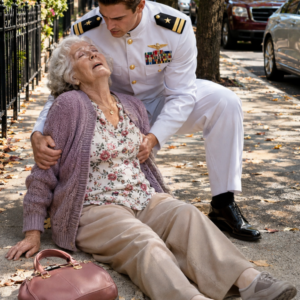
Around 10:40 p.m., Officer Daniel Harris noticed me while patrolling the neighborhood.
He stopped immediately.
“Sir?
Can you hear me?”
I tried answering, but my lips barely moved.
He radioed for an ambulance and wrapped an emergency blanket around me.
“Stay with me, Walter.
Help is coming.”
At Riverside Methodist Hospital, doctors treated me for moderate hypothermia and dehydration.
Officer Harris asked what had happened.
I told him everything.
He listened without interrupting.
Then he asked a question that changed everything.
“Mr.
Bennett, whose name is on the deed to that house?”
I blinked.
“Mine.”
He leaned forward.
“Your daughter doesn’t own it?”
“No.
My wife and I bought it twenty-six years ago.
Emily moved in after her marriage.”
The officer exchanged a stunned look with the hospital social worker.
Then my daughter called the hospital.
She demanded to know why the police had contacted her.
Officer Harris answered calmly.
“Mrs.
Collins, your father nearly died tonight.
And we need to discuss why you removed him from his own home.”
There was silence.
Then Emily whispered:
“His own home?”
But what she said next revealed that Richard had been hiding something far worse than a lie about my health.
Emily’s voice trembled over the telephone.
“Officer, that’s impossible.
Richard told me Dad transferred the house to us last year.”
I closed my eyes.
I had never transferred anything.
Officer Harris looked toward me.
“Mr.
Bennett, did you sign any property documents?”
“No.
Absolutely not.”
Emily continued speaking.
“Richard showed me paperwork.
He said Dad wanted us to have the house because he was getting older.”
My stomach tightened.
Six months earlier, Richard had asked me to sign several documents supposedly related to homeowners insurance.
I refused because I couldn’t read the small print.
He became furious.
Now I understood why.
The following morning, a hospital social worker named Patricia Moore helped me contact attorney Susan Parker, who had handled Margaret’s estate.
Susan reviewed the county property records.
The house remained legally mine.
However, she discovered something disturbing.
Three weeks earlier, Richard had submitted a fraudulent deed attempting to transfer ownership into his name.
The county recorder had flagged the document because the notarization information was inconsistent.
Susan explained:
“The transfer hasn’t been accepted.
But someone clearly attempted to take your property.”
My hands shook.
“Richard?”
“His name appears on the paperwork.”
Meanwhile, Emily arrived at the hospital wearing a mask.
She stood outside my room, crying.
“Dad, I didn’t know.”
I looked at her through the doorway.
“You knew I was seventy-seven.
You knew it was freezing.
You knew I had nowhere to go.”
She lowered her head.
“I thought you were sick.”
“Then you should have called a doctor, Emily.
Not thrown me outside.”
She covered her mouth.
For the first time, she had no excuse.
Susan joined us by telephone.
“Emily, did your husband ever tell you about a property transfer?”
“Yes.
He said Dad had already signed everything.”
“That wasn’t true.”
Emily stared at the floor.
Then she whispered:
“There’s something else.”
She explained that Richard had recently taken out several loans.
He claimed they were necessary to keep his struggling construction business alive.
Two weeks earlier, he had pressured Emily to sign a document allowing him to use their household assets as collateral.
She refused.
He became increasingly aggressive.
Then came the pandemic accusation.
Suddenly, his behavior made sense.
He wanted me gone before I discovered his attempted property fraud.
But Susan had another discovery.
A private lender had contacted Richard demanding repayment of $185,000.
Richard had apparently promised the lender that he would soon control my house.
Emily began trembling.
“He told me everything was fine.”
Susan answered:
“It wasn’t.”
That afternoon, Officer Harris and a detective interviewed Emily about Richard’s statements and the attempted deed transfer.
Emily agreed to cooperate.
When she returned home, Richard was waiting in the kitchen.
“Where’s your father?”
“Still hospitalized.”
“Good.
We need to talk about selling the house.”
Emily stared at him.
“You told me Dad gave us this property.”
“He did.”
“No, Richard.
He didn’t.”
His expression changed.
“Who have you been talking to?”
“The police.”
Richard slammed his fist against the counter.
“You stupid woman!
Do you realize what you’ve done?”
Emily stepped backward.
Then Richard grabbed a folder from the kitchen cabinet.
As he pulled it open, several papers scattered across the floor.
Emily recognized my signature on one document.
But another page contained something she had never seen.
It was an application for a $300,000 life insurance policy.
The proposed insured person was me.
The proposed beneficiary was Richard.
And the signature beneath my name was forged.
Emily looked up, horrified.
“Richard… why did you take out life insurance on my father?”
He stared at her.
Then he reached for the folder.
Emily pulled the folder away before Richard could grab it.
“Answer me!”
Richard’s face turned red.
“It’s just financial planning!”
“With Dad’s forged signature?”
He lunged toward the papers.
Emily stepped aside, hurried into the hallway, and locked herself in the bathroom.
She called 911.
“My husband is threatening me.
I found documents with my father’s forged signature.”
Richard pounded on the door.
“Emily!
Open it!”
She refused.
Police arrived minutes later.
Richard initially claimed it was a marital disagreement.
But Emily showed the officers the paperwork and explained the threats.
The officers separated them and documented her account.
Richard left the property that evening after agreeing to stay elsewhere while investigators examined the allegations.
The following morning, Emily returned to my hospital room.
She looked exhausted.
“Dad, I found something terrible.”
She handed Susan copies of the insurance documents.
Susan examined them carefully.
“The application appears to contain a forged signature.
We need to contact the insurer immediately.”
The insurance company subsequently confirmed that the application had been submitted but never approved.
No policy had taken effect.
That fact relieved me.
But it didn’t erase what Richard had attempted.
Investigators eventually obtained evidence linking him to both the fraudulent deed and insurance application.
A forensic document examiner concluded that the signatures were not mine.
Richard was charged with offenses related to forgery and attempted fraud.
Months later, he pleaded guilty under an agreement with prosecutors and received a prison sentence.
His financial problems had nearly cost me my life.
But the most painful part wasn’t Richard.
It was Emily.
Three days after my hospitalization, she sat beside my bed holding a photograph of Margaret.
“Mom would be ashamed of me.”
I looked at the picture.
Margaret was smiling beside our daughter on her wedding day.
“Your mother would have asked why you stopped listening to your father.”
Emily began crying.
“I thought Richard was protecting us.”
“You watched him push me outside.”
“I know.”
“You heard me begging at the door.”
She nodded.
“And you did nothing.”
For several minutes, neither of us spoke.
Finally, Emily whispered:
“Can you ever forgive me?”
I took a long breath.
“I don’t know, sweetheart.
Forgiveness isn’t something you can demand because you’re sorry.”
She accepted that answer.
After I recovered, Susan helped me secure the property and update my estate documents.
Emily moved out voluntarily.
I returned home with assistance from a home health aide and a neighbor who checked on me daily.
Over the following months, Emily began attending counseling.
She found an apartment, filed for divorce, and wrote me letters without asking for money or forgiveness.
Eventually, I agreed to meet her for coffee.
She arrived carrying my favorite lemon cookies.
“I made them myself.”
I smiled faintly.
“Your mother used to burn the bottoms.”
Emily laughed through her tears.
For the first time in months, we shared a peaceful moment.
But I made one thing clear.
“You can be my daughter again, Emily.
But you’ll have to earn back my trust.”
She nodded.
“I understand.”
A year later, I established a small fund supporting emergency housing assistance for vulnerable older adults.
I wanted something meaningful to come from that terrible night.
Then, on the second anniversary of my rescue, Officer Harris visited.
He brought a sealed envelope recovered during the investigation.
Inside was an old letter from Margaret, which Richard had apparently taken from my bedroom while searching through my documents.
I recognized her handwriting immediately.
The letter had been written shortly before her death.
Its final sentence brought tears to my eyes:
“Walter, if the day ever comes when our daughter forgets how much you love her, please remember that you deserve to be loved, too.”
I held that letter against my chest.
And finally, after two years, I stopped blaming myself for the night my own daughter abandoned me.
Because growing old had never made me worthless.
It had simply shown me who was willing to protect me when I could no longer protect myself.
And as I placed Margaret’s letter beside our wedding photograph, I realized something I wished I had understood years earlier:
Sometimes the hardest person to save isn’t the one freezing outside.
It’s the one who has forgotten that love means opening the door.