PART 15: THE EMPTY CHAIR BESIDE ME
I looked at Luis Ortega, then at the evaluation sheet carrying his name, and finally answered the question I would have avoided at any other point in my life.
“Yes, sir.”
The office remained silent.
Captain Velez watched me carefully.
“Explain your answer, Corporal.”
I took a breath.
“Lance Corporal Ortega demonstrated the judgment this position requires before anybody told him he was being evaluated for it.”
Luis turned toward me.
I continued.
“He warned me at lunch because he recognized that I was about to make a bad decision.”
My throat tightened.
“I ignored him because listening would have embarrassed me in front of my friends.”
I looked toward Colonel Hart.
“During the workshop, he listened when people raised concerns, and during the rehearsal, he made sure the team had accurate information before moving.”
I paused.
“Those are the things a leader should do.”
Captain Velez nodded slowly.
“And what about your own performance?”
“I’m proud of the improvement I made, sir.”
I meant it.
The rehearsal had shown me that I could change how I worked with other Marines.
“But I shouldn’t receive a leadership assignment simply because I finally started doing things Ortega was already doing.”
Luis lowered his eyes.
I turned toward him.
“You earned it.”
He didn’t answer immediately.
Then he gave a small nod.
“Thank you, Jake.”
For the first time since the incident, I felt no need to add a joke.
Captain Velez picked up his pen.
“That’s the kind of assessment I needed to hear.”
He signed the assignment sheet.
“Lance Corporal Ortega will serve as the team leader during the upcoming exercise.”
Luis straightened.
“Yes, sir.”
“Corporal Miller will serve in a supporting role and continue receiving leadership development and evaluation.”
I nodded.
“Understood, sir.”
Captain Velez looked at me.
“This doesn’t end your opportunities for advancement.”
I listened carefully.
“It means you still have work to do before I’m comfortable assigning you greater responsibility.”
“Yes, sir.”
He closed the folder.
“I expect that work to continue whether anyone is watching or not.”
The words stayed with me.
Colonel Hart rose.
I stood automatically.
She approached us with the same controlled confidence I remembered from the mess hall.
“Congratulations, Lance Corporal Ortega.”
“Thank you, ma’am.”
She shook his hand.
Then she turned toward me.
“Corporal Miller, I appreciate the honesty you showed today.”
“Thank you, Colonel.”
Her expression softened.
“I hope you understand that accepting a supporting role doesn’t diminish your value as a Marine.”
I nodded.
“I’m beginning to.”
She studied me.
“Good.”
Captain Velez dismissed us.
Luis and I walked into the hallway together.
For several seconds, neither of us spoke.
Then he stopped beside the bulletin board where we had argued after my first meeting with the captain.
“You didn’t have to say all that,” he told me.
I looked at him.
“Most of it needed saying.”
He nodded.
“I wasn’t sure you believed I could lead.”
The admission hurt.
I thought about every time I had treated his caution as weakness.
“I didn’t give you enough credit.”
Luis looked toward the floor.
“You used to make everything feel like a competition.”
“I know.”
He gave me a small smile.
“Today didn’t.”
I felt something in my chest loosen.
“You’re going to do a good job.”
“I hope so.”
“You will.”
He looked at me.
“And I’ll need you to tell me when I’m missing something.”
I smiled faintly.
“Even if you don’t like hearing it?”
“Especially then.”
We shook hands.
It wasn’t a dramatic reconciliation.
There were no speeches, no sudden promises of lifelong loyalty, and no miraculous erasure of what had happened.
It was two Marines agreeing to trust each other enough to begin working differently.
That felt more valuable than any easy forgiveness.
Over the following days, the change became a matter of ordinary decisions.
I stopped making jokes when someone raised a concern during equipment checks.
I asked Mason for his opinion before presenting my own during planning discussions.
I let Ben finish explaining his ideas without interrupting to make everyone laugh.
When Noah disagreed with something I suggested, I asked him why instead of treating his disagreement as a challenge.
Sometimes I still felt the old impulse.
Sometimes a sarcastic remark formed in my mind before I could stop it.
I learned to recognize those moments.
I learned that remaining silent for a few seconds could be more useful than filling every pause.
The upcoming exercise gave us plenty of opportunities to practice.
Luis took his leadership assignment seriously.
He prepared carefully, admitted when he didn’t know something, and asked questions that made the entire team better.
I worked beside him, offering technical assistance and supporting decisions after we had discussed the information available.
There were moments when I disagreed.
We talked through them.
Occasionally I was right.
Occasionally he was.
The important difference was that neither of us treated the other’s opinion as a personal threat.
During one planning session, Mason noticed an inconsistency in a written schedule.
Luis stopped the discussion immediately.
We reviewed the information and corrected the error before it affected the team’s preparations.
Mason looked surprised when everyone thanked him.
I remembered Colonel Hart’s story about Staff Sergeant Rios.
The similarity wasn’t dramatic.
That was precisely why it mattered.
Good judgment often looked ordinary when it happened early enough.
At the completion of the exercise, Captain Velez conducted a final review.
Our team had performed well.
Luis received praise for keeping communication clear and ensuring that every Marine understood his responsibilities.
I received positive feedback for technical competence, cooperation, and improved judgment.
My earlier conduct issue remained part of the counseling process, but the captain acknowledged the progress I had made.
He told me that future leadership opportunities would depend on sustained performance.
I accepted that without trying to bargain for a different answer.
Several days later, I learned that Colonel Hart had returned to her regular duties after completing her observation and coordination responsibilities.
I hadn’t expected to see her again.
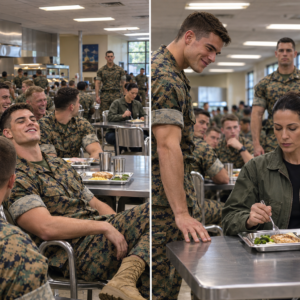
Then, nearly two weeks after the original incident, I walked into the 22 Area Mess Hall and spotted a familiar dark green flight jacket at a corner table.
For a moment, I stopped.
Colonel Hart sat alone, eating lunch with the same unhurried composure I remembered.
The jacket’s elbows were still faded.
Her hair was still pulled into a neat bun.
The room was as noisy as ever.
Metal trays scraped.
Marines laughed.
Boots crossed the polished floor.
Everything looked exactly as it had that first afternoon.
Except me.
I carried my tray toward the table where Ben, Noah, Mason, and Luis were already sitting.
Ben looked up.
“Jake, you’re late.”
I sat down.
“Had to finish checking something.”
Noah grinned.
“Don’t tell me you’ve become responsible.”
I smiled.
“Trying something new.”
The others laughed.
This time, nobody was the target.
As we ate, I noticed a young Marine standing near the serving line, looking uncertain about where to sit.
He carried a tray in both hands and glanced toward several crowded tables.
I recognized him as someone recently assigned to our area.
A few weeks earlier, I might have made a joke about his confusion.
Instead, I moved my tray to create more room.
I raised my hand.
“Hey, there’s an open seat here.”
He looked relieved.
“Thanks, Corporal.”
He joined us.
Luis introduced himself.
Ben asked about his assignment.
Mason made room for his tray.
Noah offered him the extra napkins sitting beside the drinks.
The conversation continued naturally.
Nobody needed to prove that the newcomer belonged.
Later, when I carried my tray toward the return area, I passed Colonel Hart’s table.
She looked up.
“Corporal Miller.”
I stopped.
“Good afternoon, ma’am.”
She glanced toward the table where my Marines were laughing together.
“How’s the team?”
“Doing well, Colonel.”
“And Lance Corporal Ortega?”
“He’s doing an excellent job.”
She nodded.
“I expected he might.”
I hesitated.
“Ma’am, may I thank you for something?”
“Certainly.”
“For not making yesterday’s version of me the only version you were willing to see.”
She studied me.
“I didn’t change your behavior, Corporal.”
I waited.
“You did.”
I nodded slowly.
“Yes, ma’am.”
She glanced toward the empty chair opposite her.
For an instant, I remembered approaching that same chair with a smirk and a joke.
Then she spoke.
“Would you like to sit for a moment?”
I looked at the chair.
“Yes, ma’am.”
I set my empty tray aside and sat across from her.
There was no audience waiting for a performance.
No nervous laughter.
No desperate need to impress anybody.
We talked briefly about the completed exercise, the team, and the challenges of learning to lead people who possessed different strengths.
She told me that a Marine’s career would contain mistakes, difficult decisions, and moments when pride demanded the wrong response.
She said the important question was whether those moments produced excuses or better judgment.
I listened.
When our conversation ended, I stood and thanked her.
She gave a small nod.
“Take care of your Marines, Corporal.”
“I will, ma’am.”
As I walked back toward my table, I heard Ben laughing at something the new Marine had said.
Luis was listening with a relaxed smile.
Mason looked comfortable enough to interrupt a story without worrying about being mocked.
Noah shifted his chair to make more room.
I sat down among them.
For years, I had believed that the loudest person in the room was usually the one who mattered most.
I had believed that confidence was something other people could measure by how much attention I attracted.
I had treated laughter as proof of respect, even when it came at someone else’s expense.
Colonel Rebecca Hart hadn’t needed to raise her voice to prove any of those beliefs wrong.
She had simply looked me in the eye and asked me to explain why I thought another person didn’t belong.
The question had cost me an opportunity I wanted.
It had exposed habits I had spent years refusing to examine.
It had forced me to confront the difference between being admired for my confidence and being trusted for my judgment.
And it had given me a chance to become a better Marine before those habits caused consequences far more serious than an embarrassing afternoon.
I looked around the table at the men beside me.
They were talking freely, disagreeing without fear, and laughing because they enjoyed being together.
For the first time, I understood that I didn’t need to control the room to have a place in it.
I only needed to deserve the place I already had.
That afternoon, I learned that the strongest Marine isn’t always the one who speaks first, commands the most attention, or has the cleverest answer.
Sometimes it’s the one who recognizes that another person deserves to be heard.
And sometimes the most important words a leader can say are the simplest ones.
“I was wrong.”
I finally understood that respect was never something I could demand from the people around me.
It was something I had to demonstrate through the way I treated them.
When lunch ended, I carried my tray away with the others, grateful for the ordinary noise of the mess hall and for the quiet lesson I would carry far beyond it.
I had walked toward that corner table believing I could decide who belonged.
I walked away understanding that everyone deserved basic respect before I knew a single thing about them.
And for the first time in my life, that knowledge made me feel like the kind of Marine I had always wanted to become.