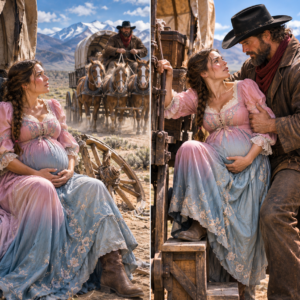
CHAPTER 1 – THE SCARS SHE HID, THE FIRE HE COULD NOT FORGET
PART 1: THE WOMAN AT THE GATE
For four months, I obeyed every order Silas Crane gave me, but I never once allowed him to see what was beneath my sleeves.
I cooked his meals, cleaned his house, prepared breakfast before sunrise, and made sure his ten-year-old son never went hungry.
I never complained about the long hours or the way Silas spoke to me as though I were another piece of ranch equipment he had hired for the summer.
But there was one rule I would not break.
I never rolled up my sleeves.
The summer of 1879 had settled heavily over Wyoming when the wagon carrying my belongings stopped at the entrance to Bellion Ranch.
I climbed down, thanked the driver, and lifted my trunk without waiting for anyone to offer assistance.
Nine thousand acres of grassland stretched beyond the gate, dotted with cattle, fences, and distant cottonwood trees.
The ranch was prosperous, but the main house looked strangely neglected.
The porch needed sweeping, one kitchen window had been cracked for months, and the front-room curtains remained drawn despite the bright afternoon.
I understood immediately that this was not a household accustomed to welcoming strangers.
A man emerged from the barn carrying a rasp.
He was tall, broad-shouldered, and weathered by years of working beneath the Wyoming sun.
His dark hair was beginning to gray at the temples, and his expression suggested that patience was something he had stopped practicing long ago.
“You are the cook?”
“I am.”
“Then listen carefully.”
He explained the schedule without introducing himself.
Breakfast had to be ready before daylight, dinner at noon, and supper whenever the ranch hands returned.
I was responsible for the stove, the pantry, and keeping the kitchen clean.
Beyond those duties, he expected me to stay out of his way.
I nodded.
“Is that all?”
“That’s all.”
His name was Silas Crane, and I would learn quickly that he preferred giving orders to having conversations.
I had traveled all the way from Cheyenne because I needed work, not because I expected a gentleman to greet me.
I had learned long ago that a roof over my head was worth more than a pleasant welcome.
The first morning, I woke before four.
I found flour, salt pork, dried beans, eggs, and enough coffee to serve the entire ranch.
By the time the first riders entered the kitchen, biscuits were cooling on the counter and breakfast was ready.
An older ranch hand named Ollie Dade stopped in the doorway.
He stared at the table.
“Well, I’ll be.”
He took one biscuit, broke it open, and tasted it.
Then he returned for two more.
Ollie had worked at Bellion Ranch for years, and I soon learned that he was one of the few men who remembered what the household had been like before Silas lost his wife.
He also became the first person to speak to me as though I belonged in the kitchen.
Silas’s son, Wesley, was more difficult to understand.
The boy was ten, but he carried himself like someone much older.
He rarely spoke during meals and often ate standing beside the kitchen door before disappearing upstairs.
His mother, Elizabeth, had died in a barn fire two years earlier.
Since then, the house had become a place where everyone moved quietly, as though even ordinary sounds might disturb something that could never be repaired.
On my third morning, Wesley appeared while I was mixing biscuit dough.
“You’re not going to leave like the other cooks, are you?”
I looked at him.
“Why would I leave?”
He shrugged.
“Because Father is mean.”
I smiled gently.
“Your father isn’t mean, sweetheart.”
“Then why does he never smile?”
“Sometimes people become so tired that they forget how.”
Wesley considered this.
Then he climbed onto the flour barrel and remained there while I worked.
That small decision meant more to me than he could have understood.
Over the following weeks, I began noticing things about the household.
The ranch hands never complained about their employer in front of Wesley, but they watched Silas carefully whenever the boy entered a room.
Silas never mentioned Elizabeth.
He avoided the barn after sunset and had forbidden anyone from bringing open flames near it.
Even the lanterns were kept well away from the wooden structure.
I did not ask why.
I had enough memories of fire to understand that some questions could hurt more than silence.
The men also noticed something about me.
Despite the heat of the iron stove, my sleeves remained buttoned tightly at the wrists.
When someone approached from behind, I turned instinctively until my back rested against a wall.
I never allowed anyone to stand behind me while I cooked.
Ollie noticed first.
One afternoon, he watched me move away from a ranch hand carrying a sack of flour.
“You move like a woman who’s had something bad happen behind her.”
I kept my eyes on the dough.
“Perhaps I’ve simply learned to be careful.”
He nodded and did not ask again.
Silas noticed too.
He noticed everything, but he never questioned me.
By the end of my first month, the kitchen had become the warmest room in Bellion Ranch.
Wesley began eating at the table instead of standing beside the door.
Ollie returned for lunch whenever he could.
Even the other ranch hands started lingering after meals, talking over their coffee instead of rushing back outside.
I was beginning to believe that I might finally have found somewhere I could work without being reminded of Cheyenne.
Then, one evening, I found Wesley struggling to read his schoolbook in the dark front room.
The curtains were drawn, and the lamp had been left unused.
I looked at the boy, then at the unlit wick.
I knew why Silas had forbidden flames inside the house, but I also knew Wesley needed to see his lessons.
So I lit the lamp.
When Silas entered and saw the flame, he stopped so suddenly that I thought he might order me out of the room.
His eyes remained fixed on the small light.
Then he looked at his son.
“He needs to be able to see,” he said quietly.
He pulled out a chair and sat beside Wesley.
I returned to the kitchen without saying anything.
But that evening, for the first time in two years, the front room of Bellion Ranch remained lit after supper.
And I began to understand that I was not the only person in that house hiding from something that had happened in a fire.
CHAPTER 2 – PART 2 – THE SCARS SHE HID, THE FIRE HE COULD NOT FORGET
PART 2: A HOUSE FULL OF SILENCE
By the second month, I had learned the daily rhythm of Bellion Ranch.
The ranch hands rose before daylight, the horses were fed, and Silas inspected the cattle before returning for breakfast.
Wesley attended to his lessons whenever the weather allowed, although he often found excuses to spend time in the kitchen.
I never discouraged him.
He reminded me of a child who had learned that asking for attention could sometimes bring disappointment.
One morning, he watched me knead bread for nearly twenty minutes before finally speaking.
“Did you always know how to cook?”
“My mother taught me when I was little.”
“Was she good?”
“Very good.”
“Better than you?”
I laughed.
“Much better.”
He smiled.
It was such a small thing, but I found myself remembering it long after he left.
Silas began noticing the changes too.
He still spoke in short sentences, but he no longer entered the kitchen only to issue instructions.
Sometimes he asked whether the men had eaten.
Sometimes he asked whether Wesley had finished his lessons.
Occasionally, he even remained at the table after supper.
Those conversations were never long, but they were different from the cold exchanges we had shared when I first arrived.
One evening, I found him standing beside the kitchen window.
He was looking at the repaired glass.
I had replaced the cracked pane with one Ollie had found in the storage shed.
“You fixed that?”
“Yes.”
“I didn’t ask you to.”
“I know.”
He examined the window for a moment.
Then he nodded.
“Looks better.”
It was the closest thing to praise I had received from him.
I was surprised by how much it pleased me.
Wesley continued to change.
He began telling me about his lessons, the horses he liked, and the things he remembered about his mother.
He never spoke about Elizabeth for very long.
But sometimes, when the kitchen was quiet, he would ask a question.
“Did you ever have someone who made you feel safe?”
I paused while folding a dishcloth.
“Yes.”
“Where are they now?”
I looked toward the window.
“Some people leave us, sweetheart.”
He lowered his eyes.
I did not tell him that some people disappeared because of death, while others remained alive but were never able to return to the people they had been.
I did not tell him that I still remembered the smell of burning timber whenever I closed my eyes.
Those memories belonged to another life.
At Bellion Ranch, I was simply Maren Hale, the cook.
And I intended to keep it that way.
Silas’s rules about fire remained strict.
The lanterns were never taken near the barn, and the men were expected to extinguish every flame before leaving the outbuildings.
I understood his caution better than he knew.
But I also began to notice that his fear had spread beyond the barn.
He avoided the subject of Elizabeth even when Wesley mentioned her.
He rarely looked at the old family photograph on the sitting-room shelf.
And whenever a lamp flickered unexpectedly, his shoulders stiffened.
One afternoon, I found Wesley standing beside that photograph.
He was looking at his mother’s face.
“She had pretty hair,” I said.
He nodded.
“Father says she was the kindest person he ever knew.”
“Then he must have loved her very much.”
Wesley looked at me.
“He doesn’t talk about her.”
I placed the clean laundry on a nearby chair.
“Perhaps talking about her makes him miss her.”
“Does missing someone ever stop?”
I considered my answer.
“No.”
His face fell.
“But it can become easier to carry.”
He looked at the photograph again.
I wondered whether anyone had ever explained grief to him without making it sound like something he was expected to overcome.
That evening, Silas found the two of us sitting in the front room.
Wesley was reading, and I was mending a torn shirt.
Silas stood in the doorway.
For a moment, his eyes moved from his son to the lamp.
Then he looked at me.
“You’ve been keeping the front room occupied.”
“Wesley wanted to read.”
Silas nodded.
He did not tell us to put the lamp out.
Instead, he sat down in the chair opposite us.
Wesley looked up in surprise.
“Father, do you remember when Mother used to read here?”
Silas’s expression changed.
“I remember.”
“She used to sit by the window.”
“I know.”
“Can we do that again sometime?”
Silas looked at the lamp.
Then he looked at his son.
“Perhaps.”
It was not much of an answer.
But Wesley smiled.
And I realized that the house was beginning to recover in ways none of us had expected.
The men noticed it too.
Ollie started eating supper at the main table whenever his duties allowed.
The ranch hands stopped treating the kitchen like a place where food appeared and disappeared without anyone noticing.
Even Silas began asking whether I needed supplies before the pantry ran empty.
For a while, I allowed myself to believe that the worst part of my past was finally behind me.
I had work.
I had a room.
I had a child who trusted me enough to ask questions.
And I had an employer who was slowly learning that kindness did not make a man weak.
But I had forgotten one important thing.
A secret can remain buried for years, but it only takes one careless moment to bring it back.
And mine was about to surface in the kitchen where I had worked so hard to feel safe.
CHAPTER 3 – PART 3 – THE SCARS SHE HID, THE FIRE HE COULD NOT FORGET
PART 3: THE MARKS BENEATH MY SLEEVE
The afternoon it happened was unusually hot.
The kitchen stove had been burning since before sunrise, and I was preparing supper while Wesley sat at the table finishing his lessons.
A heavy iron pan had been heating in the oven.
I reached for it without thinking, intending to move it before the food burned.
The cloth I normally used was not where I expected it to be.
The pan slipped.
I caught it with my bare hand before it could fall toward Wesley.
Pain shot through my palm.
I dropped the pan onto the stove and hurried toward the water pump.
Wesley jumped from his chair.
“Maren!”
“I’m all right.”
I kept moving.
The sleeve of my dress had ridden upward during the struggle, exposing the pale, puckered scar running along my forearm.
I did not notice until I reached the water pump.
Silas entered the kitchen just as I pulled my cuff down.
He stopped.
His eyes remained fixed on my arm.
I buttoned the sleeve.
“It’s an old injury.”
He said my name.
I looked at him.
“The pan is fine, Mr. Crane.”
“Your arm.”
“It happened a long time ago.”
He stepped closer.
“How?”
I turned toward the stove.
“Supper will be ready on time.”
He did not move.
For several seconds, neither of us spoke.
Then Wesley appeared beside the kitchen door.
I could feel him looking at me.
I hated that he had seen the scar.
I hated even more that I had frightened him.
I turned toward him and smiled.
“Go finish your schoolwork, sweetheart.”
He hesitated.
Then he returned to the table.
Silas remained where he was.
“I asked you a question.”
“And I answered.”
“No, you didn’t.”
I lowered my eyes.
“It isn’t something I discuss.”
His expression hardened.
But he did not force the matter.
He left the kitchen without another word.
I finished supper with my injured hand wrapped in a cloth.
That night, I could barely sleep.
I had spent four months keeping my past outside the gates of Bellion Ranch.
Now Silas had seen the one thing I had worked hardest to hide.
The following morning, he spoke to me as though nothing had happened.
He asked whether the men had enough flour.
He asked whether Wesley had eaten breakfast.
He did not mention my arm again.
I was grateful.
For eleven days, the subject remained untouched.
Then Ollie returned from Cheyenne.
He had gone into town to collect supplies and came back carrying several newspapers.
He placed them on the kitchen table while I was preparing vegetables.
“There’s something you ought to see, Silas.”
Silas was standing near the doorway.
“What is it?”
Ollie unfolded one of the papers.
“Old news, mostly.”
He looked toward me.
“Three years old, to be exact.”
I continued cutting onions.
I knew before he said the name.
“The Vanning boarding house fire.”
The knife stopped in my hand.
Ollie continued.
“Two people died when the place burned to the ground.”
Silas took the newspaper.
Ollie pointed to a short article.
“There was a laundry worker with badly burned arms.”
He looked at me again.
“Her name was Maren Hale.”
The kitchen became very quiet.
Silas lowered the paper.
I placed the knife carefully on the cutting board.
I could hear the ranch hands gathering outside.
Ollie had not spoken loudly, but the news had already begun moving through the house.
By lunchtime, the men knew.
One of them refused to eat the stew I had prepared.
Another pushed his plate away and called me a firebug.
A third demanded that Silas remove me from the ranch before something terrible happened.
I stood beside the stove and listened.
Nobody asked whether the newspaper had told the whole story.
Nobody asked what had happened to my arms.
They saw the word fire, remembered the two deaths, and decided they knew everything.
I had spent three years trying to escape that judgment.
Now it had followed me across Wyoming.
That afternoon, I was cutting onions when Silas entered the kitchen.
His hat was still on.
His face was hard.
He stood opposite me and looked at the newspaper lying beside the flour barrel.
“You’re going to tell me what happened in Cheyenne.”
I placed the knife on the table.
“You’ve already heard the story.”
“I’ve heard what the newspapers printed.”
His voice grew sharper.
“I haven’t heard your side.”
I looked at him.
For four months, I had obeyed every order he gave me.
I had never argued, never demanded special treatment, and never asked him to understand the things I could not explain.
But now I was being asked to open a door I had kept closed for three years.
He stepped closer.
“And I’m asking you, in my own house, to tell me the truth.”
I slowly lifted my eyes toward him.
For the first time since arriving at Bellion Ranch, I could no longer keep my composure.
Because the truth was not simply that I had survived a fire.
It was that I had spent three years believing I deserved to carry the blame for everyone who had died.
CHAPTER 4 – PART 4 – THE SCARS SHE HID, THE FIRE HE COULD NOT FORGET
PART 4: THE NIGHT CHEYENNE BURNED
I looked at the newspaper.
The headline was faded, but I recognized it immediately.
I had seen those words so many times that I could still remember exactly where they sat on the page.
The Vanning boarding house had burned three years earlier.
Two people had died.
And my name had been printed beneath the account of the tragedy.
Silas waited.
I took a breath.
“I worked in the laundry room.”
He said nothing.
“The boarding house needed someone to wash clothes, prepare linens, and keep the laundry stove going.”
I looked at my hands.
“I was young, I needed money, and the work paid enough to keep me fed.”
I explained that the night of the fire had begun like any other.
I had been working late.
The laundry room was warm, the floor was damp, and the building had grown quiet as the boarders retired upstairs.
I had no reason to believe anything was wrong.
Then I noticed smoke.
At first, I thought it was coming from the laundry stove.
I checked the room, but the smoke was moving from somewhere beyond the wall.
I opened the door and saw that the fire had already begun spreading through the building.
I shouted for the people upstairs.
I ran toward the staircase.
There were two people who had not escaped.
I could hear them calling from above.
Silas’s expression changed.
I continued.
“I tried to reach them.”
The smoke became so thick that I could barely see.
I remember covering my mouth and trying to climb the stairs.
I remember the heat pressing against my face.
And I remember reaching the upper landing before something burning fell across my arm.
I pulled away, but the fire had already caught my clothing.
I stumbled backward.
My arms were burning.
I could barely breathe.
I tried again.
I did not think about what might happen to me.
I only thought that there were people upstairs who needed help.
But I couldn’t reach them.
By the time I made it outside, the building was burning from one end to the other.
The two people inside never came out.
I looked at Silas.
“I survived.”
My voice broke.
“They didn’t.”
He lowered his eyes toward the newspaper.
“What happened afterward?”
I explained that the authorities questioned me because I had been working in the laundry room.
The newspaper reported that I had been the person responsible for tending the stove.
The story spread through Cheyenne before I had even recovered from my injuries.
People wanted someone to blame.
My name was already in the report.
My arms were burned.
And I had been the last person known to be working near the laundry stove.
That was enough for people to decide I had started the fire.
I had never set out to hurt anyone.
I had never wanted the building to burn.
But I could not prove exactly how the fire had begun.
And I could not bring the two people back.
I told Silas that I had spent months trying to explain what happened.
Some people listened.
Others refused.
Eventually, I left Cheyenne because every street seemed to hold another reminder of the night I had failed to save those people.
I had come to Bellion Ranch because nobody here knew my name.
I had wanted to work, keep quiet, and build a life that did not revolve around the worst thing I had ever experienced.
Silas stood very still.
For a moment, I thought he might tell me to leave.
Instead, he asked something I had not expected.
“Did you start the fire?”
I looked directly at him.
“No.”
He held my gaze.
“Are you certain?”
“Yes.”
I swallowed.
“I know what I saw, Mr. Crane.”
I told him that I had not deliberately started anything.
I had gone into that building intending to finish my work and return to my room.
When the fire began, I had tried to save the people trapped inside.
I had failed.
That was the truth I had carried.
Silas looked toward my sleeves.
Then he looked at the newspaper again.
Outside, the ranch hands were still refusing to accept my cooking.
Ollie had remained quiet.
I could tell he wanted to defend me, but he also understood that Silas had to decide what happened next.
Finally, Silas spoke.
“You should have told me.”
I looked at him.
“You hired me to cook.”
“I hired you to work in my house.”
“And I have done that.”
He rubbed his jaw.
“That’s not what I meant.”
I waited.
He looked toward the window.
“I don’t want something like that happening here.”
I felt the old fear return.
I had known that my past would eventually become a problem.
I just hadn’t expected it to happen after I had finally begun feeling safe.
I turned back toward the stove.
“If you want me to leave, I’ll pack tonight.”
Silas did not answer immediately.
Then he said something that made me look at him again.
“That’s not what I said.”
He walked out of the kitchen.
I remained beside the table, staring at the newspaper.
For the first time in three years, someone had heard my side of the story.
But I still did not know whether he believed me.
CHAPTER 5 – PART 5 – THE SCARS SHE HID, THE FIRE HE COULD NOT FORGET
PART 5: THE MAN WHO FEARED FIRE
The following morning, I arrived in the kitchen before daylight as usual.
I prepared biscuits, fried salt pork, and beans.
I made enough coffee for the entire crew.
But when the ranch hands entered, the atmosphere was different.
Several men looked at the newspaper Ollie had brought back from Cheyenne.
One man refused to sit at the table.
Another took his plate outside rather than eat in the kitchen.
I kept working.
I had learned that arguing with people who had already decided what I was rarely changed anything.
Wesley noticed the difference immediately.
He entered the kitchen and looked at the empty place where one of the ranch hands usually sat.
“Why isn’t everyone eating?”
I kept my voice gentle.
“Some people are having a difficult morning.”
He looked toward the newspaper.
“Is it because of your arm?”
I paused.
“Partly.”
“Did you do something bad?”
I looked at him.
“No, sweetheart.”
He seemed relieved.
Then he asked something that hurt more than I expected.
“Did you get burned saving somebody?”
I nodded.
Wesley lowered his eyes.
He did not ask anything else.
Silas entered a few minutes later.
He noticed the untouched food and the men standing near the doorway.
“What’s going on?”
Nobody answered immediately.
Then one of the ranch hands said he would not eat anything prepared by a woman connected to a deadly fire.
Silas looked at him.
“She’s the cook.”
“She’s also the woman in that newspaper.”
Silas’s jaw tightened.
The man continued.
“Two people died in that boarding house.”
“I can read.”
“Then you know what she is.”
Silas looked toward me.
I continued arranging the dishes.
He did not dismiss me.
But he did not defend me either.
The men eventually ate what they wanted and returned to work.
The kitchen remained quiet.
When Wesley left, Silas stayed behind.
He looked at the lamp on the counter.
Then he looked at me.
“You know why I don’t allow flames near the barn?”
I nodded.
“Because of Elizabeth.”
He pulled out a chair.
For the first time since I had arrived, he began talking about his wife without someone asking him to.
Elizabeth had died two years earlier while helping a mare deliver its foal.
The fire had started in the barn, and by the time Silas understood what was happening, the flames had spread too far.
She had been inside.
He had tried to reach her.
But the smoke and heat had made it impossible.
He did not describe every moment.
He did not need to.
I could see the memory in his face.
“She loved those animals,” he said quietly.
I listened.
“She would never leave one suffering if she could help.”
He stared at the table.
“I should have stopped her.”
I looked at him.
“Could you have?”
He did not answer.
For two years, Silas had lived with the belief that he had failed his wife.
He had forbidden flames near the barn because he could not bear the thought of another fire taking someone from him.
He had kept the house dark because light reminded him of the night everything changed.
I understood something then.
Silas had not been angry with fire alone.
He was angry with himself.
And perhaps he had been looking at my scars and seeing a danger he could not control.
“I know what it feels like,” I said quietly.
He looked up.
“To remember the fire?”
I nodded.
“To survive something and keep wondering whether you could have done more.”
His eyes remained on mine.
I told him that I had spent three years remembering the people upstairs.
I had remembered their voices.
I had remembered the heat.
And I had remembered how I had been unable to reach them.
“People see these scars and think they know what happened.”
I touched my sleeve.
“But they don’t know what I tried to do.”
Silas looked down.
For several seconds, neither of us spoke.
Then he stood.
“I need some time.”
I nodded.
He walked toward the door.
Before leaving, he stopped.
“Keep the front-room lamp lit tonight.”
I looked at him.
“Wesley has lessons,” he explained.
Then he left.
I stood alone in the kitchen.
It was not an apology.
It was not a promise that the ranch hands would accept me.
But it was the first sign that Silas was beginning to understand the difference between the fire that had taken his wife and the woman standing before him.
And I knew that the hardest part of my time at Bellion Ranch had not yet passed.
Don’t stop here—the ending will shock you. Continue reading Chapter 6 below.