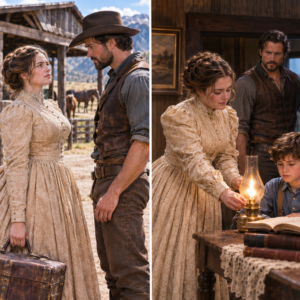
CHAPTER 1 – THE WIDOW THEY CALLED A THIEF HAD FED THE TOWN—UNTIL A QUIET RANCHER EXPOSED THE PAID DEBT
PART 1: THE ACCUSATION THAT CHANGED EVERYTHING
“THAT FAT WIDOW IS A THIEF! EVERY POUND OF MEAT SHE GAVE YOU WAS STOLEN!”
Mildred Yancy’s voice carried across the crowded porch of the Wolf Point General Store, and every head turned toward me as though I had just been caught with blood on my hands.
I stood in the muddy street, clutching my worn shawl, while the people I had fed through the worst winter in years stared at me with suspicion.
“She stole those hogs!” Mildred shouted again, pointing directly at my face, and I realized that the kindness I had offered these people meant very little now that someone had given them a reason to doubt me.
My name is Beulah Barlow, and I was thirty-six years old when Wolf Point decided I was a thief.
I was a widow with a large, rounded figure, broad hips, thick arms, full cheeks, and soft brown eyes that people often mistook for weakness.
My chestnut hair was pinned beneath a faded bonnet, and my hands were rough from years of cooking, cleaning, hauling water, and preserving whatever food I could afford.
I had endured jokes about my weight for as long as I could remember, but I had never imagined that the people who had eaten at my table would stand together and demand that I be punished.
“I paid for those hogs,” I said.
Mildred laughed.
“With what money? Everyone knows your husband left you penniless!”
Several people shifted uncomfortably, but nobody stepped forward to defend me.
Then a deep voice came from the edge of the porch.
“That’s enough, Mildred.”
I turned.
Lucas Ashby was standing beside the hitching rail, his dark coat buttoned against the cold and his expression as unreadable as ever.
He was a quiet rancher who rarely involved himself in other people’s arguments, and I had never seen him raise his voice unnecessarily.
But when he stepped forward, the laughter stopped.
I did not yet understand what he intended to do, or why he seemed so certain that Mildred had no right to accuse me.
Four months earlier, I had been standing in an entirely different place, with two freshly purchased hogs and a plan that most people in Wolf Point considered foolish.
It was the second week of October when a passing freighter stopped near the settlement with two hogs he wanted to sell before winter.
He was eager to be rid of them, and I had been looking for an opportunity to purchase meat before the roads became impassable.
I had forty dollars left after setting aside money for my household expenses, and I knew that spending part of it would leave me with almost nothing.
Still, I paid cash.
I borrowed a wagon, brought the animals into town, and spent the remainder of the morning preparing them.
By noon, I was cutting the meat into portions and rubbing each piece with coarse salt.
I had learned preservation from years of watching my mother work, and I knew that a properly salted ham could feed a household long after the roads disappeared beneath snow.
Mildred Yancy appeared outside the general store while I was working.
She was a sharp-eyed woman who seemed to believe that other people’s decisions were her personal responsibility.
“Two whole hogs? In October?” she asked.
“Yes, ma’am.”
“That’s foolishness! A woman alone shouldn’t waste money she doesn’t have!”
Several men sitting on the porch laughed.
Lucas Ashby was among them, standing beside the hitching rail with his hands tucked into his coat.
He glanced at the meat and shook his head.
“Nobody salts that much before the first real freeze.”
I continued rubbing salt into the pork.
“Salt keeps, Mr. Ashby.”
He shrugged.
“So does common sense.”
The men laughed again.
I said nothing.
I had learned that explaining myself to people who had already decided I was foolish rarely changed anything.
What they didn’t know was that my late husband, Paul, had left me with more than memories and an empty chair at the table.
Three summers earlier, he had broken his back in a wagon accident and died before he could recover.
Before that accident, he had borrowed three hundred and forty dollars against our land, cabin, and two cows.
I had spent every month since his death trying to keep what he had worked so hard to build.
Then Sylvester Dinsmore purchased the debt from the bank.
He sent word that I had until March first to pay the full amount, and if I failed, my property would be auctioned on March fourth.
Three hundred and forty dollars might not have sounded like much to a prosperous rancher, but to a widow trying to keep a small claim alive through winter, it was an impossible sum.
I had only forty dollars left after buying the hogs.
I needed work, and I needed it quickly.
Four days later, I rode out to Lucas Ashby’s ranch.
Rain had soaked my dress, mud clung to my boots, and the cold had worked its way through my shawl by the time I reached his front door.
Lucas opened it and looked at me with a guarded expression.
“I’m not asking for charity,” I said.
He waited.
“I’m asking for work.”
“What kind of work?”
“I can cook, clean, preserve meat, and feed a crew through winter.”
He studied me for a moment.
Then he asked what I expected to be paid.
“Eight dollars a month, with board.”
He nodded.
“Room’s beside the kitchen.”
I had expected him to question whether I could manage the work or make some remark about my size.
Instead, he stepped aside.
“Come in before you freeze.”
I crossed the threshold, unaware that the small room beside his kitchen would soon become the place where I found something I had almost forgotten existed.
A sense of belonging.
And I had no idea that the man who had once laughed at my salted hogs would eventually become the only person willing to stand beside me when the whole town turned against me.
CHAPTER 2 – PART 2 – THE WIDOW THEY CALLED A THIEF HAD FED THE TOWN—UNTIL A QUIET RANCHER EXPOSED THE PAID DEBT
PART 2: THE HOUSE THAT HAD FORGOTTEN HOW TO LAUGH
Lucas Ashby’s ranch was not a grand place, but it was well built and sturdy enough to withstand the winters that regularly buried the valley beneath snow.
The kitchen was large, the stove was old but dependable, and the room he gave me had a narrow bed, a small window, and a wooden chest.
It was more than I had expected.
Lucas had lived alone for years after losing his wife during their second winter in the Uinta Valley.
He rarely spoke about her, and I quickly learned not to ask questions that he had no desire to answer.
There were also two children living under his roof.
Freddy was ten years old and had grown quiet since his father left for the Nevada mines.
He spent most of his time near the barn or sitting by the window, watching the road.
Hazel was five, small enough to believe that almost every problem could be solved with a biscuit or a good story.
She was also bold enough to ask questions that grown people would never dare ask.
The first morning I entered the kitchen, I found Lucas attempting to prepare coffee while keeping an eye on a pan of eggs.
He looked as though he would rather repair a broken fence than manage breakfast.
“Good morning,” I said.
He glanced at me.
“Morning.”
“Would you like me to take over?”
He looked at the eggs.
Then at the coffee.
“Please.”
I smiled and stepped toward the stove.
By the time breakfast was ready, the kitchen smelled of hot biscuits, bacon, and fresh coffee.
Lucas ate without saying much, but he finished everything on his plate.
Freddy took a second biscuit.
Hazel asked whether there would be plum pie for supper.
I laughed.
“Not unless someone finds me some plums.”
She considered that answer carefully.
Then she looked at me.
“Are you the lady everyone calls fat?”
My hands stopped over the bread basket.
Lucas looked up immediately.
” Hazel.”
But the little girl seemed genuinely curious rather than unkind.
I took a breath.
“Yes, sweetheart, I suppose I am.”
Hazel studied my face.
“I think you’re pretty.”
Something tightened in my throat.
“That’s very kind of you.”
“Can you make plum pie?”
I laughed.
“I believe I can.”
That was all it took.
By the end of the week, Hazel had decided that I was her favorite person in the house.
Freddy was slower to trust me.
He had become accustomed to keeping his thoughts to himself, and I did not try to force him to speak.
Instead, I made sure there was always something warm waiting when he came inside.
Sometimes it was soup.
Sometimes it was biscuits.
Sometimes it was nothing more than a cup of milk and a slice of bread.
Little by little, he began sitting at the kitchen table instead of eating alone.
Lucas noticed the change.
He also noticed that the kitchen no longer looked as though nobody cared whether it was clean.
I polished the stove, washed the curtains, organized the pantry, and made sure the food was stored properly.
I was not trying to impress anyone.
I simply believed a home deserved care, even when the people living in it had forgotten how to provide that care for themselves.
Lucas continued paying me eight dollars a month.
He never complained about the food, and he never questioned the hours I worked.
Sometimes I caught him watching me while I kneaded bread or stirred a pot.
When I noticed, he usually looked away.
He was not an easy man to understand.
He trusted work more than words, and he seemed to believe that showing affection was a risk he had already taken once and could not afford to take again.
I understood that feeling better than I wanted to admit.
My own home had become painfully quiet after Paul died.
There had been no more conversations across the supper table, no more boots beside the door, and no more familiar voice asking whether I had remembered to bring in the wood.
For three years, I had been trying to keep our land alive while learning how to live without the man who had once shared it with me.
Working at Lucas’s ranch gave me something I had not expected.
A reason to wake up each morning that was not simply fear of losing everything.
By November, the weather had turned sharply colder.
The two hogs I had purchased were now properly preserved.
I salted the hams, packed bacon into crocks, and kept the smokehouse burning with applewood.
The smell of curing meat followed me everywhere.
Lucas occasionally stopped by the smokehouse to inspect the work.
One afternoon, he watched me arranging the salted portions.
“You know what you’re doing,” he said.
I looked at him.
“Thank you.”
He nodded toward the crocks.
“That’s enough meat to feed more than one household.”
I continued working.
“It will be useful when the roads close.”
He considered that.
Then he said, “You were right about the salt.”
I smiled.
It was the closest thing to an apology I had ever received from him.
Outside, the first heavy snow began falling.
The valley roads slowly disappeared beneath white drifts, and the families who had laughed at my preparations started discovering how difficult it was to find food.
I watched the snow gathering on the windows.
For the first time in months, I felt that perhaps I had made the right decision.
But I did not yet know how much those two hogs would cost me.
CHAPTER 3 – PART 3 – THE WIDOW THEY CALLED A THIEF HAD FED THE TOWN—UNTIL A QUIET RANCHER EXPOSED THE PAID DEBT
PART 3: THE MEAT THAT FED THE VALLEY
The first family to run short of food was a widow living near the eastern road.
I heard about her situation when Lucas returned from checking the cattle.
Her supplies had nearly disappeared, and the snow was too deep for her to reach town safely.
I prepared a pot of broth, wrapped it carefully, and asked Lucas to take it when he next rode past her property.
He looked at the bundle.
“That’s from your stores?”
“Yes.”
“You’ll need that yourself.”
“I have enough.”
He studied me.
Then he took the food without another argument.
A few days later, I sent bacon to a freighter’s family whose supplies had run low.
After that, I prepared a Christmas ham for neighbors who had laughed when I bought the hogs in October.
I did not do it to make them feel ashamed.
I simply knew what it meant to have children depending on food that might not arrive.
The winter was difficult enough without allowing pride to make it worse.
Lucas watched me giving away meat that I had worked so hard to preserve.
One afternoon, he found me dividing another portion.
“You’re going to empty your own stores,” he warned.
“Then we’ll stretch what’s left.”
“Beulah, you need that meat.”
I looked toward the snowy valley.
“So do their children.”
He remained quiet.
Then he looked at the portions I had prepared and carried one of them toward the door.
He never argued with me about it again.
The children began changing as the winter continued.
Freddy started talking more during supper.
He asked about the smokehouse and wanted to know why some meat needed more salt than others.
I showed him how to prepare the crocks and explained that preserving food required patience.
He listened carefully.
Hazel, meanwhile, became convinced that the kitchen was the most important place in the world.
She followed me whenever I cooked, watched me knead bread, and asked whether every meal could end with pie.
Sometimes she sat beside the stove and told me stories about things she had seen around the ranch.
I listened as though every word mattered.
Perhaps that was why she began coming to me whenever something frightened her.
Then, in December, Hazel became dangerously ill.
At first, we thought she had caught an ordinary winter chill.
But by evening, her temperature had risen, and she was too weak to leave her bed.
Lucas brought water and kept the fire burning.
I prepared what I could and sat beside Hazel, cooling her forehead with a damp cloth.
The first night passed slowly.
The second was worse.
By the third night, I had barely slept.
I stayed beside her, whispering stories and coaxing her to drink water whenever she opened her eyes.
Lucas stood in the hallway holding a lantern.
He had been coming and going quietly, doing everything he could to help without disturbing the child.
At one point, Hazel reached for my hand.
“Mama?”
My breath caught.
I leaned closer.
“I’m here, darling.”
She settled against the pillow.
Lucas stood in the doorway without moving.
I did not look at him immediately because I was afraid that the expression on my face would reveal too much.
But when I finally glanced toward him, I saw something in his eyes that I had never seen before.
He looked as though he had been reminded of something precious that he had spent years trying not to miss.
The following morning, Hazel’s condition began to improve.
She managed a little broth and eventually fell asleep without struggling.
I remained beside her until Lucas gently told me I needed rest.
For the first time since arriving at the ranch, I felt that I was not simply an employee working for eight dollars a month.
I felt that the people in that house had begun to matter to me.
And I was beginning to matter to them.
But peace did not last.
On December twentieth, a letter arrived from Sylvester Dinsmore.
I recognized the name before I even opened it.
The paper carried the familiar warning that my three-hundred-and-forty-dollar debt remained unpaid and that the full amount was due March first.
The property would be auctioned on March fourth if I failed to pay.
I read the letter twice.
Then I noticed another sentence.
Dinsmore claimed that Mildred Yancy had reported the hogs I purchased in October as stolen from her husband’s pen.
My fingers tightened around the paper.
The accusation was false.
I had paid cash to the passing freighter, and I had never taken anything from Mildred or her husband.
But I knew how easily a rumor could spread through a small town.
I folded the letter quickly and slipped it into my pocket.
Lucas had been standing near the kitchen table.
He noticed my trembling hands.
“Trouble?”
I forced a smile.
“Just a bill.”
“Beulah.”
I looked at him.
“Nothing I can’t handle.”
He studied my face, but he did not press me.
That evening, I sat alone in my small room and read the letter again.
March first.
March fourth.
Three hundred and forty dollars.
My husband’s land, our cabin, and the two cows were all tied to that debt.
I had spent three years trying to keep Paul’s home from slipping away.
Now it seemed that even the food I had worked so hard to preserve was being used against me.
And the woman who had once stood outside the store laughing at my salted hogs had suddenly found a reason to call me a criminal.
CHAPTER 4 – PART 4 – THE WIDOW THEY CALLED A THIEF HAD FED THE TOWN—UNTIL A QUIET RANCHER EXPOSED THE PAID DEBT
PART 4: WHEN KINDNESS BECAME A CRIME
The rumors began spreading the next morning.
Mildred Yancy had apparently decided that telling one person was not enough, so she repeated her accusation wherever she could find someone willing to listen.
According to her, the two hogs I had purchased from the passing freighter had actually come from her husband’s pen.
She claimed I had stolen them, dressed them, and distributed the meat to unsuspecting families.
The fact that I had paid cash meant nothing to her.
The fact that I had worked for every portion of meat meant nothing either.
By the time Lucas returned from checking the northern fence, several people in Wolf Point had already decided that I was dishonest.
I noticed the change first when I carried a basket of food toward the house of a family I had helped earlier in the winter.
The woman opened her door only halfway.
She looked at the basket, then at me.
“I don’t want it.”
I stopped.
“Is something wrong?”
She avoided my eyes.
“We don’t need anything from you.”
I looked down at the food.
“You said your little ones were running short last week.”
“They’re managing.”
She closed the door.
I stood on the porch for several seconds before turning away.
The next family returned an empty crock without saying thank you.
Another woman who had once accepted bacon from me refused to let me enter her home.
Even the men who had praised my cooking began looking away when I passed them.
It was astonishing how quickly gratitude could disappear when suspicion offered people an easier story.
I returned to Lucas’s ranch and tried to continue working as though nothing had happened.
I cleaned the kitchen.
I prepared supper.
I checked the smokehouse.
I made sure Hazel had her warm milk before bed.
But the work no longer felt like the comforting routine it had been a few weeks earlier.
Every time I looked at the salted meat, I remembered Mildred pointing at me.
Every time I heard someone outside, I wondered whether another person had come to accuse me.
I had not stolen anything.
Yet I was beginning to feel as though I had to apologize simply for existing.
That afternoon, I went to the smokehouse to check the meat.
The door closed behind me, shutting out the sound of the wind.
I stood beside the crocks and looked at the food I had spent months preparing.
I had given away broth, bacon, and ham because I knew what hunger could do to a family.
I had never expected payment.
I had never asked anyone to praise me.
But I had believed that people would at least remember that I had helped them.
Instead, they had accepted my kindness and then allowed one accusation to turn me into an enemy.
I wiped my cheeks with the back of my hand.
That was when the smokehouse door opened.
Lucas stood there.
He looked at me for a moment, then stepped inside.
“Who did this?”
I quickly turned away.
“It doesn’t matter.”
“It matters to me.”
I tried to smile.
“It’s only talk.”
“Talk doesn’t make a person cry in a smokehouse.”
I lowered my eyes.
He waited.
I had spent years learning how to keep my troubles to myself, partly because nobody had ever offered to help and partly because I did not want anyone thinking I was incapable of managing my own life.
But Lucas was not looking at me with pity.
He was looking at me as though he genuinely wanted to understand.
I reached into my pocket and removed Dinsmore’s letter.
Lucas took it.
He read the first paragraph, then the second.
When he reached the part about Mildred’s accusation, his expression hardened.
He read the letter again.
“Why didn’t you tell me?”
I folded my arms tightly.
“I didn’t want your pity.”
“That’s not what I’m offering.”
His answer was quiet, but it made me look up.
I had expected him to say that he could lend me money or that I should not worry about the rumors.
Instead, he handed the letter back and waited for me to speak.
I felt my voice begin to break.
“I’ve spent years trying to keep Paul’s land.”
I looked toward the small window.
“That cabin is all I have left of him, Lucas.”
He said nothing.
“I worked wherever I could, saved what little I earned, and tried to make sure Dinsmore couldn’t take it from me.”
I swallowed.
“And now I’m being called a thief by people who ate the food I worked so hard to preserve.”
Lucas reached for my hand.
His fingers were warm and rough.
“You’re not alone anymore.”
I wanted to believe him.
But I had lived long enough to know that kind words did not always change difficult circumstances.
“I still owe three hundred and forty dollars,” I whispered.
“March first is coming.”
Lucas looked at the letter again.
Then he asked whether Paul had kept any of the original papers connected to the debt.
I told him that I had kept a small bundle of my husband’s documents in a wooden chest at the ranch.
I had brought them with me when I came looking for work, intending to sort through them when I had enough time.
Lucas asked me to bring them to the kitchen.
I returned with the bundle.
He examined the old papers carefully, checking the dates and the amounts written on them.
Most were ordinary household records, but one folded document caught his attention.
He read it once.
Then he read it again.
His expression changed.
I asked what he had found.
He folded the paper and placed it inside his coat.
“Something I need to look into.”
“What is it?”
He shook his head.
“I want to be certain before I tell you.”
The following morning, Lucas saddled his horse.
He said he was going into Wolf Point.
I asked whether he intended to speak to Dinsmore.
He nodded.
I wanted to ask him what he had discovered, but something in his expression told me he was not ready to explain.
Before leaving, he looked at me.
“Keep the children inside if the weather turns.”
Then he rode toward town.
I watched him disappear down the snowy road.
For the first time since the accusations began, I felt that someone was willing to stand between me and the men who wanted to take everything I had.
But I still did not know what was written on the paper inside his coat.
CHAPTER 5 – PART 5 – THE WIDOW THEY CALLED A THIEF HAD FED THE TOWN—UNTIL A QUIET RANCHER EXPOSED THE PAID DEBT
PART 5: THE RANCHER WHO REFUSED TO STAY SILENT
Lucas reached Wolf Point shortly after noon.
Mildred was already outside the general store, speaking to several townspeople who had gathered near the porch.
She was repeating the accusation about the hogs, insisting that the meat I had distributed had never belonged to me.
Sylvester Dinsmore stood nearby.
He looked comfortable, almost pleased with himself, as though the trouble surrounding my name had already settled the matter in his favor.
Lucas dismounted and tied his horse to the hitching rail.
Then he approached the porch.
“You’ve been calling Beulah a thief,” he said.
Mildred lifted her chin.
“Because she is.”
Lucas looked at the people gathered around them.
“How many of you ate her food this winter?”
Nobody answered.
“How many of your children went to bed warm and fed because she spent her own money preparing meat before the roads closed?”
A man near the store lowered his head.
Another shifted his boots in the snow.
Mildred scoffed.
“That doesn’t prove anything.”
Lucas turned toward her.
“No, it doesn’t.”
His voice remained steady.
“But it tells me something about the people standing here.”
Mildred crossed her arms.
“She stole those hogs.”
Lucas did not argue about the animals immediately.
Instead, he looked toward Dinsmore.
“Before you auction that widow’s home, Mr. Dinsmore, there’s something you need to explain.”
Dinsmore’s expression changed slightly.
“What are you talking about?”
Lucas reached inside his coat.
He removed the folded paper he had taken from Paul’s documents and placed it on the store counter.
Dinsmore glanced down.
His face went white.
Lucas did not raise his voice.
He simply pointed to the writing.
“Why does this receipt show you collected payment on Paul’s debt three years ago?”
For several seconds, nobody spoke.
Mildred looked from Lucas to Dinsmore.
I was not there to see it, but Lucas later told me exactly what happened.
Dinsmore picked up the receipt.
His fingers tightened around its edges.
“Where did you get this?”
“From Paul’s papers.”
“That’s impossible.”
Lucas looked at him.
“Is it?”
Dinsmore studied the document again.
Then he tried to dismiss it.
“This proves nothing.”
Lucas pointed to the amount.
“Read it.”
Dinsmore did not.
So Lucas read it aloud.
The receipt carried Dinsmore’s name, the date, and the amount of three hundred and forty dollars.
Most importantly, it stated that the payment had been received in full satisfaction of Paul’s debt.
The same debt Dinsmore had been demanding from me.
The same debt he intended to use to take my cabin and land.
The townspeople began looking at one another.
Mildred’s expression changed.
Dinsmore quickly folded the paper.
“That payment was never properly credited.”
Lucas stepped closer.
“Then why did you sign a receipt saying it was paid in full?”
Dinsmore’s jaw tightened.
He looked toward the people standing outside the store.
“Paul Barlow owed money, and his widow still owes it.”
Lucas shook his head.
“No, she doesn’t.”
Dinsmore tried to move the conversation back to the hogs.
“This has nothing to do with where she got those animals.”
Lucas answered without hesitation.
“It has everything to do with what you’ve been trying to do.”
He pointed toward the receipt.
“You’ve been demanding money that was already paid.”
Then he looked at the townspeople.
“And while you were spreading stories about Beulah, you were allowing this man to threaten the home she has spent years trying to keep.”
Nobody laughed now.
But Dinsmore was not ready to surrender.
He insisted that the receipt had been misunderstood and that the payment had not settled the entire matter.
Lucas asked him to explain the words written in his own hand.
Dinsmore had no clear answer.
The receipt remained on the counter between them.
And for the first time, the man who had seemed so certain of my financial ruin was the one being asked to explain himself.
Don’t stop here—the ending will shock you. Continue reading Chapter 6 below.