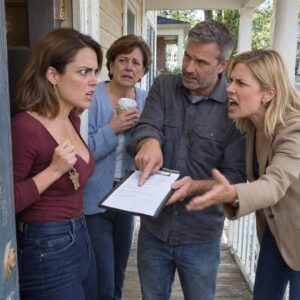
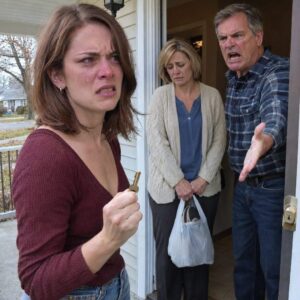
My HOA president parked a 60-ton construction crane on my driveway, cracked the concrete, and told me, “Your driveway is the closest flat surface.
Deal with it.” She thought I was just a government nobody in work boots, so I documented every fake rule and every structural shortcut next door.
When the crane came back one last time, I made one call—and her entire project stopped…
The first crack ran eighteen inches from beneath the crane’s outrigger toward my garage.
Fresh white concrete dust sat inside it like somebody had drawn a line across four years of careful maintenance.
The yellow Link-Belt crane weighed sixty tons, and three of its four stabilizers were planted on property that belonged to me.
I walked to the operator’s cab.
“This is my driveway.”
He looked genuinely confused. “The lady said it was HOA property.
She said we had access.”
“What lady?”
He described a white Porsche, expensive clothes, and a woman who looked like she was on her way to a party.
I didn’t need the rest.
Brenda Carver.
HOA president of Ridgecrest Meadows.
I found her standing next door beside the foundation of the new house her husband’s company was building.
Cream slacks, silk blouse, Chanel sunglasses balanced on her head, and Louboutin heels sinking into construction dirt she somehow managed to treat like it was beneath her.
“Brenda, there’s a sixty-ton crane on my driveway.”
She turned slowly.
“Nate, the crane needs a staging area.
Your driveway is the closest flat surface.”
“It’s my driveway.”
She smiled.
“The HOA approved temporary construction access.”
“No, it didn’t.”
She adjusted the Birkin bag on her wrist. “We’re all making sacrifices for the good of the community.”
Then came the line that told me exactly how much trouble she thought she could cause without consequences.
“I’d hate for this to become an issue.”
My name is Nate Callahan.
I’m forty-one years old, and I’m the chief building official for Williamson County, Texas.
Before that, I was a field inspector, and before that I was a structural engineer in private practice; I still hold my professional engineering license.
Markdown đã dán (1)
Most of my neighbors knew I worked for the county.
They thought that meant paperwork.
Permits.
Maybe zoning.
Brenda apparently thought it meant I was, in her words, a “government nobody who got lucky with a mortgage.”
That assumption would become expensive.
My wife Jenna and I had bought our house four years earlier because of the school district, the cul-de-sac, and—if I’m being completely truthful—the garage.
Twenty-four by twenty-eight feet.
Insulated.
Separate electrical panel.
Concrete floor.
Within a month, I had turned it into a woodworking shop.
Our seven-year-old son Owen spent weekends handing me clamps, pretending to read the tape measure, and building things that leaned slightly because I let him do more of the work than Jenna thought was wise.
The previous spring, we built a blue birdhouse together.
Owen checked it every morning because a pair of wrens moved in almost immediately.
Next door sat Lot 93.
It had been empty when we moved in.
Then Brenda’s husband, Mitchell, announced he was building a “flagship property” there through Carver Development Group.
Two stories.
Mediterranean style.
Thirty-two feet to the roof ridge.
Completely unlike every ranch-style house around it.
Brenda called it “aesthetic elevation.”
I called it somebody else’s project and minded my own business.
Until their crane started breaking my driveway.
When I confronted Brenda, she cited “Section 11.4” of an updated community-development addendum.
That night, I searched every HOA email from the previous year.
No addendum.
Then I read all sixty-three pages of our CC&Rs.
No Section 11.4 granting access to private driveways.
There was language allowing construction activity on common areas.
My driveway was not a common area.
Brenda had invented the rule.
I sent a formal email to the board with photographs and asked that no more equipment be placed on my property.
Brenda replied that the board possessed “general authority” to facilitate community projects.
She gave no section number.
No resolution.
No easement.
The crane came back Monday.
This time an outrigger crushed my irrigation riser.
Water sprayed across the driveway while another crack opened through the slab.
I called Mitchell.
“Your crane is destroying my property.”
“I understand, Nate.
It’s temporary.”
“You don’t have an easement.”
“Brenda handles the community side.”
That answer surprised me more than the crane.
A general contractor was telling a structural engineer to discuss construction access with his wife.
At the next HOA meeting, forty-one homeowners showed up.
I brought photographs and a $4,200 repair estimate.
I asked for one thing.
A board vote prohibiting construction equipment from being staged on private property without written consent.
Brenda refused to put it to a vote.
“The board sets the agenda, Nate.”
Her voice stayed sweet.
That was her specialty.
Make contempt sound like customer service.
After the meeting, my neighbor Cal Rodriguez stopped me in the parking lot.
Cal was seventy-one, a retired county records clerk, and one of those men who never misplaced a receipt because he considered paper a form of memory.
He handed me a folded printout.
“She’s using HOA money for Mitchell’s house.”
I stared at him.
Cal had traced $47,000 from a new “community enhancement reserve” directly into Carver Development Group as site-preparation fees.
The lot itself belonged to Mitchell’s company.
HOA dues were subsidizing the HOA president’s husband’s private speculative construction project.
I stood there watching Brenda through the community-center window, laughing beside the refreshment table.
That night, I began reading more carefully.
Not the HOA rules.
The project.
The crane returned twice in April.
My driveway repair estimate climbed to $6,800.
Then one afternoon, I came home and saw the crane boom extended over my property line.
A 4,200-pound steel beam was hanging forty feet above my garage.
Above my workshop.
Above Owen’s half-finished lizard terrarium.
I walked to the operator.
“Do you have a lift plan?”
Blank look.
“Load weight?
Boom angle?
Swing radius?
Ground-bearing calculations?
Signal person?”
Another blank look.
“The lady said we had clearance.”
“The lady is not an engineer.”
I pointed at the suspended beam.
“Put it down.”
He did.
That evening, I stood in my garage doorway looking at Lot 93.
And for the first time, I really looked.
The first-floor headers were undersized.
The central steel connection had no proper gusset plates.
Roof trusses were spaced wider than code permitted.
Hurricane ties were missing.
Foundation reinforcing appeared too widely spaced.
I took binoculars onto my own side porch.
Never crossed the property line.
Never touched their work.
For three evenings, I documented what I could see.
Fourteen structural deficiencies.
Then I checked the permit board.
Permit WC-2024-04291.
Approved project:
One-story residence.
2,400 square feet.
The building in front of me had two stories.
Then I noticed the expiration date.
January 14.
Three months earlier.
I stared at that permit for a long time.
Brenda had spent four years measuring people’s grass, garden flags, pergolas, basketball hoops, and paint sheen.
Meanwhile, her husband was building an unapproved two-story structure on an expired one-story permit.
That was when something finally clicked.
I had been thinking like a homeowner.
I needed to think like the chief building official.
This project fell under my department’s jurisdiction.
But I also lived next door.
That meant I could not personally inspect it.
Unlike Brenda, I understood what conflict of interest meant.
So I wrote a formal complaint as a licensed professional engineer.
Six pages.
Thirty-seven photographs.
Expired permit.
Unapproved second story.
Fourteen structural deficiencies.
Crane-safety concerns.
I stamped every page.
Then I called my deputy, Robert Tran.
Not yet.
I waited.
Jenna found me on the porch one evening staring at the construction.
“You’re doing the thing.”
“What thing?”
“The thing where you calculate every way a building can fail.”
“Fourteen ways from here.”
“When are you calling?”
“When the crane comes back.”
She looked at me.
“You want everything happening at once.”
“I want one inspection to see the whole problem.”
A Tuesday morning in May, the diesel rumble came down the street.
Same yellow crane.
Same operator.
It rolled onto my driveway as casually as if it had an appointment.
The outrigger lowered onto an existing crack.
Concrete split loudly enough that I heard it from inside the house.
When I walked out, the center of my driveway had collapsed into the base beneath it.
Then I saw Owen’s birdhouse.
A construction vehicle had hit the cedar post.
The little blue house leaned forty-five degrees, entrance pointing toward the sky.
Something inside me went very calm.
I went inside.
Opened my briefcase.
The complaint was waiting.
I called Robert Tran directly.
“Robert, it’s Nate.
I’m filing a formal PE complaint on Lot 93, Ridgecrest Meadows.
Permit WC-2024-04291.
Expired.
Major deviation from approved plans.
Fourteen documented structural deficiencies.”
I looked through the kitchen window at the crane sitting on my destroyed driveway.
“And there’s a crane on my property right now with multiple safety violations.
I’m recusing myself.
This is your inspection.”
Robert was silent for two seconds.
“I’ll be there in two hours.”
He called OSHA on the way.
At p.m., a white county pickup entered our cul-de-sac.
Robert stepped out holding the approved plans.
An OSHA compliance officer arrived behind him.
Robert spread the plans across his hood.
Then he looked at the two-story frame rising beside my house.
“The permit says one story.”
“Yes.”
He folded the plans.
Then walked onto the site.
Forty minutes later, OSHA shut down the crane.
The operator could not produce the required certification or lift documentation.
The crane was ordered held in place until the violations could be resolved.
Which meant the crane Brenda had repeatedly parked on my property without permission was now legally stuck there.
Then Robert finished his inspection.
Seventeen structural violations.
Three more than I had identified.
Expired permit.
Unapproved plans.
No engineer of record.
Improper setbacks.
Structural connections that could not remain.
Brenda arrived in her Porsche halfway through the inspection.
“What’s going on here?
This is a board-approved community development project.”
Robert barely looked up.
“The building department doesn’t answer to HOA boards, ma’am.”
He kept walking.
That was the moment her face changed.
For four years, Brenda had been the authority in every room she entered.
Now she was standing beside people whose authority came from actual law.
At p.m., Robert attached a red STOP WORK notice to the construction sign.
Every saw went quiet.
Every hammer stopped.
The crew began packing.
I stood on the broken pieces of my driveway while Brenda called people who could no longer fix this for her.
The project she had spent months calling an “investment in community excellence” was officially shut down.
And the county had not even started calculating what it was going to cost her family.
Part 2…..
IF FACEBOOK BROUGHT YOU HERE, HERE’S THE CONTINUATION YOU’VE BEEN WAITING FOR.
ENJOY! 👇
Mitchell arrived before the inspectors left.
He sat inside his gray pickup for almost a full minute, watching Robert move through the half-built house with a tape measure and clipboard.
Eventually he got out.
Hands in his pockets.
Eyes down.
The same posture he always used when Brenda was in charge.
Only Brenda wasn’t in charge anymore.
Robert’s final report documented seventeen structural violations, the expired permit, construction that did not match the approved plans, the absence of an engineer of record, and a foundation that crossed the required side setback by more than two feet.
The county assessed Mitchell’s company roughly $31,000 in fines.
His contractor license was suspended pending review.
The Dallas couple who had already signed a purchase contract on the house learned what had happened.
They had put down $80,000 in earnest money.
Their attorney demanded every dollar back.
They got it.
OSHA’s penalties were separate.
The crane company received more than $47,000 in fines connected to the violations and then filed its own claim against Carver Development Group, arguing that Mitchell and Brenda had falsely represented site access.
Then came the part Mitchell probably feared most.
The structure could not simply be repaired.
The violations were too extensive.
The county ordered demolition.
The entire thing had to come down.
New plans.
Professional engineer’s stamp.
New permit.
Start over.
The demolition estimate alone was about $62,000.
By the time you combined county fines, demolition, the lost sale, safety penalties, legal costs, and related expenses, the financial damage exceeded $340,000.
I did not celebrate.
I did watch.
The demolition crew came in June.
Four months of hurried construction disappeared in four days.
Roof trusses first.
Then framing.
Then steel.
Then foundation.
When the machines left, Lot 93 looked almost exactly as it had when Jenna and I first moved into Ridgecrest Meadows.
Flat dirt.
Packed caliche.
Orange survey stakes.
Owen stood at the kitchen window.
“The birthday cake is back.”
That was what he used to call the lot because the survey stakes looked like candles.
I put my hand on his shoulder.
For him, that was the whole story.
The loud house was gone.
His bicycle slalom course was back.
The crane finally left my driveway three days after the stop-work order, once the federal paperwork cleared.
What remained underneath it was worse than the earlier estimates.
The center section had broken apart completely.
Edges shifted.
Hydraulic fluid had contaminated portions of the base.
Full replacement came to $7,400.
Mitchell’s insurance paid.
No argument.
Apparently my photographs, measurements, and documentation made the adjuster’s job unusually simple.
I repoured the driveway myself that July.
New compacted base.
Reinforcement tighter than minimum code because I know myself well enough to admit I sleep better that way.
One continuous concrete pour.
Owen helped me screed the surface.
He was seven and contributed almost no measurable force.
But every time I pulled the board across wet concrete, he said:
“Smooth, Daddy.”
The next morning, Jenna took a picture of us standing on the new slab.
Owen had stepped too close to one edge before everything cured.
Two tiny boot prints remained.
I left them.
There are flaws you repair.
There are flaws you preserve because they remind you who was beside you while you rebuilt.
But my driveway was only the first thing that got rebuilt.
Two days after the stop-work order, Cal Rodriguez delivered an eight-page report to every mailbox in Ridgecrest Meadows.
His spreadsheet had grown.
The $47,000 “community enhancement reserve” money paid to Mitchell’s company was real.
Then Cal found another $11,000 in “consulting fees” paid to BHC Solutions.
The owner of BHC Solutions was Brenda Holt Carver.
Brenda had been paying herself with HOA funds while helping subsidize her husband’s private construction project.
Total identified misuse:
$58,000.
That changed the neighborhood.
People who had stayed quiet for years stopped being quiet.
Homeowners began bringing out old fine notices.
Emails.
Meeting minutes.
Board resolutions.
Records Brenda probably assumed nobody would ever read carefully.
An emergency homeowner meeting drew ninety-four people.
Brenda did not attend.
Her house stayed dark.
Cal ran the meeting.
The vote to remove Brenda as HOA president passed eighty-nine to five.
Even one of those five voters later admitted he had misunderstood the ballot.
A new board was elected within a month.
Paul Kessler became president.
Cal became treasurer.
Linda Cho took the secretary position.
Cal’s first act was almost comically simple.
He opened the financial records to every homeowner.
No curated Instagram story.
No designer dress.
No lecture about community standards.
Just numbers people could actually see.
The new board sued Brenda and Mitchell for breach of fiduciary duty, conversion of funds, and fraud.
Six months later, the case settled for the full disputed amount plus legal fees.
Brenda and Mitchell sold their house in August.
I later heard they moved to Pflugerville.
Apparently their new neighborhood did not have an HOA.
I also heard Brenda deleted her Instagram account.
I cannot verify which consequence hurt her most.
But for a woman whose entire public identity had been built around performing authority, losing the stage probably mattered.
The new board then reviewed every fine issued during Brenda’s presidency.
Seventy-one had relied on provisions that had never been properly ratified.
That meant a lot of families had paid money because Brenda behaved as though saying something with confidence made it enforceable.
The pergola owners got their $300 back.
Paul received reimbursement for his curb issue.
Rosa Gutierrez’s mother got back $600 she had paid over a birdbath violation.
Fourteen other families received refunds too.
People who had paid because fighting seemed harder than surrendering finally got something returned.
My check was $263.
I used it to buy lumber.
Not for anything dramatic.
A bookshelf for Owen.
He had decided he needed room for forty-two lizard field guides, which was an ambitious number for a boy who currently owned eleven.
The blue birdhouse had survived the construction truck, though the post had not.
The wrens had moved on for winter.
We put the birdhouse on the top shelf of Owen’s new bookcase with its entrance facing the window.
“They’ll find it in spring,” Owen said.
“They will.”
“Because we built it good?”
“Because we built it right.”
Months later, I was in the garage working on floating shelves when Owen came in hiding something behind his back.
His front teeth were still missing.
His smile gave him away.
“What have you got?”
He held out a small cedar board he had sanded himself.
Across it, in crooked burned letters, he had written:
CALLAHAN WORKSHOP
EST. 2020
“For the door,” he said. “So people know who built this.”
I mounted it that afternoon.
Level.
Centered.
Exactly where it belonged.
Outside, my driveway was smooth again.
Except for two tiny boot prints near the edge.
Lot 93 sat empty.
Orange stakes in the dirt.
No crane.
No framing.
No two-story monument to somebody else’s shortcuts.
Sometimes people asked whether I had planned the whole thing from the moment Brenda first put the crane on my driveway.
No.
I documented the damage because that is what I do.
I read the HOA rules because she claimed they gave her authority.
I checked the construction because a steel beam was hanging over my garage.
I checked the permit because the structure looked wrong.
Each discovery changed the meaning of the one before it.
First, I thought Brenda was entitled.
Then I learned she was inventing rules.
Then Cal showed me HOA money was flowing into Mitchell’s project.
Then I saw structural problems.
Then I learned the permit had expired.
By the time I made that call, it wasn’t about revenge.
It was about a building somebody’s family might eventually sleep inside.
That distinction still matters to me.
Brenda cared obsessively about things people could see.
Grass height.
Paint gloss.
Garden flags.
Pergolas.
Basketball hoops.
Appearance was her language.
But buildings don’t stand because they look expensive.
They stand because somebody respected what is hidden behind the walls.
Connections.
Fasteners.
Load paths.
Engineering.
Rules that exist whether anybody photographs them for Instagram or not.
Authority works the same way.
Brenda spent years looking powerful because most people never checked what supported the appearance.
Once they did, it collapsed faster than Mitchell’s house.
That was the lesson I kept.
Not that I “beat” the HOA.
Not that I happened to be chief building official.
Not that Brenda underestimated a man in work boots.
The lesson was simpler.
Real standards survive inspection.
Fake ones don’t.
The Callahan Workshop sign is still above my garage handle.
Owen is older now, but I still see the seven-year-old version of him every time I notice those crooked letters.
The driveway is still smooth.
The tiny boot prints are still there.
And Lot 93 is still a reminder of something I learned long before Brenda Carver parked a crane on my property.
Some things you build once and they last.
A good driveway.
A birdhouse.
A sign made by your son.
And the habit of checking whether the person giving orders actually has the authority they claim.
Because designer authority works beautifully right up until somebody checks the building code.
THE END.
I’ve shared the complete story, and I truly hope it touched your heart.
If this story moved you, please , like, and share the post.
Thank you for reading! ❤️