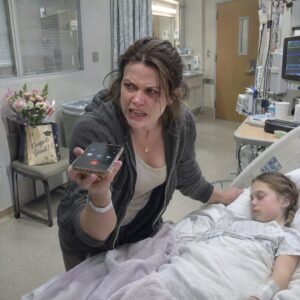
For months, my HOA president secretly charged her white Tesla from my private off-grid solar array after I had repeatedly refused her requests to share my power.
I’m a retired Los Alamos electrical engineer, so when my daughter traced a buried cable from my service panel to her garage, I stopped arguing.
At one November night, her Tesla learned exactly whose electricity it had been stealing…
At one evening, my battery bank was losing power to something that did not exist.
That is the kind of sentence only an electrical engineer could find personally offensive.
My name is Otto Cunningham.
I retired from Los Alamos National Laboratory after thirty-one years, much of that time spent working on renewable-energy integration and inverter design.
I had been retired six years when this happened, living with my wife, Sigrid, on eighteen acres outside Placitas, New Mexico, property my grandfather bought in 1923.
Markdown đã dán (1)
Retirement was supposed to mean coffee on the back porch, fewer meetings, and finally building the solar system I had been designing in my head since the 1990s.
I built it myself.
Forty-two ground-mounted panels fed a hybrid inverter and four battery units.
The system was completely isolated from the public utility, with enough surplus capacity that someday, if I bought an electric vehicle, I could charge it without changing anything.
I also built my own monitoring system.
Every fifteen seconds, it recorded generation, battery state, circuit draw, voltage, phase, and other operating information.
It was excessive for a retired couple whose largest evening electrical decision usually involved whether Sigrid wanted the dishwasher running before bed.
I liked excessive.
Engineers call it data.
Wives sometimes call it a hobby.
Sigrid called it both.
Our southern property line bordered Sandia Vista Estates, a newer development of forty-eight expensive homes built in 2014.
For years, we had no trouble with anybody there.
Then Tamson Lockhart Bramble became HOA president.
Tamson was forty-five, polished, blonde, and carried herself like every room had been waiting for her to arrive and organize it.
Her husband, Kendrick, worked in commercial real estate.
They bought one of the largest homes in Sandia Vista, directly overlooking my solar field, and Tamson made “sustainability” part of her HOA presidency.
In February 2021, she wrote me requesting that I share my “excess solar capacity” for a community benefit arrangement.
I declined.
Politely.
I explained that my system was private, off-grid, and designed for my household.
I even cited the regulatory complications that would make what she proposed impractical.
She wrote again.
I declined again.
Then again.
Same answer.
Sigrid kept the certified-mail receipts because Sigrid keeps everything that might someday become either important or funny.
By 2022, Tamson had bought a white Tesla Model S Plaid and wrote about it in the HOA newsletter as part of her “sustainable transportation commitment.”
I remember reading that sentence over breakfast.
Sigrid looked across the table.
“Don’t.”
“I didn’t say anything.”
“You were about to.”
“I was thinking.”
“That is usually when the trouble starts.”
A year passed.
Then, in the fall of 2023, my monitoring system began flagging unusual nighttime loads.
Most evenings around nine, battery discharge suddenly increased.
At first, I blamed an attic ventilation fan Sigrid had recently installed.
The numbers did not agree.
The fan accounted for only a fraction of the load.
The rest looked remarkably familiar.
Roughly the pattern of a Level 2 electric-vehicle charger.
I stared at the screen one Saturday morning.
“Sigrid.”
She came into my office holding coffee.
“What?”
“Somebody is charging a car with my electricity.”
She looked at the solar field through the window.
“Whose car?”
“I intend to find out.”
I walked every visible conduit and checked every breaker.
Nothing.
The current was leaving my system, but the connection wasn’t where I could see it.
That was when I called our daughter, Edith.
Edith is an electrical engineer too, although she works at Sandia National Laboratories instead of Los Alamos, which she has always considered an important distinction.
I gave her the numbers.
She listened without interrupting.
Then she said, “Dad, you have an unauthorized tap.”
She suggested independent current logging on each output circuit, followed by a nighttime thermal survey along the property line.
A few weeks later, Edith and her partner came up from Albuquerque with infrared equipment.
Just before eleven that night, we found it.
A warm buried line.
It ran approximately 320 feet from the southwest side of my service architecture, beneath the ground, across my property boundary, and straight toward Lot 12.
Tamson’s house.
We traced it carefully.
The cable terminated on her side near the garage.
Someone had buried a private electrical connection from my solar system to her property.
The installation was competent enough to show that whoever had done it knew residential electrical work, but there was no permission, no interconnection agreement, and no authorization from me.
Markdown đã dán (1)
I stood in the cold holding the infrared unit.
Edith looked at me.
“You know what she’s charging.”
“Yes.”
“The Tesla.”
“Yes.”
Sigrid folded her arms.
“After you told her no.”
“Repeatedly.”
That was the part that bothered me most.
Tamson hadn’t misunderstood.
She had asked.
I had answered.
Then somebody connected her garage to my system anyway.
The investigation eventually identified Kendrick’s brother Wallace, an unlicensed electrician, as the person who had installed the cable for cash.
I did not go to Tamson’s door.
I did not cut the line that night.
And despite what some people later assumed, I did not start changing voltages out of anger.
I called the proper people first.
Marin Halverson at the New Mexico Public Service Commission opened an investigation and referred the matter to the county sheriff.
She explained that my private off-grid system had no obligation to provide electrical service to an unauthorized user and documented that position in writing.
That paperwork mattered to me.
So did Sigrid’s opinion.
I could design almost anything electrical.
Sigrid was the person who made me ask whether I should.
One evening, I explained what I was considering.
My inverter could run a documented engineering voltage-modulation test while leaving our protected household circuits isolated.
Sigrid listened for forty minutes.
Then she asked me three questions.
Would our house be safe?
“Yes.”
Would the test be documented?
“Every fifteen seconds.”
Did the regulator know beforehand?
“I won’t do it until she confirms in writing.”
Sigrid nodded.
“Then do it carefully.”
Edith independently modeled what the test would mean for an electric vehicle connected illegally to that circuit.
Marin supplied the written regulatory acknowledgement.
Nobody was guessing.
On November 22, I sat at my desk at p.m.
Sigrid sat across from me knitting.
Neither of us spoke much.
At nine, the familiar unauthorized charging load appeared.
Tamson’s Tesla had plugged into my batteries again.
The same way it had on so many evenings before.
My test routine began.
The inverter output changed according to the programmed sequence.
At , it reached 380 volts on the unauthorized output.
I watched the numbers.
Not the house.
Not Tamson’s garage.
The numbers.
Current.
Voltage.
Time.
My household circuits remained isolated and normal.
The unauthorized circuit remained connected.
Four minutes later, the test ended and the inverter returned to standard output.
At , Tamson’s Tesla sent her a notification.
Vehicle charging system error.
Immediate service required.
I leaned back.
Sigrid put down her knitting.
“Is it over?”
“The test is.”
Outside, across the dark property line, a garage door suddenly opened.
A white Tesla sat beneath bright lights.
Tamson came running toward it in slippers.
I could see her phone glowing in her hand.
For months, she had treated my solar array as though it were part of her HOA amenities.
That night, for the first time, the electricity she had taken without permission became her problem instead of mine.
Part 2…..
IF FACEBOOK BROUGHT YOU HERE, HERE’S THE CONTINUATION YOU’VE BEEN WAITING FOR.
ENJOY! 👇
At , Tamson unplugged the car and tried reconnecting it.
Nothing.
The vehicle would no longer accept a charge.
She called Kendrick, who was in Albuquerque.
Kendrick called Tesla roadside assistance, and a service technician arrived the following morning.
The technician didn’t know anything about me.
He didn’t need to.
The Tesla had recorded its own electrical history.
Its diagnostic system showed the abnormal input event and damage to the onboard charger.
Tesla reviewed the information and denied warranty coverage because the vehicle had been connected to an electrical source operating far outside its specified input range.
The replacement charger assembly, labor, and recalibration came to roughly $16,400.
Tamson’s automobile insurer declined to cover it too.
That should have been the moment somebody in her house asked a very simple question.
Why was our Tesla connected to Otto Cunningham’s private solar system in the first place?
Instead, Tamson sued me.
December 11.
Sandoval County District Court.
Malicious electrical sabotage.
She wanted her repair costs plus damages.
When the complaint arrived, Sigrid laid it beside my breakfast plate.
“She sued you.”
“Yes.”
“She stole the electricity.”
“Yes.”
“She buried a cable across our property.”
“Yes.”
“And now you’re being sued because the stolen electricity wasn’t sufficiently convenient?”
I looked at her.
“That is a surprisingly accurate summary.”
Sigrid took her coffee and went back to the porch.
Edith and I began assembling the response.
By the following week, we had eighty-seven pages.
Months of inverter logs.
Circuit data.
Thermal images.
The unauthorized buried connection.
The regulator’s written acknowledgement.
The sheriff’s preliminary investigation.
My engineering records.
Edith prepared a separate technical brief as an independent engineer.
I had spent thirty-one years documenting experiments before touching equipment.
Tamson had apparently spent much less time thinking about what evidence an engineer keeps.
At the January pretrial conference, the judge asked Tamson’s attorney whether his client had any legal authorization to take electricity from my private system.
He conceded that she did not.
The lawsuit was dismissed.
Then the judge referred the complete file to the county prosecutor.
That was where the story stopped being about an expensive Tesla repair.
Investigators followed the cable installation, the power usage, and the people involved.
Felony electricity-theft charges were eventually filed against Tamson, Kendrick, and Wallace.
The investigation also uncovered something I had known nothing about.
While serving as HOA president, Tamson had been billing Sandia Vista $2,200 every month for “community sustainability consulting” through her own LLC.
Twenty-six months.
The sustainability president who had been stealing private solar power had also been paying herself from HOA funds.
I remember telling Sigrid.
She closed her eyes.
“Oh, Otto.”
Not triumph.
Disappointment.
That was Sigrid.
She had wanted accountability, not destruction.
Tamson eventually entered a no-contest plea.
According to the source, she received twenty months in state custody, three years of probation, restitution for the electricity attributed to the theft, legal-defense costs, and $58,000 connected to the HOA financial case.
She was also permanently barred from serving on a New Mexico community board.
Markdown đã dán (1)
Kendrick resolved his own case separately.
His jail sentence was suspended on successful completion of probation, and he was ordered to pay restitution.
He filed for divorce later that summer.
Wallace, who had installed the unauthorized line, entered a separate plea and received his own custodial sentence in Texas.
His pending electrician-licensing application was denied.
The Tesla was eventually sold at salvage auction.
I never celebrated that.
People expected me to.
They would ask whether I smiled when I heard what happened to the car.
No.
The car hadn’t stolen anything.
A machine does what people connect it to do.
That was true of my inverter too.
The more meaningful change happened inside Sandia Vista.
Wendell Buchard, the retired engineer who had been HOA president before Tamson, came to our house with his wife, Renata.
Renata was recovering from her second stroke and used an assistive tablet to communicate.
Wendell apologized for stepping away and not challenging Tamson earlier.
“You had a wife who needed you,” I told him.
“That wasn’t wrong.”
“It left space for her.”
“Those are different things.”
Sigrid reached across the porch and took Renata’s hand.
We sat there for a long time.
Eventually Wendell told us he wanted to help rebuild the board.
Would we publicly support him?
“Yes.”
The new board election happened in June.
Wendell deliberately accepted the vice presidency instead of trying to reclaim the top job.
A retired University of New Mexico chemistry professor named Edmund became president.
That decision told me more about Wendell than any speech could have.
He wanted the HOA fixed.
He didn’t need it to belong to him.
Edmund came to our house with a casserole and a handwritten apology from the new board.
He told Sigrid and me that eleven bylaws Tamson had used to serve her own interests had been repealed.
Then he said something I appreciated more than the casserole.
“We intend to be boring neighbors.”
“Excellent,” I said.
We became friends.
The unauthorized cable was removed completely from my service panel.
My solar system returned to doing what it had been built to do.
Household.
Battery bank.
No mystery nighttime load.
Steady 240 volts.
But something unexpected happened after the case became public.
The Albuquerque Journal wrote about it.
Then an engineering publication picked up the story.
Soon other off-grid homeowners were contacting me because they wanted systems that could detect unauthorized use before months of electricity disappeared.
I had retired from engineering.
Apparently engineering had not retired from me.
I accepted a limited number of consulting jobs.
Sigrid imposed one rule.
“Fifteen hours a week.”
“I’m retired.”
“That is why I said fifteen.”
She was right.
The consulting income eventually gave us enough room to create something better than another lawsuit.
We established the Cunningham Solar Education Foundation.
Its purpose was simple.
Small grants for rural New Mexico high schools to teach off-grid solar engineering, electrical systems, and technical vocational skills.
The first ten schools received grants that October.
Then thirteen more.
Eventually we had awarded twenty-three grants totaling $146,000.
When three students from one of those programs enrolled in electrical engineering at New Mexico State University, the newspaper wrote about them.
Markdown đã dán (1)
Sigrid cried when she read the article.
So did I.
That mattered more than Tamson’s sentence.
More than the Tesla.
More than being proven right.
Edith and some colleagues also began writing a technical paper about the case.
She asked me to be a co-author.
I accepted.
We signed it the same way we had signed little father-daughter engineering projects since she was twelve.
O.
Cunningham and E.
Cunningham.
Cunningham Engineering Associates.
There was never really such a firm.
It was just us.
That made it better.
Sigrid found her own response to everything.
She returned to printmaking.
For decades, she had worked as a graphic designer at the New Mexico Museum of Art.
Now she began producing large intaglio prints based on the geometry of solar arrays across the Southwest.
She called the exhibition The Geometry of Sunlight.
I offered technical advice.
She declined.
Politely.
“I do not need an electrical engineer explaining my art.”
After more than forty years of marriage, you learn when a sentence requires no rebuttal.
The exhibition opened in Santa Fe.
Family came.
Friends came.
Marin came.
Wendell came with Renata.
Several prints sold.
The rest returned to Sigrid’s studio, where she immediately began planning another show.
The engineering case also reached farther than I expected.
A federal policy analyst asked me to testify at a regulatory hearing on distributed-energy theft protection.
I flew to Washington.
Ninety minutes of testimony.
Fourteen pages of transcript.
Not bad for a retired man who had originally built a solar array because he wanted to charge a future car without paying a power company.
Marin was later promoted within the Consumer Protection Division.
She sent me a handwritten note.
She thanked me for trusting the regulatory process and wrote that the next homeowner confronting a similar theft would have a clearer path.
I framed it.
That hallway near the inverter cabinet eventually became a strange little museum.
Marin’s note.
A newspaper clipping.
One of Sigrid’s prints.
A framed hearing title page.
And later, a dark blue wool scarf.
That scarf came from Astrid Vandermir, the eighty-two-year-old mother of Edith’s partner.
Astrid’s late husband had been an electrical engineer.
She knitted a small white solar-array pattern along the edge.
When she handed it to me over Thanksgiving dinner, she said her husband would have respected the work.
I cried for almost a minute.
I still don’t wear the scarf outside.
Some things feel too important to risk losing.
Our border collie, Alena, is fourteen now.
She sits on the back porch at sunset and watches the solar panels as though she personally supervises them.
She also steals food beneath the dining-room table.
Edith calls that Alena’s solar tariff.
Unlike Tamson, Alena has never pretended she had authorization.
These days I work about fifteen consulting hours a week.
No overnight travel.
Sigrid monitors that rule with more precision than I monitor battery discharge.
She also made me switch to decaf after three in the afternoon.
That rule is marked on the family calendar too.
Sigrid has kept that calendar since the 1980s.
Birthdays.
Doctor appointments.
Christmas dinners.
School events.
Retirement dates.
On the 2024 page, mixed among ordinary family notes, she wrote three tiny entries in pencil.
January 18 — FERC testimony, Washington.
November 22 — voltage modulation.
May 5 — Tamson to Grants.
No red ink.
No dramatic circles.
Just Sigrid’s careful handwriting.
That made me smile.
The whole affair had once seemed enormous.
Police.
Court.
HOA turmoil.
A ruined charger.
Engineering reports.
Newspapers.
Yet eventually it became another set of dates sitting between birthdays and Thanksgiving.
Life absorbing the unusual until it becomes family history.
In the evenings now, I sit with coffee while the Sandia Mountains turn orange.
Forty-two panels feed the inverter.
The inverter feeds the batteries.
The batteries feed the house.
The illegal cable is gone.
The system holds steady at the voltage it was designed to provide.
Sometimes I think about Tamson’s first letter.
She wanted my private power to become a “community benefit.”
In a strange way, that eventually happened.
Just not through her Tesla.
It became school grants.
Training equipment.
Engineering students.
Research.
Better protection for people building off-grid systems of their own.
That is the part I choose to keep.
Not the four minutes when a charger failed.
The years afterward when something useful grew out of the mess.
I spent most of my career believing engineering was about controlling electrons.
Retirement taught me something slightly different.
Engineering is also about boundaries.
Knowing what belongs on one side of a circuit and what does not.
Knowing when a connection is authorized.
Knowing when somebody has crossed a line because they assumed your silence meant permission.
Tamson asked for my electricity.
I said no.
That should have ended it.
When it didn’t, the data told the truth.
It always had.
Every fifteen seconds.
Quietly.
Patiently.
Waiting for somebody to look.
Sigrid still sketches in the evenings.
I still bring her coffee.
Alena still sleeps beneath the table waiting to collect whatever food tax she can manage.
Edith still corrects my engineering assumptions whenever she believes Sandia knows better than Los Alamos.
And the solar array keeps working.
Some systems need constant adjustment.
Some families do too.
But after more than forty years beside the same careful woman, I have learned that a few things do not need improving.
They only need protecting.
THE END.
I’ve shared the complete story, and I truly hope it touched your heart.
If this story moved you, please , like, and share the post.
Thank you for reading! ❤️