PART 1The fluorescent light over window four at the county DMV had a low, buzzing hum that gave me a headache.
I was sitting on one of those hard molded plastic chairs, clutching ticket B-44 and waiting to renew my driver’s license.
It was a rainy Tuesday morning, and the line had barely moved in forty minutes.Right in front of the counter stood an elderly woman wearing a faded lavender cardigan and holding a small brown purse with both hands.
Her white hair was pinned back neatly with two bobby pins.
Her name was Evelyn Morris.
I learned that because the clerk behind the glass kept shouting it across the room.The clerk shoved the black vision machine forward.
Evelyn leaned in, squinted, and took a slow breath.
Her fingers tightened around the strap of her purse.”Read line four,” the clerk said.
She didn’t look up from her monitor.Evelyn was quiet for a long second. “B…
R…
T… no, maybe that’s an E.””Incorrect,” the clerk said flatly. “Try line three.””F…
P…
O…” Evelyn’s voice shook. “I’m sorry, dear.
The glare on the glass is terrible today.””You missed four out of five on line three, ma’am,” the clerk said, pulling the machine back.
She picked up a red pen and stamped a form with a sharp thud. “I’m sorry.
You can’t drive anymore.”Evelyn didn’t argue.
Her shoulders dropped, and her whole face crumpled in on itself.
She looked down at the linoleum counter like she had just been told someone died.”Please,” she whispered. “My husband’s grave is at Oakridge Cemetery out on the county line.
That’s fourteen miles away.
How will I get to my husband’s grave?
I visit Arthur every Sunday.
I haven’t missed a Sunday in three years.”The clerk shrugged, clicking her ballpoint pen twice. “Take the bus.
Or call a cab.
Next number.
B-forty-five.””There is no bus to Oakridge,” Evelyn said.
Her voice broke completely. “The county transit line stops five miles before the township border.”The clerk didn’t answer.
She slid Evelyn’s paperwork toward the edge of the desk and looked past her. “B-forty-five!”Evelyn backed away from the window.
She stepped toward the wall near the row of chairs and began to cry.
It was quiet, terrible crying.
Not loud sobbing, just tears running down her cheeks while her chest hitched without making a single sound.
She was eighty years old, holding an expired plastic card in her hand, realizing she was trapped.I was fifty-eight, living alone in a small two-bedroom bungalow after my divorce two years earlier, working thirty hours a week doing medical billing from home.
My Sunday mornings were usually spent sitting on my back porch drinking black coffee, listening to the neighbor’s lawnmower, wondering where the years went.I stood up.
I left my ticket on the plastic chair and walked over to her.”Excuse me,” I said gently.Evelyn tried to wipe her cheeks with the back of her sleeve. “I’m sorry, dear.
I’m causing a scene.””No, you aren’t,” I said.
Then I turned toward the window.
The clerk was watching us with her arms crossed.
I looked at Evelyn and said, “I’ll drive you.
Every Sunday.
For free.”The clerk rolled her eyes and shook her head, muttering something about people being crazy. Evelyn looked up at me.
Her pale blue eyes were wide, and she looked at me like I had just offered her the entire world. “You don’t even know me, miss.””My name is Sarah,” I told her.
“I have a dependable Honda Civic.
And my Sundays are wide open.”She reached into her purse with trembling fingers, pulled out a small floral notepad and a stubby pencil, and wrote down her address on Elm Street.
We exchanged phone numbers right there beside the water cooler. When I went back to window four to finish my own renewal, the clerk handed me my receipt and said under her breath, “You’re going to regret that.
Old folks will run you ragged.”I didn’t answer her.
That following Sunday at eight in the morning, I pulled into the gravel driveway of a small, immaculate white cottage on Elm Street.
Evelyn was already sitting on the front porch with a small basket of yellow chrysanthemums on her lap.PART 2That first drive was quiet for the first five miles.
The highway out toward Oakridge was bordered by old hayfields and bare telephone poles.
Evelyn kept her hands folded over her basket, watching the yellow road lines slip by.”Arthur loved this drive in the spring,” she said as we crossed the township bridge. “He worked in tool and die for forty years.
When he retired, he’d take me out this way just to look at the deer near the timberline.
When he had his stroke three years ago, he lasted three days.
I never got used to the house being empty.”At the cemetery, I offered to wait in the car, but she asked me to walk with her.
Oakridge was an older cemetery, peaceful and shaded by towering red oaks.
Arthur’s headstone was simple granite, marked with his birth year, his death year, and a small bronze medallion noting his Army service in Korea.
Evelyn knelt stiffly, swept away a few fallen pine needles with her gloved hand, set the flowers down, and spoke to him in a soft murmur. On the way home, she insisted on buying me a cup of diner coffee.
I told her it wasn’t necessary, but she placed a crisp five-dollar bill on my dashboard and said, “A ride is a ride, Sarah.
Don’t take away an old woman’s pride.”One Sunday turned into a month.
A month turned into eight months. We fell into a clockwork routine.
Every Sunday at AM, my Civic pulled into her driveway.
By summer, the chrysanthemums were replaced by red zinnias from her flowerbed.
On the drives, she talked about Arthur.
She showed me a faded black-and-white snapshot she carried in her wallet of a young, lean man in a military jacket, grinning in front of a canvas tent. “He wasn’t much for boasting,” she told me in July, while the car air conditioner hummed against the heat. “He was quiet.
Kept everything in notebooks in his workshop.
Even after the war, he just liked fixing things that were broken.”Around month five, I noticed her roof was losing shingles on the north corner, and the wooden steps to her back porch had begun to sag.
Her house was clean, but it was clear she lived on a modest fixed income.
She bought the store-brand canned soup, reused aluminum foil until it ripped, and kept her living room thermostat at sixty-four during the chilly spring mornings. One Sunday in August, my car started making a loud grinding noise as we pulled off the highway.
When I checked, the front brake pads were worn down to the metal rotors.
I knew my bank account had less than $400 left after paying my property taxes.
I worried about how I would cover the repair, but I never mentioned it to Evelyn.
I borrowed my brother’s pickup truck the next weekend so we wouldn’t miss her visit to Arthur.Evelyn noticed the different truck immediately.
When I told her my car was just in the shop for maintenance, she looked at me closely, her eyes sharp despite her failing vision.
She didn’t say anything, but she reached across the bench seat and patted my hand.By October, the leaves at Oakridge had turned copper and red.
It was our thirty-fifth Sunday together.
We walked the familiar path to Arthur’s stone.
The wind off the open fields was brisk, and Evelyn pulled her knit scarf tight around her throat.
She stayed longer than usual that morning.
She touched the cold stone twice, leaned close, and whispered, “I brought a friend today, Artie.
Like always.”When we got back into my Civic, she didn’t place a five-dollar bill on the dashboard.
Instead, she took a thick white business envelope out of her brown purse and pressed it firmly into my hands.”What is this, Evelyn?” I asked.”Take it,” she said, her voice steady. “And open it when you get home.
Not before.”PART 3I parked in my driveway twenty minutes later.
I sat behind the wheel with the engine off, listening to the tick of the cooling exhaust.
The envelope was sealed with clear tape across the back flap.I sliced it open with a house key. Inside was a cashier’s check drawn on a regional bank.
I looked at the payee line: my name was typed neatly.
Then I looked at the amount box. $50,000.00.I stared at the numbers.
My immediate thought was that it was a mistake or some kind of cruel promotional mailer people send to senior citizens.
But the check was thick bond paper, watermarked, with an official bank teller stamp and signature.Tucked behind the check was a piece of Evelyn’s floral stationery, covered in her shaky handwriting:”Dear Sarah,When the girl at the desk took my license, I thought my life was over.
Arthur was my whole world, and being able to sit by him on Sundays was the only thread holding me together.
You didn’t ask for gas money.
You didn’t complain when it rained.
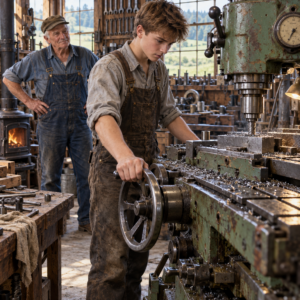
You drove an old woman thirty-five times because you have a good heart.My husband wasn’t just an Army veteran who worked a machine shop.
Before he retired, he was the co-founder of Morris Precision Tooling.
When he sold his share of the patents twenty years ago, he put our savings into a private trust and told me, ‘Evie, live simply, but use what you have to help the people who show up when nobody else does.’ Arthur’s trust provides for me comfortably, far more than my old house shows.
I keep my house simple because it’s where we raised our life, and I don’t need fancy things.
But you need new brakes, and you need some peace of mind.
Arthur would have loved you.
Thank you for keeping my promise to him.”My hands shook so hard the paper rattled.
Fifty thousand dollars was more money than I had earned in two years of medical billing.
It was enough to wipe out my credit card debt, replace the aging roof on my own home, fix my car, and still leave a cushion I hadn’t had since my marriage ended.I turned the car on, backed out of my driveway, and drove straight back to Elm Street.When I knocked on her front door, Evelyn opened it with a small, knowing smile.
She already had two mugs of chamomile tea poured on the kitchen table.”I can’t take this,” I said, holding the envelope out to her. “Evelyn, it’s too much.
I drove you because it was the right thing to do.
Not for money.”She stepped aside and pointed to a chair. “Sit down, Sarah.”I sat.
The kitchen smelled of toast and cinnamon.”If you give it back,” Evelyn said quietly, sitting across from me, “it will sit in an account until I die, and some corporate trustee who never met Arthur will distribute it to distant relatives who haven’t called me since his funeral.
Arthur wanted his hard work to matter.
You gave me thirty-five Sundays with my husband.
You gave me back my dignity.
Don’t tell me what that is worth.”ENDINGI deposited the check on Monday morning at my credit union.
The teller verified the cashier’s check with the issuing bank within ten minutes. I paid off the $6,200 balance on my credit card, paid an auto shop $740 for a complete brake and tire overhaul, and put the rest into a high-yield certificate of deposit.
For the first time in ten years, I slept through the night without waking up at AM worrying about an unexpected bill.Evelyn’s cottage still looks the same from the road, but last month I hired a local contractor to replace the bad shingles on her north roof and rebuild her back steps so she wouldn’t slip on the ice this winter.
When she tried to fuss about it, I told her it was my turn to buy the tea.Tomorrow is Sunday.
My alarm is set for AM.
My car runs silently now, the gas tank is full, and Evelyn’s floral basket is sitting on her front porch, waiting for the ride out to Oakridge.