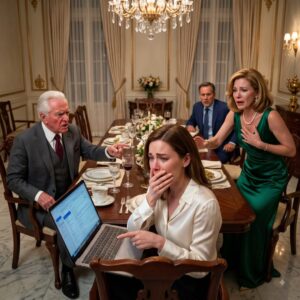
The day my husband abandoned me, I was sitting in a hospital wheelchair, holding a medical report that said my chances of surviving the next year were dangerously low.
My name is Emily Carter.
I was thirty-four, living in Boston, Massachusetts, and had been married to Daniel Carter for eleven years.
Three months earlier, doctors had diagnosed me with an aggressive form of lymphoma.
Chemotherapy had left me exhausted, painfully thin, and almost unrecognizable.
Daniel had promised to stand beside me.
Instead, he walked into my hospital room wearing an expensive suit, accompanied by a woman in a cream-colored designer coat.
I recognized her immediately.
Vanessa Whitmore.
His forty-two-year-old boss.
She was the regional director of the consulting company where Daniel worked.
Daniel placed a brown envelope on my hospital bed.
“Emily, we need to talk.”
I looked at the envelope.
“What is that?”
“Divorce papers.”
For several seconds, I couldn’t breathe.
Vanessa folded her arms.
“Daniel has been under tremendous pressure.
He deserves a future that doesn’t revolve around hospitals.”
I stared at her.
“Are you seriously standing in my hospital room telling me you’re taking my husband?”
Daniel looked away.
“Vanessa and I have been together for eight months.”
Eight months.
He had started sleeping with his boss before my cancer diagnosis.
I gripped the blanket covering my knees.
“Daniel, I’m fighting for my life.”
His answer shattered something inside me.
“And I’m tired of feeling like my life is already over.”
Vanessa stepped closer.
“You should understand that love sometimes changes.”
I looked directly at Daniel.
“Did you ever love me?”
He remained silent.
That silence was worse than any answer.
Then he said something I would remember for the rest of my life.
“Vanessa can give me opportunities you never could.”
He left the envelope on my bed and walked out with her.
I didn’t cry until the elevator doors closed.
My oncologist, Dr.
Rebecca Lawson, found me twenty minutes later.
“Emily, what happened?”
I handed her the papers.
She read the first page, then quietly sat beside me.
“I’m so sorry.”
I whispered:
“He thinks I’m going to die.”
Rebecca squeezed my hand.
“Your illness is serious, Emily.
But your treatment isn’t finished.
There are still options.”
I nodded, although I barely heard her.
Two weeks later, Daniel moved out of our apartment.
He emptied our joint savings account of $38,000, claiming the money belonged to him because he had earned most of it.
My attorney immediately challenged the withdrawal.
Meanwhile, Vanessa posted photographs of their vacation in Miami.
One caption read:
“Finally choosing happiness.”
I saw it while receiving chemotherapy.
Something inside me changed that afternoon.
I stopped checking Daniel’s social media.
I stopped answering his calls about the divorce.
And I started fighting.
My younger brother, Michael, moved into my apartment to help me.
Every morning, he drove me to treatment.
Every evening, he cooked dinner, even when I couldn’t swallow more than two bites.
Six months later, my doctors recommended an advanced treatment at a specialized cancer center.
The risks were significant.
The costs were frightening.
But I agreed.
Before the procedure, Michael held my hand.
“You’re going to make it, Em.”
I smiled weakly.
“And if I don’t?”
His eyes filled with tears.
“Then I’ll know you never stopped fighting.”
I survived the procedure.
But recovery was brutal.
For months, I battled infections, exhaustion, and complications.
Then, nearly a year after Daniel abandoned me, my scans showed something extraordinary.
No detectable active cancer.
My doctor warned that remission wasn’t a guarantee.
But I had been given another chance.
I cried harder that day than I had when Daniel left.
And I made myself a promise.
The man who abandoned me would never again decide what my life was worth.
Four years later, Daniel would walk into a crowded Boston ballroom, look toward the stage, and discover that the woman he believed was dead was standing directly in front of him.
And the company he desperately needed to save his career was connected to her.
Four years after Daniel left me, I stood in front of a mirror adjusting a navy-blue evening gown.
My hair had grown back, darker and thicker than before.
I was thirty-eight, healthy enough to work full-time, and the founder of a patient-support organization called Second Chance Alliance.
What began as a small online community had grown into a nonprofit helping cancer patients navigate transportation, emergency expenses, and treatment resources.
My experience had taught me something painful.
Illness didn’t just threaten people’s lives.
Sometimes it exposed the people who were never truly committed to staying.
That evening, our organization was hosting a fundraising gala at a luxury hotel in downtown Boston.
More than three hundred guests were attending.
Among them were executives from several major healthcare consulting firms.
One company had requested a meeting about becoming our corporate technology partner.
Whitmore Strategic Solutions.
Vanessa’s company.
I knew exactly who owned it.
What I didn’t know was that Daniel had recently become its chief operating officer.
Michael approached me backstage.
“Emily, are you sure you’re ready?”
I smiled.
“For the speech?”
“For seeing him.”
I took a slow breath.
“Daniel doesn’t scare me anymore.”
At seven thirty, the ballroom lights dimmed.
I stepped onto the stage.
“Four years ago, I was fighting cancer while losing my marriage.”
The room became silent.
“Someone I trusted decided my illness made me a burden.
But the people who stayed taught me that compassion is not an obligation.
It’s a choice.”
Applause filled the ballroom.
Near the front, Daniel froze.
His face drained of color.
Beside him, Vanessa gripped his arm.
“Daniel, what’s wrong?”
He whispered:
“That’s Emily.”
Vanessa stared at the stage.
“Your ex-wife?”
Daniel swallowed.
“I thought she died.”
After my final chemotherapy treatment, Daniel had stopped contacting me entirely.
He had heard through an old acquaintance that I was critically ill again, and instead of confirming anything, he had assumed the worst.
Now I was standing before him.
Alive.
Successful.
And completely beyond his control.
After my speech, Daniel approached me near the reception tables.
“Emily?”
I turned.
“Hello, Daniel.”
His eyes filled with tears.
“I can’t believe it’s you.”
“Clearly.”
“I thought…”
“That I died?”
He looked ashamed.
“Someone told me you were back in the hospital.”
“I was.
I recovered.”
Vanessa joined us.
“Emily, congratulations on your organization.”
“Thank you.”
She forced a smile.
“We’re actually hoping to work together.”
I looked at Daniel.
“Then I’m sure you’ll submit a formal proposal like everyone else.”
Daniel stepped closer.
“Emily, could we talk privately?”
“No.”
His expression tightened.
“Please.
I owe you an explanation.”
“You owed me one four years ago.”
Before he could answer, my attorney, Sarah Mitchell, approached.
“Emily, we need to discuss something.”
She handed me a confidential report.
I read the first page.
Then the second.
My hands went cold.
Whitmore Strategic Solutions was facing serious financial trouble.
Its leadership had apparently concealed major liabilities from potential investors.
But the final document contained something even more disturbing.
A former company accountant had provided evidence suggesting Daniel had authorized payments from a corporate account into a business controlled by Vanessa.
And attached to the records was a familiar name.
Mine.
PLOT TWIST: The documents revealed that, while I was hospitalized four years earlier, Daniel had allegedly used a forged authorization bearing my signature to transfer $240,000 from an investment account inherited from my grandmother.
The money had helped finance Vanessa’s company—and Daniel had apparently believed I would never survive long enough to discover it.
I stared at the financial records until the numbers blurred.
Two hundred and forty thousand dollars.
My grandmother, Margaret Bennett, had left me that money shortly before her death.
She had worked as a public-school teacher for thirty-seven years, saving carefully so I would always have some financial security.
When I became ill, I had placed the inheritance in a separate brokerage account.
Daniel knew about it.
But he had never been authorized to withdraw anything.
Or so I believed.
I looked at Sarah.
“How did he get access?”
She lowered her voice.
“The records suggest someone submitted an electronic transfer authorization using your identity.
We’re still determining exactly how it was approved.”
I remembered something.
During my second round of chemotherapy, Daniel had brought several documents to the hospital.
He told me they were insurance forms.
I had been weak, nauseated, and heavily medicated.
I remembered signing one document.
But I couldn’t remember the others.
“Sarah, I need every record from that account.”
“I’ve already requested them.
We also need to preserve these documents and report the suspected fraud.”
I looked across the ballroom.
Daniel was laughing nervously beside Vanessa, unaware of what I had just discovered.
For the first time in four years, I felt the old anger rising.
Not because he had left me.
Not even because he had chosen another woman.
But because he had apparently taken money my grandmother had saved over a lifetime and used it to build a future with someone else while I fought to stay alive.
Michael noticed my expression.
“Emily?”
I handed him the report.
He read it slowly.
Then his jaw tightened.
“He stole Grandma’s money?”
“We don’t know everything yet.”
Michael looked toward Daniel.
“I’m going to talk to him.”
I caught his arm.
“No.
We do this legally.”
He stared at me.
“After everything he did?”
“Especially after everything he did.”
The following morning, Sarah arranged an emergency meeting with a financial investigator named Thomas Reed.
Thomas reviewed the transfer records, the electronic authorization, and the receiving accounts.
By the end of the meeting, he had identified three suspicious transactions.
The first was for $90,000.
The second was for $75,000.
The third was for another $75,000.
All three had occurred during my hospitalization.
Thomas pointed at the documents.
“The transfer instructions appear to have been submitted using credentials associated with your account.
We need the brokerage firm’s authentication logs to establish who actually initiated them.”
Sarah nodded.
“We’ll notify the firm, request preservation of its records, and refer the suspected identity theft and forgery to the appropriate authorities.”
I stared at the dates.
One transfer had happened on the same morning Daniel told me he couldn’t continue being married to a sick woman.
I remembered him standing beside my hospital bed.
His expensive suit.
His cold expression.
The brown envelope.
While I was terrified of dying, he had apparently been arranging his financial escape.
Three days later, Sarah received a response from the brokerage firm.
Its records showed that the transactions had been initiated from a device previously used by Daniel.
The firm also supplied a copy of an electronically submitted authorization.
The signature was supposed to be mine.
It wasn’t.
A forensic document examiner later identified significant inconsistencies between that signature and verified examples of my handwriting.
Sarah cautioned that the evidence would still need to be tested through the legal process.
But the investigation was moving forward.
Then Daniel called me.
I hadn’t heard his voice outside the gala in four years.
“Emily, we need to meet.”
“About what?”
“Vanessa says your organization is refusing our partnership proposal.”
“That’s correct.”
“Why?”
“Because your company hasn’t satisfied our financial disclosure requirements.”
He exhaled sharply.
“Emily, please don’t make this personal.”
I almost laughed.
“Personal?”
“We have employees depending on us.”
“So did I, Daniel.
I had a life depending on you.”
He fell silent.
Then his voice softened.
“I know I hurt you.”
“You abandoned me during chemotherapy.”
“I was scared.”
“So was I.”
“I made mistakes.”
“Leaving me was your decision.
Taking my money was something else.”
Silence.
A long, unmistakable silence.
Finally, he whispered:
“What money?”
“My grandmother’s inheritance.”
I heard him breathing.
“Emily, listen to me.”
“No.
You’ll be hearing from my attorney.”
I ended the call.
That afternoon, Vanessa arrived at Sarah’s office without an appointment.
She looked nothing like the confident executive who had stood in my hospital room four years earlier.
Her expensive coat was wrinkled.
Her eyes were red.
Sarah agreed to meet her with me present.
Vanessa sat across from us.
“Daniel told me the money was his.”
I studied her.
“What money?”
She hesitated.
“The initial investment in my company.”
Sarah leaned forward.
“Are you saying Daniel represented those funds as his personal assets?”
Vanessa nodded.
“He said he had liquidated investments from his marriage after the separation.”
I felt my stomach tighten.
“Did you know they belonged to me?”
“No.”
“Did you know he was still married when you started seeing him?”
Her face reddened.
“Yes.”
I nodded slowly.
“Then you knew enough about his character to ask questions.”
Vanessa lowered her eyes.
She explained that the company had expanded too quickly and borrowed heavily against expected contracts.
Several clients had canceled agreements.
Creditors were demanding repayment.
And Daniel had assured her that securing our nonprofit’s technology partnership would attract another investor.
“Without that investment,” she whispered, “we may have to close.”
I looked at her.
“Four years ago, you told me Daniel deserved a future that didn’t revolve around hospitals.”
Tears slipped down her cheeks.
“I remember.”
“You also told me love sometimes changes.”
She said nothing.
“Well, Vanessa, circumstances change too.”
Sarah interrupted gently.
“Emily, let’s keep this focused on the financial records.”
Vanessa handed over copies of internal accounting documents and agreed to cooperate with the investigation.
Those records became important evidence.
Over the following months, the brokerage firm investigated its authentication failures, and law enforcement examined the suspected fraudulent transfers.
Daniel initially denied wrongdoing.
Then investigators obtained additional electronic records linking him to the transaction instructions.
Faced with the evidence, he eventually admitted through his attorney that he had initiated the transfers without my permission.
His explanation was that he had intended to repay the money once Vanessa’s business became profitable.
But he had never repaid a dollar.
A criminal case followed.
Daniel ultimately pleaded guilty to charges arising from the unauthorized transfers and received a sentence that included restitution, supervised probation, and financial penalties.
Separate civil proceedings resulted in a repayment agreement backed by assets he still owned.
Whitmore Strategic Solutions entered an orderly liquidation after its lenders refused further financing.
Vanessa lost the company she had spent years building.
She wasn’t charged in connection with the transfers, and the investigators did not establish that she knew the investment money had been stolen.
Daniel lost his executive position.
His professional reputation collapsed.
But none of that brought me the satisfaction I once imagined revenge would provide.
One afternoon, nearly five years after my diagnosis, Daniel appeared outside the nonprofit’s office.
He looked older.
His hair was thinning.
His shoulders sagged beneath a faded gray jacket.
“Emily.”
I stopped near the entrance.
“Daniel.”
He held a small envelope.
“It’s the first restitution payment.”
“Send it through the proper channels.”
He nodded.
“I know.”
For a moment, neither of us spoke.
Then he looked at me.
“Do you ever think about what would’ve happened if I’d stayed?”
I considered his question.
“I used to.”
His eyes filled.
“And now?”
“Now I think about the people who did stay.”
He wiped his face.
“I loved you, Emily.”
I shook my head.
“Maybe you loved the healthy version of me.
The woman who cooked dinner, paid bills, smiled at your promotions, and made your life comfortable.”
He looked down.
“But when I needed you to carry some of the weight, you decided I wasn’t worth it.”
“I’m sorry.”
“I believe you regret what happened.”
He raised his head hopefully.
“But regret doesn’t erase what you chose.”
I stepped toward the door.
“Emily, could we ever be friends?”
I turned back.
“No, Daniel.
I wish you no harm, but I don’t want you in my life.”
Then I went inside.
That evening, Michael came over for dinner.
We ate pasta at my kitchen table, laughing about the terrible meals he’d cooked during my chemotherapy.
At one point, he became quiet.
“Grandma would be proud of you.”
I smiled.
“I hope so.”
“Not because of the money.”
“I know.”
“Because you didn’t let him turn you into someone cruel.”
I looked around my apartment.
There were photographs from our nonprofit’s charity events.
Letters from patients we’d helped.
A framed picture of my grandmother.
And a recent medical report confirming that I remained in remission.
I had survived something I once thought would kill me.
I had built a meaningful life.
And I had learned that being abandoned didn’t mean I was unworthy of love.
Two years later, I used part of the recovered inheritance to establish the Margaret Bennett Emergency Assistance Fund.
It helped patients facing financial hardship during cancer treatment.
At the fund’s first anniversary celebration, a young woman approached me.
She had recently completed chemotherapy.
Her husband stood beside her, holding her hand.
“Your organization helped us keep our apartment,” she said.
I smiled.
“I’m glad we could help.”
Her husband added:
“We don’t know how to thank you.”
I looked at their joined hands.
“Just keep taking care of each other.”
Later, standing alone by the ballroom windows, I thought about the day Daniel walked out of my hospital room.
He had believed he was leaving behind a dying woman with no future.
He had been wrong.
But the greatest victory wasn’t that his career had fallen apart.
It wasn’t that Vanessa lost her company.
It wasn’t even that I recovered my grandmother’s money.
It was that I had stopped measuring my worth through the eyes of the man who abandoned me.
Daniel had chosen a life without me.
And I had built a life that no longer needed him.
Sometimes the greatest revenge isn’t watching someone lose everything.
It’s surviving what they put you through, finding your own happiness, and realizing you never needed their approval to deserve it.