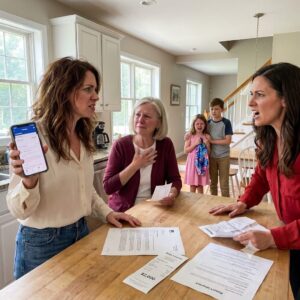
The day before my father’s funeral, I found my childhood in six cardboard boxes on the driveway.
Rain had soaked through the one marked BOOKS, and Dad’s faded work jacket lay half in a puddle, one sleeve stretched toward the garage door.
My key no longer worked.
Linda, my stepmother, opened the front door just far enough to show me the new deadbolt.
“He’s gone, Emma.
Everything is mine now.
You get nothing.”
Behind her, the hallway lamp Dad used to leave on for me was still burning.
“Where’s his truck?” I asked.
“Sold it.
The watches, too.
I need money to move on.”
Dad had been dead four days.
We hadn’t even buried him.
I bent to pick up his jacket.
In the pocket was a carpenter’s pencil, sharpened with the little knife he always carried.
When I was nine, he’d used pencils like that to mark my height on the pantry doorframe, insisting that every quarter inch deserved celebrating.
Linda watched me gather the boxes.
“Don’t come back with a lawyer and make this ugly.”
I didn’t argue.
I put everything in my car and drove to my friend Sarah’s house, where she made tea I forgot to drink.
My name is Emma Dawson.
I’m thirty-nine, and the white two-story house outside Columbus, Ohio, had been home for most of my life.
Dad raised me there after my mother died.
Eight years ago, when his repair shop closed and he needed to clear its debts, I bought the house from him at an independently appraised price.
I took out the mortgage in my name and gave him a written right to live there for the rest of his life without rent.
Dad married Linda three years later.
She moved in, and I welcomed her.
During his final illness, I stayed in the upstairs bedroom to care for him, paying the mortgage from my salary and never discussing ownership at family dinners.
Linda called it “Frank’s house.”
I didn’t correct her every time.
But after the lockout, I called the attorney who’d handled the sale.
He told me not to force my way inside.
He would address Linda’s occupancy through proper notice, and we’d report what had happened to Dad’s belongings.
Three weeks later, my phone rang while I was sorting his damp books.
A real-estate agent asked, “Ms.
Dawson, are you aware someone has listed your property for $485,000?”
I looked up at the rain-stained jacket hanging by Sarah’s door.
Linda had found a buyer.
She had even signed the listing paperwork as the owner.
What she hadn’t done was check the recorded deed.
Because the only name on it was mine.
The agent checked county records while Dad’s pencil rolled between my fingers.
“Oh,” she said softly. “I’m so sorry.
The listing is coming down immediately.”
Within an hour, Linda called.
“You tricked your father into giving you his house!”
“I bought it eight years ago, Linda.
He used the proceeds to pay the shop’s creditors.
The deed was recorded before you married him.”
“He told me this was our home!”
“It was your home while he lived.
That doesn’t make it yours to sell.”
I remembered sitting across from Dad at the bank when we signed the purchase papers.
His hands had trembled as he handed me the old brass house key.
“I’m supposed to be the one keeping a roof over your head,” he’d said.
“You did,” I’d answered. “Now it’s my turn.”
He had insisted on a written lifetime occupancy agreement, not because he distrusted me, but because he wanted us both to know our promises had meaning.
He still mowed the lawn and complained when I replaced the furnace.
When Linda came into his life, I hoped someone would sit with him on the porch after I went home.
For a while, she did.
My attorney sent her written notice disputing any claim of ownership and began the appropriate process to recover possession.
Her having lived there meant I couldn’t simply change the locks, no matter what she’d done to me.
He also explained that Dad’s truck and watches belonged in the estate accounting unless she could establish a lawful transfer.
The truck was a green Ford F-150 with a dent near the tailgate.
Dad had refused to fix it because I’d made the dent learning to reverse at sixteen.
He said it reminded him of how hard we’d laughed afterward.
The estate’s attorney, preparing the probate inventory, discovered that Linda had sold it two days after Dad died.
She’d shown the buyer an old power of attorney.
That authority had ended with Dad’s death.
She’d also sold his three watches to a dealer, including the silver one Mom gave him on their tenth anniversary.
I had photographs and the serial number engraved inside its case.
I asked the attorney whether we could get them back.
He couldn’t promise it, but he could demand an accounting and contact the buyers.
Then he showed me an email Linda had sent the truck buyer, arranging collection just before the day she’d thrown me out.
“Please pick it up before Emma comes over.
She’ll try to stop me.”
I read it twice.
I’d believed Linda was acting out of grief, bitterness, or panic.
But she had arranged to remove Dad’s belongings before I even knew they were being sold.
Then she’d left my childhood possessions outside in the rain.
She hadn’t just decided that I deserved nothing.
She’d taken steps to make certain there was nothing left for me to ask about.
By the time we met with Linda and her attorney, I had stopped rehearsing angry speeches in the car.
I brought Dad’s carpenter’s pencil instead.
It fit between my fingers the way it had when he first taught me to measure a board.
Linda sat across the conference table wearing a heavy gold bracelet.
She didn’t look at me when I sat down.
“I was his wife,” she said. “I deserve more than being thrown out.”
“I haven’t disputed that you may have rights in his estate,” I answered. “But you changed the locks on a house I own.
You sold things before anyone had authority to handle the estate.
You put my belongings in the rain.”
She turned to her lawyer.
“He promised I’d always be taken care of.”
My attorney laid out the recorded deed, the sale documents from eight years earlier, and the lifetime occupancy agreement.
Dad’s personal right to live in the house had ended when he died.
Linda’s continued occupancy still required a lawful resolution, but the property was never his to leave to her.
She studied the papers for a long time.
“Then why didn’t he tell me?”
“He told people it was home,” I said. “You heard that as ownership.”
She looked up sharply.
“You let me believe it!”
I thought about the dinners we’d shared, and the years I’d spent trying not to make her feel like an outsider in the house where Dad had raised me.
“I never told you it belonged to him.
And I never gave you permission to sell it.”
For the first time, Linda had nothing to say.
The dispute didn’t disappear in one meeting.
Linda wanted money to leave, and I wanted the house back without putting either of us through months of additional court hearings.
Through our attorneys, we agreed on a move-out date, documented access for her belongings, and a signed surrender of possession.
I didn’t pay her for the house.
I gave her reasonable time to arrange another place to live.
The estate matter was handled separately.
Linda provided records of the truck and watch sales, and the estate sought reimbursement of the proceeds.
The truck buyer agreed to return it after the disputed title transaction was corrected and the estate reimbursed his purchase price from funds recovered from Linda.
The silver watch turned up at the dealer, who held it while the estate arranged its return.
The other two had already been resold, and their value was included in the settlement.
It took almost six months from the morning I found the boxes to the day Linda returned the keys.
By then she’d rented a room across town.
The money she’d expected from selling my house had never been hers.
I went back inside alone.
The rooms smelled of stale candles and furniture polish.
There was a pale rectangle on the wall where Linda had taken down Dad’s photograph, and the pantry doorframe had been painted white.
I stood there longer than I expected.
At nine, I’d demanded Dad mark my height even though I’d barely grown since summer.
He’d drawn a line anyway, added the date, and written, Still going up.
When Mom died, he kept adding those little lines, even on years when neither of us had much to celebrate.
I opened the bottom drawer of the kitchen cabinet and found the metal ruler he used for carpentry.
Then I began gently sanding a patch of the doorframe, hoping the old marks might survive beneath the paint.
They did.
There was my name in his block handwriting, dated the year I turned sixteen.
Beside it was the last line he’d ever drawn: the summer before I left for college.
A week later, I hung his jacket beside the back door.
The truck sat in the driveway again, its dent exactly where he’d left it.
I put Dad’s silver watch in a small box for safekeeping rather than on display.
I didn’t feel triumphant.
I missed him too much for that.
But I finally slept in my own bedroom, with the hallway lamp glowing under the door.
Linda had told me I would get nothing because my father was gone.
She hadn’t understood the quiet arrangement we’d made years before she arrived: I would keep the house standing, and he would always have a place in it.
In the end, I didn’t take his house from his widow.
I simply came home to the one I’d bought.
And kept the promise I’d made to him.
My stepmother thought losing my father meant losing my right to belong.
She didn’t realize that, long before she changed the locks, he’d already trusted me with the keys.