PART 1The yellow school bus dropped Toby off at my gravel driveway every afternoon for ten years, and for ten years, my front porch was the only home he knew. My son, Greg, made it clear when Toby was barely two that he wanted no part of being a father.
He took off for Phoenix, sent thirty dollars in a birthday card once, and never looked back.
Toby’s mother, Shannon, had left even earlier.
She packed two duffel bags one Tuesday morning while the baby was asleep in his crib, handed me his diaper bag, and said she needed time to figure herself out. I took that baby in without asking questions or filing court motions.
I was fifty-two years old, working thirty-two hours a week at the county clerk’s records desk, and I poured every spare dime and ounce of energy into raising him.
I paid for his asthma inhalers, signed his permission slips under temporary guardianship forms that schools used to hand out back then, and sat on the bleachers for every Little League game he ever played.
Greg and Shannon never legally signed away their rights, but in every way that counted, Toby was my boy. Then came a Friday afternoon when Toby was twelve years old. I heard a car door slam out front.
A beige sedan with out-of-state plates was parked by my hydrangeas, and Shannon walked up the porch steps wearing a crisp gray blazer.
Next to her was a man carrying a heavy leather briefcase. “Shannon?” I said, wiping flour from my hands onto my apron. She did not step inside to hug her son.
She did not even look past me into the hallway where Toby was sitting on the carpet, untying his sneakers. “We’re here to pick up Toby, Evelyn,” she said.
Her voice was flat and businesslike, like a supervisor conducting an inventory check. “This is Mr.
Vance.
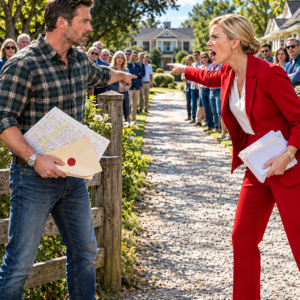
He’s my attorney.”The man handed me a sealed envelope with county stamps on the front.
It was a formal revocation of informal custody, along with a certified custody declaration asserting Shannon’s absolute parental rights.
Because no legal adoption or court-ordered permanent custody had ever been established through the state, Shannon was still his legal mother.
She had never been declared unfit by a judge.”He lives here,” I told her, my voice shaking so hard the paper rattled in my fingers. “He’s lived here for ten years, Shannon.
You can’t just show up and pull him out of his school, his room, his whole life.”Shannon looked at her wristwatch. “Thanks for your services, Evelyn.
Truly.
I’ll take it from here.”Toby came to the screen door, looking terrified.
“Grandma?”Mr.
Vance stepped forward, speaking calmly. “Ma’am, if you interfere, the local sheriff will have to enforce the custody order.
The paperwork is legally binding.
Don’t make this traumatic for the boy.”I begged her.
I stood in my gravel driveway in my house slippers and begged a woman who had ignored her child for a decade to just sit down and talk to me.
She didn’t.
She took Toby by the arm, put him in the back of that beige sedan, and drove away. I called the county legal aid office the next morning.
I talked to three different family law attorneys over the following month.
Every single one told me the exact same brutal truth: without an existing custody order or proof of immediate, active neglect, a biological parent with unbroken parental rights has the legal right to claim their minor child. I wrote letters to the address on the court paper.
They were returned marked undeliverable.
When I called the lawyer’s office, a secretary told me Shannon had closed her file and moved out of state. They vanished.
For six years, my house was utterly silent.
Toby’s bedroom stayed exactly the way he left it on that Friday, with his baseball glove resting on the corner of his desk and his middle school science binder on the nightstand. Six years went by.
Then, two months after Toby turned eighteen, a beat-up pickup truck pulled into my driveway. A tall young man got out.
He had the same cowlick in his brown hair and the same round hazel eyes, but his shoulders were broad and his face was drawn and pale.
When our eyes met, he broke down crying on the porch stairs. I rushed out and wrapped my arms around him.
We held each other right there on the wooden steps, both of us sobbing.
I thought he was crying because he was finally home.
I thought he had spent six years trying to get back to me. Then Toby pulled back, wiped his cheeks with the sleeve of his flannel jacket, and reached into his back pocket. “Grandma,” he whispered, his hands trembling. “You have to look at this.”PART 2The document Toby pressed into my hands was a folded sheaf of formal legal papers from the State of Texas, dated three months before Shannon took him from my porch. I smoothed the sheets out on my kitchen table, right beside the ceramic sugar bowl Toby used to steal spoonfuls from when he was six. The top sheet was an administrative determination from the Texas Department of Family and Protective Services and the Office of the Attorney General.
It was an award of retroactive child support and dependent benefits stemming from a wrongful death settlement. My breath caught in my throat.
I looked up at Toby. “What is this?””Look at the third page, Grandma,” Toby said, sitting heavily on the kitchen chair. “Look at the disbursement requirements.”I turned the page.
The settlement was connected to Greg.
My son Greg had been killed in an industrial crane accident at a rail yard outside El Paso in the spring of Toby’s twelfth year.
Because Greg had died on a union-managed rail project with no will and no spouse, his entire wrongful death settlement, along with his accrued pension death benefit, belonged exclusively to his sole legal dependent: Toby. The total settlement amount was $340,000. Under Texas law and the insurer’s trust terms, the funds could not be released to a minor directly.
The money had to be placed in a court-supervised custodial trust managed by the child’s primary physical custodian, or held until the boy turned eighteen.
Furthermore, the custodian was granted a monthly living allowance of $2,400 to maintain a household for the dependent child until his high school graduation or eighteenth birthday. The date on the insurer’s initial notification letter to Shannon was four weeks before she showed up at my house with a lawyer. “She didn’t come for me, Grandma,” Toby said, his voice breaking. “She came for the monthly checks.
She found out Dad died, she hired that lawyer in Dallas to establish that she was my sole surviving parent, and she came to get the body that held the bank account.”For ten years, Shannon had not spent a single dollar on shoes, school lunches, dental cleanings, or winter coats.
The moment my son died and left a pile of money tied to the custody of our boy, she drove across state lines, walked onto my porch, and claimed him like a piece of abandoned property. “Where did she take you, Toby?” I asked, reaching across the table to hold his cold hand. “San Antonio first.
Then a rental house outside Fort Worth,” he said, staring at the scarred tabletop. “She told me you were too old to care for me.
She told me you called her and asked her to take me because your health was failing and you couldn’t afford to feed a growing teenager anymore.”The room seemed to shrink. “She told you that?””She swore on Dad’s grave,” Toby said, tears cutting lines down his dusty face. “She told me you packed my bags while I was at school and told her to make sure I never called, because hearing my voice would break your heart.
I believed her, Grandma.
I spent four years hating myself because I thought I was too heavy a burden for you to carry.”He opened his jacket and pulled out another document.
It was a formal accounting report he had requested from the county probate court the day after his eighteenth birthday. “She spent the living allowance every month,” Toby said. “She bought new cars, took vacations with her boyfriend, and paid for rent on fancy subdivisions.
But that wasn’t enough.
When I turned sixteen, she petitioned the court to release early disbursements from the principal trust for my ‘private preparatory education and specialized medical care.’ The court granted three withdrawals totaling $180,000.””Did you go to private school?” I asked. Toby gave a hollow laugh. “I went to public high school and worked twenty hours a week at an oil-change shop so I could pay for my own clothes.
She forged the receipts.
She created fake tuition invoices from an academy that didn’t exist.”PART 3The paper trail Toby laid out was meticulous, but the final insult was waiting on the last page of the probate accounting. When Toby turned eighteen, the remaining balance of his father’s trust was supposed to transfer directly into his name.
Out of the original $340,000, exactly $42,110 remained. Shannon had called him into her living room the morning of his birthday, handed him a check for that remaining $42,110, and told him that his father’s debts had eaten the rest.
She told him he should be grateful she had managed to preserve even that much. “She handed me the check,” Toby told me, his jaw tightening, “and then she told me I had two weeks to find an apartment because she was selling the house and moving to Florida with her new partner.”
Toby had not cashed the check.
Instead, he took the trust account number printed on the disbursement stub and went straight to the county courthouse in Fort Worth.
A clerk in the probate division took pity on the boy, looked up the underlying file, and printed out the entire docket of petitions Shannon had filed over the previous six years. Among those files was a certified affidavit Shannon had submitted to the judge during her second petition for early trust release.
In that sworn statement, she claimed she had maintained full, sole custody of Toby since infancy, and that the paternal grandmother had abandoned the child at birth. “She used your name to justify taking the money, Grandma,” Toby said.
“She told the court you dumped me on her doorstep, and she used that fake story to show the judge how selflessly she had raised me without any family support.”I stood up from the table.
At seventy years old, my knees didn’t work as quickly as they used to, but the fog that had hung over my chest since that terrible Friday vanished completely. “Get your jacket, Toby,” I said. “Where are we going?””We’re going to the county courthouse,” I said. “And then we’re going to see Arthur Miller.”Arthur had handled my husband’s estate when he passed away twelve years earlier.
He was seventy-four now, semi-retired, and kept an office above the local pharmacy on Main Street.
When Arthur looked over the Texas probate dockets, the original temporary guardianship forms I had filed with our local school district from when Toby was four to twelve, and the clinic vaccination records showing my signature for ten straight years, his face went completely rigid. “This isn’t just a family dispute,” Arthur said, taking off his reading glasses. “This is felony perjury and aggravated fraud upon the probate court.
She obtained court orders by filing fraudulent affidavits regarding the child’s custody history and fabricating educational expenses.”Arthur did not promise an overnight miracle.
What he did was file an emergency referral with the Dallas County Probate Court and the Texas Attorney General’s Child Protection Division, attaching ten years of verified public school records, pediatric medical bills paid out of my personal checking account, and sworn affidavits from Toby’s former Little League coach and our family doctor.
Three weeks later, an administrative freeze was placed on Shannon’s personal bank accounts pending a formal evidentiary audit. Shannon called my house the night after the freeze took effect.
My phone rang seven times before I picked it up. “Evelyn,” she hissed, her voice sharp and panicky. “You need to call off your lawyer.
Toby is an adult now.
What happened between me and his father’s estate has nothing to do with you.””You came to my porch and told me to step aside after ten years of sweat and love,” I told her, my voice level and cold. “You lied to that boy.
You told him I abandoned him so you could steal his father’s death benefit.””I took care of him!” she yelled. “I put a roof over his head!””You put a price tag on his head,” I said.
“And now you’re going to answer to the judge you lied to.”I hung up the phone and did not take another call from her. ENDINGThe Texas probate court did not waste time once the actual records were presented. At the formal hearing in Fort Worth two months later, Shannon appeared without a lawyer.
Her former attorney had withdrawn from the case the moment the fraudulent academy invoices were uncovered.
The judge revoked her final discharge as custodian, found her in civil contempt for gross fiduciary breach, and entered a formal restitution judgment against her for $297,890. Because she had used a large portion of the stolen funds as a down payment on a residential property in Denton County, Arthur helped Toby place a formal judgment lien against the home before she could sell it and move to Florida.
When the property was liquidated under court order the following spring, $165,000 was recovered and transferred directly into Toby’s personal account.
The remaining balance was placed on a court-ordered wage garnishment order that will follow Shannon for the rest of her working life. Shannon was also referred to the local district attorney for criminal perjury charges, resulting in three years of supervised felony probation and mandatory community service. None of that money brought back the six years we lost.
It didn’t give me back his eighth-grade graduation, his first driver’s license test, or the years he spent believing his grandmother had cast him aside like an unwanted chore. Money cannot fix a stolen childhood.
But the truth can heal what is left of it. Toby did not move into an apartment in Texas.
He brought his pickup truck back to my gravel driveway, carried his bags up the porch stairs, and unpacked his clothes in the bedroom that had waited for him since he was twelve. He enrolled in the mechanical engineering technician program at the technical college forty minutes down the highway.
Every afternoon around four o’clock, I hear his truck rumble over the cattle guard by the road. Yesterday, Toby walked into the kitchen while I was paring apples for a cobbler.
He set his car keys on the counter, walked over, and pulled a familiar blue object from his pocket.
It was his twelve-year-old Little League championship medal, tarnished and worn at the edges, which he had kept hidden in the bottom of his duffel bag through all six years of separation. He didn’t say anything profound.
He just set the medal on the windowsill right above the kitchen sink, where it had sat for six years before Shannon took him, washed his hands, and picked up the paring knife to help me peel the rest of the fruit.