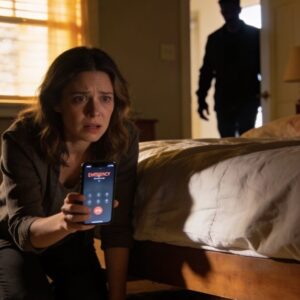
PART 1The deadbolt snapped around two in the morning.I was asleep on the foldout sofa in my off-base rental when the wood gave out with a crack like a rifle shot.
Before my feet hit the floorboards, a heavy boot slammed into my chest, driving the wind completely out of my lungs.
I reached blindly for the floor lamp, but a gloved hand caught me by the collar and shoved my face down into the rug.”You should have kept your mouth shut, Ava,” a voice rasped above me.I knew that rasp before I even saw his face.
It belonged to Richard Lawson.Richard had married my mother when I was eleven years old.
For eight years, until the day I boarded the bus for boot camp, he ruled our house with sudden outbursts, closed doors, and a belt he kept folded across the kitchen radiator.
He used to tell me that nobody outside our front door cared whether I lived or died.
I spent ten years in the Navy, earning my commission as a lieutenant in naval logistics, partly to put five states and an ocean between myself and that house in rural Georgia.Now he was in my apartment in Norfolk, smelling of stale black coffee and cheap tobacco, pinning my shoulder against the floor with his knee.”Where’s the drive?” he demanded, driving his knuckles into my temple until my ears rang. “The logistics ledger from the Norfolk depot.
Give it to me.””I don’t have it,” I choked out, tasting copper where my mouth had hit the coffee table.He didn’t search the drawers.
He didn’t check my desk.
He just hit me again, hard across the jaw, then dragged me into the narrow hallway and threw me against the baseboard.
He pulled a coil of zip-ties from his coat pocket.
He wasn’t acting like an angry relative looking for money.
He was moving with a cold, deliberate hurry, glancing repeatedly at his wristwatch.When he stepped back into the living room to tear my laptop bag open, my hand slid across the floor.
My military-issued phone had slipped under the hallway shoe bench when the table flipped.
My fingers found the textured casing.Active-duty logistics officers handling sensitive manifests carry an alert protocol on government hardware.
If you press the recessed power toggle five times in succession, it bypasses civilian dispatch and transmits an immediate officer-in-distress beacon directly to Naval Criminal Investigative Services and the regional base watch commander.
It routes GPS coordinates, officer service number, and a high-priority distress flag to shore patrol.I pressed the button five times.
The tiny LED beside the lens flashed red three times.Richard came back down the hall, cursed when he saw the phone in my hand, and kicked my arm away.
The screen skittered across the linoleum, face down.
He grabbed my wrist, bent it back until the tendon burned, and drove his knee into my ribs.
The second crack was louder than the door.
The pain took the room completely black.When I opened my eyes, the apartment was dead silent.The front door hung crooked on one hinge, swaying gently in the damp November draft.
Rain was blowing in across the hardwood floor.
My ribs throbbed with every shallow breath, but through the ringing in my ears, I could hear sirens approaching from two different directions.They weren’t civilian squad cars.
The heavy diesel engines and distinctive two-tone wails belonged to naval security force interceptors.Within six minutes, four patrol units had cordoned off the street.
Two base security officers came through the door with service weapons drawn, followed immediately by local city police.
A paramedic knelt over me on the hallway rug, cutting away my flannel shirt to tape my ribs while shore patrol cleared the rooms.”Lieutenant Ava Reynolds?” an investigator in plainclothes asked, kneeling beside the medic.
His badge identified him as Special Agent Miller, NCIS. “Your beacon pinged depot command at 0214.
Who attacked you?””Richard Lawson,” I whispered, every syllable feeling like broken glass in my side. “My stepfather.
He was driving a gray Ford F-150 with Georgia plates.”Miller stood up and spoke rapidly into his shoulder radio.
Within ninety seconds, a regional dispatch alert went out across every precinct from Norfolk to the Chesapeake Bay Bridge-Tunnel.Richard hadn’t even cleared the city limits.
Thinking he had knocked me out cold and bought himself an hour of lead time, he had stopped at a gas station less than two miles away on Military Highway to wash blood off his hands in the restroom.
Three patrol units boxed his truck against the fuel pumps before he could put the transmission into reverse.They brought me to Sentara Norfolk General Hospital under military escort.
By a.m., while the nurse was taping my cracked ribs and cleaning the laceration above my left brow, Commander Harris, my immediate department head from the depot, walked into the trauma room.
His face was rigid.”The police have Lawson in custody at the second precinct,” Commander Harris said quietly, shutting the curtain behind him. “NCIS is taking over jurisdiction.””Why NCIS?” I asked, struggling to sit upright. “He’s a civilian.
He broke into my private rental.””Because of what they found under the front passenger seat of his truck,” Harris said.
He pulled a pair of nitrile gloves from his pocket, opened an evidence bag, and held it up so I could see through the clear plastic.Inside was a heavy manila folder, stamped with a crimson seal and marked with restricted depot classification numbers.
Across the bottom tab, printed in bold standard military font, was my full name and service record number.The seal was intact.
But the custody chain printed on the label had never been logged through depot dispatch.
It was a restricted personnel dossier that should not have existed outside a secure shore installation, and Richard Lawson had no military service, no security clearance, and no lawful business within five hundred miles of Virginia.PART 2By nine that morning, I refused to stay in the hospital bed.
I signed the release against medical advice, took the prescribed anti-inflammatory pills, and rode in an official staff car straight to the regional NCIS field office near the naval station.My left eye was swollen shut, and every breath against my taped ribs felt like a knife slipping between the bone.
But I wasn’t going to sit in a hospital room while people decided what happened to me behind closed doors.Special Agent Miller met me in the second-floor briefing room.
On the center table sat the manila folder from Richard’s truck.”We ran Lawson’s phone records from the past seventy-two hours,” Miller said, sliding a printed transcript across the table. “He received three incoming calls from a burner device registered in Virginia Beach.
The caller gave him your home address, your duty schedule, and the exact floor plan of your apartment.”I looked at the sheet.
“What was he looking for, Miller? He kept asking for a ledger.
I’m a logistics lieutenant.
I manage standard dry-cargo freight and depot warehouse manifests.
I don’t handle black-budget hardware.””Look at the file,” Miller said.I picked up the manila folder.
The red security tape across the seam had been slit open with a clean razor cut by the evidence tech.
Inside were twenty-eight pages of personnel notes, payroll copies, and transfer authorizations dating back to 2018.Tucked into the back pocket of the folder was a cashier’s check drawn on a local commercial bank in the amount of $45,000, made out directly to Richard Lawson.
Attached to the check was a yellow sticky note written in block pencil:*Deliver the master cargo manifest for Bay 4.
Keep her quiet until Sunday.*My hands began to shake, not from fear, but from the sudden clarity of what Richard really was.
He hadn’t come to Norfolk because of some ancient household grudge.
He had never cared enough about me to drive seven hours just to settle a childhood score.
He was a paid muscle hire.
Someone had picked him because they knew he had a violent history with me, and because if he hurt me, everyone would write it off as domestic family baggage.”Who runs Bay 4 at the depot?” Miller asked, though his eyes told me he already knew.”Captain Thomas Vance,” I said.Captain Vance was the depot operations director.
He was three months away from mandatory retirement after thirty years of naval service.
For the past six months, Vance had been signing off on container transfers routed through Bay 4 without logging physical container weights at the scales.
Two weeks earlier, during a routine quarterly audit of shipping manifests, I noticed a weight discrepancy of nearly fourteen tons between the intake ledger and the rail dispatch receipts for three maritime shipping containers.I hadn’t reported it up the chain yet because I assumed it was a clerical error from the terminal civilian contractors.
I had sent Vance an email on official depot letterhead asking for the corrected weight tickets.Vance had never replied.
Instead, he had walked into my office the following morning, smiled his grandfatherly smile, and told me he would personally handle the paperwork so I wouldn’t have to stay late.I looked down at the $45,000 cashier’s check in the evidence folder.”Lawson didn’t find the manifest in my apartment,” I said to Miller. “Because I didn’t take it home.
I left the audit printout in my locked desk at the depot.””We know,” Miller said quietly. “Lawson gave up his contact twenty minutes after we showed him the federal aggravated assault and conspiracy charges.
He thought he was doing an off-the-books repo job for a private investigator.
When we told him Vance was an active-duty Navy captain facing federal sabotage and larceny charges, Lawson started singing like a choirboy.”Before Miller could finish, the briefing room door opened.Rear Admiral Edward Caldwell walked in, accompanied by two armed master-at-arms guards.
Caldwell was the regional commander for Mid-Atlantic shore installations.
He looked at my bruised face, my split lip, and the heavy tape visible through my open uniform collar.”Sit down, Lieutenant,” Caldwell said, his voice flat and controlled.He pulled out the chair across from me, picked up the manila file, and read the handwritten sticky note and the cashier’s check.
He flipped through the personnel pages until he reached an authorization slip dated four days ago, stamped with a forged command seal approving my emergency administrative reassignment to a naval station in San Diego.Caldwell closed the file slowly.
He leaned forward, rested his forearms on the table, and whispered six words that stopped the breath in my throat:”Lieutenant Reynolds was never his real target.”PART 3I stared at the admiral. “Sir?””Captain Vance wasn’t trying to hide a shipping error from you, Ava,” Admiral Caldwell said, sliding the personnel reassignment form across the varnished wood. “He was using your credentials to clear those containers out of the yard.
Your digital access signature was used to release Bay 4’s rail shipments at midnight yesterday.”The room seemed to shrink.”He used my login?” I asked.”He cloned your depot security token two weeks ago when you submitted that audit question,” Miller explained.
“The containers in Bay 4 didn’t hold surplus machine parts.
They contained tactical communication equipment and drone guidance sensors scheduled for depot overhaul.
Vance had a commercial buyer lined up in Savannah.
The shipment was scheduled to clear the depot gates at 0400 this morning.”The timeline snapped into place with terrifying precision.Vance had hired Richard to break into my home, beat me badly enough to put me in an emergency room, take my phone, and keep me incapacitated through the weekend.
By the time I woke up or was discharged, the rail cars would have cleared the state line, signed out under my name and my digital signature.
When the missing inventory was discovered on Monday morning, I would look like a disgraced junior officer who had stolen government property and fled the area.And Richard’s reward was forty-five thousand dollars of stolen equipment money, handed over by a corrupt depot director who knew Richard’s name from my background security clearance file.
“Lawson told NCIS that Vance promised him an additional fifty thousand once the Savannah terminal confirmed delivery,” Miller added. “Vance gave him that personnel file to convince him that you were under military investigation anyway, so Richard convinced himself he was just helping the government clean up a mess.””Where is Captain Vance right now?” I asked.Admiral Caldwell stood up. “He’s at the commercial rail spur behind Bay 4.
He thinks the shipment is delayed because of morning track maintenance.
He has no idea Lawson was apprehended.”The admiral looked at my uniform. “Can you walk, Lieutenant?””Yes, sir,” I said.Thirty minutes later, three unmarked federal sedans pulled into the gravel access road behind Bay 4 at the Norfolk depot.
The gray morning drizzle had turned into a steady, cold downpour.
Through the rain-streaked windshield, I saw Captain Vance standing on the loading dock beneath a yellow corrugated awning, drinking coffee from a paper cup while two civilian truck drivers waited by the rail siding.When our cars stopped and four armed NCIS agents stepped out onto the gravel, Vance didn’t run.
He set his coffee cup on an empty wooden pallet, looked at the agents, and then looked directly through the windshield of the lead sedan, right at my swollen, bruised face.Every bit of smug military authority drained out of his posture.
His shoulders dropped four inches.Agent Miller stepped onto the dock and presented the federal arrest warrant.
Two shore patrol officers moved in, turned Vance against the cinderblock wall of Bay 4, and clicked handcuffs around his wrists.They didn’t make a scene.
They didn’t shout.
They simply stripped him of his depot badge, his service phone, and his command credentials right in front of the civilian terminal workers.As they walked him down the metal steps toward the patrol vehicle, Vance glanced at me one last time.
He tried to speak, his mouth working silently, but I didn’t give him the satisfaction of looking away.
I stood in the rain, holding my cracked ribs with one arm, and stared at him until the back door of the squad car slammed shut.ENDINGThe federal trial took nine months to reach a plea agreement.Captain Vance pleaded guilty to conspiracy to commit federal larceny of government defense property, wire fraud, and solicitation of a violent felony.
He received twelve years without parole at the federal corrections facility in Butner, North Carolina, and was dishonorably dismissed from the Navy with total forfeiture of his pension.Richard Lawson didn’t get off easy, either.
Because he crossed state lines to commit an assault in furtherance of a federal property theft, his state charges were folded into a federal indictment for interstate extortion and violent assault.
He was sentenced to seven years in federal custody.
During his sentencing hearing in the federal courthouse in Newport News, he sat at the defense table in orange coveralls, his thinning hair uncombed, refusing to look back at the gallery where I sat.When the judge gave him a chance to speak before sentencing, Richard mumbled that he had only taken the job because his small engine repair shop in Georgia was forty thousand dollars in debt and facing foreclosure.
He thought he was doing business with an important military officer.
He thought nobody would look twice at what happened to an ungrateful stepdaughter.I didn’t say a single word to him in the hallway afterward.
I didn’t need to.
The frightened, cowardly man who had terrorized my childhood was gone, replaced by an aging convict being led toward a holding van in leg irons.My mother called me twice from Georgia after Richard was booked.
The first time, she asked if I could drop the charges so they wouldn’t lose the repair shop.
I listened to her voice for thirty seconds, remembered the closed bedroom doors from when I was twelve years old, and quietly hung up the phone.
When she called back twenty minutes later, I blocked the number.The depot leadership offered me an immediate transfer to a desk assignment in San Diego or Hawaii.
They told me nobody would blame me if I wanted to leave the Norfolk depot behind.I turned them down.Three months after the raid at Bay 4, my ribs had fully healed, leaving only a faint, thin scar above my left brow where Richard’s ring had cut the skin.
I walked back into the depot logistics office on a bright Monday morning, put my cover on the coat rack, and logged into my station using a newly issued security credential.On my desk sat a small brass paperweight Admiral Caldwell had sent over from the regional command building.
Engraved on the polished metal was my rank, my name, and the official depot motto: *Integrity Above All.*I picked up the morning manifest for Bay 4, signed my name across the verification line in blue ink, and went back to work.