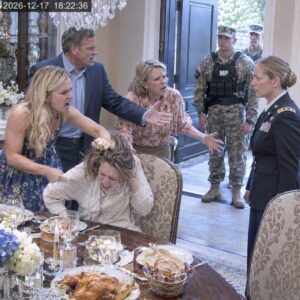
I removed the guest card from my jacket, placed it beside his money, and told him I wouldn’t accept another humiliation.
Then a woman behind him spoke my name, and his confident expression suddenly disappeared.
Colonel Bennett? she asked, stepping forward.
I turned and recognized Senator Caroline Mitchell, whom I’d worked with during a congressional military readiness briefing the previous year.
We were attending a fundraising gala at a luxury hotel in Richmond, Virginia.
My father, Richard Bennett, was a wealthy real estate developer and prominent political donor.
I was thirty nine, an Army lieutenant colonel with seventeen years of service.
My assignments included overseas deployments, operational planning, and advising military leadership on logistical challenges.
Dad had never approved of my career.
He believed success meant expensive property, influential connections, and a recognizable name among wealthy business executives.
When I joined the Army after college, he insisted I was wasting opportunities.
He’d wanted me to work in his company and eventually manage his investments.
For years, he’d introduced my younger brother, Daniel, as the family’s successful heir while describing me as someone who followed orders for a government paycheck.
Nevertheless, Dad personally invited me to the gala.
He said he wanted the family together for an evening honoring organizations supporting military families.
I arrived in a dark suit and approached the registration table.
The attendant couldn’t find my name, although Dad had confirmed the invitation days earlier.
When I called him, he appeared irritated.
He looked at the gathered guests before accusing me of trying to embarrass him at his own event.
Then he pressed the money against my chest and suggested I buy dinner somewhere ordinary.
He insisted that the service exit was less noticeable.
Senator Mitchell had witnessed enough to understand the situation.
She asked why Dad was treating a decorated military officer as an unwanted visitor.
Dad immediately changed his tone.
He claimed there’d been a misunderstanding involving seating arrangements and insisted he hadn’t intended to offend anyone.
I picked up my guest card but left the money on the floor.
Then I told Senator Mitchell that I appreciated her concern but intended to leave.
Before I reached the hallway, she explained that the evening’s program included a military family initiative I’d helped develop, and the organizers had expected me to speak.
I stopped beside the ballroom entrance.
Senator Mitchell explained that the nonprofit’s director had specifically requested my participation because of my experience supporting military families.
Dad stared at her.
He’d apparently assumed my invitation was merely a courtesy and hadn’t realized the organizers had contacted me independently.
I explained that I’d received an invitation from Dad but hadn’t seen the final program.
Senator Mitchell suggested we speak with the event director.
The director, Margaret Collins, greeted me warmly.
She confirmed that my recent work coordinating family support programs had informed several recommendations being presented that evening.
Margaret apologized for the registration confusion.
She explained that an updated guest list hadn’t included my name, although my speaking invitation remained valid.
I asked whether my presence would cause difficulties.
She answered that the organizers valued my experience and wanted me to participate if I felt comfortable.
Meanwhile, Dad approached and insisted that everything had been a harmless joke.
He claimed I’d misunderstood his intentions because military service had made me overly sensitive.
I looked at him and asked whether humiliating me before strangers was supposed to be entertaining.
He glanced toward the guests without answering.
Senator Mitchell quietly explained that public service shouldn’t be measured by income or fashionable connections.
Dad nodded, suddenly eager to end the conversation.
I decided to remain for the scheduled program.
I wasn’t interested in embarrassing Dad, but I refused to abandon work that mattered because of his behavior.
During dinner, Margaret introduced several families who’d received assistance through the nonprofit.
Their stories described employment disruptions, repeated relocations, and difficulties accessing community resources.
When my turn came, I spoke about the practical challenges military families faced during deployment and transition periods.
I focused on solutions rather than personal achievements.
I described the importance of coordinated housing support, employment assistance, and accessible services for spouses and children.
The audience listened carefully and asked thoughtful questions.
Afterward, several guests approached to discuss possible partnerships.
Their interest came from the program’s value, not from my father’s business connections.
Dad remained near the back of the ballroom.
When I approached to retrieve my coat, h
I told Dad that the organizers had invited me because of my professional experience.
His embarrassment came from his own behavior, not from anything I’d planned.
He insisted that I’d misunderstood his intentions.
I reminded him that he’d physically pushed money against me and ordered me to leave through a service entrance.
Dad looked toward the ballroom.
Several guests were still discussing the military family initiative, and his usual confidence seemed to have disappeared.
He finally admitted that he’d assumed I wasn’t important enough to attend.
The words came quietly, but they explained years of dismissive remarks.
I asked why he’d spent so much time measuring his children against wealthy acquaintances.
He answered that he’d wanted us to achieve more than he had.
I told him that achievement didn’t always involve money.
My work had taken me far from comfortable offices, but it had given me purpose.
Dad tried to change the subject by mentioning Daniel’s latest business expansion.
I stopped him and explained that my brother’s accomplishments didn’t diminish mine.
For the first time, Dad listened without immediately offering another comparison.
He admitted that he’d never fully understood what my military responsibilities involved.
I suggested that understanding required genuine interest, not expensive invitations or introductions to influential people.
Then I collected my coat and prepared to leave.
Senator Mitchell thanked me for participating and introduced me to a nonprofit representative interested in expanding employment assistance for military spouses.
We exchanged professional contact information and agreed to discuss possible cooperation through appropriate channels.
The conversation reminded me why I’d accepted the invitation.
Several days later, Dad called.
He apologized for the incident and admitted that the money he’d offered had been intended to humiliate me.
I accepted his acknowledgment but explained that our relationship couldn’t improve unless he stopped treating my career as something shameful.
He asked whether we could have dinner privately the following month.
I agreed to consider it, provided we could speak respectfully without comparing achievements.
That evening, I placed my military service photographs beside a framed picture of my family.
I remembered the hotel doorway, the discarded hundred dollar bill, and the guest card lying on the floor.
Dad had believed his wealth entitled him to decide who deserved respect.
But seventeen years of service had taught me that dignity wasn’t something powerful people could grant or remove.
I’d entered that ballroom hoping for a peaceful family evening and left knowing I no longer needed my father’s approval to feel proud of the life I’d chosen.