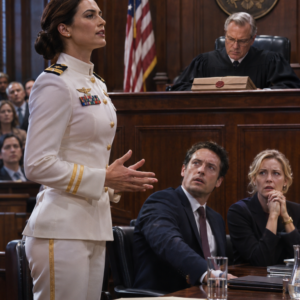
Seven months after my release, I walked into a courtroom again.
The smell almost made me turn around.
Polished wood.
Old paper.
Cold air.
My body remembered before my mind did.
I could hear my original verdict.
Guilty.
My knees weakened.
Amelia leaned toward me.
“You can step outside.”
“No.”
“You do not have to prove toughness.”
“I know.”
That helped.
I stayed.
The state had agreed to a hearing on my motion to vacate the conviction while its own review continued.
Not a ceremonial exoneration.
Not yet.
Evidence.
Witnesses.
Questions.
Loretta testified.
She was terrified.
Good.
Courage is more meaningful when fear is visible.
She admitted opening LMM Clinical Holdings.
Admitted she suspected wrongdoing.
Admitted staying silent.
Admitted allowing Trevor to tell people she was dead.
Then Amelia asked:
“Did Rebecca Hale know about your account?”
“No.”
“Did she direct the transfers?”
“No.”
“Did she ask you to conceal money?”
“No.”
“Who told you Rebecca was responsible?”
“My son.”
“Did you believe him?”
“For too long.”
Then the voicemail was played.
Trevor’s voice:
**She doesn’t know about your account.**
Silence in the courtroom.
I closed my eyes.
Those six words were not enough alone to undo everything.
But they were mine.
A piece of truth that had survived.
Then Monica testified.
My sister wore a dark suit.
No father’s watch.
I noticed immediately.
Where was it?
Irrelevant.
Still noticed.
She looked at me once.
Then avoided my eyes.
Under questioning, Monica admitted creating early invoices.
She admitted Grant helped establish the vendor.
She admitted Trevor discovered the theft.
She admitted they then used my authentication pathway to create the appearance I approved transfers.
I felt strangely empty hearing her say it publicly.
No explosion.
No vindication music.
Just sentences.
Then Amelia asked:
“Why Rebecca?”
Monica began crying.
“Because she owned the company.”
“That explains access.”
“It does not explain motive.”
Monica looked toward me.
“You want the truth?”
Amelia said:
“Yes.”
Monica’s voice cracked.
“I hated her.”
There it was.
Rebecca the successful one.
Rebecca with Dad’s approval.
Rebecca who opened a company.
Rebecca who hired her younger sister.
Rebecca who corrected Monica’s mistakes.
Rebecca who married Trevor.
Wait.
That one landed strangely.
I frowned.
Monica continued.
“Everyone thought Rebecca was brilliant.”
“She wasn’t.”
“She was lucky.”
“I worked as hard as she did.”
“Then ask for equity.”
Amelia said.
Monica looked down.
“I thought she would say no.”
The recurring disease.
People committing enormous harm rather than risk hearing one small word.
No.
Amelia continued.
“So you stole.”
“Yes.”
“Then Trevor discovered it.”
“Yes.”
“And joined.”
“Yes.”
“Then when investigators noticed the transfers?”
“We panicked.”
“Did Rebecca know?”
“No.”
“Did you knowingly produce documents that made her appear responsible?”
“Yes.”
“Did you testify against her?”
“Yes.”
“Did you know your testimony was false?”
Monica started sobbing.
“Yes.”
My stomach twisted.
Amelia let the silence sit.
Then:
“Why are you telling the truth now?”
Monica looked toward the prosecutor.
“Because I want to make it right.”
I almost stood.
Amelia’s expression barely changed.
“Is that the only reason?”
“Yes.”
My lawyer nodded.
Then the prosecutor rose.
Apparently Monica had forgotten that cooperation did not mean the state had stopped verifying her.
He played an audio recording.
One Monica did not know existed.
Loretta had recorded a call two months earlier.
Monica’s voice:
If I give them Trevor, they’ll reduce mine.
Grant too.
Rebecca gets cleared, everybody wins.
Loretta:
What about what you did?
Monica:
I was first, not worst.
Then:
**I’m not going to prison for four years because Rebecca already did.**
The courtroom went silent.
Monica closed her eyes.
I stared at her.
There.
The truth beneath the truth.
She regretted my conviction.
Maybe.
But she still understood prison primarily as something I had already paid on everyone’s behalf.
Like a family bill.
My time.
Their debt.
The prosecutor asked:
“Were you completely truthful when you said remorse was your only motive for cooperation?”
Monica whispered:
“No.”
Good.
At least eventually.
Trevor did not testify.
His lawyer advised him not to.
But the digital records spoke.
The texts.
The recovery authentication.
The sale documents.
His own voicemail.
Then Grant’s records.
Then Opal.
She testified about the acquisition.
The forged founder authorization.
Preserved servers.
Escrowed proceeds.
At one point Trevor’s attorney suggested Hargrove Healthcare Investments benefited financially from undermining the legitimacy of his sale.
Opal stared at him.
“My firm would have made more money if I had ignored all of this.”
“Then why didn’t you?”
She glanced at me.
“Because property acquired through fraud does not become clean simply because the buyer paid for it.”
My eyes filled.
Afterward, I whispered:
“That almost sounded noble.”
Opal said:
“Don’t spread it around.”
The judge took the matter under advisement.
I hated that phrase.
I had spent enough life under things other people were considering.
Three weeks later, Amelia called me.
“Sit down.”
I was in Opal’s kitchen.
I sat.
“The court granted the motion.”
I stopped breathing.
“What?”
“Your conviction is vacated.”
The spoon fell from my hand.
Opal stood.
Russell, who happened to be there, closed his eyes.
I whispered:
“Does that mean I’m innocent?”
Amelia was careful.
“The conviction is no longer valid.”
“The prosecutor has also informed me that, based on the new evidence, the state is dismissing the original charges against you.”
My entire body began shaking.
“Dismissed?”
“Yes.”
“Can they change their minds?”
“Under some extraordinary circumstances, legal questions can be complicated.”
“Amelia.”
She softened.
“They are filing dismissal paperwork.”
“The conviction that sent you to prison has been set aside.”
“You are not going back for that case.”
I covered my mouth.
Four years.
Not returned.
Nothing could return them.
But for four years I had been **Rebecca Hale, convicted felon.**
Now the government that once said guilty was saying:
Not this conviction.
Not this case.
Not anymore.
Opal sat beside me.
Still did not touch.
I reached for her.
Then she hugged me.
I cried into the shoulder of the woman who had hired me to cook because she wanted to decide whether I was lying.
Life has an ugly sense of humor.
Russell wiped his eyes.
“I don’t cry.”
Opal said:
“You’re crying.”
“Dust.”
“In my kitchen?”
“Old house.”
I laughed until I couldn’t breathe.
The dismissal did not magically restore everything.
My record required corrections across multiple systems.
Licensing applications had questions.
Background databases lagged.
Civil litigation remained.
Trevor, Monica, and Grant faced their own criminal cases based on evidence developed after my release.
I was advised not to narrate outcomes before they existed.
So I waited.
Monica eventually entered a plea covering her role in the fraud and false testimony.
Her cooperation affected the result.
It did not erase her responsibility.
Grant pleaded to financial crimes and forfeiture terms.
Trevor fought longer.
Then the evidence became too heavy.
He entered his own negotiated resolution.
I attended his sentencing.
Not because I wanted to see him punished.
I wanted to hear whether he would say my name.
He did.
“Rebecca.”
His voice broke.
“I told myself I was protecting what we built.”
I nearly laughed.
“What we built.”
Then:
“I knew she didn’t authorize the transfers.”
“She went to prison because I was afraid of losing everything.”
He looked toward me.
“I lost it anyway.”
That was true.
His business position.
His reputation.
Our marriage.
The house.
Much of the money.
Years of freedom.
Then:
“I am sorry.”
I did not nod.
Did not forgive him publicly.
Did not give him a final look that made his confession meaningful.
His remorse belonged to him.
My healing did not have to perform for it.
When the hearing ended, I walked outside.
Monica was in another part of the case process.
I had not spoken to her since the threat in Opal’s yard.
Then someone called:
“Rebecca.”
I turned.
My sister stood twenty feet away with her lawyer.
On her wrist—
Dad’s watch.
Of course.
I walked toward her.
Her attorney tensed.
I stopped several feet away.
“Why are you still wearing that?”
Monica touched it.
“Because it was Dad’s.”
“He gave it to me.”
“He was my father too.”
“Yes.”
I said.
“He was.”
Her face changed.
She expected a fight.
I was tired of objects carrying more than they could hold.
“Keep it.”
Monica stared.
“What?”
“Keep the watch.”
“Rebecca—”
“I don’t need it to prove he loved me.”
Her eyes filled.
I continued.
“You can keep the watch.”
“You cannot keep my life.”
Then I walked away.
That felt better than taking it back.