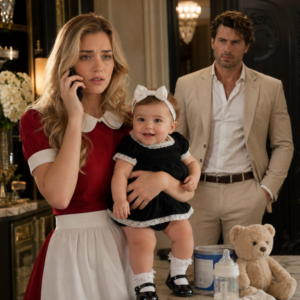
The moment my brother-in-law announced that my father’s entire $3 million inheritance belonged to his wife, the lawyer sitting across from him actually choked on his coffee.
We were standing in a private conference room at a law firm in Chicago, barely forty minutes after my father’s funeral.
My sister, Vanessa, sat beside her husband, Richard, wearing black designer sunglasses and holding a designer handbag that probably cost more than my monthly mortgage payment.
Richard stood at the head of the table, one hand resting confidently on a folder he had brought from home.
“Let’s not make this more complicated than necessary,” he announced. “Vanessa is the oldest daughter.
According to family tradition, the stocks, investment accounts, and the entire three-million-dollar inheritance should go to her.”
I stared at him.
Then I looked at my father’s attorney, Mr.
Harrison.
He pressed his lips together.
Richard interpreted our silence as agreement.
“My wife has always been Dad’s favorite,” he continued. “She deserves everything.
There’s no reason her younger sister should interfere with that.”
I slowly put down my cup.
“Did you just say everything?”
Richard smirked.
“Yes, Emily.
Everything.
You can have the family photographs or whatever sentimental things you want.
But the money belongs to Vanessa.”
Vanessa finally removed her sunglasses.
“Please don’t turn this into a fight, Emily.
Richard is only trying to make sure Dad’s wishes are respected.”
I almost laughed.
Almost.
Because there was one little detail my brother-in-law apparently hadn’t considered.
My sister was not my father’s biological daughter.
And more importantly, she had been legally adopted into our family under circumstances that made Richard’s little inheritance speech particularly embarrassing.
But that wasn’t even the biggest problem.
I turned toward Mr.
Harrison.
“Would you like to explain it, or should I?”
The attorney finally lost control.
He burst out laughing.
Not a polite chuckle.
Not a nervous laugh.
He actually leaned back in his chair, covered his mouth, and laughed until his eyes watered.
Richard’s face turned crimson.
“What exactly is so funny?”
Mr.
Harrison wiped his eyes and opened the leather briefcase beside him.
“Richard, before you make another statement about who owns your father-in-law’s estate, I strongly recommend you read this document.”
He slid a sealed envelope across the table.
Vanessa stared at it.
Richard snatched it up, tore it open, and began reading.
His expression changed almost immediately.
First confusion.
Then disbelief.
Then something dangerously close to panic.
“What is this?” he whispered.
I leaned forward.
“That’s the question you should have asked before announcing that my father’s money belonged to your wife.”
Mr.
Harrison placed another document on the table.
“And there’s something else,” he said quietly. “Something your wife apparently hasn’t told you.”
Vanessa suddenly grabbed Richard’s arm.
“Don’t read that.”
But it was already too late.
Because the name printed at the bottom of the document wasn’t Vanessa’s.
It was mine.
And the next sentence would destroy everything Richard thought he knew about our family.
The room went completely silent as Richard stared at my signature.
My sister’s hands began trembling, and for the first time that afternoon, her confidence disappeared.
But what the attorney revealed next was far more shocking than the inheritance itself.
Richard looked from the document to me, then back to the attorney.
“Why is Emily’s name on a document concerning Vanessa’s inheritance?”
Mr.
Harrison folded his hands.
“Because this document concerns the legal ownership of the estate, and Emily is the sole beneficiary named in your father-in-law’s most recent will.”
Vanessa shot to her feet.
“That’s impossible!
Dad promised me the house, the investments, everything!”
I watched her carefully.
“Dad promised you a lot of things, Vanessa.
He also promised me that neither of us would ever have to fight over his money.”
Richard slammed the paper onto the table.
“This is ridiculous.
Vanessa is the oldest daughter.
She has every right to inherit.”
Mr.
Harrison adjusted his glasses.
“Being the oldest child does not automatically establish inheritance rights in Illinois.
Your father was free to distribute his estate according to his wishes.”
He opened a second folder.
“Your father executed his final will eleven months ago.
It was properly witnessed and notarized.
He also completed the necessary estate-planning arrangements for his investment accounts.”
Richard shook his head.
“Then we’ll contest it.”
“You’re welcome to pursue whatever legal options you believe you have,” the attorney replied. “However, I suggest you understand the circumstances before doing so.”
He turned toward Vanessa.
“Your father knew about the financial problems in your marriage.”
Vanessa went completely still.
I felt my stomach tighten.
Financial problems?
I knew Richard had lost money in a failed restaurant investment.
I knew he’d been borrowing from friends.
But I had no idea Dad had been investigating him.
Mr.
Harrison continued.
“Your father discovered that approximately $186,000 had been transferred out of an account he had allowed you to access for household emergencies.”
Vanessa’s face drained of color.
Richard immediately interrupted.
“That money was a gift!”
“No,” I said.
Everyone turned toward me.
“Dad told me about those withdrawals.”
Richard pointed at me.
“You knew?”
“I knew something was wrong.
I didn’t know how much.”
Mr.
Harrison removed a printed bank statement.
“The transfers were made to a company registered under Richard’s name.
Your father confronted him about it three months before his death.”
Vanessa turned toward her husband.
“You told me that money came from your business!”
Richard refused to look at her.
Then the attorney revealed the first real twist.
“The $3 million inheritance was never intended to be distributed directly to either daughter as cash.
The majority was placed in a trust structure.
Your father appointed an independent trustee and established specific protections against claims from spouses, creditors, and unauthorized withdrawals.”
Richard’s jaw tightened.
“So Emily controls the money?”
“No,” Mr.
Harrison answered. “Emily is the primary beneficiary.
She does not have unrestricted authority over the trust.”
I could see Richard calculating.
He had expected three million dollars to fall into his wife’s hands.
He had already imagined paying off his debts, buying another property, and rebuilding his failed business.
Now that fantasy was disappearing.
But Vanessa wasn’t finished.
She reached into her handbag and pulled out a folded document.
“Fine.
Then explain this.”
She placed it in front of the attorney.
“Dad signed this two years ago.
It says I receive his entire estate.”
Mr.
Harrison studied the paper.
His expression changed.
For several seconds, he said nothing.
Then he looked directly at Richard.
“Where did you obtain this document?”
Richard smiled again.
“From my wife’s personal files.”
The attorney slowly removed his glasses.
“Because this is where the situation becomes considerably more serious.”
He turned the document around.
And I recognized the signature immediately.
It looked like my father’s.
But there was one detail that made my blood run cold.
The date printed beneath his signature was three weeks after the day my father had entered the hospital unconscious.
Mr.
Harrison picked up his phone.
“I think we need to contact the authorities before anyone leaves this room.”
Richard stopped smiling.
Vanessa looked at the document as if it had suddenly become something alive and dangerous.
“What do you mean, contact the authorities?” she demanded.
Mr.
Harrison placed the paper inside a transparent document sleeve.
“I mean this document appears to have been created after your father lost the legal and physical capacity to sign anything.
We will need to establish its authenticity.”
Richard stood up.
“This is a family matter.
There’s no reason to involve the police.”
“Then you should have no reason to be concerned about an investigation,” I replied.
He glared at me.
“You think you’re clever, don’t you, Emily?”
“No.
I think you’re frightened.”
Vanessa grabbed the paper.
“Dad signed it.
I watched him sign documents all the time!”
Mr.
Harrison calmly retrieved it.
“Not this one.
Your father’s medical records indicate that he was unconscious and receiving intensive care on the date shown here.”
Vanessa’s lips parted.
Richard immediately stepped between her and the attorney.
“She must have the date wrong.
That’s all.”
But Mr.
Harrison wasn’t interested in excuses.
He called his office manager and requested that she bring the original estate records from the firm’s secure archive.
While we waited, I watched my sister.
For years, Vanessa had been the person everyone noticed first.
She was confident, charming, and exceptionally good at making people feel that disappointing her was somehow their fault.
She had been adopted when she was six, after our parents spent years trying to have another child.
Dad and Mom had never treated her differently.
They gave her the same opportunities, the same affection, and the same place in the family.
Yet Vanessa had developed a strange obsession with being the oldest daughter.
She believed that being first meant being entitled to more.
And Richard had encouraged that belief.
When the archive records arrived, Mr.
Harrison placed three documents side by side.
The first was my father’s original will.
The second was his final will.
The third was the suspicious document Vanessa had brought.
“Your father’s signature was examined during the preparation of his final estate plan,” he explained. “We also have several authenticated signatures from the same period.”
He pointed to the suspicious document.
“Notice the unusual upward stroke on the final letter of his surname.”
I leaned forward.
I knew that signature.
Dad always wrote the final letter of his last name with a small downward hook.
He had done it for as long as I could remember.
The document in front of us had a perfectly smooth ending.
It looked convincing at first glance.
But it wasn’t his handwriting.
Richard’s face had become almost gray.
Mr.
Harrison continued.
“Your father also instructed us to preserve correspondence concerning anyone who attempted to influence the distribution of his estate.”
He opened another folder.
Inside were printed emails.
And one of them had Richard’s name at the top.
I recognized the date immediately.
It was from four months before Dad died.
The message read:
If you want Vanessa to inherit everything, we need to make sure Emily doesn’t get involved.
She trusts you, so you can handle the conversation.
Once the documents are signed, there won’t be anything she can do.
I stared at Richard.
He shook his head.
“That’s out of context.”
Mr.
Harrison opened the next email.
This one was even worse.
It contained a discussion about obtaining an older copy of my father’s signature and reproducing his handwriting.
Vanessa slowly stepped away from her husband.
“You told me Dad had already changed his will.”
Richard turned toward her.
“Vanessa, listen to me.”
“You told me the money was ours!”
“It would have been ours if your sister hadn’t interfered!”
I finally understood.
He had never been fighting for Vanessa’s inheritance.
He had been using her name as a doorway into my father’s estate.
The attorney then revealed something neither of them had anticipated.
My father had anticipated Richard’s attempts to gain control.
Months before his death, Dad had arranged for an independent forensic accountant to review his financial records.
That investigation uncovered the $186,000 in transfers, several unauthorized attempts to access investment information, and evidence that Richard had been preparing documents that appeared to misrepresent my father’s wishes.
The suspicious inheritance document wasn’t an isolated mistake.
It was part of a much larger pattern.
And Dad had left instructions that the evidence should be provided to the appropriate authorities if anyone attempted to enforce it.
Vanessa sank into her chair.
“Did Dad know?” she whispered.
Mr.
Harrison softened his voice.
“He knew enough to protect the estate.
But he also made it clear that he didn’t want either of his daughters punished for someone else’s decisions.”
I felt tears gathering in my eyes.
That sounded exactly like Dad.
He had always believed that money revealed people’s priorities.
He also believed that love shouldn’t require someone to surrender their judgment.
Then Mr.
Harrison handed me a final envelope.
“This was written specifically for you and your sister.
Your father asked that it be opened in the presence of both of you.”
My hands trembled as I unfolded the letter.
Emily and Vanessa,
If you’re reading this together, then I hope you have remembered that you are sisters before remembering that you are heirs.
I have spent my life trying to give both of you a home where neither of you would ever feel less important than the other.
Vanessa, you became my daughter the day I carried you through our front door.
Nothing about biology could ever change that.
Emily, you were my first child, but that never meant you were entitled to more love.
I am leaving the estate to Emily because I trust her to protect it, not because I love Vanessa less.
The trust has been established to ensure that neither of you can lose your future because of another person’s debts or decisions.
I have also arranged for Vanessa to receive a separate educational and housing allowance, administered independently, should she ever need help rebuilding her life.
Please don’t let money become the final thing you remember about me.
Dad.
I couldn’t finish reading without crying.
Vanessa covered her face.
For the first time that afternoon, she wasn’t arguing about the money.
She was crying about our father.
Richard, however, was still trying to save himself.
“This letter proves nothing.
I never forged anything.”
Mr.
Harrison calmly closed the folder.
“That is for the investigators to determine.”
Over the following weeks, the situation unfolded exactly as Dad’s estate attorney had anticipated.
The suspicious document was submitted for forensic examination.
Investigators reviewed the financial transfers, the correspondence, and the records of Richard’s company.
The investigation eventually established that Richard had used my father’s access arrangements to transfer money without authorization.
The forged inheritance document became part of the evidence examined in the broader case.
Vanessa cooperated with investigators after discovering that Richard had concealed the financial transactions from her.
Their marriage collapsed.
Richard faced criminal proceedings related to the financial misconduct and document fraud.
The money he had transferred was pursued through the appropriate legal channels, and the estate remained protected by the trust.
I never received three million dollars in a check.
Instead, I became the primary beneficiary of a carefully structured estate containing investment accounts, stocks, and property interests.
An independent trustee administered the assets according to Dad’s instructions.
Vanessa eventually moved into a smaller apartment and began rebuilding her life.
Six months after the funeral, she called me.
“Emily, can we meet?”
We sat together in a small restaurant near our childhood neighborhood.
She looked exhausted.
“I owe you an apology,” she said.
I didn’t interrupt.
“I spent so much time believing I deserved more because I was the oldest daughter.
Richard kept telling me that Dad’s money would solve everything.
I believed him.”
She looked down at her hands.
“I didn’t even ask what Dad actually wanted.”
I thought about the funeral, the conference room, and Richard’s ridiculous announcement.
Then I remembered Dad’s letter.
“You’re still my sister, Vanessa.”
She began crying.
“I don’t expect you to forgive me.”
“I don’t know if I can forget what happened,” I answered. “But I don’t want Dad’s last gift to become the reason we never speak again.”
We didn’t magically repair everything that afternoon.
Trust takes longer than an apology.
But we started talking again.
And when Vanessa eventually used the housing assistance Dad had arranged, I made sure she understood that it wasn’t charity from me.
It was something our father had planned because he loved both his daughters.
A year later, I returned to Mr.
Harrison’s office to finalize another part of the estate administration.
He handed me a small wooden box Dad had left in his care.
Inside was an old photograph of the three of us.
Vanessa was sitting on Dad’s shoulders, while I held his hand.
On the back, Dad had written:
Two daughters.
One family.
No competition necessary.
I stood there for a long time, holding that photograph.
Richard had walked into the lawyer’s office believing that being married to the oldest daughter entitled him to three million dollars.
He left with an investigation hanging over his head, a marriage in ruins, and the discovery that my father had seen through him long before the funeral.
And the lawyer?
He later admitted that he had laughed because Richard had confidently announced his claim just seconds before the attorney was about to reveal that Dad had already prepared for exactly that situation.
The inheritance had never been the real surprise.
The surprise was that my father had known precisely who would try to steal it.
And he had made sure they couldn’t.