Part 6 – The Birthday We Chose
“I’m not the only one who has been waiting to see you.”
The words stayed between us, suspended in the quiet of my study.
I looked at Rosa.
She had gone very still, one hand resting against the photograph in its protective sleeve.
Marco’s expression had tightened, but he kept his voice calm.
“Who else?” I asked.
My father drew a slow breath on the other end of the line.
“Rosa.”
Her eyes closed.
“I told Mercer she might come,” I said.
“I know,” Frank replied. “I hoped she would.”
Rosa reached for the phone, then stopped and looked at me.
I held it out to her.
She accepted it with both hands.
“Frank,” she said.
For a moment, the years seemed to fall away, leaving only the old affection in her voice and the careful hurt beneath it.
“Rosa,” he answered. “I’m sorry.”
She looked down at the blanket over her knees.
“I’ve heard that before, in my own head.”
“I should have said it to you years ago.”
“You should have said a great many things.”
“I know.”
She closed her eyes again, and I saw how much effort it took not to let the conversation become either a forgiveness or a farewell.
“Why did you ask if I would come?” she said.
“Because I want Vincent to hear the truth from me, but I don’t want to pretend I’m the only person I hurt.”
Rosa’s thumb moved along the phone’s edge.
“That’s a better beginning than I expected.”
“I don’t know if I’ve earned one.”
“No,” she said gently. “You haven’t.”
My father accepted the answer without argument.
“We’ll see you tomorrow,” I said.
“Yes.”
“And Frank?”
“Yes, Vincent?”
“If there’s something you haven’t told us, don’t save it for the meeting.”
A pause followed.
“I don’t believe there is,” he said. “But I’ll answer whatever you ask.”
I ended the call before either of us could soften the promise into something easier than the truth.
The next morning, Rosa came to the historical center with me and Marco, who waited in a nearby room with the door open and a clear view of the entrance.
The meeting room was small and bright, with tall windows overlooking a quiet garden.
I set the photograph on the table between the chairs.
Rosa chose the seat nearest the window.
I remained standing until the door opened.
Frank Moretti was older than the man in my memories, but I recognized him at once.
His hair had turned almost completely white, and the lines around his eyes were deeper than I expected.
He carried himself carefully, as if every movement had been considered before he made it.
For a few seconds, neither of us spoke.
Then his gaze went to the photograph.
“I remember that cake,” he said.
His voice was rough, but unmistakable.
“I don’t.”
“I know.”
He looked at me, and I saw something in his face I had never had the chance to see as a child: not distance, but a fear of being rejected before he had earned the right to stay.
He pulled out a chair and waited.
I sat.
Rosa did not move from her place by the window.
Frank kept his hands on the table, palms down.
“I won’t ask you to forgive me,” he said. “I won’t ask you to understand everything today.”
“Good.”
“I left because I thought the people connected to the property might come after you if they knew you were the reason it had been sold.”
“Were they looking for me?”
“They were looking for leverage. You were a child, and your life had already been frightening enough.”
“So you decided the best way to protect me was to disappear.”
“Yes.”
“Did you ever think about what that would do to me?”
His eyes lowered.
“I did.”
“And you left anyway.”
“Yes.”
The answer was plain, without excuses folded around it.
“I thought distance would hurt less than danger,” he said. “I was wrong about how much it would hurt. I was wrong to believe I could make that choice for you and leave no harm behind.”
I looked at his hands.
I remembered those hands only in fragments: guiding me across a street, fastening a winter coat, resting briefly on my hair.
“I grew up believing you didn’t want me,” I said.
“I know.”
“No, you don’t. You weren’t there for the birthdays I hated, or the school nights when I watched the door. You weren’t there when I stopped asking when you were coming back.”
His face tightened, but he did not look away.
“You’re right,” he said. “I wasn’t there.”
I had expected him to defend himself, perhaps to insist that he had done what he had to do.
Instead, he let the truth remain where I had placed it.
That did not ease the pain.
It did make room for me to keep listening.
“Why did you never come back after the danger passed?” I asked.
“I didn’t know when it had passed.”
“Didn’t you have anyone who could check?”
“I had people checking on the old connections, but I was cautious. Then your life grew larger than I could enter without bringing my past with me.”
“Did you know what my life became?”
“I knew you were successful. I knew you were safe, or at least that was what I told myself.”
“You stayed away because you thought I didn’t need you anymore?”
“Partly.”
“That isn’t a good reason.”
“No,” he said. “It was an excuse that sounded safer than admitting I was afraid you would look at me and see a man who had left.”
I glanced at Rosa.
She was listening with her hands folded, her expression sad but steady.
“You let Rosa carry the cost too,” I said.
Frank turned to her.
“I did.”
“You told me to go because you believed it would protect Vincent,” Rosa said. “You didn’t ask what I believed.”
“I should have.”
“You could have trusted me with the truth.”
“I should have.”
“And when you didn’t, I had to live with a promise I barely understood.”
Frank lowered his head.
“I’m sorry, Rosa.”
She studied him for a long moment.
“I believe you’re sorry,” she said. “I don’t know what that changes yet.”
“Nothing you don’t want changed.”
For the first time, something in her expression eased.
She had not forgiven him completely, and he had not asked her to.
That mattered.
I touched the edge of the photograph.
“What happened that day at the bakery?”
Frank’s gaze settled on it.
“Your treatment had succeeded, and your mother wanted to celebrate somewhere familiar. She said if we went home, we’d spend the evening talking about hospitals and bills.”
A small, aching smile touched his face.
“She wanted cake, coffee, and one ordinary birthday.”
“The receipt says you paid for the private room.”
“I wanted her to have a place where she could speak without people asking questions. She had been trying to decide whether to tell you about your heart.”
“Why was it written as her birthday celebration?”
“Because it was her birthday, and because Elena thought calling it a celebration for you would make you uncomfortable when you were older.”
“Did she know she was sick?”
Frank looked at Rosa before answering.
“She knew something was wrong, but she didn’t understand how serious it was. She planned to talk to you after supper, then she became ill before she could.”
Rosa folded her hands more tightly.
“She seemed cold,” she said. “I remember taking her coat from the car.”
“I remember,” Frank replied. “You were helping her while I spoke to the owner.”
“Why did you leave?”
“I had to make a call about the property. I thought I’d be back before the cake was brought in.”
“You weren’t,” Rosa said.
“No. I wasn’t.”
The apology in his voice did not erase the memory, but it gave the empty space around it a shape.
I turned the photograph over in its sleeve.
“Mom hid another letter behind the frame.”
“I wondered if she had.”
“You knew about it?”
“I knew she wrote more than one letter. I didn’t know where she placed the second.”
I watched his face.
“Why didn’t you tell me where the first one was?”
“I didn’t know Rosa had it. I thought it had been lost.”
“You could have asked.”
“I could have.”
He did not try to make the past sound unavoidable.
That was harder to resist than any polished explanation.
I took the note he had written to Dr. Bell from my coat pocket and placed it beside the photograph.
“Do not let him believe this was his fault.”
My father read the words, and his eyes closed for a moment.
“I wrote that because I knew how easy it would be for you to blame yourself for what happened.”
“I never knew enough to blame myself.”
“I hoped you wouldn’t.”
“Did you know Dr. Bell kept checking on me?”
“He agreed to keep your medical history private and to make sure you were getting appropriate care. I paid him because he had helped us, and because I wanted to know you were well without asking anyone to break your confidence.”
“Why the false name?”
“The people who had questions about the property were watching the family’s accounts. I did not want your name connected to the payments.”
“Were those payments debts?”
“Some were medical bills. Some were the cost of keeping the records and checkups private.”
“And the property sale?”
“It covered your treatment. I signed it over because I could not think of anything more important than giving you the chance to grow up.”
He looked at me.
“I’m not saying that as a reason you owe me. You don’t.”
I had not realized how much I feared he might ask for gratitude.
The relief of not hearing that request was small, but real.
“What happened to the people who were looking for leverage?” I asked.
“They stopped asking after the property changed hands and the old agreements were settled. By then, I had learned to live as if returning would start the questions again.”
“That was your decision too.”
“Yes.”
“You could have come back sooner.”
“Yes.”
“You could have sent me a letter.”
“Yes.”
“You could have trusted me with the truth.”
His gaze held mine.
“I should have.”
The words did not restore the years between us.
They did not need to.
For the first time, he was not asking me to pretend the loss had been necessary in every way.
I sat with that for a while.
“Are you staying?” I asked.
“If you’ll let me.”
“For how long?”
“As long as you want me to. Or until you tell me to go.”
“I’m not ready to decide that.”
“I understand.”
“Don’t come back and expect me to become the boy in the photograph.”
“I won’t.”
“And don’t expect me to call you Dad just because you’re here.”
“I won’t.”
“I might be angry tomorrow. I might be angry next week.”
“You have every right.”
“I may ask the same questions more than once.”
“I’ll answer them.”
I looked toward Rosa.
“And you’ll have to speak to her too.”
Frank nodded.
“I owe her that.”
Rosa met his eyes.
“You owe me honesty, not a performance.”
“I’ll try.”
“Trying is a beginning,” she said. “It isn’t the end.”
“I know.”
The meeting lasted longer than I expected.
We spoke about small things as well as the hard ones: my mother’s habit of humming while she cooked, the bakery’s cinnamon rolls, the old family house that had stood near the river before it was sold.
Frank remembered the silver spoon Elena had misplaced three times in one week.
Rosa remembered the way he used to burn toast and insist it was supposed to be dark.
I discovered that they could laugh together, though neither laughed freely at first.
I discovered that Frank’s memories of me were not the polished memories of a man trying to win his way back.
He remembered the way I used to sleep with one hand curled around the edge of my blanket.
He remembered that I hated peas and loved orange slices.
He remembered a song my mother sang to me when I had been ill, though he could not recall all the words.
“I kept those memories,” he said. “I didn’t know what else I could keep without making your life harder.”
“That sounds like something you would say now because you know it sounds sad.”
“Maybe,” he said. “But it’s true.”
I could not tell whether believing him would ever become easy.
I could tell that I wanted to keep hearing him.
When we left the historical center, Marco drove us back in quiet.
Rosa sat beside me, while my father rode in the back, his gaze following the passing trees.
We had not decided where he would stay, or how much of his life he would bring back with him.
We had only agreed that he would not disappear again without telling us why.
For now, that was enough.
The following weeks did not unfold like a story in which one conversation healed every wound.
My father stayed at a quiet house outside the city while Marco and his team reviewed the old protection arrangement.
We met in careful, ordinary places: the garden at the historical center, a neighborhood café, the small park where Rosa used to take me as a child.
Frank answered my questions without asking me to soften them.
Sometimes I asked about the hospital.
Sometimes I asked why he had not written.
Sometimes I asked nothing at all, and we sat together while the afternoon moved around us.
Rosa began calling him when she had something she wanted to say.
At first, their conversations were brief.
Then they became longer, less guarded, filled with memories that did not all agree.
They corrected each other.
They apologized.
They learned that forgiveness was not a door one person opened for the other, but a path they would have to walk at a human pace.
I kept the North Point operation under its temporary manager.
The loss of direct control cost me money and influence, and it forced me to reconsider how much of my identity depended on being the one who held every decision.
The people around me adjusted.
Some were resentful.
Others were relieved to discover that a family matter could take priority without the world ending.
Marco remained close, but he stopped treating every quiet moment as a problem to solve.
At home, Ellie’s drawing stayed on my desk.
Its crooked figures reminded me every day that love did not need perfect lines to hold people together.
The next birthday came sooner than I expected.
Rosa suggested we return to the bakery.
Frank did not say whether he wanted to go, but he showed up early and helped Marco carry a box of candles inside.
The bakery had new tables and fresh paint, though the old brick walls remained.
The owner had reserved the small room at the back for us.
There were no banners, no speeches, and no crowd of people who needed to be impressed.
There was a cake, coffee, and a bowl of cinnamon rolls Ellie insisted were for “emergency snacks.”
Rosa sat beside me.
Frank took the chair across from us, close enough to be part of the table and far enough not to assume anything.
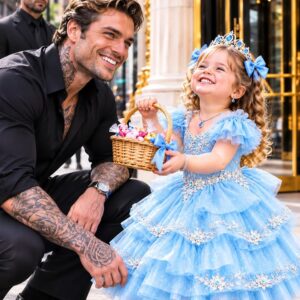
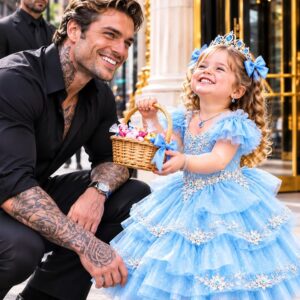
Ellie climbed into her chair, her silver tiara tilted at an angle.
“I made a new rule,” she announced.
“What’s the rule?” I asked.
“No secrets at birthdays.”
Rosa’s eyes moved to mine.
“That sounds like a good rule.”
“It is,” Ellie said. “Also, five dollahs.”
“For what this year?” Frank asked.
“Song, picture, and hug.”
“That’s a generous package,” I said.
“Five dollahs,” she repeated.
I handed her a five-dollar bill.
She tucked it into the pocket of her dress with the solemnity of a professional collecting payment.
Then she stood on her chair and began to sing.
“Happy birfday to yooou…”
Her voice wavered through the familiar tune.
At the line she had once forgotten, she glanced at me and made up her own words.
“Happy birfday, Mister Vinny, you are not alone…”
The room became very quiet.
I looked at the people around the table.
Rosa, who had kept the photograph safe even when she did not know what it meant.
Frank, who had returned without asking me to forgive him.
Marco, who had learned that protecting me did not always mean keeping the past outside the door.
Ellie, who had drawn all of us together before she knew there was anything to mend.
And my mother, present in the photograph beside the cake.
When Ellie finished, she held out one small hand.
“Now the hug.”
I rose and gathered her carefully against me.
She hugged my neck with all the strength her little arms could manage.
Then, after a moment, she reached one arm toward Rosa and the other toward Frank.
“Everybody.”
Rosa leaned in first.
Frank waited until I looked at him.
I gave a small nod.
He joined us gently, his hand resting on my shoulder without claiming more than I had offered.
For one quiet moment, we held each other around the little girl in the tiara.
No one asked me to forget what had happened.
No one asked me to call the past harmless.
We simply stayed.
When Ellie pulled back, she examined our faces.
“See?” she said. “Everybody together.”
I looked at the photograph beside the cake, then at the people gathered around me.
For years, I had thought birthdays marked what I had lost.
This one marked something else: not a repaired past, but a future we were choosing honestly, one conversation at a time.
I blew out the candles.
This time, I did not wish for a different childhood or an answer that could erase the years.
I wished for another birthday with the truth spoken plainly, the cake shared freely, and the people I loved still at the table when the candles went dark.
**–THE END–PLEASE
Share your thoughts or feedback to motivate us to create more stories ♥️
* * *
[PREVIOUS: PART 5](https://puretales.idolsgift.com/blog/part-5-the-letter-beneath-the-photograph15-026)