Part 6 – The Door Opens on Her Terms
Peter’s question remained with me after the call ended.
If the figure in the reflection was not Gordon, who else had been helping him?
I looked at Arthur’s letter, then at the old compass sealed away in Peter’s office, and understood that the answer would not come from staring harder at a photograph.
It would come from the people who had been there, and the records they had left behind.
The court’s examiner studied the image for several days.
When the report arrived, Peter called Miriam and me into his office.
The figure in the glass was not Arthur.
It was a man wearing Arthur’s old coat and holding the brass compass, but the face belonged to Gordon Pike.
“He must have taken the coat from the house,” I said.
Peter nodded.
“Or had access to it before you began sorting Arthur’s things.”
The photograph had been taken on the day Daniel tried to stop the withdrawal.
Gordon had brought the compass to the office as part of a deliberate performance, a way to make Daniel believe Arthur’s wishes were present even when Arthur was not.
The image did not prove everything, Peter reminded us, but it joined other evidence: records showing Gordon’s office had submitted the forged signature, bank notes documenting Daniel’s objection, and messages in which Vanessa discussed the transfers before they were explained to the bank.
There was also the matter of the authority form bearing my name.
The handwriting examiner found that my signature had been copied from a tax document in Gordon’s files.
I had signed the original tax form years earlier, unaware that it would later be used to make a false authority look familiar.
The evidence did not arrive all at once.
It came in careful pieces, each one checked and checked again, until the pieces began to tell the same story.
Gordon had been draining the estate through accounts and false paperwork for years.
Arthur had discovered the theft and tried to move what remained into a protected account for me.
Gordon used Arthur’s own signature to make the account appear to be part of the scheme, then persuaded Daniel that his father had asked him to keep me from taking the family’s money.
Vanessa, facing debts she had hidden from Daniel, helped route the funds through accounts she controlled.
She used the injuries as a second kind of evidence, turning moments of harm into a story about my inability to care for myself.
The injuries were real.
So was Daniel’s part in them.
He had shoved me during an argument and had allowed the guardianship petition to describe the bruises as falls, though he knew I had told him otherwise.
He had not known Vanessa planned to use the injuries as evidence, and he had not understood how far Gordon’s fraud reached.
That explained his choices.
It did not erase them.
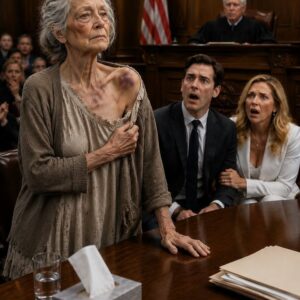
When the hearing resumed, the courtroom felt smaller than it had the first time.
Perhaps because I no longer had to carry every unanswered question into it.
Judge Mercer reviewed the new records, listened to the bank investigator, and heard Peter explain how Arthur had tried to protect the remaining funds.
Daniel testified after them.
He spoke without looking toward Vanessa, though his hands trembled against the rail.
He admitted that he had believed Gordon’s false letter without verifying it.
He admitted that I had told him my injuries were not falls.
He admitted that he had gone ahead with the guardianship petition anyway.
He described the transfer he tried to stop, and the moment he let Vanessa persuade him that the bank’s approval meant there was nothing more to ask.
“I wanted to believe the person who made my fear sound manageable,” he said.
“I did not ask my mother what was true, and I did not listen when she told me.”
The courtroom stayed silent.
Daniel took a breath.
“I was responsible for what I chose, even when I was misled about the money.”
I watched him as he spoke.
He did not ask me to rescue him from the consequences.
That, too, was a choice.
Vanessa’s testimony was brief and carefully phrased.
She acknowledged arranging transfers but said she believed the money had been authorized.
The bank records and her own messages showed otherwise.
Gordon’s attorney argued that the paperwork had been misunderstood and that Arthur had intended the transfers as part of estate planning.
The examiner’s findings, Arthur’s letter, and the records from Gordon’s office contradicted that account.
By the time the judge finished, the central questions had been answered.
The guardianship petition was denied.
The court found no basis to remove me from my home or give anyone control of my finances.
My accounts were restored to my sole authority, and the bank placed the remaining protected funds beyond Gordon’s reach while the estate claim proceeded.
The court also referred the evidence of assault and financial fraud to the appropriate authorities.
I had once believed that seeing the truth clearly would feel like victory.
Instead, I felt the quiet ache of watching a family become a set of facts for strangers to examine.
Outside the courtroom, Daniel stood at a distance while Peter spoke with the clerk.
Vanessa had left with her attorney.
Gordon had been taken away for further questioning, his once-polished confidence gone beneath the weight of records he could no longer explain.
Daniel waited until I turned toward him.
“I’ll cooperate with the investigation,” he said.
“I know.”
“I’ll testify about what I saw and what I failed to do.”
“Good.”
“And I’ll make restitution for my part in the harm, as the court orders.”
I studied his face.
He looked older than he had when the case began, though perhaps I was only seeing him without the certainty he had once worn.
“There are conditions,” I said.
“I expected that.”
“You will not come to the house without my permission.”
“I understand.”
“You will not handle my money, my papers, or my medical decisions.”
“I understand.”
“You will complete the treatment the court approves and follow the no-contact period while it is in place.”
He nodded.
“I will.”
“And when that period ends, you will not take silence as an invitation or forgiveness as a guarantee.”
“I won’t.”
It would have been easier if he had asked me to forgive him.
Then I could have said no and allowed anger to carry the rest.
Instead, he stood there without asking for anything.
“I don’t know what our relationship will be,” I said.
“Neither do I.”
“I can’t promise it will become what it was.”
“It shouldn’t.”
That answer surprised me.
Daniel’s eyes lowered, then lifted again.
“I can only try to become someone you might trust again.”
I wanted to believe that was possible.
I did not yet know if it was.
“Then start by keeping your promises when no one is watching,” I said.
“I will.”
He left without reaching for me.
I watched him go, feeling both the loss of what had been and the small, uncertain space in which something different might one day grow.
The weeks that followed were difficult, though less mysterious.
Vanessa and Gordon were charged with financial crimes and with their roles in the assault and deception surrounding the guardianship.
Their accounts were traced, the remaining funds recovered, and the false records preserved.
When the cases reached court, the evidence held.
Vanessa was convicted of financial fraud and assault.
Gordon was convicted of fraud, forgery, and the theft of estate funds.
The sentences were measured by the court, not by me, and I did not attend every hearing.
I had spent enough time in courtrooms to know that accountability could be necessary without becoming a life’s purpose.
Daniel testified against them.
He did not soften what he had done to make himself useful.
He said plainly that he had shoved me, that he knew the injuries were not falls, and that he had allowed the petition to move forward anyway.
He explained how Gordon’s forged letter had shaped his fear, and how Vanessa had used that fear to keep him from asking me questions.
His testimony helped establish the larger scheme.
It did not spare him from the consequences of his own actions.
He completed the court-approved treatment, made restitution according to the court’s order, and observed the no-contact period without sending messages through other people.
The first months without hearing from him were harder than I expected.
I had imagined that distance would feel like relief.
Often, it felt like a room in the house where the light had been left off.
Miriam never tried to tell me that missing him meant I should invite him back.
She understood that love was not a command.
She helped me unpack the last of my things from her guest room and drove me home the day the court confirmed that I had full access to the house again.
The new lock had been replaced.
The front door opened beneath my hand with the familiar catch at the bottom.
I stood in the entry for a long moment, listening to the house.
The hallway clock ticked.
The radiator gave its small, uneven sigh.
Somewhere in the kitchen, a loose cupboard door tapped once in the draft.
Nothing sounded like a courtroom.
I walked through the rooms slowly, as if I were meeting them again.
The framed wedding photograph had been returned to the wall.
I did not know who had put it back.
I did not ask.
In Arthur’s study, the desk stood where it always had.
The empty patch behind it had been repaired, and the papers were gone, but the scratch from the dropped ruler remained.
I rested my fingers on it.
“I found your letter,” I whispered.
“I know you meant to protect me.”
The room gave no answer.
It did not need to.
For a while, I lived quietly.
I changed the locks, updated the account access, and asked a lawyer to review every document that had belonged to Arthur.
I put the blue tin on the study shelf, with the compass inside it and the letter in a separate archival sleeve.
I kept the account records in a locked cabinet of my own choosing.
When my hands shook, I did not treat it as proof that I was weak.
When I forgot where I had left my reading glasses, I searched for them without imagining a judge deciding whether I could be trusted.
Little by little, ordinary life returned.
I began watering the rosemary by the kitchen window.
I visited the library on Thursdays.
I took Miriam to lunch and argued with her about whether the new bakery’s bread was worth the drive.
She said it was.
I said it needed more salt.
The day Daniel’s no-contact period ended, he did not appear at my door.
He sent one letter instead.
It was brief.
He wrote that he was not asking me to meet him, and that he understood the choice was mine.
He said he had finished the first stage of treatment and would continue.
He enclosed a copy of the restitution schedule and a note confirming that he had made the first payment.
He did not write that he was a changed man.
He did not write that he hoped I would forgive him.
He only wrote that he would keep doing what the court had ordered, whether or not I ever chose to speak with him again.
I read the letter twice and put it in a drawer.
For several days, I did nothing.
Then I took it out and read it once more.
The words did not heal me.
They did not need to.
They were simply a beginning that did not demand I call it more.
A month later, I called Daniel.
He answered after the second ring.
“Hello?”
“It’s Mom.”
There was a small pause.
“Hello, Mom.”
“I’m not ready to discuss the case.”
“All right.”
“I’m not ready to say everything is forgiven.”
“I understand.”
“But I would be willing to meet at the house.”
He breathed in quietly.
“On what day?”
“Saturday afternoon.”
“I’ll be there.”
“Come alone.”
“I will.”
“And do not bring anything except yourself.”
“All right.”
I ended the call before either of us could turn the invitation into a promise it was not.
On Saturday, the sky was pale and clear.
I set two cups on the kitchen table, then removed one and put it back again.
I did not want the meeting to feel staged.
I did not want him to think that a place at the table meant the old place had been restored.
In the end, I left both cups there.
When Daniel arrived, he waited on the porch until I opened the door.
He looked thinner and more tired, but his eyes were clear.
“Thank you for inviting me,” he said.
“I’m willing to have tea.”
“That’s enough.”
He came inside.
Neither of us rushed toward an embrace.
We sat across from one another at the kitchen table, the same table where Arthur and I had once opened bills and planned holidays.
Daniel looked toward the window.
“The rosemary’s still here.”
“It’s difficult to kill.”
“I remember.”
For a while, we spoke about ordinary things.
He told me he had found work that suited him better than managing other people’s accounts.
I told him the bank had finally returned the last of the care funds.
He asked after Miriam.
I said she was well and still thought the bakery bread needed more salt.
He smiled, but did not laugh as if the past had become harmless.
Then the silence returned.
I did not hurry to fill it.
“I have something for you,” I said.
Daniel looked at the shelf in the study.
The blue biscuit tin was there, faded but intact.
“Dad’s compass?”
“Yes.”
“And a letter.”
I had decided before he arrived that I would share it only if I could do so without using it to soften what had happened.
Arthur’s words belonged to both of us, but the letter did not absolve either one.
I brought the tin to the table and unlocked it.
The compass lay on top.
Its brass face had dulled, and the needle moved in a slow, steady turn before settling north.
Underneath was the envelope addressed to me.
I had made a copy of the letter.
I handed the copy to Daniel.
He read it without speaking.
When he reached Arthur’s line about not excusing him, he stopped.
He read the paragraph again.
“I wish Dad had told me,” he said.
“So do I.”
“I wish I’d asked you.”
“So do I.”
He folded the copy carefully along its crease.
“I’m sorry I believed someone else before I believed you.”
I looked at the compass between us.
“I know.”
“I’m sorry I used fear as an excuse not to ask.”
“I know that too.”
He did not ask whether I forgave him.
Instead, he returned the letter to the envelope and set it beside the compass.
“I can’t give you the years back,” he said.
“No.”
“I can only be honest from here.”
“That is what I need.”
He nodded.
We finished our tea.
When he stood to leave, he waited by the door until I opened it.
“I’ll call before I come again,” he said.
“Good.”
“And if you decide you don’t want another visit, I’ll respect that.”
“I know.”
He paused on the porch.
“Thank you for today.”
“You’re welcome.”
I watched him walk down the path and reach the gate.
He turned once, not to ask me to call him back, but simply to look at the house.
Then he continued toward his car.
The afternoon light rested on the windows, catching the old glass in soft gold.
I closed the door and returned to the kitchen.
Arthur’s compass sat on the table, its needle pointing north.
I put it back in the blue tin, but I left the letter beside it.
The house was mine again.
My money was mine.
My decisions were mine.
The truth had cost more than I had known how to count, and forgiveness had not arrived like a key that made every locked door disappear.
Still, the door had opened.
Not because Daniel had earned his way back in all at once, and not because I had forgotten what he did.
It opened because I chose the terms, because he honored them, and because a heart could protect its freedom without closing forever.
I carried the letter to Arthur’s study and placed it in the drawer beside the old photograph of our wedding.
Then I returned to the kitchen, where the tea had gone cool and the afternoon was still waiting.
**–THE END–PLEASE
Share your thoughts or feedback to motivate us to create more stories ♥️
* * *
[PREVIOUS: PART 5](https://puretales.idolsgift.com/blog/part-5-the-envelope-beneath-my-coat-028)