The last thing I remembered before collapsing was hearing my name echo through the auditorium.
“Emily Carter, Bachelor of Science in Nursing, summa cum laude!”
I was twenty-four, standing beneath the bright lights of Ohio State University’s graduation ceremony.
After four years of exhausting shifts, student loans, and sleepless nights, I had finally made it.
But three seats in the family section remained empty.
My parents and my older sister, Vanessa, had promised to come.
At that morning, Mom had texted:
“Running a little late, sweetheart.
Save us some seats!”
At , Dad stopped answering.
At 10:05, my vision blurred.
I remember reaching for the podium, hearing someone scream, and then everything went black.
When I opened my eyes, I was in a hospital.
A heart monitor beeped beside me.
An oxygen tube rested beneath my nose, and an IV line disappeared into my arm.
A woman in blue scrubs leaned over me.
“Emily?
I’m Dr.
Rachel Morgan.
You’re at University Hospital.
You suffered a serious cardiac arrhythmia, and we’re investigating what caused it.”
I tried sitting up.
“My parents.
Where are they?”
Her expression changed.
“We’ve called both emergency contacts several times.”
“And?”
“Neither answered.”
Something inside me sank.
Hours passed.
Doctors discovered that severe dehydration and an electrolyte imbalance had triggered a dangerous heart rhythm.
My condition required continuous monitoring.
At p.m., my phone finally lit up.
Not with a call.
With a Facebook notification.
Vanessa had tagged me in a photograph.
There they were.
My mother, my father, Vanessa, and her husband, smiling beside a lake at an expensive lakeside resort.
The caption read:
“FAMILY DAY WITHOUT THE DRAMA. ❤️”
I stared at the photograph until my eyes burned.
Then I noticed the timestamp.
11:17 a.m.
While doctors were trying to stabilize my heart, my family had been drinking champagne.
I called Mom.
She answered on the fourth ring.
“Emily?
Honey, we’re having dinner.”
“Mom, I’m in the hospital.”
A pause.
“Yes, the school called.
Vanessa said you probably fainted from stress.”
“I nearly died.”
“Don’t exaggerate, Emily.
Your sister planned this weekend for months.
We couldn’t just cancel everything.”
I couldn’t speak.
Then I heard Vanessa laughing in the background.
“Is she still doing the graduation thing?”
Mom sighed.
“Emily, we’ll talk when you’re feeling less emotional.”
She hung up.
I didn’t cry.
I simply turned off my phone.
Three days later, I was still hospitalized.
The doctors had stabilized my heart, but they wanted more testing before deciding whether I needed a longer-term treatment plan.
My roommate and closest friend, Lauren Mitchell, sat beside my bed.
“You know you don’t have to keep protecting them,” she whispered.
I looked at her.
“I know.”
She squeezed my hand.
“Then stop.”
That afternoon, I turned my phone back on.
75 missed calls.
Twenty-three messages.
And one text from Dad:
“WE NEED YOU.
ANSWER IMMEDIATELY.”
Another message followed.
“Emily, this is serious.
Your sister’s future is at stake.”
I stared at those words.
Not Are you alive?
Not Are you okay?
Just Vanessa.
Again.
Without thinking twice, I blocked all three numbers.
Then I called my bank.
“I need to revoke a third party’s access to my savings account.”
The representative verified my identity.
“Ms.
Carter, are you referring to the authorized access held by your father, Richard Carter?”
“Yes.”
“Before we proceed, there’s something you should know.”
My stomach tightened.
“What?”
“Someone attempted to transfer forty-eight thousand dollars from your account this morning.”
I stopped breathing for a moment.
“Who?”
The representative hesitated.
“The request was submitted using your father’s authorized credentials.”
Then she added something that made my blood run cold.
“Ms.
Carter, the transfer was marked for an urgent payment connected to Vanessa Carter.”
“Forty-eight thousand dollars?” I repeated.
The bank representative confirmed the amount.
That money was everything I had.
Twenty thousand came from my grandmother’s inheritance.
The rest came from working nights as a nursing assistant, scholarships, and years of saving.
Dad had been given limited account access when I was nineteen, helping me manage tuition payments.
I had never revoked it because I trusted him.
Until now.
“Did the transfer go through?” I asked.
“No.
Our fraud monitoring system flagged it because the destination was a newly added business account.”
“Freeze everything.”
Within minutes, the account was secured.
Lauren watched my expression.
“What happened?”
“My father tried taking my savings.”
Her face hardened.
“Emily, you need an attorney.”
The following morning, I contacted a lawyer named Daniel Brooks.
He reviewed the transaction records and explained that although Dad had previously been authorized to access the account, the attempted transfer raised serious questions about whether he had acted beyond the permission I’d given him.
“Preserve every message,” Daniel instructed.
“Why?”
“Because your family may claim you agreed to this.”
Two hours later, an unfamiliar number called.
I answered.
Vanessa was screaming.
“YOU RUINED EVERYTHING!”
I held the phone away.
“What are you talking about?”
“The bank rejected the payment!
Do you understand what you’ve done?”
“What payment?”
Silence.
Then she snapped.
“Dad said you were helping me!”
“With my entire savings?”
“You don’t even need that money right now!”
I looked down at the hospital bracelet around my wrist.
“I’m lying in a cardiac unit, Vanessa.”
“Stop making everything about yourself!”
For the first time, I laughed.
Not because anything was funny.
Because her cruelty had become almost unbelievable.
“Goodbye, Vanessa.”
I disconnected.
That evening, Dad appeared at the hospital.
He wasn’t carrying flowers.
He carried a folder.
“You’ve caused a serious problem,” he announced.
Lauren stood immediately.
“She’s recovering.
You need to leave.”
Dad ignored her.
“Emily, your sister’s business has a payment due tomorrow.
If she misses it, she could lose everything.”
“Then she should pay it.”
His face reddened.
“That money came from this family!”
“Grandma left it to me.”
“And who raised you?”
I stared at him.
“Is that what parenting was?
An investment?”
He slammed the folder onto my bedside table.
Inside was a document titled Family Financial Assistance Agreement.
My name appeared at the bottom.
But I had never signed it.
“Where did you get this?” I whispered.
Dad’s jaw tightened.
“Vanessa prepared it.”
I photographed every page.
“Get out.”
“You’re making a mistake.”
“No, Dad.
I’m finally correcting one.”
Security escorted him away after he refused to leave.
Daniel examined the photographs the next morning.
“The signature looks copied from another document,” he said. “We’ll need the original to establish that.”
He requested the bank’s records and advised me to file a police report about the suspected forgery.
But the strangest discovery came that afternoon.
My grandmother’s former attorney, Margaret Ellis, called.
“Emily, I heard about your hospitalization.
Are you well enough to discuss your grandmother’s estate?”
“Yes.”
“There’s something you should know.
Your grandmother left instructions concerning your inheritance.”
I frowned.
“I received the twenty thousand dollars years ago.”
“That was only the first distribution.”
My heart began pounding.
“What do you mean?”
Margaret lowered her voice.
“Your grandmother established a trust.
Your parents were never supposed to control it.”
I gripped my blanket.
“Why didn’t anyone tell me?”
“Because the remaining distribution was tied to a specific milestone.”
“My graduation?”
“Yes.
We were preparing to contact you when your hospitalization delayed the meeting.”
I closed my eyes.
“How much?”
Margaret answered quietly.
“Approximately six hundred and eighty thousand dollars.”
I couldn’t speak.
Then she said something even more disturbing.
“Emily, three weeks before your graduation, your father contacted my office asking whether your sister could be substituted as the beneficiary.”
My mouth went dry.
“He knew?”
“He knew there was a trust.
We refused to disclose its value or change its beneficiary.”
Then Margaret added:
“And Emily, your grandmother left a sealed letter explaining exactly why she never trusted your father with that money.”
I met Margaret Ellis six days after leaving the hospital.
Lauren drove me to her office in downtown Columbus because my cardiologist had advised me not to drive until my follow-up evaluation.
Margaret placed a cream-colored envelope on the conference table.
My grandmother’s handwriting covered the front.
For Emily, when she graduates.
My hands trembled as I opened it.
Inside were three handwritten pages.
My dearest Emily,
If you’re reading this, you’ve accomplished something extraordinary.
I wish I could have been there to see you receive your diploma.
Tears blurred the words.
I have watched your parents repeatedly sacrifice your needs to protect Vanessa from the consequences of her decisions.
I have watched you apologize for things that were never your responsibility.
I created this trust because I wanted you to have a future nobody could take away.
Please don’t mistake obligation for love.
I pressed the letter against my chest.
For years, I’d believed Grandma was the only person who truly understood me.
Even after her death, she was still protecting me.
Margaret explained that Grandma had placed the trust under independent management.
I was now eligible to receive its assets, subject to the trust’s administrative requirements.
“Your father has no authority over this money,” she said.
“What happens if he challenges it?”
“He can consult an attorney.
But the documents are clear, and your grandmother established the trust while legally competent.”
I nodded.
Then I asked the question I’d been avoiding.
“Can he be prosecuted for the forged agreement?”
“That’s for investigators and prosecutors to determine.
Your attorney has already helped you submit the evidence.”
Over the following weeks, my family became increasingly desperate.
Vanessa’s business had been struggling for months.
She had borrowed heavily to expand her boutique, and a major supplier was demanding payment on overdue invoices.
Dad had promised her money he didn’t own.
When the bank rejected the transfer, her supplier suspended deliveries.
But instead of admitting their mistakes, my family blamed me.
Mom sent an email.
“Your sister could lose her business because of your selfishness.
Family should help family.”
I replied with one sentence.
“Family should also show up when someone is fighting for their life.”
She never answered.
Two weeks later, I received an invitation to a family meeting.
I almost deleted it.
But Daniel suggested that if I wanted to communicate my decision, I could do so in writing or through him.
I chose one final conversation, with Lauren accompanying me.
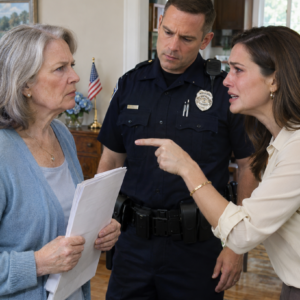
We met at my parents’ house on a Sunday afternoon.
Vanessa stood beside the fireplace, arms crossed.
Dad sat at the dining table.
Mom looked exhausted.
“You’ve finally decided to be reasonable,” Dad said.
I remained standing.
“I’m here to tell you that you will not receive any money from me.”
Vanessa scoffed.
“You’re seriously going to let me lose my business?”
“Your business is your responsibility.”
Mom began crying.
“We’re your parents, Emily.”
“I know.”
“Then how can you treat us like strangers?”
I looked at her.
“Because when I needed my family, you acted like I was one.”
Nobody spoke.
Dad suddenly stood.
“You think you’re better than us because you inherited some money?”
“No.
I think I deserve to make decisions about my own life.”
His expression changed.
“How much did Margaret tell you?”
I watched him carefully.
“Enough.”
Vanessa’s eyes widened.
“What inheritance?”
Dad looked away.
That was when I understood.
He hadn’t told Vanessa about the trust.
He’d simply assumed he could obtain my savings first, then pressure me for more if necessary.
“Dad?” Vanessa demanded. “What inheritance?”
I picked up my purse.
“Ask him.”
As Lauren and I walked toward the door, Mom called after me.
“Emily, please.
We can fix this.”
I turned around.
“You had three days to visit me in the hospital.
You didn’t come once.”
Her face crumpled.
“I thought you were exaggerating.”
“You never asked a doctor.”
There was nothing left to say.
Over the next several months, investigators reviewed the attempted transfer and the disputed agreement.
The case did not produce an immediate criminal charge, but my attorney ensured that the bank preserved the records and that my accounts remained protected.
Vanessa eventually closed her boutique and negotiated repayment arrangements with creditors.
My parents sold their vacation property to help cover some of her debts.
I didn’t celebrate their losses.
I simply stopped accepting responsibility for them.
My heart condition improved with treatment, follow-up monitoring, and changes to my routine.
My doctors eventually cleared me to begin working.
I accepted a nursing position at a hospital in Cleveland.
With professional financial advice, I arranged for most of my inheritance to remain invested while I used a small portion to pay off my student loans.
Six months after graduation, Lauren surprised me with a framed photograph.
It showed me standing outside the university auditorium in my cap and gown, smiling despite the exhaustion in my eyes.
Beneath it, she’d written:
You made it.
Even when nobody showed up.
I cried harder than I had in the hospital.
That evening, I received one final email from Dad.
“I hope one day you’ll understand that we did what we thought was best for this family.”
I read it twice.
Then I typed:
“I was part of that family too.”
I pressed send.
And for the first time in my life, I didn’t wait for an answer.
Because Grandma had been right.
Love wasn’t supposed to be something I had to earn by sacrificing myself.
And the day I stopped begging my family to choose me was the day I finally chose myself.