Part 2…..
IF FACEBOOK BROUGHT YOU HERE, HERE’S THE CONTINUATION YOU’VE BEEN WAITING FOR.
ENJOY! 👇
Zane came on Tuesdays and Saturdays, the days I invited him.
He learned how Kit wanted to be held when he was overtired and that Nash calmed fastest when someone spoke steadily rather than soothingly.
He never arrived unannounced and never called himself anything in relation to the boys.
He was simply Zane: the man whose low voice settled Nash and whose expressions during difficult restoration work made me laugh.
Gareth’s DNA test confirmed paternity.
He said he was not in a position to commit to a consistent parental role.
He sent no birth gift and asked for no photographs.
I did not chase him.
When the boys were two, I established Avery’s Surface Studio in a converted loft above the Castine Harbormaster’s building.
My name went on the door.
I documented every commission, hired two artisans I had trained at the mill, and began teaching workshops twice a year.
The Pelham Mill documentation received a regional preservation citation.
When the presenter credited Zane, he corrected her.
He named my research, pattern analysis, pigment work, and training program, then said he had simply had the good sense to stay out of my way.
Briana later launched a consultancy featuring photographs of Langford’s collection, including several of my patterns.
One letter from my attorney ended that.
The patterns disappeared from her social accounts.
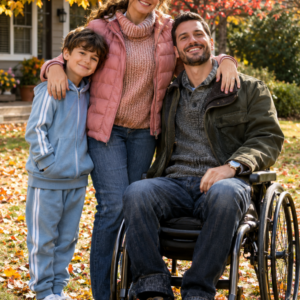
Kit and Nash were three when they began calling Zane Dad.
It started with Nash on a Tuesday morning.
Zane was crouched on the kitchen floor repairing a broken toy when Nash climbed into his lap, settled as if that place had always been his, and said, “Dad fix.” Zane looked up at me.
I looked back.
Neither of us made a speech.
The moment was allowed to be what it was.
When the boys were four, Gareth requested photographs through the legal service and asked whether they knew he existed.
I told him they knew he was their biological father and that he had not been able to be part of their lives.
He said he wanted to meet them.
I reminded him he had declined or ignored ten scheduled introductions over four years.
When he was ready to offer something consistent, he could contact the service.
I would listen, but I would not arrange a sudden entrance into their lives.
At the Regional Heritage Preservation Symposium outside Providence, Langford Estates appeared on the attendee list.
I kept my presentation slot.
I was there to present the Pelham Mill documentation, not to manage Gareth’s reaction.
I arrived with Edith.
Zane attended as a sponsoring mill owner, and when he found me in the registration line, his first update was that Nash had a new molar and was perfectly fine.
Gareth found me during the lunch break.
Briana was beside him wearing a cream outfit and a replica of Mother’s cameo.
For a moment my stomach tightened, but the feeling passed.
Zane approached carrying two plates.
He introduced himself to Gareth without offering his hand, then looked at me and said, “Whenever you’re ready.”
Gareth said he wanted to try with the boys.
He had missed four years and was asking for a start.
I had thought about that possibility long before the symposium.
I was not the barrier between Gareth and his sons.
He was.
I told him to write each boy a short letter explaining who he was and apologizing for not being there.
A counselor would review the language.
If the boys wanted to respond, that would be their choice.
If they did not, he would have to accept it.
He glanced at Briana, then said they would think about it.
I told him not to approach the boys directly.
Zane and I left after my presentation and drove along the coast.
On the way home, Kit called Zane to describe a boat Nash had drawn, complete with three masts, a slide, and a dedicated room for crackers.
Zane pulled over and listened to the entire blueprint as seriously as if it were a construction proposal.
He promised they would build it when he got home.
Gareth’s letters arrived six months later.
The counselor approved them.
They were two short, honest notes: he was their biological father, he had made choices when they were born, he had not been part of their lives, and that failure belonged to him, not to them.
He made no demands and asked for no forgiveness.
I read them twice with Zane at the kitchen table.
On Sunday morning, I showed the boys their letters.
Nash asked why Gareth had not wanted to know them before.
I told him the truth: Gareth had not been ready, and that was something adults sometimes did.
It was never a child’s fault.
Kit asked whether Gareth was nice.
I said he could be.
Then Kit asked whether he was as nice as Dad.
I thought about it and answered honestly. “No, he isn’t.” Kit accepted that and returned to breakfast.
Zane was very still in the kitchen doorway.
I crossed the room and wrapped my arms around him from behind.
He covered my hands with his.
That afternoon, while the boys played in the yard, I told him I wanted to talk about what we were.
He said he knew what we were.
I asked what he wanted to call it.
I had been carrying a ring for two weeks, waiting for the right moment and finally deciding the right moment was the one I chose.
It was simple platinum, engraved inside with the silhouette of a cameo—not Mother’s original, which was safely back in its display case, but an impression of it in my own design.
I told Zane I was not asking because I was afraid of losing him.
I was asking because I wanted to choose this out loud.
He looked from the ring to my face. “Priscilla,” he said, voice rough, “yes.
Obviously yes.” I put the ring on his finger.
He pulled me close, and the kiss held four years of ordinary mornings, bottles, scaffolding, and harbor benches.
It was not a rescue.
It was a choice we had both made.
Then Nash called from the yard because Kit had decided the fence was a boat and wanted to know whether that was allowed.
Zane rested his forehead against mine and promised to confirm the maritime status.
He ducked under the gate and began explaining load capacity and local harbor regulations to two very serious little boys.
I stood in the late October light listening to my sons argue boat safety with the man they called Dad.
I had left once because staying would have meant disappearing inside a life I had not chosen.
By then, my name was on the studio door and in the preservation record.
My work was recognized, my sons were loved, and I had decided who deserved to be let into the life I built.
Some things that break should be repaired.
Some should be allowed to scar cleanly.
The difference, I had learned, is whether the original damage was ever honest.
Mine had not been.
But everything I built afterward was.
Final
THE END.
I’ve shared the complete story, and I truly hope it touched your heart.
If this story moved you, please , like, and share the post.
Thank you for reading! ❤️