Part 6 – The Window Open to Morning
Liam’s mother answered on the fourth ring.
For a moment, neither of them spoke.
Then Liam said, “You know what Mara wrote.”
A small, unsteady breath came through the phone.
“I do.”
“Why did she come back?”
His mother fell silent again, and the letter in Liam’s hands seemed to grow heavier.
“I can explain,” she said at last.
“I’m listening.”
“I’m not asking you to excuse me.”
“Good.”
The reply was quiet, but it held a certainty I had not heard from him before.
His mother spoke slowly.
“Mara had left the estate the evening before the crash. You had argued about the company, and she was afraid you were letting your family decide the shape of your life.”
Liam looked down at the sealed fold.
“She thought I was choosing the business over her?”
“She thought you were choosing what everyone expected of you over what you wanted.”
His fingers shifted against the paper.
“What happened after she left?”
“She called me the next morning. She said she wanted to speak with you, but she didn’t want to return unless you were willing to listen.”
His mother paused.
“She had written the letter before she came back.”
“Why did she come back at all?”
“Because she loved you. She said one argument wasn’t a reason to give up on you, but she also needed you to understand that she couldn’t keep asking you to choose yourself.”
Liam closed his eyes.
The room was still except for the soft tick of the clock and the muted sound of his mother’s breathing over the line.
“She was driving to the estate when the crash happened,” his mother continued. “She had asked to see you before she decided what came next.”
“And you knew?”
“I knew she was coming back. I didn’t know what she planned to say.”
“Why did you let me believe she died at the scene?”
The silence that followed was longer than the others.
“Your father and I were frightened,” she said. “You were badly injured, and the doctors warned us that your recovery would be difficult. We thought the details would break you.”
“They did break me.”
His mother gave a soft, wounded sound.
“I know that now.”
“You decided I couldn’t hear the truth. You decided I didn’t deserve her words.”
“I told myself I was sparing you pain.”
“You were sparing yourself the conversation.”
The truth landed without anger in his voice, but his mother did not answer it.
“I’m sorry,” she said finally. “I should have given you the letter. I should have trusted you to grieve her.”
Liam looked toward the window, where the last color of the evening rested in the sky.
“I can’t tell you that I forgive you.”
“I understand.”
“But I don’t want to keep living inside what you decided for me.”
“I hope you won’t.”
He lowered his gaze to the letter.
“Was there anything else?”
“Only that Mara loved you, and she wanted you to be brave enough to choose a life that belonged to you.”
The words seemed to reach him more gently than the ones he had spent years imagining.
“Thank you for telling me.”
His mother began to say his name, then stopped.
“I’m here if you want to speak again,” she said.
“I know.”
When the call ended, Liam kept the phone in his hand for a moment before placing it down.
He looked at the folded letter.
“Do you want to open it now?” I asked.
“Yes.”
Leo moved the water glass farther from the bedside table, clearing a space without coming too close.
Liam eased the paper open along its old creases.
The handwriting was delicate, slanting slightly upward across the page.
He read silently, his lips moving once over a line he seemed unable to take in at first.
Then he began again, aloud.
“Liam,” he read, “I’m coming back because one hard conversation shouldn’t be the whole story.”
His voice faltered, but he continued.
“I love you, and I also need you to hear me. You don’t have to run your father’s business to prove that you’re worthy of being loved. You don’t have to be invulnerable to make me proud of you.”
His thumb pressed gently against the edge of the page.
“I want us to make a life that is ours, even if we have to disappoint people who thought they knew what we should become.”
He paused, his eyes moving to the final lines.
“When you find this, I hope we’ve had the chance to say everything we were afraid to say. If we haven’t, please remember that coming back is not the same as giving up. I came back because I still believed we could choose a better way together.”
Liam stopped.
He held the letter very still.
I waited beside him, listening to his breathing and the faint rustle of the curtains.
“She came back for me,” he said.
“Yes.”
“She didn’t come back because she thought I had changed.”
“No,” I said. “She came back because she believed you could.”
His eyes lifted to mine.
For once, the light in them was not the brief, guarded glimmer I had seen when sunlight crossed the floor.
It was grief, still, but no longer alone.
“I thought I knew what happened,” he said. “I built everything after that night around it.”
“Now you know more.”
“I know she wasn’t asking me to stay broken.”
“No.”
He looked down at her handwriting again.
“I don’t want to turn her letter into another rule I can fail.”
“Then don’t.”
“What if I don’t know how to live the way she hoped?”
“You can find out one day at a time.”
He released a slow breath.
“I think I can try.”
That night, he asked Leo to put Mara’s photograph and both letters in a protective sleeve rather than returning them to the drawer.
He wanted them near him, but not hidden beneath old papers.
When Leo had finished, Liam said, “I’m sorry I blamed you for what my family chose.”
Leo’s face tightened.
“You had reason to be angry.”
“I still do.”
“I understand.”
“But I know you kept the letter because you were afraid of hurting me.”
“I did.”
“You should have trusted me enough to ask.”
“I should have.”
Liam reached for the photograph.
“I’m not ready to forgive everyone,” he said. “But I don’t want to keep carrying this alone.”
Leo lowered his head.
“Thank you.”
“Don’t thank me yet.”
A faint smile touched Leo’s mouth.
“I won’t.”
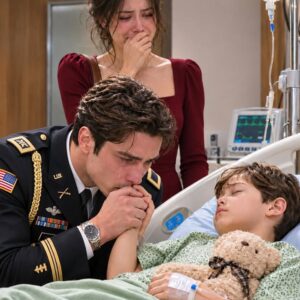
The following morning, a specialist from Tommy’s hospital joined the consultation by video before the in-person appointment.
She reviewed the results with us, answered Tommy’s questions, and explained that the trial offered a genuine possibility, not a promise.
Tommy listened carefully from his hospital bed, his face serious in the way it became when he was trying not to let hope show too plainly.
“So there’s a chance it could help,” he said.
“Yes,” the specialist replied. “There is a chance. We’ll keep assessing you closely, and you’ll be part of every decision.”
“And if it doesn’t work?”
“Then we talk about the next step together.”
Tommy glanced toward the phone, where I was sitting in Liam’s room.
“Okay,” he said. “I want to try.”
After the call, he asked to speak to Liam.
I placed the phone on speaker and held it near the bed.
“Hey,” Tommy said. “You’re the one who arranged the consultation?”
“I helped create a fund for the medical expenses,” Liam replied. “The hospital is handling it. You don’t owe me anything.”
“I know my sister said that.”
“It’s still important that you hear it from me.”
Tommy shifted against his pillow.
“Thanks.”
“You’re welcome.”
“I should warn you, I’m excellent at cards.”
“I’ve heard you’re not.”
Tommy laughed.
“Then you’ve been hearing lies.”
“I’ll let you prove it someday.”
The call ended with Tommy promising he would teach Liam a game, and Liam promising only to give him a fair chance.
A week later, the hospital confirmed that Tommy met the trial’s criteria.
The first treatment day was long, crowded with careful explanations, forms, and waiting.
I sat beside him throughout it, holding his hand when he wanted me to and letting him be quiet when he didn’t.
There was no miraculous change.
There was no guarantee that the trial would succeed.
There was a treatment plan, a medical team watching closely, and a brother who still had enough stubbornness to complain about the hospital tea.
That evening, he called me from his room.
“I’m tired,” he said.
“I know.”
“But I’m okay.”
I let my breath out slowly.
“Then rest.”
“Tell Liam I’m still going to beat him at cards.”
“I’ll tell him.”
“You better.”
When I passed the message along, Liam was seated at the edge of his bed with the physical therapist standing beside him.
He had started rehabilitation again, beginning with small movements and careful transfers.
The effort made his face pale, and sweat gathered along his hairline, but he did not ask to stop until the therapist reached the point they had agreed upon.
When he was settled back against the pillows, he closed his eyes and breathed through the ache.
“You did well,” I said.
“Don’t praise me for doing what I’m supposed to do.”
“I wasn’t praising you for obeying.”
“What, then?”
“For showing up.”
He opened his eyes.
“That’s different?”
“It is to me.”
He considered that, then gave a small nod.
“Tomorrow, I’ll show up again.”
He did.
Some days were harder than others.
He grew frustrated with the brace and the slow pace of rebuilding strength, but he began telling the therapist when something hurt rather than waiting until the pain swallowed the rest of the day.
He ate more regularly.
He allowed the doctor to examine his incision without turning the appointment into a battle.
And each morning, when he was awake, he asked for the blinds to be opened.
At first he asked for a little.
Then, on a clear day, he asked for the whole window.
Sunlight filled the room, revealing the books untouched on the shelf, the small scratches on the bedside table, and the pale gold of the walls beneath the shadows.
Liam looked out at the garden.
“I thought light would make me remember the crash,” he said.
“Does it?”
“Sometimes.”
“What does it make you remember now?”
He watched a branch move in the breeze.
“That the morning came anyway.”
The answer stayed with me longer than either of us expected.
When my contract ended, the hospital had already completed two stages of Tommy’s treatment.
The doctors were careful with every update, and none of them promised more than they could know.
There were difficult days, and there were days when Tommy joked with the staff and argued with me about whether I was allowed to call his cards bad.
Hope did not make the uncertainty disappear.
It gave us something to carry through it.
Liam asked me to meet him in the sitting room on the last afternoon of my contract.
The curtains were open.
A wide patch of sunlight rested across the rug between us.
He stood beside the chair with a cane in one hand, his injured leg still stiff but bearing more of his weight than it had before.
“The agency sent the final paperwork,” he said. “Your contract ends today.”
“I know.”
“You’re free to go whenever you’re ready.”
I looked at him.
“You don’t have to sound as if you’re dismissing me.”
“I’m trying to be clear.”
“I know.”
He turned the cane slightly in his hand.
“I don’t want you to stay because I helped your brother.”
“I wouldn’t.”
“I don’t want you to feel that you owe me a chance at anything.”
“I don’t.”
“Good.”
He seemed to have rehearsed the words, but when he looked at me, the rehearsed part fell away.
“I want to ask you something,” he said. “Not as your employer, and not because of Tommy.”
“All right.”
“Would you have dinner with me sometime?”
I felt the question more than I expected.
It was not a grand declaration, and it did not try to turn everything that had happened into a promise.
It was simply a question, offered without pressure.
“I would,” I said. “But not while I’m still working here.”
“I thought that might be the answer.”
“My brother is in the trial. My life is still complicated.”
“So is mine.”
“And I don’t want to become responsible for your healing.”
“I don’t want you to be.”
“I can’t be your nurse and your partner.”
“I understand.”
“Then when my contract ends, and when I’m ready, we can have dinner.”
His shoulders eased.
“When you’re ready,” he said.
“I mean that.”
“So do I.”
I left the mansion two days later with my duffel bag, my phone, and a quiet certainty that my life had not become simple just because I was leaving.
Liam did not ask me to stay.
He walked me to the front entrance with Leo beside him and the cane steady in his hand.
“Call Tommy when you get home,” he said.
“I will.”
“Tell him I expect our card game.”
“I’ll tell him.”
He held my gaze.
“Thank you for telling me when I was wrong.”
“You weren’t always happy to hear it.”
“I wasn’t always happy to hear anything.”
A smile came and went between us.
“I’m glad you kept opening the blinds,” I said.
“So am I.”
For the next few months, we spoke sometimes by phone and sometimes in brief messages.
We did not hurry to name what was growing between us.
Tommy continued the trial, his doctors keeping close watch on his health and adjusting the plan when they needed to.
Some tests brought encouraging news.
Others left us waiting.
Each time he called with an update, I listened to the doctors as closely as I listened to my brother.
There was no cure promised, only careful medicine, family, and a chance we had not possessed before.
Liam continued physical therapy.
He went to appointments, learned how to manage his pain, and gradually returned to moving through the house without needing to measure every step.
He did not return to the daily control of the company.
Instead, he and his family agreed that he would take a limited role when he was ready and make decisions about the business one at a time.
The conversations with his parents remained difficult.
They did not erase what had happened, but Liam stopped letting their fear decide what he was allowed to know.
He also began speaking about Mara without turning every memory into a reason to punish himself.
When he was ready, he sent the original letters and photograph to a specialist conservator, then kept copies where he could reach them.
He told me that remembering her had become less like standing at the crash site and more like carrying a person who had been part of his life.
The first time he asked me to dinner, I declined because Tommy had a test scheduled the next morning and I did not want my mind in two places.
The second time, I said yes.
We met at a small restaurant near the hospital, where neither of us was anyone’s employer or patient.
We talked about Tommy, then about books, and then about the ordinary things we had never had room to discuss while Liam’s world was confined to one dark room.
He was still learning to ask for help.
I was still learning not to solve every problem before anyone asked me to.
We did not mistake those beginnings for a finished story.
But we kept choosing to meet again.
Nearly a year after my first day at the mansion, Liam invited Tommy to visit the estate.
Tommy arrived wearing a knit cap and carrying a deck of cards he insisted was better than any in the hospital.
He was thinner than he had once been, but his eyes had regained some of their old mischief.
“Show me the game you promised,” Liam said.
Tommy settled into a chair beside him.
“I’ll show you if you accept that I’m going to win.”
“I accept that you believe you’re going to win.”
“That’s not the same thing.”
“No,” Liam said. “It isn’t.”
They played through most of the afternoon.
Tommy won the first game.
Liam claimed he had misunderstood the rules, and Tommy accused him of making excuses.
Leo brought tea.
The house manager brought sandwiches.
I watched from the doorway and felt the room fill with a kind of life no one had planned for.
When Tommy grew tired, he leaned back in his chair and looked toward the window.
“You leave these open all the time now?” he asked.
“Most days,” Liam said.
“Even when it’s bright?”
“Especially then.”
Tommy glanced at me.
“I think he likes the light.”
“I think he’s right,” I said.
Liam looked at the two of us, and the sunlight rested across his face without making him turn away.
Later, after Tommy had gone upstairs to rest, Liam and I stood together beside the window.
Outside, the garden carried the quiet green of late morning.
“I used to think getting through the day was all I had to do,” he said.
“What do you think now?”
“That a day can hold more than one thing.”
He looked at me.
“Grief, fear, hope. Even a card game you lose.”
“Especially a card game you lose.”
“I’m still not convinced I lost.”
“You did.”
“I’ll ask Tommy to review the evidence.”
“He’ll be happy to.”
Liam smiled.
A moment later, his phone rang on the table.
It was Tommy, who had gone only as far as the next room before remembering he had left one of his cards behind.
Liam answered on speaker.
“I’m missing a card,” Tommy said. “Did you steal it?”
“I did not.”
“You’re a terrible liar.”
“I’m an excellent liar. I’m choosing not to lie.”
Tommy laughed on the other end.
“Fine. I’ll come get it.”
The call ended, and Liam looked toward the open doorway.
“Is he still doing well?” he asked.
“He has difficult days,” I said. “But the last update was hopeful.”
“I’m glad.”
“Me too.”
The sunlight had shifted while we stood there, crossing the floor until it reached the place where Liam’s bed had once been.
He no longer spent his days there.
He still had pain sometimes, and grief still arrived without warning.
But he had returned to therapy, to conversations he had once avoided, and to the possibility of wanting something without insisting he could not ask for it.
I reached for the blind cord, then stopped.
Liam noticed.
“You can leave it,” he said. “I like it this way.”
The blinds stayed open.
A little later, Tommy called again from the hospital, this time to share the latest news from his care team.
His doctors had seen encouraging signs in his recent results.
They were cautious, as they had always been, and no one called it a cure.
But the trial was giving him a real chance, and the next step was one he could face with his sister beside him.
Liam listened to the whole update, asking only what Tommy was comfortable sharing.
When the call ended, he put down the phone and looked at the bright window.
For the first time, morning light filled the room without asking anyone to prove they deserved it.
I stood beside him, not as his nurse and not as someone bound by a contract, but as a person who had chosen to stay and see what we might become.
The blinds remained open by choice, the old letters safe in the light, while somewhere beyond the garden, Tommy’s voice lingered in the quiet and the day made room for hope.
**–THE END–PLEASE
Share your thoughts or feedback to motivate us to create more stories ♥️
* * *
[PREVIOUS: PART 5](https://puretales.idolsgift.com/blog/part-5-the-light-he-thought-he-hated-034)