CHAPTER 1 – PART 1 – THE LITTLE BOY AT THE BURNING STOVE
PART 1: THE LITTLE BOY AT THE BURNING STOVE
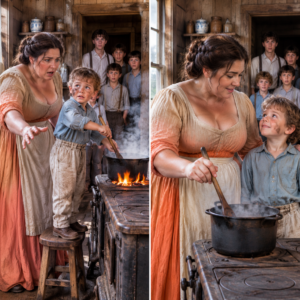
I had traveled halfway across the country to marry a man I had never seen, only to find his four-year-old son standing on a stool beside a blazing stove, desperately trying to cook a pot of beans while his five older brothers watched with empty stomachs.
For several seconds, I could not move.
The little boy’s arms trembled as he stirred the blackening beans, his cheeks red from the heat and his tiny fingers struggling to hold the wooden spoon.
A thin ribbon of smoke curled toward the ceiling, and the smell of scorched food filled the kitchen.
“May I?” I asked gently.
The boy turned toward me with frightened brown eyes, as though he expected me to shout at him for making a mistake.
He looked at the spoon, then at my face, before reluctantly nodding.
I crossed the kitchen and carefully took the spoon from his hands.
“Beans need a little water,” I explained, reaching for the pitcher, “and certainly not this much fire.”
“I didn’t know,” he whispered.
“Now you do.”
I poured water into the pot, lowered the flame, and stirred until the beans began separating from the scorched bottom.
The little boy continued watching me.
“What is your name, sweetheart?” I asked.
“Ru.”
“That’s a lovely name.”
He looked toward the doorway before answering.
“Are you the new lady?”
I swallowed.
“I suppose I am.”
He considered my answer with the seriousness only a very small child could manage.
Then he asked the question that made my heart ache.
“Can you cook better than me?”
I smiled.
“I certainly hope so.”
Behind him stood five older boys, each watching me as though I were an unexpected visitor who might disappear if they remained silent long enough.
The oldest was Thomas, a tall, serious boy who had driven the wagon from town.
Beside him stood Eli, whose arms were folded tightly across his chest.
Cade leaned against the doorframe with an expression that suggested he had already decided I was not going to impress him.
Porter stood slightly behind the others, while Reeve watched me without saying a word.
There were six boys in total, and I was the woman who had agreed to marry their father.
My name was Nora Callaway.
I was a woman of thirty-four years, nearly one hundred kilograms, with broad hips, strong arms, a rounded face, and chestnut hair that I usually pinned into a practical bun.
People in Sorrow Creek had spent most of my adult life reminding me that my body was apparently the greatest obstacle between me and happiness.
Men had called me too large to be desirable, too plain to attract a husband, and too old to expect anyone respectable to choose me.
I had heard those remarks so often that sometimes I wondered whether the world had decided my future before I had even been given the chance to live it.
But I had refused to accept their judgment.
When Harlon Greer’s letter arrived, explaining that he was a struggling rancher with six sons and a household in need of help, I had read it several times.
He had written honestly about his circumstances.
His wife had died of fever two years earlier, leaving him to raise six boys while keeping a small ranch running.
He did not promise wealth, luxury, or an easy life.
He simply asked whether I would consider becoming his wife and sharing the responsibility of building a home.
I had answered that I would.
We exchanged several letters, but neither of us had arranged a meeting before the journey.
The final six miles from town to his ranch had been particularly difficult, with the wagon wheels sinking into muddy ground and the cold wind cutting through my traveling coat.
I had spent the entire ride wondering whether Harlon would find me acceptable.
Now, standing in his kitchen, I was beginning to understand that my appearance might be the least important thing this family needed to worry about.
“When did you boys last eat?” I asked.
Thomas shifted his weight.
“We had bread.”
“This morning?”
He nodded.
“Nothing since?”
Nobody answered.
I looked at the six children again.
Ru was small enough that the stove seemed almost twice his height, and the other boys looked thinner than children should.
I felt something tighten in my chest.
“Thomas, find me some salt pork.”
He blinked.
“What?”
“Salt pork, please.”
“There’s some in the pantry.”
“Good, bring it.”
I turned toward Eli.
“Are there vegetables in the root cellar?”
He glanced at Thomas before answering.
“Some potatoes and onions.”
“Bring anything that hasn’t spoiled.”
Then I looked at Cade.
“Get me a bucket of clean water.”
Cade raised an eyebrow.
“Why?”
“Because I asked you to.”
He seemed surprised by the firmness in my voice.
I turned toward Porter.
“Clear the table, please.”
Then I looked at Reeve.
“Find six clean plates.”
The boys remained motionless.
I placed my hands on my hips.
“Unless all six of you intend to stand there and watch a hundred-kilogram woman starve beside you?”
For the first time, Thomas’s serious expression softened.
The corner of his mouth twitched.
Then he turned and began giving the others instructions.
Within minutes, the kitchen became busy.
Thomas brought the salt pork, Eli returned with potatoes and onions, Cade carried water, Porter cleared the table, and Reeve searched through the cupboards for plates.
Ru remained beside me.
“Can I help?”
“Of course you can.”
I found him a small basket and asked him to put the clean potatoes inside after I had washed them.
He approached the task with enormous concentration.
Every time he placed another potato in the basket, he looked toward me as though waiting for approval.
“Perfect,” I told him.
His face brightened.
I trimmed the spoiled portions from the vegetables, diced the salt pork, rescued the beans, and began preparing a thicker stew.
There was enough flour in the cupboard for biscuits, although I had to work carefully because the household supplies were running low.
As the food began cooking, I noticed the condition of the house.
Laundry was piled near the hallway, several shirts needed mending, and dust covered the furniture.
The dining table had scratches and old stains, while the kitchen shelves contained mismatched bowls and nearly empty jars.
This was not simply a household that needed cleaning.
It was a family that had been trying to survive without anyone having enough time or strength to care for the ordinary things that made a home feel welcoming.
I understood that feeling.
After my mother died, I had helped keep our household together while my father worked long days.
I had learned that cooking was more than putting food into a pot.
It was a way of telling people that somebody had remembered them.
It was a way of making an empty room feel less lonely.
When the biscuits finally came out of the oven, the smell drifted through the kitchen.
All six boys moved closer to the table.
Ru stared at the golden biscuits.
“Are those for us?”
“Every one of them.”
I filled six bowls with steaming beans and vegetables, added portions of salt pork, and placed a biscuit beside each serving.
Then I prepared a seventh plate for myself.
Thomas waited until everyone was seated before picking up his spoon.
He tasted the food carefully.
For a moment, his expression did not change.
Then his shoulders relaxed.
He took another spoonful.
Eli followed, then Cade, Porter, and Reeve.
Ru held his bowl with both hands and ate as though he had been waiting for that meal all day.
Nobody spoke for several minutes.
The only sounds were spoons touching bowls and the occasional quiet request for another biscuit.
I watched them eat.
I had spent years hearing that my body made me unsuitable for marriage, yet no man in Sorrow Creek had ever understood that the things people called my weaknesses had taught me how to care for others.
My broad hands could knead bread.
My strong arms could carry heavy pots.
My patience could comfort a frightened child.
And my heart had room for a family that was not yet mine.
I was preparing another serving when the front door opened.
Heavy boots crossed the main room.
The boys immediately stopped eating.
A tall man appeared in the kitchen doorway, his work shirt streaked with dirt and his shoulders carrying the exhaustion of a long day in the south pasture.
His dark hair was damp with sweat, and a short beard covered his jaw.
He looked at the boys.
Then at the steaming food.
Finally, his eyes settled on me.
Harlon Greer.
The stranger I had traveled all that way to marry.
He gripped the doorframe and stared at the kitchen as though he had entered a house he no longer recognized.
I stood between the stove and the table with flour on my cheek and a wooden spoon in my hand.
Nobody moved.
Then Thomas slowly turned toward his father.
“Pa,” he said quietly, “she did something you haven’t seen in this house for a long time.”
Harlon’s eyes narrowed slightly.
“What did she do?”
Thomas looked down at his full bowl.
Then he lifted his eyes again.
“She made us feel like somebody wanted us here.”
And the expression on Harlon’s face changed so completely that I suddenly wondered whether I had walked into a family whose deepest wound was much older than an empty kitchen.
CHAPTER 2 – PART 2 – THE MAN WHO HAD FORGOTTEN HOW TO COME HOME b038
PART 2: THE MAN WHO HAD FORGOTTEN HOW TO COME HOME
Harlon remained in the doorway, staring at his sons as though Thomas had just spoken words he had been trying not to hear.
“What do you mean?” he asked.
Thomas lowered his spoon.
“I mean she made supper.”
Harlon looked at the bowls.
“I can see that.”
“No, Pa, you don’t understand.”
Thomas glanced toward the other boys before continuing.
“Ru was trying to cook because we didn’t know what else to do.”
Harlon’s face tightened.
He looked at the youngest child.
“Ru?”
The little boy immediately lowered his head.
“I was making beans.”
“Why were you standing at the stove?”
Ru looked toward me.
“I was hungry.”
The words were so small that they seemed to disappear into the kitchen.
Harlon stepped away from the doorframe.
“Where was Thomas?”
Thomas straightened.
“I was trying to get the stove going.”
“And the others?”
“We were waiting.”
“Waiting for what?”
Nobody answered.
Harlon looked from one son to another.
Then he noticed the empty bread basket, the nearly bare pantry shelf, and the blackened bottom of the pot I had rescued.
His face changed again.
I could see the moment he understood how close his children had come to being left without a proper meal.
“I thought you boys had enough bread,” he said.
Thomas looked at him.
“We did yesterday.”
Harlon closed his eyes briefly.
He had spent the entire day repairing a fence and moving cattle before the weather turned, and he had believed the boys would manage until he returned.
He had not understood that managing and living were not the same thing.
I placed the wooden spoon beside the stove.
“Mr. Greer, the food is ready.”
He looked at me.
“Please call me Harlon.”
I nodded.
“Then you should sit down, Harlon.”
He glanced toward the seventh plate.
“Is that for me?”
“Unless you already ate.”
He shook his head.
I pulled out a chair.
He sat slowly, still looking at the children.
For several minutes, he ate without speaking.
The boys watched him carefully, and I realized that they were waiting to discover whether he would be angry about the food or about the fact that I had taken charge of his kitchen.
Instead, he finished the entire bowl.
“Thank you,” he said.
I nodded.
“You’re welcome.”
His eyes moved toward the stove.
“You’ve been here less than an hour.”
“Long enough to know these boys needed supper.”
He lowered his gaze.
“I should have made certain they had food.”
“Yes,” I answered gently.
The honesty of my reply surprised him.
He looked up.
I continued before he could misunderstand.
“I don’t think you meant for them to go hungry, but a house with six children needs more attention than one tired man can give after working outside all day.”
Harlon rubbed his forehead.
“I know that.”
His voice was tired rather than angry.
“My wife handled everything.”
The kitchen became quiet.
I glanced toward the boys.
None of them looked up.
Harlon continued.
“After she died, I thought I could manage the same way she had, but there was always another fence to mend, another animal needing attention, another bill coming due.”
He stopped.
“I kept telling myself the boys were growing older and could help.”
Thomas looked down at his plate.
I understood that the oldest child had probably been carrying far more responsibility than anyone his age should have been expected to manage.
I turned toward him.
“Thomas, you are a boy, not the head of this household.”
He stiffened.
“I can help.”
“I know you can, and I expect you to help when necessary, but you should not have to worry about feeding five brothers every day.”
Thomas looked at his father.
Harlon did not disagree.
After supper, I cleared the table while the boys carried their plates to the washbasin.
Ru followed me into the kitchen.
“Will you make beans tomorrow?”
I smiled.
“If you promise not to stand on that stool near the stove again.”
He nodded solemnly.
“I promise.”
Harlon watched us.
When the children had gone to the main room, he approached me.
“I owe you an apology.”
I turned.
“For what?”
“For letting you walk into this.”
I looked around the kitchen.
“I knew you had six sons.”
“You didn’t know how bad things had become.”
“No,” I admitted, “but I can see it now.”
He leaned against the counter.
“I expected to introduce you to the boys, show you around, and give you time to settle before the wedding.”
I glanced toward the dining table.
“Perhaps we should have started with supper.”
A faint smile appeared on his face.
It disappeared almost immediately.
“There’s something else you should understand.”
I waited.
“This marriage is going to be difficult.”
I folded the dishcloth.
“I never expected an easy one.”
“My boys loved their mother.”
“I wouldn’t want them to forget her.”
Harlon looked at me for a long moment.
“Some days they still expect her to walk through that door.”
I felt a familiar ache.
“Then we should not ask them to stop remembering.”
He looked toward the hallway.
“I don’t know how to explain that to them.”
“Perhaps you should let them tell you what they need.”
He seemed uncertain.
I understood why.
He had been trying to remain strong for two years, and admitting that he did not know what to do might have felt like another kind of failure.
Then he looked at me.
“There’s a room I want you to see before you decide whether to marry me.”
I glanced toward the hallway.
“What room?”
“My wife’s.”
He paused.
“I haven’t changed anything since she died.”
I looked at the man standing before me.
For the first time, I realized that I had not simply agreed to marry a struggling rancher.
I had agreed to enter a home where another woman had once been loved so deeply that even the furniture seemed afraid to move on.
CHAPTER 3 – PART 3 – THE ROOM THAT STILL BELONGED TO ANOTHER WOMAN c038
PART 3: THE ROOM THAT STILL BELONGED TO ANOTHER WOMAN
Harlon led me down the hallway without speaking.
The house was quieter now, although I could hear the boys whispering in the main room.
He stopped before a closed door.
His hand rested on the handle for several seconds before he finally turned it.
The room beyond was neat and carefully preserved.
A quilt covered the bed, a small wooden dresser stood beside the window, and a pair of women’s shoes remained beneath a chair.
A folded dress hung inside the wardrobe.
On the bedside table sat a small framed photograph of a woman with gentle eyes and dark hair.
I understood immediately.
This was the room of the woman who had died two years earlier.
Harlon stood near the doorway.
“Her name was Margaret.”
I looked at the photograph.
“She looks kind.”
“She was.”
His voice softened.
“She could make six boys behave with one look, and she never seemed to run out of patience.”
I smiled faintly.
“That sounds like a useful talent.”
He looked at the bed.
“I thought I would eventually put her things away, but every time I came in here, I couldn’t make myself do it.”
I stepped closer to the dresser.
A small brush rested beside the photograph, with a few strands of dark hair caught between its bristles.
I did not touch it.
“I wouldn’t expect you to.”
Harlon turned toward me.
“I don’t want you thinking you have to become her.”
I looked at him.
“I couldn’t become her even if I wanted to.”
He seemed surprised.
I continued.
“She was their mother, and she was your wife, and she will always have a place in this house.”
He lowered his eyes.
“But if you marry me, there will be another woman living here.”
“I understand.”
“Some things will change.”
“Some things need to change.”
His expression tightened.
“You’re speaking as though this will be simple.”
“It won’t.”
I turned toward him.
“But leaving the house exactly as it was when Margaret died won’t bring her back, Harlon.”
He looked away.
For several seconds, neither of us spoke.
Then he told me about the fever.
It had begun with a cough and a headache, and by the time the doctor arrived, Margaret was already too weak to recover.
He had been away checking cattle when the illness worsened, and he had returned to find his wife barely conscious.
He had held her hand through the final night.
The boys had waited outside the bedroom because nobody knew how to explain what was happening.
When she died, the entire household seemed to stop.
Harlon had returned to work because the ranch could not survive without him, but the children had been left to manage the grief in their own ways.
Thomas became responsible for everyone.
Eli grew angry.
Cade began arguing over small things.
Porter withdrew.
Reeve stopped asking questions.
Ru was so young that his memories of his mother were already becoming uncertain.
Harlon told me these things without looking at me.
I listened.
When he finally finished, I asked whether the boys talked about Margaret.
“Not much.”
“Perhaps they think it makes you sad.”
He looked up.
“Maybe.”
“Then you should tell them they can remember her whenever they want.”
Harlon stared at me.
I could see that the suggestion had not occurred to him.
He had believed that silence protected the children, while the children had probably believed that silence protected him.
Sometimes grief became a room nobody entered because everyone inside the house was afraid of what might happen if the door opened.
I looked once more at the photograph.
“She should not have to disappear for me to belong here.”
Harlon stepped closer.
“You say that now.”
“I mean it.”
He looked toward the doorway.
Then he said something that caught me completely off guard.
“I don’t know whether I can love you the way you deserve.”
I turned toward him.
He continued before I could answer.
“I can respect you, provide for you, and give you a home, but I cannot promise that the feelings I had for Margaret will simply disappear.”
I felt my cheeks grow warm.
“I never asked you to forget your wife.”
“I know.”
“Then why are you telling me this?”
“Because I don’t want you discovering it after the wedding.”
I studied his face.
He was trying to be honest, but I could hear something beneath his words.
Fear.
He was afraid that marrying again would betray the woman he had lost, and perhaps he was also afraid that he might never be able to offer me the affection I wanted.
I understood more than I wanted to.
In Sorrow Creek, men had often made me feel that I should be grateful for any attention they offered.
I had no intention of entering another relationship where I was expected to accept less simply because someone believed I should not expect more.
“I didn’t come here to compete with a dead woman,” I said quietly.
Harlon looked at me.
“I know.”
“And I didn’t travel all this way to become a servant who happens to sleep in your house.”
His expression changed.
“That isn’t what I want.”
“Then I need you to understand something.”
I stepped toward the hallway.
“I can help raise your boys, cook their meals, and build a home with you, but I will not spend my life apologizing for being another woman in this house.”
Harlon remained silent.
I walked past him.
When I reached the main room, Thomas was standing near the doorway.
He had apparently heard enough of our conversation to understand that something important had happened.
His face was pale.
“Are you leaving?” he asked.
I looked at him.
“I haven’t decided.”
He glanced toward the bedroom.
Then he said something I had not expected.
“There’s something you should know about Ru.”
I stopped.
“What is it?”
Thomas looked down.
“He doesn’t remember Mama very well anymore.”
I felt my heart tighten.
Thomas continued.
“Sometimes he asks me what she looked like, and I don’t know how to answer without making him cry.”
I knelt so that I could look at him properly.
“Then we will tell him together.”
Thomas stared at me.
“But you won’t be her.”
“No,” I said softly, “I won’t.”
He looked away.
And in that moment, I realized that the question facing this family was not whether I could cook well enough or keep the house clean.
It was whether six children could accept a new woman without feeling that they were betraying the mother they had lost.
CHAPTER 4 – PART 4 – THE SIX CHILDREN WHO FEARED AN EMPTY PROMISE d038
PART 4: THE SIX CHILDREN WHO FEARED AN EMPTY PROMISE
I found Ru sitting on the floor beside the kitchen table the following morning.
He was holding a wooden spoon and examining it with great seriousness.
“Good morning,” I said.
He looked up.
“Are you still here?”
I smiled.
“For now.”
He seemed pleased by that answer.
“Can we make breakfast?”
“Of course.”
He climbed onto the small chair beside the table, and I began preparing oatmeal and eggs.
The other boys entered one at a time.
Thomas came first, followed by Eli, Cade, Porter, and Reeve.
Nobody mentioned the previous evening.
I served breakfast and allowed them to eat without questioning them about their mother or their feelings.
Afterward, I asked Thomas to show me where the household kept its supplies.
He led me through the pantry, the storage room, and the small cellar.
The shelves were not completely empty, but several jars had spoiled, and there was very little flour.
I made a list.
“We need more beans, flour, salt, coffee, and potatoes.”
Thomas looked at the paper.
“Pa can get those next time he goes to town.”
“Good.”
He watched me fold the list.
“Are you going to stay?”
I paused.
“I am considering it.”
He frowned.
“Why?”
“Because your father and I agreed to marry, and because I like you boys.”
He looked uncomfortable.
“You don’t even know us.”
“That’s true.”
I smiled.
“But I would like to.”
Thomas lowered his eyes.
I realized that he was carrying a responsibility that had become too heavy for him.
He had become the person who made sure the others ate, who watched Ru near the stove, and who tried to keep the household functioning whenever Harlon was away.
I wanted to help him without making him feel useless.
“Would you show me how your father likes the tools arranged in the barn?” I asked.
He looked surprised.
“Why?”
“Because I don’t want to put things where he cannot find them.”
He nodded.
We spent the next hour organizing the kitchen supplies and checking the shelves.
Then Harlon returned from the south pasture.
He looked at the list I had written.
“Planning to buy half the town?”
“Only what this house needs.”
He glanced toward the pantry.
“You’ve already started taking inventory.”
“I have.”
He looked at Thomas.
“Did you help?”
Thomas nodded.
Harlon seemed relieved.
But when I asked whether we could purchase supplies that afternoon, his expression changed.
“There’s something we need to discuss first.”
He led me outside, where the boys could not easily hear us.
“I’ve been thinking about what you said last night.”
I waited.
“You shouldn’t feel obligated to marry me simply because you traveled here.”
I looked at him.
“Do you want me to leave?”
He hesitated.
“No.”
“Then what are you asking?”
“I’m asking you to be certain.”
I folded my arms.
“I was certain when I answered your letters.”
“Things look different now.”
“They do.”
He looked toward the house.
“My sons are not easy children.”
I almost laughed.
“Neither am I always an easy woman.”
A faint smile touched his mouth.
Then it disappeared.
“I don’t want you becoming unhappy here.”
I studied him.
“Are you trying to protect me, or are you trying to protect yourself from feeling responsible if this doesn’t work?”
He looked away.
For the first time, I saw how uncomfortable he was with being questioned.
He had spent two years making decisions for everyone while keeping his own feelings hidden.
I continued.
“I understand that this house has suffered a loss, Harlon, but I am not frightened by the fact that your children need help.”
“That isn’t what worries me.”
“Then tell me what does.”
He took a slow breath.
“I’m afraid they’ll never accept you.”
I looked toward the kitchen window.
Ru was standing behind it, watching us.
“Perhaps they won’t call me their mother.”
Harlon said nothing.
“But that doesn’t mean they cannot learn to trust me.”
He looked at me again.
“You make it sound simple.”
“It isn’t simple.”
I paused.
“But I have spent too many years allowing strangers to decide what I can and cannot become.”
I turned toward the house.
“I will not let fear make that decision for me either.”
That evening, I sat with the boys near the kitchen table while I mended a torn shirt.
Ru played with a wooden horse.
Porter sorted a handful of buttons.
Reeve watched me thread the needle.
Cade asked whether I knew how to make biscuits without burning them.
I laughed.
“I managed it yesterday.”
He shrugged.
“That doesn’t mean you can do it again.”
I smiled.
“Then perhaps you should help me tomorrow.”
He looked pleased despite himself.
Later, when the children went to bed, I found Harlon standing in the doorway of Margaret’s room.
He was holding the small framed photograph.
I stopped several feet away.
“Are you all right?”
He nodded.
Then he looked at the picture.
“I used to think that if I opened this room and put her things away, I would be leaving her behind.”
I waited.
“Now I’m beginning to think I was leaving the boys behind instead.”
I stepped closer.
“Remembering someone and making room for someone new are not the same thing as forgetting.”
He looked at me for a long time.
Then he placed the photograph back on the dresser.
“I want you to stay, Nora.”
My heart beat faster.
“I want that too.”
He nodded.
But before either of us could say more, Thomas appeared at the end of the hallway.
His expression was troubled.
“Pa, we need to talk.”
Harlon turned.
“About what?”
Thomas looked at me.
Then at his father.
“About the wedding.”
And from the way he spoke, I knew the decision he had been keeping inside was finally coming.
CHAPTER 5 – PART 5 – THE QUESTION THAT CHANGED OUR MARRIAGE e038
PART 5: THE QUESTION THAT CHANGED OUR MARRIAGE
Thomas stood in the hallway with his hands clenched at his sides.
Harlon looked at him.
“What about the wedding?”
Thomas glanced toward me before answering.
“Do you really expect us to act like everything is normal?”
Harlon frowned.
“Nobody said you had to.”
“You told us she was coming to marry you.”
“Yes.”
“You didn’t ask us.”
Harlon went quiet.
Thomas continued.
“You just decided that somebody new was going to live here.”
I watched the older boy carefully.
He was not speaking like a child who disliked me simply because I was unfamiliar.
He was speaking like a boy who had been afraid of losing something precious and had never been given the opportunity to say so.
Harlon rubbed his jaw.
“Thomas, I should have talked to you.”
“You should have talked to all of us.”
Eli appeared behind him.
Cade followed.
Porter and Reeve stood near the stairs, listening.
Ru was still asleep.
Harlon looked at his sons.
“I made a mistake.”
Thomas seemed surprised.
“I should have explained what I was thinking before making arrangements.”
He paused.
“But I did not bring Nora here to replace your mother.”
Thomas lowered his eyes.
“Then why did you bring her?”
Harlon looked toward me.
I understood that he wanted me to answer.
I stepped forward.
“Because your father and I both wanted a chance to build a family together.”
Thomas shook his head.
“We already had a family.”
“You’re right.”
I looked at him.
“You did, and you still do.”
He seemed uncertain.
“Then what are you doing here?”
I took a breath.
“Your father asked me to marry him because he believed we might make a good life together, and I accepted because I wanted a home where I could be useful, respected, and loved.”
I paused.
“I knew he had six sons, and I knew their mother had died.”
Thomas’s eyes filled with something he quickly tried to hide.
“You don’t know what she was like.”
“No,” I said gently, “but I’d like to hear about her.”
He looked away.
For a long moment, nobody spoke.
Then Eli asked whether I expected them to call me Ma.
I shook my head.
“No.”
Cade frowned.
“Then what are we supposed to call you?”
“Nora.”
He looked surprised.
“Just Nora?”
“Just Nora is perfectly fine.”
Porter finally spoke.
“Are you going to make us stop talking about Mama?”
I shook my head.
“Never.”
Reeve looked at me.
“Even if it makes Pa sad?”
Harlon answered before I could.
“It doesn’t make me sad to hear you remember your mother.”
He stepped toward them.
“I should have told you that a long time ago.”
Thomas stared at the floor.
Then he asked the question that had been troubling him most.
“Are you going to make Pa forget her?”
I looked at Harlon.
He answered himself.
“No.”
His voice was firm.
“Your mother was part of my life, and she will always be part of yours.”
Thomas looked at him.
“But you’re marrying someone else.”
“Yes.”
“Does that mean you don’t love her anymore?”
Harlon took a slow breath.
“Love doesn’t work that way, son.”
He looked toward Margaret’s room.
“I loved your mother, and I still miss her, but that doesn’t mean I have to spend the rest of my life alone.”
The words settled over the hallway.
I had not expected Harlon to speak so openly.
He continued.
“I should have explained this before Nora arrived, and I’m sorry I didn’t.”
Thomas’s face tightened.
He turned and walked toward the main room.
Eli followed him.
Cade hesitated, then went after them.
Porter and Reeve remained for a moment before returning upstairs.
I looked at Harlon.
“That was difficult.”
He nodded.
“I should have done it sooner.”
I touched his arm.
“At least you did it now.”
He looked at my hand.
Then he asked whether I still wanted to marry him.
I studied his face.
The man before me was not the confident rancher I had imagined when I first read his letter.
He was tired, uncertain, and carrying grief that had never been properly spoken aloud.
But he was also trying.
And I had not traveled all that way because I expected a perfect man.
“I still want to try,” I said.
He looked relieved.
Then he asked whether I could accept that his affection might take time to grow.
I answered honestly.
“I can accept that love takes time, but I cannot accept being treated as though I am merely useful.”
He nodded.
“That is fair.”
“I need to be your wife, not just the person who keeps your kitchen running.”
“I understand.”
“And I need you to speak to me when something troubles you instead of hiding behind silence.”
He gave a small, rueful smile.
“That may be the hardest part.”
I smiled back.
“Then we can practice.”
For the first time since I arrived, Harlon reached for my hand.
He held it carefully, as though he were afraid that I might change my mind.
But before he could say anything else, Thomas returned.
His eyes were red.
He looked at his father.
Then at me.
“I don’t want you to marry her.”
Harlon’s expression hardened.
“Thomas.”
The boy swallowed.
“I don’t want another woman in Mama’s place.”
I stepped forward.
“Thomas, listen to me.”
He looked at me.
“I am not asking for your mother’s place.”
His voice shook.
“Then why can’t things stay the way they were?”
I looked at the child who had tried to become a man because he believed his family needed one.
“Because the way things were is hurting all of you.”
He stared at me.
“And I cannot promise that everything will be easy, but I can promise that I will never ask you to forget her.”
Thomas wiped his cheek.
Then he looked toward the front door.
“I need some air.”
He walked outside before anyone could stop him.
Harlon started after him.
I gently caught his arm.
“Let him go for a moment.”
He looked at me.
Then he nodded.
We stood together in the quiet hallway, listening to Thomas’s footsteps disappear into the yard.
And I understood that our wedding was no longer simply a decision between two adults.
It was a promise that would affect six children who had already lost the person they loved most.
Don’t stop here—the ending will shock you. Continue reading Chapter 6 below.