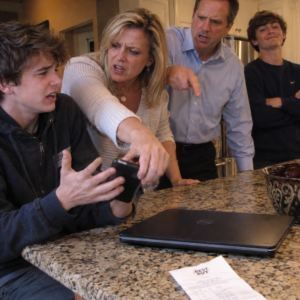
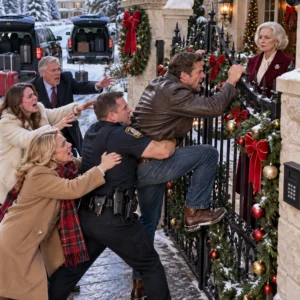
“Sign over your $362,000 garage—or get out!” My daughter demanded on Christmas Eve.
Still recovering from knee surgery, I refused.
Twenty minutes later, she threw me into the snow without my cane while my grandson begged her to stop.
Waiting for a ride, I opened the loan documents.
There was my signature, approving the mortgage.
Dated six weeks before she’d even asked me.
PART 1 — My Daughter Demanded My Building Before Throwing Me Into The Snow
“Sign it before dessert, Mom.
I don’t want another lecture about how hard you worked.”
My daughter, Tessa Vale, pushed a thick folder across her Christmas Eve table.
Her husband, Colin, stopped carving the turkey.
His father, Preston Vale, watched me over the rim of his wineglass.
I was sixty-four, recovering from knee replacement surgery, and sitting in the house where Tessa had promised I could stay until I was strong enough to live alone again.
Apparently, my recovery had acquired an expiration date.
“What am I signing?” I asked.
“Something that benefits everybody,” Tessa said.
The first page identified my four-bay commercial garage on the south side of Santa Fe, New Mexico.
I had bought it in 1993, when I was working double shifts as a commercial electrician.
By the time my husband, Arthur, died, the mortgage was paid off.
A local heating-and-air-conditioning company leased the building.
Its rent helped cover my retirement expenses.
According to the latest appraisal, the property was worth $362,000.
And my daughter wanted to use it as collateral for a business loan.
I flipped to page three.
“Preston, this gives your company the right to seek a mortgage against my building.”
Preston smiled.
“Only as security, Judith.
The bank needs reassurance while we expand our storage business.”
“Then use your own property.”
Colin’s knife stopped moving.
Preston’s expression tightened. “My properties are already committed to other projects.”
That seemed like an excellent reason not to add mine.
Tessa leaned across the table.
“You’ve lived here nine months without paying rent.
Don’t you think it’s time you contributed something?”
I stared at her.
For nine months, I had bought groceries, paid the electric bill, and watched her teenage son, Mason, whenever she and Colin disappeared on weekend trips.
Two months earlier, I had paid $4,800 toward their emergency plumbing repairs.
None of that apparently counted.
“Family doesn’t charge family for every little favor,” Tessa continued. “Unless you’re the one who needs help.
Then suddenly you remember exactly what everything costs.”
I set the folder down.
“I’m not signing.”
Preston reached for his glass.
“Your daughter tells me you’ve become unusually suspicious since your surgery.”
There it was.
My knee had been replaced, so apparently my judgment had been removed with it.
“There’s nothing wrong with my memory, Preston.”
“Then remember who took you in,” Tessa said.
Mason, eighteen and home from his first semester of community college, looked up from his plate.
“Mom, Grandma already paid for—”
“Stay out of this.”
He dropped his eyes.
Colin finally spoke.
“Your garage is just sitting there, Judith.
We’re trying to turn it into something useful.”
“It’s rented.
It produces income.”
“Not enough to make you wealthy.”
“Enough to keep me independent.”
Tessa pushed back her chair.
“Then go be independent.”
I thought she was bluffing.
She wasn’t.
Twenty minutes later, Colin carried my suitcase down from the guest room while Tessa stood by the front door holding my winter coat.
Outside, snow covered the driveway.
My cane was still leaning beside the downstairs bathroom.
“Can I at least call somebody?” I asked.
“You have a phone,” Tessa replied.
Mason hurried into the hallway.
“Grandma can stay in my room.
I’ll sleep downstairs.”
“Go upstairs,” Colin ordered.
“Dad, it’s Christmas.”
“Now.”
Tessa opened the front door.
“Maybe a few nights alone will teach you that being stubborn has consequences.”
I took my suitcase and stepped outside.
The door closed before I reached the driveway.
My former coworker, Lorraine Salazar, answered my call from across town.
She immediately drove over to get me.
While waiting beneath the carport, I opened the folder Tessa had shoved into my purse after dinner.
I wanted my attorney to see exactly what they had demanded.
A folded lender disclosure slipped from the back.
It listed my building’s address under Owner-Provided Collateral.
Below that was a document marked Property Owner Consent.
I unfolded it beneath the carport light.
The signature at the bottom read:
Judith M.
Calder — November 12, 2021.
Six weeks before Christmas.
Six weeks before anyone had asked my permission.
And beside my name was a certification stating that I had already agreed to pledge the property.
PART 2 — A Four Year Silence Ended With Another Stolen Signature
Lorraine arrived with a thermos of coffee and a blanket from her back seat.
When she saw my swollen knee, she swore so loudly that a neighbor’s porch light came on.
The following Monday, she drove me to attorney Rebecca Sloane’s office.
Rebecca examined the paperwork for twenty minutes.
“This isn’t a recorded mortgage,” she explained. “They still need valid authorization and proper closing documents to place a legitimate lien on your property.”
“Then they can’t take it?”
“Not legally using this paperwork.
But somebody has already represented that you consented.
We need to challenge that immediately.”
She sent written notices to the lender and Preston’s company, obtained copies of the relevant records, and helped me document the suspected forgery.
The financing proposal involving my garage was withdrawn.
My daughter told relatives a different story.
According to Tessa, I had demanded $50,000 for letting them help me recover from surgery.
When I called to confront her, she laughed.
“Mom, you’re remembering everything backward.
That’s exactly why we were worried about you handling property decisions.”
I hung up.
Mason texted that night.
Grandma, I was there.
I heard everything.
I saved his message.
With Lorraine’s help, I rented a modest apartment near downtown Santa Fe.
Once my knee improved, I began volunteering at Second Shift Workshop, a nonprofit teaching practical repair skills to adults trying to rebuild their careers.
I taught electrical safety, repaired donated appliances, and eventually helped train twelve apprentices.
For the first time in years, people asked for my advice without following it with a demand.
Four Christmases passed.
Then, on December 22, 2025, Tessa walked into the workshop.
She carried flowers and wore a smile I hadn’t seen since childhood.
“I heard you’re getting an award tonight,” she said. “I’m proud of you.”
Before I could answer, she opened her handbag.
Inside was another property agreement.
Preston’s company needed $1.4 million in refinancing, and my garage was once again listed as collateral.
“I thought your lawyer settled this.”
Tessa’s smile disappeared.
“Preston’s lenders are expecting that building.
You’re going to embarrass the entire family over a technicality?”
She lowered her voice.
“Those investors already believe you’ve agreed.
You can either cooperate or explain why you’re suddenly backing out.”
“I’m not signing anything.”
She leaned closer.
“Then here’s something you should know.”
She placed a photocopy on my workbench.
It was a quitclaim deed transferring my garage to Preston’s company.
My signature appeared above a notary acknowledgment.
Tessa tapped the date.
“It’s already been sent to escrow, Mom.
In forty-eight hours, that building won’t be yours anymore.”
PART 3 — My Attorney Found The Document They Thought Nobody Would Check
Rebecca was eating lunch when I arrived with the photocopy.
She set down her sandwich, examined the deed, and immediately called the title company handling Preston’s refinancing.
I listened as she identified herself and explained that her client disputed the signature.
Then she requested the closing documents.
“Do not assume a deed is valid just because it has a notary block,” she told me after hanging up. “And don’t assume a forged deed can legally transfer ownership.
We’ll make sure nobody relies on it.”
By midafternoon, the title company’s legal department had acknowledged our objection and suspended the proposed transfer pending investigation.
A county records search showed that no deed transferring my garage had been recorded.
Rebecca then asked whether I still possessed the original lease renewal from November 2021.
I did.
It was stored with my tax records.
She placed the scanned signature from that lease beside the signature on the new deed.
The same crooked capital J.
The same unusual break in the letter d.
Even the tiny ink mark beneath my last name appeared in exactly the same position.
“They’ve copied a signature image,” she said.
She enlarged both files.
The marks aligned precisely.
Rebecca documented the comparison and contacted the appropriate authorities about the suspected forgery and notarial irregularities.
Then we called Evelyn Cho, a local businesswoman who supported Second Shift Workshop.
Evelyn was also serving on the investment committee reviewing Preston’s refinancing proposal.
She had already received a financing presentation showing my garage as contributed collateral.
“I thought that property belonged to his company,” she said.
“It doesn’t,” I replied.
Her voice became very quiet.
“Judith, Preston is attending tonight’s reception.
He’s expecting to meet two members of our investment group.”
I nearly canceled my award appearance.
Rebecca wouldn’t hear of it.
“You earned that recognition independently of these people.
Let them explain their paperwork.”
That evening, I entered the community arts center wearing a navy dress Lorraine had helped me choose.
Mason was waiting near the entrance.
At twenty-two, he was taller than his father.
He hugged me so tightly that my glasses shifted.
“I told Dad I was coming,” he whispered. “He said not to get involved.”
“You can make your own decisions.”
“I know.
That’s why I’m here.”
After the award presentation, Evelyn invited me into a private conference room beside the reception hall.
Rebecca entered with a slim legal folder.
Tessa, Colin, and Preston were already seated.
Preston looked irritated.
“Judith, we can settle our family misunderstanding without involving outsiders.”
Tessa pushed a fresh agreement across the table.
“Everybody is exhausted, Mom.
Just sign the confirmation so we can finally move forward.”
I remained standing.
Colin glanced toward the door.
“Dad, I thought the title company had everything.”
“It does,” Preston replied sharply.
Tessa picked up a silver pen, placed it on the signature line, and slid the document toward me.
“Sign it, Mom.
Everybody in this room is waiting.”
PART 4 — The Investors Finally Saw Who Had Signed My Name
Rebecca reached across the table and moved the pen aside.
“My client won’t be signing that document.”
Preston gave an irritated laugh.
“Who invited you into our financial discussions?”
“Your proposed transaction includes property belonging to my client.
That makes this very much her business.”
Rebecca opened her folder.
The first document was the original lease renewal from November 2021.
The second was the purported owner’s consent used in Preston’s earlier financing attempt.
The third was the new quitclaim deed.
She placed enlarged copies of all three signatures side by side.
“Notice anything unusual?”
Colin leaned forward.
His forehead creased.
“They look identical.”
“Not merely similar,” Rebecca replied. “The reproduced ink marks and scanning imperfections align.
We have reason to believe a signature image was copied from the lease.”
Tessa shook her head.
“Mom signed documents when she was staying with us.
She probably doesn’t remember which ones.”
“I remember that lease,” I said. “I signed it in your kitchen because my tenant needed the renewal before Thanksgiving.”
Preston interrupted.
“Electronic document preparation is perfectly normal.”
“Electronic preparation doesn’t authorize anyone to sign for a property owner,” Rebecca answered.
She turned to Evelyn.
“The county records still show Judith as the owner.
She disputes both the deed and the collateral commitment.
The title company has suspended the proposed transfer.”
Evelyn placed Preston’s investment presentation on the table.
It described my garage as an asset already committed to his company.
“Preston, your application represented this contribution as secured.”
“It was always understood within the family.”
“Understood by whom?” I asked.
He looked at Tessa.
She looked at Colin.
Nobody looked at me.
Rebecca produced one more document: a copy of her written notice from December 2021, disputing the earlier consent and warning Preston’s company against representing that I had pledged the property.
Evelyn read the date aloud.
“You were told four years ago that she hadn’t authorized this.”
Preston reached for the paper.
“That concerned a different financing arrangement.”
“But the same building,” Evelyn replied.
Colin pushed back his chair.
“Dad, you told me the title problem had been resolved.”
“It would have been if your wife could control her mother.”
Tessa turned on him.
“You told me all we needed was the signature page!”
Evelyn closed the presentation.
“Our committee cannot approve financing based on disputed collateral.
I’m referring these materials to our legal counsel.”
Preston’s phone began vibrating.
He glanced at the screen.
His banker.
“Excuse me,” he muttered, answering.
The voice on the other end was loud enough to carry across the table.
“Mr.
Vale, our credit committee has withdrawn the $1.4 million refinancing commitment.
The closing is canceled, and our legal department is reviewing the documents you submitted.”
Preston’s hand opened.
His phone struck the table.
PART 5 — My Garage Stayed Mine While Their Business Lost Its Lifeline
Three months later, I stood outside my garage while the HVAC tenant unloaded replacement compressors.
The building was still mine.
No unauthorized deed had been recorded, and the disputed documents had not created a valid mortgage against my property.
Rebecca had helped me obtain a formal correction from Preston’s company, along with a settlement covering my legal expenses and prohibiting further representations that I had pledged the building.
The suspected forged documents remained the subject of a separate investigation.
Rebecca reminded me that financial wrongdoing and criminal charges were different matters, and neither she nor I could dictate what investigators would conclude.
Preston’s company lost its refinancing opportunity.
Unable to satisfy several existing creditors, it sold two properties and substantially reduced operations.
Colin left the business.
Tessa lost her consulting position after the company’s investment partners learned what had happened.
She sent me one letter.
Most of it blamed Preston.
Three sentences apologized.
I kept it but didn’t respond.
Mason visited every Sunday.
He helped me paint the workshop, carried equipment, and never once asked what I intended to leave him.
One afternoon, he noticed a framed photograph of Arthur beside my desk.
“Grandpa would’ve liked this place,” he said.
“He would’ve complained about the wiring.”
Mason laughed.
I had updated my estate plan with Rebecca.
My property would support my retirement during my lifetime, with a portion eventually benefiting Second Shift Workshop.
That December, we hosted Christmas dinner for twenty-seven apprentices, volunteers, and neighbors.
Lorraine brought green chile stew.
Mason burned the cornbread.
Somebody put on an old country Christmas record.
Near the door sat a new workbench, paid for entirely by me.
I looked around at the people pulling up chairs, passing plates, and arguing cheerfully about dessert.
Then I picked up my keys, locked the workshop’s storage cabinet, and joined them at the table.
THE END