PART 11: What Silence Made Us Believe
The technical team said they would need time, and for once nobody tried to make waiting sound like an answer.
Hayes gave me a written contact number before she returned to the equipment review.
Mercer walked outside with me.
The afternoon light had shifted across the training lanes, leaving the concrete bright in places that had been shaded when I arrived.
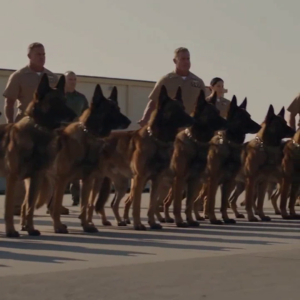
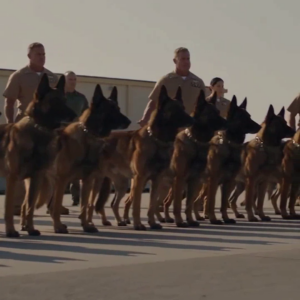
The dogs were tired of the disrupted schedule.
Their handlers were tired of being watched.
Ordinary work had begun returning in small pieces.
A recall.
A reward.
A quiet correction delivered without anger.
I stood beneath the canopy while Ruiz checked Atlas’s water.
“He hasn’t stopped looking for you,” the young man said.
Mercer glanced at me.
Ruiz noticed the look.
“I mean today.”
I almost smiled.
“I know.”
Atlas approached only after Ruiz gave him permission.
That mattered to me.
I crouched carefully, letting the dog choose the last few inches.
His nose touched the patch above my pocket.
Then he pushed his forehead beneath my chin with the same solid insistence he had used years before.
I closed my eyes.
There had been mornings at Harbor Annex when Ethan brought him into the kitchen before work because he hated leaving the old dog waiting in the vehicle.
Atlas would stand beside the counter while Ethan pretended not to know why toast disappeared from his plate.
I had buried those memories beneath the fire because remembering anything good always seemed to end at the same locked door.
Now the dog smelled of clean fur, warm concrete, and the faint rubber scent of his training toy.
He was alive.
He was here.
I let that be the whole truth for several breaths.
Ruiz crouched beside us.
“Was he Ethan’s dog?”
“He worked most closely with him during recovery exercises.”
“Was your husband a handler?”
“A systems technician who became indispensable to a program that kept asking him for one more favor.”
Ruiz nodded as though he knew that kind of person.
I touched the folded tip of Atlas’s ear.
“He learned the gates, the routines, the dogs who needed more space, and the people who forgot they were supposed to eat lunch.”
Mercer stood a little farther away, giving us room.
“Did Atlas see what happened?” Ruiz asked softly.
I opened my eyes.
“I don’t know what he understood.”
It was the only answer I could give without using the dog to tell a story he could not confirm.
“He came back to me afterward.”
“With your husband?”
“No.”
Ruiz lowered his gaze.
Atlas had emerged from the outer route carrying one of Ethan’s work gloves.
For months, I had treated that glove like a message with a meaning I could discover if I suffered hard enough.
Eventually, a counselor had asked whether it might simply be an object Atlas knew belonged with familiar people.
I had hated her for saying it.
Then I had understood how desperately I needed the world to explain itself.
“He brought a glove,” I said.
Ruiz stroked the dog’s shoulder.
“He still picks those up.”
I looked at him.
“Maintenance leaves them around the yard sometimes.”
A laugh escaped me before I could stop it.
It was small and broken, but it was a laugh.
Atlas lifted his head, surprised by the sound.
I pressed my forehead briefly against his.
“You always were a thief.”
The moment passed without turning into anything dramatic.
That made it precious.
Mercer asked whether I would return the following morning if the records team had more information.
“Yes.”
“Would you also help us document the old cues?”
“With the right authorization.”
“We’ll arrange it.”
I stood slowly.
The handlers needed to know the whole foundation history, including the habits that had made the morning dangerous.
They also needed to understand that remembering me did not mean the dogs loved them less or could never trust them.
I told Ruiz that while he adjusted Atlas’s lead.
He looked relieved enough that I realized how personally he had taken the dog’s first refusal.
“I thought I was failing him.”
“He’s carrying an old map.”
Ruiz watched Atlas look between us.
“Can he learn a new one?”
“He already is.”
At the gate, the security officer approached me.
He kept a respectful distance.
“I reached too fast this morning.”
“I moved my hand without explaining.”
He nodded.
For a moment, neither of us seemed to know what else belonged there.
Then he opened the gate.
I left through it carrying the same toolbox.
My uniform had not changed.
My badge still held the old restriction.
But this time I knew someone inside the fence would answer when I called.
That evening, I sat at my kitchen table with the working chronology spread beneath the lamp.
I took Ethan’s glove from the drawer where I kept it wrapped in an old towel.
There was nothing hidden inside.
I had checked too many times.
I laid it beside his warning.
Just after nine, Hayes called.
The technical team had recovered an early segment from the maintenance recording.
Ethan had reported a physical failure at the rear release before the sequence attributed to my intervention.
I closed my eyes.
Then Hayes said the team had also found my original interview.
In it, I had repeated one sentence eleven times.
I left him there.