“SHUT YOUR KID UP!
I’M FILMING!”
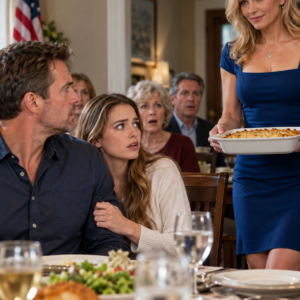
Mandy’s voice cut through the restaurant so sharply that a waiter stopped beside our table with two water glasses balanced in his hand.
At the next table, a little boy in a dinosaur sweatshirt froze with a French fry halfway to his mouth, while his mother reached instinctively for his shoulder.
“He’s five,” the father said. “He dropped a spoon.
We’re sorry for the noise.”
“Some people shouldn’t be allowed to have children,” Mandy snapped, lifting her phone again. “Hannah, tell them.
You heard it too.”
I’d known Mandy Pierce since college, long before she built an audience reviewing restaurants around Columbus, Ohio.
When my mother died, Mandy brought groceries to my apartment and sat on the floor while I sorted photographs; that kindness was why I’d kept excusing the way she treated servers, demanded free meals, and called ordinary people “background noise” in her videos.
I was thirty-four now, a freelance videographer who shot and edited most of her content.
That afternoon I’d agreed to help her record a sample for Cedar Table Hospitality, a local restaurant group considering a six-month, $42,000 promotional contract.
But she’d planted her tripod in the middle of a busy dining room and expected the world to go silent.
“Don’t put my name in this,” I said quietly.
Mandy laughed toward her phone. “My producer agrees.
Parents need to control their kids.”
The boy’s mother folded a napkin over the spilled water by his plate.
He whispered, “I’m sorry, Mommy,” though he hadn’t done anything wrong, and something about how carefully he said it made my throat close.
“Actually, I don’t agree,” I said, louder this time. “Mandy, stop filming them.”
The father turned toward me.
I recognized his face from a staff scholarship event I’d filmed the previous spring: Thomas Reed, founder of Cedar Table Hospitality.
I’d watched him stay after the photographs to help an elderly dishwasher carry boxes to her car.
Mandy had dealt only with his marketing director.
She had never bothered to learn his face.
“Are you threatening my review?” she demanded of him, cheeks flushed.
Thomas didn’t raise his voice.
He moved his chair closer to his son, then glanced at the phone trained on their table.
“No,” he said. “I’m asking you to stop recording my family.”
Mandy smirked. “Do you have any idea who you’re talking to?”
“Yes,” he said. “You’re the woman whose $42,000 contract is sitting on my desk for approval tomorrow.”
Mandy lowered her phone so quickly that the little tripod scraped against her plate.
I watched her glance from Thomas to the restaurant’s name printed on the menu, doing the calculation she should have done before she opened her mouth.
“I didn’t realize you were with Cedar Table,” she said, suddenly sweet. “I was just trying to get a clean recording.”
Thomas looked toward his son, who had tucked his face beneath his mother’s arm. “He’s trying to eat his dinner.
That’s all.”
I apologized to the family, and the mother, Lauren, nodded without pretending it was fine.
When I asked if they wanted me to delete the material from my camera, Thomas requested that I preserve the unedited recording privately because it documented what had happened; I agreed not to publish any image of their child.
Mandy collected her tripod and hurried outside.
She stood beside my car, her cheeks blotchy with anger, and demanded that I tell Thomas his wife had started the argument.
“You watched the whole thing,” I said.
“You work for me, Hannah.”
I thought of the nights I’d stayed up putting subtitles on her sponsored videos while she called me her “little helper” on camera.
She had paid my invoices, usually late, but she had never paid for the part where I was expected to excuse her cruelty.
“I work with you,” I answered. “Not for whatever story you want to invent.”
She drove away without me.
I sat on a bench outside the restaurant until my hands stopped trembling, then called a rideshare home.
That night, Mandy posted a thirty-second clip to her followers.
It began with the boy crying, skipped her first insult, and ended on a few words I’d said earlier about the pasta: “I agree,” pasted beneath a caption claiming we’d both been harassed by an unruly family.
My own name was tagged.
By morning strangers were calling me cruel, while others had recognized the restaurant and were trying to identify the child.
I asked Mandy in writing to remove my name and the family footage; instead she sent a voice message saying she would tell every client in town that I was unreliable if I contradicted her.
I saved it.
Then I called Thomas’s marketing director, Rebecca, and arranged to submit my original file through their counsel, with the family’s permission.
It included Mandy’s insults, my objection, and the mother comforting her son.
I sent the agency only what was needed for its review and kept the child’s face out of any public discussion.
Rebecca thanked me, but her voice sounded strained. “There’s another problem, Hannah.
Mandy has already filed a written complaint against Thomas.”
I assumed it was another exaggeration until Rebecca shared the document with my attorney copied in.
The complaint alleged the family had verbally threatened Mandy and said I had witnessed it.
Beneath the statement was my name and a scanned signature from an old production invoice.
My best friend hadn’t just lied about me online.
She had signed my name to her lie.
For nearly twenty-four hours, I kept reaching for my phone to call Mandy the way I always had after a bad day.
My thumb would stop over her name, and I’d remember the little boy whispering an apology for dropping a spoon.
I sent the complaint to my attorney, who notified Cedar Table’s counsel that I had neither written nor approved it.
We supplied the unedited video, my original invoice bearing the same signature image, and Mandy’s message threatening my reputation if I contradicted her.
A week later, Cedar Table withdrew its unsigned partnership offer.
Its decision cited the filming of other diners without consent, the misleading public clip, and the false statement, not the fact that a child had made noise in a family restaurant.
Mandy responded by posting that I had betrayed her for a rich businessman.
She said I’d secretly wanted her career, and for one miserable evening I watched people I’d never met decide which of us was telling the truth.
Then I remembered my mother, standing at our kitchen sink after a difficult shift at the diner where she worked.
She used to say you could tell plenty about someone by the way they spoke to the person clearing their plate.
I published one short statement: I did not agree with Mandy’s remarks, did not authorize the complaint carrying my signature, and would not share footage identifying the child.
I explained that the unedited material had been provided privately to the people involved; I didn’t turn the family’s worst dinner into another piece of content.
Several local businesses paused or ended Mandy’s sponsored arrangements after reviewing the facts, and one demanded corrections to claims she had made in past videos.
Her online following didn’t disappear overnight, but the paid opportunities she had treated as guaranteed stopped arriving.
Two weeks later, she came to my apartment with the canvas tote I’d lent her years before.
She looked exhausted, and for a second I saw the friend who had brought soup when my mother was dying.
“Tell them you misunderstood,” she said. “You can still fix this.”
The tote slipped from her wrist and landed between us.
“You could have fixed it in the restaurant,” I answered. “You could have apologized to a frightened child.
Instead you used my name twice because you thought I’d never say no.”
“I was scared of losing the deal.”
“And I was scared of losing my best friend.”
Her eyes filled, but she still wanted me to change the truth.
I handed back the tote, closed the door gently, and cried only after she’d gone.
Through our lawyers, Mandy withdrew the complaint and signed a correction confirming she had used my signature without permission.
She removed the edited post, issued a public retraction, and paid the last outstanding invoice for my editing work; I declined any future projects.
Months later I filmed a staff-training video for Cedar Table, a job Rebecca offered after reviewing the professional work I’d done long before that dinner.
Thomas and Lauren weren’t there, and I was grateful their son could simply be a little boy instead of a character in someone else’s scandal.
After the shoot, I ate lunch alone at a small table near the window.
A child laughed behind me, loud and delighted, and nobody turned around.
I thought of the boy with the dinosaur sweatshirt and hoped that wherever he was eating, he knew he had never needed to apologize.