## CHAPTER 3: THE MAN WHO WALKED THROUGH THOSE DOORS WAS THE LAST PERSON I EVER EXPECTED TO SEE
For a moment, I thought I was dreaming.
The auditorium doors opened slowly, revealing a man standing in the hallway.
He wore a dark gray suit that seemed slightly too large for his shoulders. His hair had turned almost completely gray, and there were deep lines around his eyes that hadn’t been there twelve years earlier.
He stood motionless.
His hands were trembling.
Then he took one step forward.
It was Michael Carter. My ex-husband. Caleb’s father. The man who had abandoned us when our lives became difficult.
My fingers tightened around the armrests of my wheelchair.
I couldn’t speak.
Caleb stood beside me, holding the microphone.
“Mom,” he whispered, “I know you’re surprised.”
I stared at him.
“You invited him?”
Caleb nodded.
“Yes.”
My eyes returned to Michael.
He was walking slowly toward the stage, looking at me as though he expected me to turn away at any moment.
And perhaps I would have.
Because the last time I had seen him, twelve years earlier, I was lying in a rehabilitation hospital, struggling to understand how I would ever live independently again.
He had stood beside my bed with his arms crossed.
“This isn’t the life I wanted, Laura.”
I had thought he was upset.
I had thought he needed time.
Then he said something that remained in my memory long after everything else faded.
“I deserve something better.”
And he left.
No goodbye to Caleb.
No promise to return.
No explanation beyond those cruel words.
For twelve years, I had learned to live without him.
Now he was standing in front of me.
“Caleb,” I whispered, “why would you bring him here?”
My son lowered the microphone.
“Because there’s something he needs to tell you.”
Michael finally reached the stage.
He stopped several feet away.
His eyes moved from my face to my wheelchair.
Then he looked at our son.
“Hello, Caleb.”
Caleb didn’t smile.
“Hello, Dad.”
The word sounded strange.
Not angry.
Not affectionate.
Just distant.
Michael swallowed.
“Congratulations, son.”
“Thank you.”
Michael looked toward me.
“Laura.”
I stared at him.
“What are you doing here?”
He lowered his head.
“I came because Caleb asked me to.”
“That doesn’t answer my question.”
He nodded.
“You’re right.”
The principal approached quietly.
“Would you prefer to continue this conversation privately?”
Before I could answer, Caleb raised the microphone again.
“Please, Principal Harris. I want everyone to understand why I invited him.”
He turned toward the audience.
“Twelve years ago, my father left my mother and me after the accident. He said he couldn’t handle our new life.”
A murmur moved through the auditorium.
Caleb continued.
“At the time, I was twelve years old. I didn’t understand why someone who had promised to love our family forever could suddenly decide that we weren’t worth staying for.”
Michael lowered his eyes.
“But during the past few months, I discovered something about that accident that changed everything.”
My heart began racing.
I looked at my son.
“What did you discover?”
Caleb swallowed.
“Mom, do you remember anything about the night we crashed?”
I frowned.
“I remember rain. I remember getting into the car. Then I remember waking up in the hospital.”
He nodded.
“That’s what I thought.”
He turned toward Michael.
“Dad, you promised you would tell her.”
Michael looked at me.
For several seconds, he couldn’t speak.
Then he took a shaky breath.
“Laura, there’s something I should have told you twelve years ago.”
My stomach tightened.
“What?”
He looked at the floor.
“I was driving the car that night.”
I stared at him.
“I know you were.”
He shook his head.
“No. You don’t understand.”
His voice cracked.
“I wasn’t simply driving. I caused the accident.”
The auditorium went completely silent.
I felt my body become strangely cold.
“What?”
Michael wiped his face.
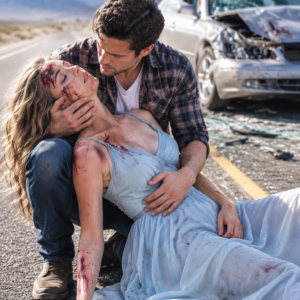
“It was raining. We were on our way home from Caleb’s school event. I received a message on my phone.”
I remembered that evening.
Caleb had performed in a school concert.
He had been so excited that we had taken him out for ice cream afterward.
I remembered laughing.
I remembered the rain.
Then nothing.
Michael continued.
“I looked down to read the message. It was only a few seconds. But when I looked up, the traffic ahead had stopped.”
He struggled to continue.
“I tried to brake. The car skidded. We hit the barrier.”
I stared at him.
“You were looking at your phone?”
He nodded.
“Yes.”
“While you were driving?”
“Yes.”
I felt something break inside me.
“Why didn’t you tell me?”
He covered his face.
“Because I was ashamed.”
I laughed once.
It wasn’t amusement.
It was disbelief.
“You let me believe it was just an accident.”
He nodded.
“You let me spend twelve years believing that fate had taken away my ability to walk.”
“I’m sorry.”
“You knew?”
He looked at me.
“I knew I had caused it.”
I gripped my wheelchair.
“And then you left.”
He nodded.
“Yes.”
I stared at him.
“Do you understand what you’re telling me?”
His eyes filled.
“I do.”
“No, Michael. You don’t.”
My voice grew louder.
“You looked at your phone. You caused the crash. I woke up paralyzed. Our son was injured and frightened. And instead of standing beside us, you walked away because you couldn’t handle the consequences of what you’d done?”
He began crying.
“Yes.”
I looked toward Caleb.
My son was crying too.
But he wasn’t looking at me.
He was staring at his father.
“That’s what happened, Dad?”
Michael nodded.
“Yes.”
Caleb lowered his head.
“All these years, I thought Mom had simply been unlucky.”
Michael took a step toward him.
“Caleb—”
“Don’t.”
My son raised his hand.
“Don’t come closer.”
Michael stopped.
Caleb wiped his cheeks.
“Do you know what I remember about that night?”
Michael shook his head.
“I remember you shouting. I remember the headlights. I remember Mom asking whether I was okay.”
His voice trembled.
“Even though she was hurt, she was asking about me.”
I began crying.
Caleb continued.
“And I remember you standing outside the ambulance, talking to the police. You told me everything was going to be okay.”
Michael closed his eyes.
“I remember.”
“Then why did you leave us?”
Michael looked toward the audience.
“I was afraid.”
Caleb gave a bitter laugh.
“Mom was afraid too. I was afraid. But we stayed.”
Michael’s shoulders collapsed.
“You’re right.”
The principal finally approached.
“Perhaps we should give the family some privacy.”
I nodded.
The microphone was switched off.
The audience was asked to remain seated while the graduation program paused.
A teacher helped move my wheelchair toward a small room beside the auditorium.
Caleb walked beside me.
Michael followed at a distance.
When we entered the room, I turned toward him.
“Start from the beginning.”
Michael sat down.
His hands were shaking.
“After the accident, the police questioned me. I admitted that I had looked at my phone.”
“Did you face charges?”
“I received a citation for distracted driving. The insurance investigation established that I was responsible.”
I stared.
“And you never told me?”
He shook his head.
“The doctors said you were unlikely to remember the accident clearly. You had suffered a serious injury and were heavily medicated. I told myself I would explain when you were stronger.”
“And then?”
He looked down.
“Then I couldn’t face you.”
I laughed bitterly.
“So you decided to leave.”
“Yes.”
He continued.
“When the doctors told us you might never walk again, I panicked. I couldn’t imagine the life ahead of us. I was selfish. I was ashamed of what I had done, and instead of accepting responsibility, I blamed the situation.”
I stared at him.
“You blamed me.”
He closed his eyes.
“Yes.”
“You told me you deserved better.”
He nodded.
“I did.”
I swallowed.
“Michael, do you know how many nights I wondered whether you left because I was no longer attractive to you? Whether you couldn’t bear being married to someone in a wheelchair?”
His eyes filled.
“I know.”
“No, you don’t.”
I looked at Caleb.
“Do you know how many times our son asked whether his father was coming home?”
Michael began crying.
“I know.”
“Do you know how many birthdays I explained your absence?”
He lowered his head.
“I know.”
I looked directly at him.
“Then tell me why you’re here.”
He wiped his cheeks.
“Because I owe both of you the truth.”
He reached into his jacket and removed a folded document.
It was an old police report.
I recognized the date immediately.
The date of our accident.
He placed it on the table.
“I kept this for twelve years.”
I looked at it.
“Why?”
“Because I couldn’t bring myself to destroy it. And because I knew that someday I would have to stop hiding.”
Caleb leaned forward.
“Mom, I found this report three months ago.”
I turned toward him.
“How?”
“Remember when I was organizing the old medical records for the scholarship application?”
I nodded.
“I found a box of documents in the storage closet. The police report was inside.”
I stared at him.
“You’ve known for three months?”
He nodded.
“Yes.”
“Why didn’t you tell me?”
He took my hand.
“Because I wanted to understand everything before I brought it to you.”
I felt tears gathering.
“Sweetheart, you didn’t have to carry that alone.”
He smiled sadly.
“I know that now.”
Then he looked toward his father.
“I contacted him because I wanted him to explain what happened. I didn’t want to spend the rest of my life wondering.”
Michael nodded.
“Caleb asked me to come today. He said he would only invite me if I agreed to tell the truth and never ask you to forgive me.”
I looked at my son.
“Is that why you wanted him here?”
Caleb nodded.
“I wanted you to know that none of this was your fault.”
He squeezed my hand.
“You didn’t deserve what happened. You didn’t deserve to be abandoned. And you never deserved to spend twelve years wondering why Dad left.”
I began crying.
Then Caleb leaned down and hugged me.
“Mom, you were never the problem.”
Those words hurt more than anything Michael had confessed, because they reminded me how long I had spent believing that somehow I had been responsible for being abandoned.
I held my son tightly.
And for the first time in twelve years, I allowed myself to stop wondering what I could have done differently.
Because the truth was finally clear.
I hadn’t failed my marriage.
I hadn’t failed my husband.
I had survived an accident, a devastating injury, and a man who had chosen to run away.
And I had raised a wonderful son.
That was enough.
## CHAPTER 4: MY SON HAD DISCOVERED SOMETHING ELSE — AND THE LETTER HIS FATHER BROUGHT MADE ME CRY
The graduation ceremony eventually continued.
I was too emotionally exhausted to return to the auditorium immediately.
Caleb stayed beside me.
Michael remained near the door.
For several minutes, nobody spoke.
Then Caleb looked at me.
“Mom, are you angry that I invited him?”
I took a breath.
“I’m surprised.”
“That’s understandable.”
I smiled faintly.
“Very surprised.”
He looked down.
“I didn’t want to ruin your special day.”
I touched his cheek.
“You didn’t ruin anything.”
“But I brought back something painful.”
I shook my head.
“Sweetheart, that pain was already part of our history. You didn’t create it.”
He nodded.
Then I asked:
“How did you find him?”
Caleb looked toward Michael.
“Can I explain?”
I nodded.
He pulled a chair closer.
“After I found the accident report, I searched for Dad online. I found his business address.”
Michael lowered his eyes.
Caleb continued.
“I wrote him an email. I asked him why he had never told us the truth.”
“What did he say?”
“He didn’t answer immediately.”
Michael spoke quietly.
“I was afraid of what he would ask.”
Caleb looked at him.
“I asked him whether he had ever thought about Mom.”
Michael nodded.
“Every day.”
Caleb continued.
“I asked whether he had ever thought about me.”
Michael closed his eyes.
“Every day.”
I looked at him.
“Then why didn’t you call?”
He swallowed.
“Because thinking about you wasn’t the same as having the courage to face you.”
I remained silent.
Caleb continued.
“Eventually, he replied. We met at a coffee shop.”
I turned toward him.
“You met your father?”
He nodded.
“Twice.”
My heart tightened.
“Why didn’t you tell me?”
“I wanted to hear his explanation first.”
I looked at Michael.
“And what did he tell you?”
Caleb hesitated.
“That he had been ashamed for twelve years. That he had convinced himself you were better off without him.”
I let out a slow breath.
“That sounds familiar.”
Caleb nodded.
“He also told me something else.”
“What?”
My son looked at his father.
“Tell her.”
Michael removed another envelope from his jacket.
“This is for you.”
I stared at it.
“What is it?”
“A letter.”
“From whom?”
“Me.”
I didn’t take it immediately.
Michael placed it on the table.
“You don’t have to read it now.”
I looked at the envelope.
My name was written across the front.
Laura.
The handwriting was familiar.
I had seen it on birthday cards, grocery lists, and notes he used to leave on the refrigerator.
I opened it.
Inside were several pages.
I began reading.
Laura,
I don’t expect you to forgive me.
I don’t expect you to believe that I am a different person.
But I owe you the truth about what happened after the accident.
When I saw you lying in that hospital bed, I knew my distraction had changed your life forever.
I was terrified.
I was ashamed.
And instead of accepting responsibility, I became angry at everything.
I hated the hospital.
I hated the doctors.
I hated the wheelchair.
But most of all, I hated myself.
I stopped reading.
My hands trembled.
Michael looked at me.
“Please keep going.”
I continued.
I remember the first time you asked me whether I would still love you if you never walked again.
I told you yes.
And I meant it when I said it.
But when the doctors explained what our lives would look like, I became frightened. I started thinking about everything that would change.
I imagined the responsibilities, the financial difficulties, the appointments, and the adjustments.
I convinced myself that I was too young to live that way.
I told myself I deserved something better.
I was wrong.
My eyes filled.
I continued.
The truth is that I didn’t deserve better.
You deserved better.
Caleb deserved better.
I caused the accident. I caused the injury. And then I caused another kind of damage by leaving.
I cannot undo any of it.
I can only admit that I was a coward.
I hope you have found happiness.
I hope Caleb has grown into a good man.
And I hope that one day, when you think about me, you won’t remember only the worst thing I ever did.
Michael.
I folded the letter.
For a long time, I couldn’t speak.
Then I looked at him.
“Why now?”
He swallowed.
“Because Caleb made me understand something.”
“What?”
“That an apology doesn’t become less necessary simply because you’ve waited too long.”
I stared at him.
“That’s true.”
He nodded.
“I should have apologized years ago.”
“Yes.”
“I should have been there when Caleb graduated from middle school. I should have been there when he learned to drive. I should have been there when he received his first school award.”
His voice broke.
“I missed everything.”
I looked at him.
“Yes, you did.”
He lowered his head.
Then Caleb reached into his graduation gown.
He removed a small notebook.
“Mom, there’s something else I want to show you.”
I looked at him.
“What now?”
He smiled.
“Remember when you used to tell me stories about nursing school?”
I nodded.
“You always talked about the hospital library, the anatomy classes, and the professor who made everyone nervous.”
He laughed.
“Dr. Bennett.”
I smiled.
“She was terrifying.”
Caleb opened the notebook.
Inside were several printed emails.
“Three months ago, I contacted your former nursing school.”
I stared.
“Why?”
“Because I wanted to find out whether you could return.”
I felt my eyes fill again.
He continued.
“I spoke to the admissions office. They explained that your old credits were still documented, although the program requirements had changed.”
I shook my head.
“Caleb, I haven’t studied nursing in twelve years.”
“I know.”
“I don’t even remember half the things I learned.”
He smiled.
“That’s why schools have teachers.”
I laughed through my tears.
He continued.
“I also contacted your old instructor, Dr. Bennett.”
I looked at him.
“Dr. Bennett?”
“Yes.”
“She remembers me?”
“Very well, apparently.”
He turned a page.
“She told me that you were one of the strongest students in your class.”
I shook my head.
“That’s impossible.”
Caleb grinned.
“Her words, not mine.”
Then he handed me another sheet of paper.
It was an email from Dr. Bennett.
Dear Caleb,
I remember your mother very well.
She was one of the most determined students I ever taught. When she left the program following her accident, I was deeply saddened.
I often wondered what had happened to her.
Please tell her that I would be delighted to meet her again.
And please tell her that an accident changed her circumstances. It did not erase her intelligence, her compassion, or her ability to become an excellent healthcare professional.
I covered my mouth.
Caleb watched me.
“Mom, there’s a reason I wanted this graduation to be special.”
I looked at him.
“What reason?”
He smiled.
“Because I wanted you to understand something.”
He took my hand.
“For twelve years, you’ve been telling me that I can still build the future I want, even when life doesn’t go according to plan.”
He paused.
“Now I want you to believe the same thing about yourself.”
I began crying again.
He leaned closer.
“You didn’t lose your dreams when you lost the ability to walk. You only lost the chance to follow them for a while.”
I hugged him.
And I realized that my son had spent months preparing something far bigger than a graduation surprise.
He had been quietly rebuilding a part of my life that I had given up on.
A few minutes later, Principal Harris entered the room.
“Mrs. Carter, I hope you’re feeling all right.”
I smiled weakly.
“I’m overwhelmed.”
He laughed.
“I imagine you are.”
He held another folder.
“Caleb has asked us to keep something else confidential until today.”
I looked at my son.
He smiled.
“One more surprise.”
The principal opened the folder.
“Your former nursing college has approved a full educational scholarship.”
I stared.
“Full?”
“Tuition, textbooks, required learning materials, and accessible study arrangements.”
I couldn’t speak.
He continued.
“The community foundation has also contributed a separate grant to help with transportation, assistive technology, and any necessary accessibility equipment.”
I looked at Caleb.
“How did you manage all this?”
He shrugged.
“I asked people.”
The principal smiled.
“He did considerably more than that.”
He explained that Caleb had approached several local businesses, community organizations, and former students of the college.
He had written letters.
He had prepared a presentation.
He had even organized a small online fundraiser.
The scholarship committee had been impressed not only by my previous academic record but also by Caleb’s determination to help me return to education.
I stared at the documents.
“Caleb, how much time did you spend doing this?”
He smiled.
“A little.”
The principal laughed.
“More than a little.”
Caleb looked embarrassed.
“Okay. A lot.”
I reached for his hand.
“Why didn’t you tell me?”
He smiled.
“Because I wanted you to have one day when you didn’t have to worry about anything.”
I looked at my son.
And I began crying again.
My twelve-year-old boy had once sat beside my hospital bed, frightened that he might lose his mother. Now, at eighteen, he was standing beside me, helping me find a future I had thought was gone forever.
That evening, after the graduation celebrations, Caleb and I returned home.
Michael did not come with us.
He had asked whether he could visit another day.
I told him I needed time.
He accepted.
When Caleb helped me settle into my favorite chair, I looked at him.
“Come here.”
He sat beside me.
I held his face between my hands.
“Thank you.”
He smiled.
“You’re welcome.”
“No, sweetheart. I mean everything.”
His eyes filled.
I continued.
“You worked so hard. You carried so much. And you never once made me feel like I was holding you back.”
He looked down.
“Mom, you never held me back.”
I kissed his forehead.
Then he said something that made me smile.
“Besides, I have a confession.”
“What?”
He grinned.
“I was terrified you would say no to the scholarship.”
I laughed.
“Why would I say no?”
“Because you always tell me you’re too old to start over.”
I shook my head.
“Well, I suppose I can’t keep saying that now.”
He smiled.
“Good.”
Then he leaned back.
“Because I already bought you a notebook.”
I laughed.
“Of course you did.”
He stood and retrieved a small package from his backpack.
Inside was a beautiful leather notebook.
On the first page, he had written:
LAURA CARTER — FUTURE NURSE.
I pressed it against my chest.
And for the first time in twelve years, I allowed myself to imagine what my future might look like.
## CHAPTER 5: I RETURNED TO THE COLLEGE I HAD LEFT TWELVE YEARS EARLIER — AND MY FORMER PROFESSOR DID SOMETHING I NEVER EXPECTED
Two weeks after graduation, I received a phone call from the nursing college.
The admissions director wanted to meet with me.
I almost declined.
Not because I didn’t want to go.
But because I was terrified.
I hadn’t been inside a classroom for twelve years.
I hadn’t taken an examination in more than a decade.
And although I had spent years working remotely, my confidence in my academic abilities had slowly disappeared.
I knew how to manage a household.
I knew how to help Caleb with homework.
I knew how to solve problems.
But becoming a nursing student again?
That felt enormous.
When I told Caleb about the meeting, he smiled.
“That’s wonderful!”
I shook my head.
“I’m nervous.”
He laughed.
“Mom, you used to tell me that nervousness meant you cared about something.”
I smiled.
“Did I?”
“Every time I had a test.”
I sighed.
“Apparently, I gave you too many speeches.”
He grinned.
“Now you have to listen to one.”
He leaned toward me.
“You’re going.”
I laughed.
“Yes, sir.”
The college looked almost exactly as I remembered it.
The main building had been renovated, and the entrance was now equipped with automatic doors and a wide ramp.
There were new signs, new classrooms, and a modern student center.
But the smell of the library was the same.
Paper.
Coffee.
And that faint scent of cleaning products.
I sat in my wheelchair near the entrance, looking around.
For a moment, I was twenty-four again.
I could almost hear the voices of my classmates.
I could almost see myself walking through the corridor carrying a stack of textbooks.
Then a familiar voice called my name.
“Laura Carter?”
I turned.
An older woman was walking toward me.
She had silver hair, thin glasses, and the same confident posture I remembered.
I immediately recognized her.
“Dr. Bennett?”
She smiled.
“Oh, my goodness.”
She stopped in front of me.
“Look at you.”
I laughed nervously.
“Look at you. You’re still terrifying.”
She burst out laughing.
“Good. At least I haven’t lost my reputation.”
Then she leaned down and hugged me.
It was a long, warm hug.
When she pulled away, her eyes were wet.
“I’ve wondered about you for years.”
I swallowed.
“I wasn’t sure you’d remember me.”
She looked almost offended.
“Laura, you once corrected my lecture notes in front of an entire class.”
I laughed.
“You had written the wrong dosage calculation.”
“I remember.”
She shook her head.
“You were absolutely right, by the way.”
We both laughed.
Then she became serious.
“How have you been?”
I looked at my wheelchair.
“Life has been complicated.”
She nodded.
“I can imagine.”
I told her briefly about the accident, the divorce, and raising Caleb.
She listened without interrupting.
When I finished, she reached for my hand.
“You have survived an extraordinary amount.”
I smiled faintly.
“I’ve just been doing what needed to be done.”
She shook her head.
“Don’t minimize your own strength.”
Then she said something I hadn’t expected.
“Do you remember your final clinical assessment before the accident?”
I frowned.
“Yes.”
“You were assigned to a rehabilitation ward.”
I nodded.
“I remember.”
“You spent an entire afternoon with a patient who had suffered a spinal injury.”
I looked at her.
I remembered that patient.
His name had been Mr. Peterson.
He had been frustrated, angry, and unwilling to participate in therapy.
I had stayed with him after my shift ended.
Dr. Bennett continued.
“Do you remember what he told you?”
I shook my head.
“He said that the hardest part of his recovery wasn’t learning to use a wheelchair. It was learning to believe that he still had a future.”
I stared.
Dr. Bennett nodded.
“You sat with him for hours. You listened. You didn’t rush him. And eventually, he agreed to participate in his rehabilitation.”
I felt tears gathering.
“Yes. I remember him.”
She smiled.
“That afternoon, I wrote in your evaluation that you possessed something that couldn’t easily be taught.”
“What?”
“Compassion.”
She squeezed my hand.
“Laura, I don’t know whether you’ll choose nursing exactly as you imagined twelve years ago. The profession has changed, and your educational pathway will need to be reviewed.”
She paused.
“But I know this.”
“You still have the qualities that made you a wonderful nursing student. Your wheelchair does not erase them.”
I lowered my head.
For twelve years, I had been afraid that the world saw only my disability.
That people would look at me and think about what I couldn’t do.
Dr. Bennett was reminding me that I still had something valuable to offer.
The admissions director joined us in a conference room.
Her name was Ms. Reynolds.
She explained that the college had reviewed my previous academic records.
Several of my completed credits could still be recognized, subject to the program’s current requirements.
The scholarship would cover the approved course of study.
She also discussed the accessibility arrangements.
The college had installed accessible laboratory stations, adjustable work surfaces, accessible restrooms, and improved routes between buildings.
The clinical placement team would work with me to identify an appropriate pathway that met the nursing program’s essential competency requirements while providing reasonable accommodations.
I listened carefully.
Then I asked the question that had been frightening me.
“Will I be able to complete the clinical requirements?”
Ms. Reynolds nodded.
“We’ll assess your individual needs and arrange appropriate placements. We cannot promise that every task will be adapted in every setting, because nursing has essential professional standards. But we can work with you to identify suitable clinical environments and reasonable accommodations.”
I appreciated her honesty.
I didn’t want someone pretending the road would be easy.
I wanted a real opportunity.
Dr. Bennett smiled.
“And you won’t be doing it alone.”
I looked at her.
She continued.
“I’ve already spoken with the faculty. We would like to assign you an academic mentor.”
I smiled.
“Who?”
She raised an eyebrow.
“Someone who is apparently still terrifying.”
I laughed.
“You’re not serious.”
“Completely serious.”
I shook my head.
“You’re going to make me work hard.”
She smiled.
“That was always the plan.”
When I returned home, Caleb was waiting.
He had made dinner.
There was a plate of pasta on the table and a glass of orange juice beside it.
“How did it go?”
I smiled.
“Well.”
His face brightened.
“Really?”
“They’ve accepted my application pathway.”
He threw both hands into the air.
“Yes!”
I laughed.
“And Dr. Bennett is going to mentor me.”
He stared.
“Seriously?”
“Yes.”
He laughed.
“That woman still scares you.”
“Absolutely.”
He came over and hugged me.
Then he looked at the folder on my lap.
“Does this mean you’re officially going back?”
I nodded.
“Yes.”
His smile became enormous.
Then he said:
“Mom, I’m so proud of you.”
I reached for his hand.
“I’m proud of you too.”
He shook his head.
“No, this is your moment.”
I smiled.
“Then we’ll share it.”
That night, I couldn’t sleep.
I kept thinking about my first day.
Would the other students stare?
Would I struggle to keep up?
Would the younger students think I was strange?
Would I be able to manage the workload?
Then I remembered something Caleb had said.
You always told me I could become anything I wanted.
I reached for the leather notebook he had given me.
On the first page, beneath his words, I wrote:
Day One. I am beginning again.
And beneath that:
It is not too late.
The first week was harder than I expected.
The online learning platform was unfamiliar.
The textbooks were enormous.
And some of the younger students seemed to understand the new technology effortlessly.
I felt out of place.
During one lecture, I accidentally submitted the wrong assignment file.
Another day, I struggled to navigate the online discussion system.
I began questioning whether I had made a mistake.
One afternoon, I sat in the accessible student lounge, staring at my laptop.
A young woman approached.
“Are you Laura?”
I looked up.
“Yes.”
She smiled.
“I’m Sophie. I’m in your class.”
I nodded.
“Hello.”
She hesitated.
“Would you like to join our study group?”
I blinked.
“Me?”
She laughed.
“Yes, you.”
I smiled.
“Of course.”
She pulled out a chair.
“We’re meeting on Thursday.”
Then she added:
“Dr. Bennett said you have a lot of experience with rehabilitation care.”
I laughed.
“She says too much.”
Sophie grinned.
“She also said you corrected her calculations once.”
I covered my face.
“That story is never going to disappear, is it?”
Sophie laughed.
“No chance.”
And just like that, I had made my first new friend.
When I told Caleb, he smiled.
“See? You’re already becoming popular.”
I rolled my eyes.
“Don’t exaggerate.”
He sat beside me.
“How are you feeling?”
I thought about it.
“Tired.”
He nodded.
“Anything else?”
I smiled.
“Happy.”
He looked relieved.
Then I said:
“Caleb, I need you to understand something.”
He looked at me.
“What?”
“I don’t want you to feel responsible for making my life wonderful.”
He frowned.
“I don’t.”
“Yes, you do sometimes. You’ve spent so much time trying to give me things you think I lost.”
He looked down.
I continued.
“You gave me the opportunity to return to school. That is an incredible gift. But the work ahead is mine.”
He smiled faintly.
“I know.”
“And I want you to live your own life.”
He nodded.
“I am.”
I squeezed his hand.
“Good.”
Then he grinned.
“Actually, I have some news.”
“What?”
“I got accepted into university.”
I stared.
“Caleb!”
He laughed.
“I got the email this morning.”
I grabbed his hands.
“Why didn’t you tell me immediately?”
“I wanted to wait until dinner.”
I laughed.
“You’re becoming a terrible person to keep secrets from.”
He smiled.
“I learned from the best.”
I shook my head.
And for the rest of the evening, we celebrated.
For the first time in years, our conversations weren’t about surviving another difficult month. They were about the futures we were building.
## CHAPTER 6: MY EX-HUSBAND RETURNED WITH AN UNEXPECTED OFFER — BUT I REFUSED TO LET HIM BUY HIS WAY BACK INTO OUR LIVES
Three months after graduation, Michael contacted Caleb.
He wanted to meet.
Caleb asked whether I would mind.
I considered it.
Then I nodded.
“That’s between you and your father.”
He looked at me.
“Would you come too?”
I hesitated.
“Why?”
“Because I don’t want to keep having two separate conversations about the same family.”
I smiled faintly.
“All right.”
We arranged to meet at a small restaurant near the university.
Michael arrived early.
He stood when he saw us.
“Hello.”
Caleb nodded.
“Hi.”
I gave him a polite smile.
“Michael.”
He pulled out chairs.
We sat down.
For several minutes, the conversation was awkward.
Then Michael looked at Caleb.
“I heard about your university acceptance.”
Caleb smiled.
“Yes.”
“Congratulations.”
“Thank you.”
Michael looked toward me.
“And your nursing course?”
“I’m doing well.”
He smiled.
“I’m glad.”
I nodded.
Then he reached into his briefcase.
“I brought something.”
I immediately felt cautious.
“What is it?”
He placed a document on the table.
It was a bank statement.
I looked at him.
“Why are you showing me this?”
He took a breath.
“I’ve been saving money for Caleb.”
Caleb frowned.
“What?”
Michael explained that he had opened a savings account several years earlier.
He had been depositing money whenever he could.
The account was intended for Caleb’s education.
I stared at him.
“Why didn’t you tell us?”
He looked uncomfortable.
“Because I didn’t think I deserved to be part of his life.”
I shook my head.
“Money doesn’t replace being a father.”
“I know.”
He nodded.
“I know that now.”
Caleb looked at the statement.
“How much is there?”
Michael told him.
It was a substantial amount.
Enough to cover a significant part of his university expenses.
Caleb looked surprised.
“Why didn’t you give it to me before?”
Michael lowered his eyes.
“Because I was ashamed.”
I felt anger rising again.
“Michael, you keep using shame as an explanation.”
He nodded.
“You’re right.”
I continued.
“You could have called. You could have written. You could have asked whether Caleb needed anything.”
“I know.”
“You could have helped us when I was struggling to pay for his school supplies.”
His face tightened.
“I know.”
I leaned back.
“Then why did you wait?”
He looked at me.
“Because I thought sending money would somehow give me the right to come back.”
I stared.
“And now?”
He swallowed.
“Now I understand that it doesn’t.”
He pushed the statement toward Caleb.
“The money belongs to you. If you want it for university, it’s yours. If you don’t want to accept it, I understand.”
Caleb studied him.
Then he said:
“I appreciate it.”
Michael nodded.
“But I want to make something clear.”
“Of course.”
“I don’t want money to become the reason we have a relationship.”
Michael looked directly at him.
“It won’t.”
Caleb continued.
“If we’re going to rebuild anything, it has to be because you actually show up.”
Michael nodded.
“You’re right.”
“And you can’t disappear the next time something gets difficult.”
Michael’s eyes filled.
“I won’t.”
Caleb looked at him for a long time.
Then he said:
“Okay. We can try.”
Michael covered his face.
He was crying.
I watched him.
And I felt something unexpected.
Not happiness.
Not forgiveness.
But a small amount of relief.
Our son had made a decision for himself.
He wasn’t being forced to forgive his father.
He was choosing to see whether a relationship could exist.
That was his right.
After lunch, Michael asked whether he could speak with me privately.
Caleb went outside to take a phone call.
Michael looked nervous.
“Laura, there’s something else.”
I waited.
He removed another document from his briefcase.
It was a proposal for an accessible housing renovation.
I frowned.
“What is this?”
“I’ve started working with a nonprofit organization that renovates homes for people with mobility challenges.”
I looked at him.
“Why?”
He nodded toward the document.
“After the accident, I spent years trying not to think about what happened. Eventually, I realized that avoiding the consequences didn’t make them disappear.”
He explained that he had joined a local road safety and disability support organization.
He had volunteered with families whose lives had changed following serious accidents.
He had helped with accessibility assessments and home modifications.
I listened quietly.
“That’s good work.”
He nodded.
“I know it’s not enough.”
“No. It isn’t.”
He accepted my answer.
Then he said:
“I would like to help make your home more accessible.”
I stared.
“My home is already accessible.”
“I know. But Caleb told me you’ve been having trouble with the kitchen counters and the upstairs storage.”
I frowned.
“Caleb told you that?”
“He mentioned it during one of our conversations.”
I looked toward the window.
There were things I had learned to work around.
The kitchen counter was slightly too high for certain tasks.
Some cupboards were difficult to reach.
The bathroom was functional but not ideal.
I had adapted.
I always adapted.
Michael continued.
“I know you won’t want money from me. But I have contacts with the organization. We could arrange an assessment and see whether there are improvements that would make daily life easier.”
I looked at him.
“Why are you doing this?”
He swallowed.
“Because I caused a lot of damage, and I want to spend the rest of my life being useful rather than avoiding responsibility.”
I studied his face.
Then I said:
“Helping with an accessibility renovation doesn’t make you my husband again.”
He nodded.
“I understand.”
“It doesn’t erase the past.”
“I know.”
“And I won’t let you use it to pressure me into forgiving you.”
He looked directly at me.
“I wouldn’t ask that.”
I considered his proposal.
Finally, I nodded.
“An assessment is fine. But I want the organization involved. I want everything done professionally.”
He smiled faintly.
“Of course.”
Over the following month, a team visited my home.
They measured the kitchen.
They examined the bathroom.
They checked the doorways and turning spaces.
They suggested several improvements.
The kitchen counters could be adjusted.
Storage could be lowered.
A better work surface could be installed.
The bathroom could be redesigned for safer transfers.
There were also small changes to the front entrance that would make coming and going easier.
The organization arranged much of the work through its community program.
Michael helped coordinate the contractors.
He did not insist on being present every day.
He simply made sure everything was completed properly.
When the renovations were finished, I rolled into the kitchen and stopped.
The counters were at a comfortable height.
The cupboards were easier to reach.
The sink had been adjusted.
There was space beneath the main work surface for my wheelchair.
I ran my hand across the counter.
It was beautiful.
Caleb came in.
“What do you think?”
I smiled.
“I love it.”
He grinned.
“Good.”
Then Michael appeared in the doorway.
He was holding a small toolbox.
“Everything working properly?”
I nodded.
“Yes. Thank you.”
He smiled.
“You’re welcome.”
For a moment, none of us spoke.
Then Caleb said:
“Maybe we should cook dinner.”
I laughed.
“Now?”
“Why not?”
Michael looked uncertain.
“Would you like me to help?”
I considered it.
Then I smiled.
“All right. But if you burn anything, you’re cleaning it up.”
Caleb burst out laughing.
Michael smiled.
“Fair enough.”
And that evening, for the first time in twelve years, the three of us prepared a meal in the same kitchen.
It wasn’t a romantic reunion.
It wasn’t a return to the marriage we had lost.
It was something different.
Something smaller.
Something more honest.
We were three people learning how to share a room without pretending the past hadn’t happened.
A few weeks later, Michael came to watch Caleb receive an academic award.
He sat beside me in the audience.
We didn’t hold hands.
We didn’t pretend to be a couple.
But when Caleb walked onto the stage, we both stood and applauded.
Afterward, Caleb came over.
“Did you see that?”
I smiled.
“Of course!”
Michael shook his head proudly.
“You did brilliantly.”
Caleb laughed.
“Thanks.”
Then he looked between us.
“Can we get dinner?”
I nodded.
“Absolutely.”
Michael smiled.
And we went.
One evening, while Caleb was studying, I received a message from Michael.
Thank you for allowing me to spend time with our son.
I read it twice.
Then I replied:
He deserves both parents to show up.
A moment later, he answered:
I know. I’m trying to learn how.
I put my phone down.
I wasn’t ready to forgive everything.
But perhaps forgiveness didn’t have to be a single dramatic moment.
Perhaps it could begin with something smaller.
A truthful conversation.
A kept promise.
A father attending a school event.
A son being allowed to decide what kind of relationship he wanted.
And a mother finally refusing to carry everyone else’s guilt.
That semester, I received my first major examination result.
I had passed.
Not just passed.
I had earned one of the highest marks in the class.
When I opened the email, I stared at the screen.
Then I called Caleb.
“Sweetheart!”
He answered immediately.
“What happened?”
“I passed!”
There was a pause.
Then he shouted:
“YES!”
I laughed.
“I got one of the highest marks!”
He began cheering.
I could hear him moving around his room.
“Mom! That’s incredible!”
I smiled.
“I know!”
Then he said:
“See? I told you.”
I laughed.
“You did.”
He paused.
Then his voice softened.
“I’m really proud of you.”
I looked at the notebook on my desk.
The first page still carried his handwriting.
Laura Carter — Future Nurse.
I smiled.
“Thank you, sweetheart.”
Then I said something I had wanted to say for a long time.
“You gave me the chance. But I earned this.”
He laughed.
“Exactly.”
And that was when I understood something important.
My son had given me a door. I had finally found the courage to walk through it in my own way.
## CHAPTER 7: THE DAY I WORE A WHITE UNIFORM AGAIN, MY SON BROUGHT SOMEONE TO THE HOSPITAL WHO MADE ME FORGET HOW TO BREATHE
The second year of my nursing education was the most challenging.
There were difficult examinations.
Long reading assignments.
Clinical simulations.
Group projects.
And days when I questioned whether I had taken on too much.
But I kept going.
Sophie became one of my closest friends.
She was twenty-two, energetic, and endlessly patient with my occasional technological disasters.
We studied together.
We shared notes.
Sometimes she came to my house when the campus schedule became difficult.
Dr. Bennett remained my mentor.
She was demanding, but she never treated me as though I needed less challenging work because I used a wheelchair.
When I struggled, she expected me to ask questions.
When I succeeded, she expected me to understand why.
And when I complained, she usually said:
“Good. Now show me what you’ve learned.”
I began to love the work again.
Not because it was easy.
Because it mattered.
One afternoon, during a rehabilitation-focused placement, I met a woman named Patricia.
She was forty-five and had recently suffered a spinal injury.
She had been independent before the accident.
Now she was struggling with the changes in her body and daily routine.
During our first conversation, she barely looked at me.
“I don’t want to talk.”
I nodded.
“That’s okay.”
She frowned.
“You’re supposed to encourage me.”
I smiled.
“Only if you want encouragement.”
She looked at me.
Then she glanced toward my wheelchair.
“Do you use one permanently?”
“Yes.”
She looked away.
“I’m sorry.”
I smiled.
“You don’t have to be.”
She remained quiet.
Then she asked:
“How long have you been like that?”
“Twelve years.”
Her eyes widened.
“Twelve?”
I nodded.
“Yes.”
She looked at me again.
“How do you do it?”
I considered the question.
“Some days are easier than others.”
She gave a small laugh.
“That’s not much of an answer.”
I smiled.
“You’re right.”
I leaned forward slightly.
“I think the biggest thing I learned was that I didn’t have to figure out my entire future immediately.”
She looked at me.
“When I first came home from the hospital, I was terrified. I thought everything I had wanted was gone.”
“And now?”
I smiled.
“Now I’m studying nursing.”
She stared.
“You’re a nurse?”
“Not yet.”
I laughed.
“But I’m working toward it.”
She looked surprised.
“At your age?”
I raised an eyebrow.
“What’s wrong with my age?”
She laughed.
For the first time, her expression softened.
We talked for nearly an hour.
I didn’t tell her she had to be positive.
I didn’t tell her everything would be easy.
I simply listened.
And before I left, she asked whether I would come back.
I smiled.
“If my placement allows it.”
She nodded.
“Good.”
As I rolled toward the door, she called after me.
“Laura?”
I turned.
“Yes?”
“Thank you.”
I smiled.
“You’re welcome.”
And I realized that I was beginning to understand why Dr. Bennett had remembered me.
I had spent twelve years learning how to live with a disability. Now I could use that experience to help someone else feel less alone.
That evening, I told Caleb about Patricia.
He listened carefully.
Then he smiled.
“You’re already helping people.”
I nodded.
“I hope so.”
He looked at me.
“Mom, can I tell you something?”
“Of course.”
“I used to worry about you.”
I smiled faintly.
“I know.”
“No, I mean when I was younger. I used to watch you getting ready for work and wonder whether you were happy.”
I looked at him.
He continued.
“Sometimes you’d be tired, but you’d still smile at me. You’d tell me everything was fine.”
I swallowed.
“I didn’t want you to worry.”
“I know.”
He looked down.
“But I wish you’d told me when things were difficult.”
I reached for his hand.
“You’re right.”
He smiled.
“I think I understand that better now.”
I laughed softly.
“Apparently, we both had a lot to learn.”
He nodded.
Then he said:
“There’s something else.”
“What?”
“I’ve been thinking about the future.”
I smiled.
“That’s good.”
He took a breath.
“I want to work in healthcare technology.”
I looked at him.
“Really?”
He nodded.
“Something that helps people with disabilities access medical services and education more easily.”
I smiled.
“That’s wonderful.”
He continued.
“I’ve been developing an idea for an accessible appointment and rehabilitation support platform.”
I stared.
“Caleb, that’s ambitious.”
He laughed.
“I know.”
“Do you have a plan?”
“Yes.”
He opened his laptop.
On the screen was a detailed presentation.
It included appointment reminders, accessible transportation coordination, rehabilitation resources, and a system for helping patients communicate their accessibility requirements before visiting a medical facility.
I studied it.
“This is impressive.”
He smiled.
“Thank you.”
Then he said something that made my heart swell.
“I got the idea from watching you struggle to arrange appointments after the accident.”
I looked at him.
“All those years?”
He nodded.
“I noticed how many times you had to call places to ask whether they had ramps, accessible bathrooms, or suitable examination equipment.”
He paused.
“I thought someone should make that easier.”
I smiled.
“Then I hope you do.”
A month later, Caleb invited me to a presentation at his university.
He had entered his project into a student innovation competition.
I arrived early.
The room was full of students and professors.
Caleb stood near the front, adjusting his laptop.
When he saw me, he smiled.
“Mom!”
I waved.
He came over.
“Thanks for coming.”
“Wouldn’t miss it.”
He leaned closer.
“There’s something I haven’t told you.”
I laughed.
“Again?”
He grinned.
“Don’t worry. It’s good.”
I raised an eyebrow.
“What?”
He looked toward the judges.
“One of the people reviewing the project is from a major healthcare technology company.”
I smiled.
“That’s exciting.”
“Yes.”
Then he took a breath.
“And if they like it, they might offer me a placement.”
I squeezed his hand.
“Caleb, that’s wonderful.”
He nodded.
“Let’s see what happens.”
His presentation began.
He explained the problem.
He demonstrated the platform.
He discussed the difficulties people with disabilities encountered when trying to access routine healthcare.
He showed how a patient could specify accessibility requirements, arrange transportation, and receive information about available facilities.
Then he showed a photograph.
It was of me.
I was sitting in my wheelchair outside a medical building, holding a folder of appointment documents.
I stared.
He had taken the photograph years earlier.
He turned toward the audience.
“My mother taught me that independence isn’t always about doing everything alone.”
He paused.
“Sometimes it’s about having the right support so you can make your own decisions.”
I felt tears gathering.
He continued.
“After her accident, I watched her spend hours trying to arrange simple appointments. I saw her being transferred between departments because nobody had documented her accessibility requirements.”
He looked at the judges.
“I started thinking about how many other people were facing the same problems.”
He paused.
“This project is for them.”
The room applauded.
I wiped my eyes.
And I realized that my son had taken the hardest part of our family history and turned it into something that might help others.
After the presentation, Caleb came over.
“Well?”
I laughed.
“You were brilliant.”
He smiled.
“Thank you.”
Then a woman approached.
She introduced herself as Helen Brooks, a director at a healthcare technology company.
She congratulated Caleb.
Then she turned toward me.
“Are you Laura?”
I nodded.
“Yes.”
She smiled.
“Your son has spoken about you.”
I laughed.
“I hope only good things.”
“Very good things.”
She looked at Caleb.
“We’d like to discuss a placement opportunity.”
Caleb’s face changed.
“Really?”
“Yes.”
He looked at me.
I smiled.
“Go on.”
Helen continued.
“We’re particularly interested in your experience with accessibility requirements and patient communication. We’d like to see whether you could work with our development team.”
Caleb was speechless.
Then he smiled.
“Absolutely.”
I hugged him.
And I knew that whatever happened next, he had earned that opportunity.
Later that evening, I received a message from Michael.
He had watched the presentation online.
Your son is extraordinary.
I smiled.
Then I replied:
He is.
A moment later, he wrote:
I wish I had been there for more of these moments.
I stared at the message.
Then I typed:
You can’t change the past. But you can show up for the next one.
He replied:
I will.
And this time, I believed that he might.
The following month, Michael came to one of Caleb’s university events.
He sat beside me.
We watched our son receive an award for his project.
When Caleb came over, he hugged both of us.
For a moment, the three of us stood together.
I looked at Michael.
He was crying.
“What’s wrong?” I asked quietly.
He shook his head.
“Nothing.”
Then he smiled.
“I’m just proud of him.”
I nodded.
“So am I.”
He looked at me.
“Thank you for raising him.”
I smiled faintly.
“He raised me too.”
Michael looked confused.
I laughed.
“He’s the reason I went back to school.”
He nodded.
Then he said something I would remember.
“Maybe he saved both of us.”
I considered that.
Perhaps he had.
But I also knew something else.
Caleb hadn’t saved me because I was helpless. He had reminded me that I was still capable of building a life.
There was a difference.
And I was finally beginning to understand it.
## CHAPTER 8: I FINALLY GRADUATED AS A NURSE — AND THE SURPRISE WAITING FOR ME AFTER THE CEREMONY WAS BIGGER THAN ANYTHING I HAD GIVEN MY SON
Three years after Caleb carried me onto his graduation stage, I received my own graduation invitation.
My name was printed across the front.
LAURA CARTER — NURSING PROGRAM GRADUATION.
I stared at it for several minutes.
Then I began crying.
I had done it.
I had completed the coursework.
I had passed the examinations.
I had completed the approved clinical requirements with the accommodations arranged by the college.
There had been difficult days.
There had been moments when I wanted to quit.
There had been nights when my body was exhausted and my mind refused to cooperate.
But I had finished.
And now, at forty-three years old, I was preparing to graduate.
The morning of the ceremony, Caleb arrived at my house carrying a large bouquet.
“Good morning, graduate!”
I laughed.
“You’re early.”
“I couldn’t sleep.”
He placed the flowers on the table.
Then he looked at my graduation gown.
“Mom.”
“What?”
“You look amazing.”
I smiled.
“Thank you.”
He helped me adjust the fabric around my shoulders.
Then he stepped back.
For a moment, he simply stared at me.
I raised an eyebrow.
“What?”
He shook his head.
“Nothing.”
“Caleb.”
He smiled.
“I was just thinking about the day you came home from the hospital.”
I lowered my eyes.
“So was I.”
He continued.
“You were frightened. I was frightened. We had no idea what would happen.”
I nodded.
“And now?”
He smiled.
“Now you’re graduating.”
I laughed.
“Apparently.”
He leaned down and hugged me.
Then he whispered:
“I’m proud of you, Mom.”
I closed my eyes.
“I’m proud of you too.”
The graduation ceremony was held in the same auditorium where Caleb had graduated.
The same stage.
The same rows of seats.
The same large windows.
But this time, I wasn’t sitting near the back.
I was one of the graduates.
When I entered the hall, several classmates waved.
Sophie came over and hugged me.
“Can you believe it?”
I laughed.
“No.”
She smiled.
“We actually did it.”
I nodded.
“We did.”
Dr. Bennett approached.
She was carrying a small bouquet of white flowers.
“Laura.”
I smiled.
“Dr. Bennett.”
She handed me the flowers.
“These are for you.”
I looked at them.
“Thank you.”
She leaned closer.
“I have to admit something.”
I raised an eyebrow.
“What?”
“When you returned to the college, I wondered whether you would finish.”
I laughed.
“That’s encouraging.”
She smiled.
“I wondered whether the demands would be too much. I wondered whether the adjustments would work.”
She paused.
“But I never doubted your determination.”
My eyes filled.
She continued.
“Today, I am not proud of you because you completed a program despite your disability.”
She looked directly at me.
“I am proud of you because you became the nurse you wanted to become, and you did the work required to get there.”
I hugged her.
And I cried.
The ceremony began.
Names were called.
Graduates crossed the stage.
Families applauded.
Then I heard:
“Laura Carter.”
For a moment, I couldn’t move.
Sophie squeezed my shoulder.
“Go!”
I smiled.
Then I wheeled toward the stage.
The applause grew louder.
I saw Caleb standing near the front.
He was holding his phone.
He was recording.
Michael was sitting beside him.
Margaret, my former instructor’s colleagues, and several members of the accessibility organization were there too.
When I reached the stage, Dr. Bennett was waiting.
She handed me my certificate.
I looked down.
My name was printed across the top.
I had dreamed about seeing those words twelve years earlier.
Now they were real.
I held the certificate against my chest.
And I cried.
After the ceremony, I was surrounded by classmates.
Sophie hugged me.
“We need to celebrate!”
I laughed.
“Absolutely.”
Caleb came over.
He was carrying something behind his back.
“What are you hiding?”
He grinned.
“Nothing.”
I raised an eyebrow.
“Caleb.”
He laughed.
“Okay, okay.”
He brought out a framed photograph.
It was the picture taken on his graduation day.
The one in which he had carried me onto the stage.
I stared.
Below the photograph was a small plaque.
It read:
THE DAY MY MOTHER’S DREAMS STARTED AGAIN.
I covered my mouth.
Caleb smiled.
“I thought you should have this.”
I looked at him.
“Sweetheart…”
He continued.
“That day, you thought I was giving you a scholarship.”
I laughed through my tears.
“I remember.”
“But I was really giving you something else.”
“What?”
He smiled.
“A reason to believe that your future wasn’t over.”
I began crying.
He leaned closer.
“And today, you gave yourself the rest.”
I hugged him.
For several seconds, neither of us spoke.
Then I whispered:
“You have no idea what you’ve done for me.”
He smiled.
“I think I do.”
But Caleb wasn’t finished.
He reached into his jacket and removed another envelope.
I stared at him.
“Another one?”
He laughed.
“Apparently, I have a problem.”
I opened it.
Inside was a letter from Helen Brooks, the director of the healthcare technology company where Caleb had completed his placement.
I read the first paragraph.
Then I looked at him.
“Caleb…”
He smiled.
“Keep reading.”
The letter explained that the company had approved a partnership with a regional rehabilitation network.
They wanted to launch a new accessibility initiative.
And they wanted Caleb to lead the development team.
I stared at the document.
“You got the position?”
He nodded.
“Yes.”
I hugged him.
“That’s wonderful!”
But there was more.
The letter continued.
The initiative would include a patient advisory panel.
The company wanted someone with direct experience navigating healthcare services as a wheelchair user.
Someone who understood rehabilitation, accessibility, and patient needs.
Someone who had recently completed professional nursing education.
I looked up.
Caleb was smiling.
I stared at him.
“What are you doing?”
He laughed.
“Mom, they want to interview you.”
I blinked.
“Me?”
He nodded.
“For a clinical accessibility consultant position.”
I couldn’t speak.
He continued.
“They want you to help review the platform, advise the clinical team, and make sure the system actually works for patients.”
I looked at the letter again.
The position would be flexible and could be performed partly from home.
It included paid training and opportunities to work with rehabilitation clinics.
I looked at Caleb.
“You arranged this?”
He shook his head.
“I introduced them to your work and told them about your experience. They reviewed your qualifications independently.”
I stared.
Then he smiled.
“They were impressed.”
I began crying again.
“Caleb, I don’t know what to say.”
He laughed.
“Say yes to the interview.”
I looked at the letter.
Then at my son.
Then at the photograph of him carrying me onto the stage.
And I laughed.
“All right.”
He threw his arms around me.
The following week, I attended the interview.
The company director greeted me warmly.
They asked about my nursing education.
They asked about my experience with rehabilitation.
They asked what improvements I believed were necessary in healthcare technology.
I answered honestly.
I explained how difficult it could be to arrange accessible transportation.
How many medical facilities had ramps but lacked accessible examination equipment.
How often patients had to repeat their needs because information wasn’t properly shared between departments.
How important it was to preserve independence rather than make assumptions about what a person could or couldn’t do.
The interview lasted nearly two hours.
At the end, the director smiled.
“Ms. Carter, I think you understand our patients better than most people ever could.”
I smiled.
“I understand some of their experiences.”
She nodded.
“That’s exactly why we’d like you to join us.”
I stared.
“You’re offering me the position?”
“Yes.”
I felt tears gathering.
Then I laughed.
“Yes. I’d love to.”
When I told Caleb, he shouted so loudly that I had to hold the phone away from my ear.
“YOU GOT IT!”
I laughed.
“Apparently!”
He began cheering.
Then he said:
“Mom, we’re going to work together.”
I smiled.
“Not exactly. You’ll be developing the technology, and I’ll be helping review the clinical side.”
He laughed.
“Still.”
I nodded.
“Still.”
Then he said:
“Remember what I told you when I carried you onto the stage?”
I smiled.
“What?”
“That you hadn’t finished dreaming.”
I looked toward the photograph on the shelf.
“Yes.”
He continued:
“Well, I think you should keep going.”
I laughed softly.
“I intend to.”
Three months later, our family attended the launch of the new accessibility platform.
The event was held at a rehabilitation center.
Several patients and healthcare professionals were present.
Caleb stood at the front, presenting the technology.
I sat near the stage.
Michael was there too.
He had come with a small bouquet.
After the presentation, he approached me.
“Congratulations.”
I smiled.
“Thank you.”
He looked toward Caleb.
“He’s done something wonderful.”
I nodded.
“Yes, he has.”
Then Michael said:
“There’s something I want to tell you.”
I waited.
“I know I can never undo what happened.”
I nodded.
“But I want you to know that watching you rebuild your life has changed the way I understand strength.”
I looked at him.
He continued.
“I spent twelve years believing that my mistake defined everything. But I’ve realized that the only thing I can control is what I do next.”
I smiled faintly.
“That’s true.”
He looked down.
“I don’t expect us to become what we were.”
I appreciated that.
“Good.”
He laughed softly.
“Fair enough.”
Then he said:
“But I would like to keep being part of Caleb’s life. And, if you’re comfortable with it, I’d like us to remain on good terms.”
I considered his words.
Then I nodded.
“We can do that.”
His eyes filled.
“Thank you.”
I shook my head.
“Don’t thank me. Just keep showing up.”
He smiled.
“I will.”
And he did.
He attended Caleb’s work events.
He called on birthdays.
He helped with practical things when asked.
He became a more consistent father.
But he never asked me to return to the marriage.
And I never felt obligated to pretend the past hadn’t happened.
We found a new relationship built on boundaries, honesty, and the understanding that some things cannot be repaired by simply saying sorry.
## THE FINAL SURPRISE: THE LETTER CALEB HAD WRITTEN WHEN HE WAS TWELVE YEARS OLD
Almost a year after my graduation, Caleb asked me to visit the rehabilitation center where he had first presented his project.
He said there was something he wanted to show me.
When I arrived, I found him standing beside a display table.
There were photographs.
Old school certificates.
Copies of the scholarship documents.
A photograph of me in my graduation gown.
And one particular picture that made me stop.
It was a photograph taken twelve years earlier.
I was lying in my hospital bed.
My hair was untidy.
My face was pale.
And Caleb was sitting beside me, holding my hand.
I stared.
“Where did you get this?”
He smiled.
“I found it in Grandma’s old photo album.”
I looked at the photograph.
I barely remembered that day.
Caleb continued.
“Do you remember what you told me when I asked whether you would ever be able to come home?”
I shook my head.
He smiled sadly.
“You told me that things would be different, but we would still be a family.”
I felt my throat tighten.
He reached beneath the display table.
Then he produced a small envelope.
It was yellowed with age.
The handwriting on the front was unmistakably his.
TO MOM. WHEN SHE IS SAD.
I stared.
“Caleb?”
He smiled.
“I wrote it when I was twelve.”
I opened it carefully.
Inside was a single sheet of paper.
The handwriting was uneven.
Some letters were too large.
Others were almost impossible to read.
But the words were clear.
Dear Mom,
I don’t know why this happened.
I wish I could make you walk again.
I wish Dad would come home.
I wish you didn’t cry when you think I’m asleep.
But I want you to know something.
I don’t care if we have to move to a smaller house.
I don’t care if we can’t go on holidays.
I don’t care if you can’t come to my football games.
I just want you to stay happy.
I promise I will work hard.
I promise I will help you.
And when I grow up, I will make something good happen for us.
Please don’t think your life is over.
You’re still my favorite person.
I love you.
Caleb.
I covered my mouth.
I couldn’t breathe.
I looked at him.
“You wrote this?”
He nodded.
“Yes.”
“Why didn’t you give it to me?”
He looked down.
“Because I was afraid it would make you cry.”
I laughed through my tears.
“Well, it certainly did.”
He smiled.
Then he pointed toward the display.
“There’s something else.”
I looked.
Beneath the letter was a small photograph of the two of us taken at my nursing graduation.
I was wearing my gown.
Caleb was standing beside my wheelchair.
We were both laughing.
Underneath it was another sentence.
HE PROMISED TO MAKE SOMETHING GOOD HAPPEN. AND HE DID.
I looked at my son.
Then I began crying.
He knelt beside my wheelchair.
“Mom?”
I touched his face.
“Yes, sweetheart?”
He smiled.
“Do you remember the day I carried you onto the graduation stage?”
I nodded.
“Of course.”
He continued.
“I thought I was giving you a dream back.”
I smiled.
“You did.”
He shook his head.
“No. I think we gave each other something.”
I looked at him.
“What?”
He smiled.
“Hope.”
I reached for his hand.
And I understood.
When Caleb was twelve, he had believed that his mother’s life had ended.
He had watched me struggle.
He had heard me cry.
He had seen me fight through days when I barely believed I could manage.
And instead of allowing those experiences to define his childhood, he had made a promise.
A promise that one day he would help me see myself differently.
He had kept that promise.
But I had given him something too.
I had shown him that difficult circumstances didn’t have to destroy a person’s future.
That love could survive disappointment.
That strength wasn’t always about being able to stand.
And that dreams didn’t disappear simply because life became unexpectedly difficult.
I looked at the old letter again.
Then I looked at the photograph.
And I finally understood the full meaning of the day he carried me onto that stage.
He hadn’t been trying to carry his helpless mother. He had been carrying the woman who had taught him never to give up.
That evening, we went home together.
Caleb helped me through the front door.
The kitchen renovation had made everything easier.
The flowers Michael had brought were sitting on the counter.
My nursing certificate hung on the wall.
Beside it was the framed photograph from Caleb’s graduation.
I looked at the two pictures.
One showed my son carrying me onto the stage.
The other showed me wearing my own graduation gown.
I smiled.
Caleb followed my gaze.
“Pretty good, isn’t it?”
I nodded.
“Pretty good.”
Then he said:
“Mom, I have one more question.”
I laughed.
“How many surprises do you have?”
He grinned.
“Just one.”
“What?”
He looked at me.
“Are you happy?”
I thought about it.
I thought about the accident.
The hospital.
The divorce.
The difficult years.
The lonely evenings.
The graduation ceremony.
The scholarship.
The new career.
The friends I had made.
The patients I had helped.
And the young man standing in front of me.
I smiled.
“Yes, sweetheart.”
He nodded.
“Good.”
Then I added:
“Not because everything turned out the way I wanted.”
He looked at me.
“But because I learned that my life was still mine to build.”
He smiled.
I reached for his hand.
“And because I have you.”
He leaned down and hugged me.
For a long moment, we stayed that way.
Then I whispered:
“Caleb?”
“Yes, Mom?”
“Thank you for carrying me onto that stage.”
He smiled.
“Always.”
I shook my head gently.
“No, sweetheart. You don’t have to carry me anymore.”
He looked at me.
I continued:
“You helped me remember that I could still move forward.”
His eyes filled.
And he whispered:
“That’s what I wanted.”
A few weeks later, I received a message from a woman who had attended Caleb’s graduation.
She told me that her sister had recently become a wheelchair user after an accident.
Her sister had stopped attending social events and refused to discuss returning to work.
The woman said she had shown her our story.
And for the first time in months, her sister had agreed to attend a rehabilitation appointment.
I read the message twice.
Then I looked at Caleb.
He was sitting at the table, working on his computer.
“Sweetheart?”
He looked up.
“Yes?”
I showed him the message.
He read it.
Then he smiled.
“That’s wonderful.”
I nodded.
“Yes.”
He returned to his laptop.
I watched him for a moment.
Then I thought about the twelve-year-old boy who had once sat beside my hospital bed, holding my hand and promising that everything would be okay.
He had kept his promise in ways neither of us could have imagined.
And I had kept mine too.
I had raised him.
I had loved him.
I had encouraged him.
And I had shown him that even when life changes completely, a person can still find a reason to keep going.
The accident took away my ability to walk. It did not take away my ability to dream, to love, to learn, or to begin again.
My husband had walked away because he couldn’t imagine a different life.
My son had stayed because he believed we could build one.
And years later, standing beside him at the beginning of our new chapter, I finally understood which of those choices had changed our lives forever.
I looked at Caleb.
He smiled.
And I smiled back.
Sometimes, the greatest gift a child can give a parent isn’t money, a house, or even a second chance.
It’s the reminder that the person who raised them still deserves a beautiful future of their own.
I had once thought my son’s graduation was the proudest day of his life.
I was wrong.
It was the day he showed me that my story wasn’t over.
And that, after twelve years of believing otherwise, was the greatest gift I could ever have received.
## THE END.