PART 3 (FULL ENDING)
I stared at the signature until the letters blurred.
My father had signed my name to a financial document without my permission.
The man who had taught me that honesty was the foundation of a respectable life had helped his son steal from his daughter. “You signed this?” I whispered.
Dad straightened his shoulders. “I was protecting this family.” “You committed fraud.” “Watch your mouth, Emily.” For thirty years, those words had been enough to silence me.
Not anymore. “You didn’t miss my wedding because of a church picnic,” I said. “You missed it because you were trying to cover up a crime against me.” Mom started crying.
Tyler muttered, “You’re ruining everything.” I turned toward him. “No, Tyler.
You ruined it when you used my identity.
Dad made it worse when he signed my name.” Then I picked up the folder and walked outside.
Daniel was waiting beside our car.
When he saw my face, he opened his arms without asking a question.
I cried against his chest until I could finally explain what had happened.
That afternoon, we contacted an attorney and began disputing the fraudulent credit account.
I filed an identity theft report and provided copies of the documents Rebecca had given me.
The investigation took months.
Tyler eventually admitted that he had submitted the application, while Dad acknowledged signing the authorization.
Their attorney negotiated the resolution of their cases, and both faced legal consequences.
The fraudulent debt was removed from my credit record after the lender completed its investigation.
But the hardest part wasn’t dealing with the paperwork.
It was accepting that my own family had treated my future as something they could gamble with to protect Tyler.
Mom called repeatedly, begging me to withdraw my complaint.
Dad sent letters accusing me of destroying the family.
Tyler left angry voicemails until my attorney advised me to stop responding.
Rebecca was the only person who apologized without making excuses.
She admitted she had been afraid of Dad and ashamed of her silence.
I didn’t forgive her immediately, but over time, we slowly rebuilt our relationship.
My parents never truly apologized.
They wanted the consequences erased, not the damage acknowledged.
Eventually, I stopped waiting for them to become the parents I needed.
Fourteen years passed.
Daniel and I built a peaceful life outside Springfield, Missouri.
We bought a modest house, raised two wonderful daughters, and filled our walls with photographs of birthdays, school concerts, camping trips, and family dinners.
Daniel’s parents became the grandparents my girls knew best.
Rebecca visited often, bringing homemade cookies and stories that made the children laugh.
I had learned that family wasn’t defined by who shared your blood.
It was defined by who showed up when it mattered.
Then, one October afternoon, an unfamiliar number appeared on my phone.
I almost ignored it.
The message read, “Emily, this is your father.
I’m in the hospital.
I’d like to see you before it’s too late.” I sat staring at those words for several minutes.
Daniel found me at the kitchen table. “What do you want to do?” he asked. “I don’t know.” He kissed my forehead. “Whatever you decide, you don’t owe anyone an explanation.”
Two days later, I drove to the hospital.
Dad looked smaller than I remembered, his hair completely white, his hands trembling against the blanket.
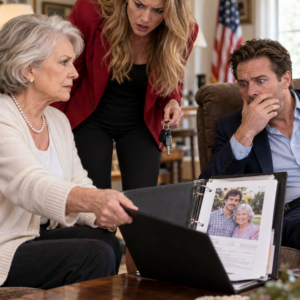
He stared at me for a long moment before saying, “You look like your mother did at your age.” I remained standing. “Why did you ask me here?” He reached toward the bedside drawer and pulled out an old envelope.
Inside was the wedding photograph I had mailed him fourteen years earlier.
On the back, my four words were still visible.
You had plans.
His eyes filled with tears. “I’ve kept this every day,” he whispered. “I thought I had time to make things right.” I looked at the photograph. “You had fourteen years, Dad.” He lowered his head. “I know.”
For the first time, he didn’t blame me or defend Tyler.
He admitted that he had failed me, that he had chosen protecting his son over respecting his daughter, and that he had been ashamed to face what he’d done. “I’m sorry I missed your wedding,” he said. “And I’m sorry I made you feel like you mattered less.” Tears slipped down my cheeks.
I believed he regretted it.
But regret couldn’t return those fourteen years. “I forgive you for what I can,” I told him. “But forgiveness doesn’t mean we can pretend nothing happened.”
Before leaving, I placed the photograph back in his hands. “Keep it, Dad.
It’s part of our story.” Then I drove home, where Daniel and our daughters were waiting.
That evening, we sat together around the dinner table, laughing over something our youngest had said at school.
I looked at the people who had never made me beg for a place in their lives and finally understood something.
Fourteen years earlier, I had mailed my father a photograph of the family who hadn’t shown up.
But the life I built afterward became the picture that mattered most.
My wedding had empty chairs.
My home never did.
Thank you so much!