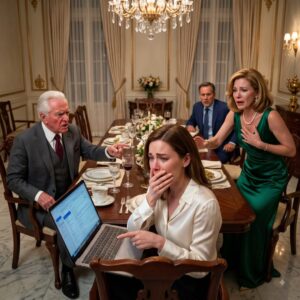
My father erased me from the family legacy between the appetizer and the main course.
He did it with a smile.
We were sitting in the private dining room of Bellamy House, one of those old Manhattan restaurants where the waiters knew which families wanted discretion more than good food.
My father, Richard Whitmore, sat at the head of the table.
At sixty-three, he still carried himself like the investment banker he had once been—straight back, silver hair, expensive watch, absolute certainty that everyone in the room eventually did what he wanted.
My mother, Elaine, sat beside him.
My younger brother, Ethan, sat across from me, barely hiding his grin.
Then Dad slid a cream-colored folder across the table.
“Sign it, Claire.”
I looked at the first page.
It was a waiver.
Not a normal one.
It stated that I voluntarily relinquished any future claim to Whitmore Holdings, the family’s real estate company, including ownership interests, voting rights, inheritance expectations, and disputed beneficial interests.
I looked up.
“What exactly am I signing away?”
Ethan laughed.
“Everything you were never supposed to have.”
Mom gave him a warning look, but she didn’t disagree.
Dad folded his hands.
“You’ve chosen your own path.
You moved to Chicago.
You refused to join the company.
Ethan stayed.”
“I worked for Whitmore Holdings for six years.”
“And then you left.”
“Because you wanted me to falsify occupancy projections for the Baltimore development.”
The smile disappeared from Dad’s face.
Mom leaned toward me.
“Claire, tonight isn’t about reopening old arguments.”
“No.
Apparently it’s about deleting me.”
Dad exhaled impatiently.
“You received opportunities most people would kill for.
This arrangement simply acknowledges reality.
Ethan will inherit the company.”
I flipped through the pages.
The language was aggressive.
Too aggressive.
Someone was afraid of something.
“What happens if I don’t sign?”
Dad picked up his wine.
“Then certain financial support arrangements involving your grandmother’s estate will be reviewed.”
That got my attention.
My grandmother, Margaret Whitmore, had died fourteen months earlier.
Grandma Margaret had hated my father’s obsession with control.
Three weeks before she died, she had called me into her apartment overlooking Central Park.
She gave me a small brass safe-deposit key.
No explanation.
Just eight words.
“Don’t use this until Richard shows you who he is.”
I had carried that key in my purse ever since.
Tonight, it was in my jacket pocket.
I touched it beneath the table.
Dad continued.
“Your grandmother left some complicated structures behind.
Ethan and I have been cleaning them up.”
I stared at him.
“Cleaning them up?”
“Administrative matters.”
“Which bank?”
For the first time all evening, my father’s eyes shifted.
Only slightly.
But I noticed.
Ethan noticed too.
Dad put his glass down.
“That’s irrelevant.”
My phone vibrated.
An unknown number.
I ignored it.
It vibrated again.
Then a text appeared.
Ms.
Whitmore, this is Daniel Kessler of Helvetia Privatbank, Zurich.
Please do not sign any document affecting your beneficial ownership interests.
Contact me immediately.
My heartbeat changed.
Swiss bank.
Grandma.
The key.
I looked at my father.
He was watching me now.
“Problem?”
“No.”
I locked my phone.
“Actually, I think I’m finally understanding.”
Dad pushed a pen toward me.
“Then sign.”
I picked it up.
Ethan leaned back, satisfied.
Mom smiled faintly.
And I signed.
My brother actually laughed.
“That wasn’t so difficult.”
Dad took the folder.
“Thank you.”
I put the pen down.
“You should read the signature.”
His expression changed.
He looked at the page.
Instead of my legal signature, I had written:
Signed under protest.
Rights expressly reserved.
Dad’s jaw tightened.
“Claire.”
I stood.
“Enjoy dinner.”
Mom stared at me.
“Where are you going?”
“To find out why a Swiss banker knows about my ownership interests when my own family supposedly doesn’t.”
Nobody moved.
That silence told me more than shouting would have.
I reached the door.
Then Ethan spoke.
“You don’t know what you’re getting involved in.”
I turned.
“That’s an interesting thing to say when five minutes ago you claimed there was nothing for me to inherit.”
His face went pale.
Dad rose from his chair.
“Claire, sit down.”
“No.”
“That wasn’t a request.”
“It hasn’t worked that way since I was sixteen.”
My phone rang.
Same Swiss number.
This time I answered.
“Claire Whitmore.”
A calm male voice responded.
“Ms.
Whitmore, my name is Daniel Kessler.
Your grandmother established a protected ownership structure eleven years ago.
We received notice forty minutes ago that someone attempted to transfer assets requiring your authorization.”
I looked directly at my father.
“What assets?”
There was a brief pause.
“Controlling shares of Whitmore Holdings.”
Nobody at the table could hear Daniel.
But they could see my face.
“How many shares?”
“Fifty-one percent.”
My knees almost weakened.
I held the back of a chair.
Daniel continued.
“Your grandmother designated you as the conditional beneficiary and controlling successor.”
Dad stepped toward me.
“Who are you speaking to?”
I ignored him.
“What condition?”
Daniel answered.
“An unauthorized attempt by another beneficiary to remove or circumvent your ownership rights.”
I looked at the waiver on the table.
Grandma hadn’t merely left me money.
She had built a trap.
And my father had just triggered it.
By nine the next morning, I was sitting in a conference room thirty floors above Madison Avenue with Daniel Kessler on a secure video call and a New York trust attorney named Rebecca Sloan beside me.
The brass key rested on the table.
Rebecca studied the markings.
“This isn’t merely a safe-deposit key.”
Daniel nodded from the screen.
“The engraved number corresponds to a physical authentication deposit your grandmother maintained in New York.”
I frowned.
“Then why is a Swiss bank involved?”
“Because the trust is administered through Switzerland, but its principal assets are American.”
Daniel shared a document.
The structure was complicated, but the outcome wasn’t.
Grandma had quietly transferred 51 percent of Whitmore Holdings into the Margaret Whitmore Continuity Trust eleven years earlier.
My father controlled the company operationally.
He didn’t own it.
The trust did.
And I was its successor beneficiary.
Rebecca tapped one paragraph.
“This is the important provision.”
I read it twice.
Any attempt by Richard Whitmore, Ethan Whitmore, or associated parties to fraudulently dilute, transfer, pledge, conceal, or extinguish the successor beneficiary’s interest would automatically suspend their management authority.
I leaned back.
“So Dad’s attempt to make me sign that waiver—”
“Wasn’t enough by itself,” Rebecca said. “But there was more.”
Daniel brought up another file.
At p.m. the previous evening, thirty-eight minutes before our dinner, my father had submitted documents claiming I had already surrendered my beneficial interest.
My stomach tightened.
“But I hadn’t signed anything.”
“Exactly,” Daniel said.
Rebecca looked at me.
“Someone forged your consent.”
I immediately knew who.
“Ethan.”
Daniel didn’t answer.
He didn’t need to.
The trust’s protective provisions had activated automatically.
Richard’s voting authority was frozen.
Ethan’s proposed succession shares were frozen.
Several company-controlled credit lines were suspended pending review.
And because my father had personally guaranteed loans secured by company stock he did not legally control, those guarantees could now be challenged by the lenders.
I stared through the window at Manhattan.
“How bad is it?”
Rebecca answered carefully.
“For your father personally?”
“Yes.”
“If the lenders accelerate the guarantees, very bad.”
My phone started ringing.
Dad.
I declined it.
He called again.
Then Ethan.
Then Mom.
By noon, I had seventeen missed calls.
At 12:23, Dad finally texted.
We need to discuss this as a family.
I replied.
You tried that at dinner.
Three minutes later, Mom called from another number.
I answered.
“Claire, please.”
Her voice sounded different.
No authority.
Only fear.
“Your father says you’ve frozen the company accounts.”
“I didn’t freeze anything.
Grandma’s trust did.”
“You can reverse it.”
“Why should I?”
“Because the bank could take the house.”
There it was.
Their $8.4 million Connecticut estate had been pledged as collateral for one of Dad’s private guarantees.
So had the Hamptons property.
So had an investment apartment in Manhattan.
Dad had spent years looking wealthy with borrowed money secured against assets whose value depended on maintaining control of Whitmore Holdings.
And now control belonged to me.
Mom lowered her voice.
“Your father made mistakes.”
“He forged my consent.”
“Ethan handled the paperwork.”
I closed my eyes.
Of course.
Dad would sacrifice Ethan if necessary.
“What did Ethan forge?”
Silence.
“Mom?”
Finally, she whispered.
“Your signature.”
I ended the call.
At three, Rebecca received confirmation from the trustee.
Effective immediately, I possessed full voting authority over the trust’s 51 percent stake.
My first decision was simple.
I removed Richard Whitmore as CEO.
My second was removing Ethan from the board.
My third was authorizing an independent forensic audit.
At p.m., Dad appeared in the lobby of my attorney’s building demanding to see me.
I went downstairs.
He looked twenty years older than he had at dinner.
“You think you’ve won?”
“I think Grandma knew you.”
“You have no idea how this company works.”
“Then it’s fortunate I’m hiring people who do.”
His eyes hardened.
“If the lenders call those guarantees, your mother and I lose everything.”
“You weren’t worried about my future yesterday.”
“This isn’t revenge.”
“No.”
I stepped closer.
“It’s accounting.”
He stared at me for several seconds.
Then something strange happened.
He smiled.
Not confidently.
Almost sadly.
“You still don’t understand Margaret.”
Before I could respond, Rebecca came through the lobby doors holding her phone.
“Claire.”
Her expression stopped me.
“What?”
“The audit team found another beneficiary.”
Dad’s smile widened.
Rebecca looked from him to me.
“The trust documents show your grandmother had two conditional successors.”
My throat tightened.
“Ethan?”
“No.”
She turned the screen toward me.
The second beneficiary was a woman named Natalie Pierce.
My mother’s maiden name was Pierce.
But Natalie wasn’t my mother.
According to the attached birth certificate, Natalie Pierce was twenty-nine years old.
And Richard Whitmore was listed as her father.
I didn’t sleep that night.
At the next morning, Rebecca had already located Natalie Pierce.
She lived in Philadelphia and worked as a physical therapist.
No company position.
No luxury apartment.
No obvious connection to the Whitmores.
Except blood.
Rebecca arranged a meeting at her office.
Natalie arrived wearing black trousers, a gray coat, and the expression of someone who had spent the entire train ride questioning her life.
She looked at me.
“You must be Claire.”
“You knew about me?”
“I knew Richard Whitmore had a daughter.”
The distinction was deliberate.
Richard Whitmore.
Not Dad.
I gestured toward the chair.
“Did you know he was your father?”
“Since I was twelve.”
My chest tightened.
“Did my mother know?”
Natalie looked uncomfortable.
“I don’t know.”
Rebecca placed the trust documents between us.
“Natalie, Margaret Whitmore listed you as a secondary conditional successor.”
Natalie stared.
“Margaret knew about me?”
“Apparently.”
Natalie’s eyes filled, but she looked away before any tears fell.
“My mother told me Richard wanted nothing to do with us.”
I almost laughed.
Not because it was funny.
Because it was predictable.
“When were you born?”
“1997.”
I calculated.
Dad had been married to Mom for three years.
Natalie understood immediately.
“Yes.
I was the affair.”
“No.”
I shook my head.
“You were the child.
The affair belonged to them.”
For the first time, she looked directly at me.
Something changed between us.
Not trust.
Not yet.
Recognition.
Rebecca explained the trust.
Grandma had apparently learned about Natalie years earlier and quietly included her.
But the shares weren’t divided equally.
I retained controlling authority unless I voluntarily abused the trust, concealed assets, or attempted to eliminate Natalie through fraudulent means.
Grandma had protected Natalie from me exactly as she had protected me from Dad.
I almost smiled.
“She didn’t trust anybody.”
Rebecca closed the folder.
“She trusted incentives.”
That sounded exactly like Grandma.
The forensic audit took twelve days.
What it uncovered made Dad’s attempted inheritance scheme look small.
Richard had redirected nearly $14 million from Whitmore Holdings through consulting agreements connected to companies controlled by Ethan.
Ethan had used part of the money for speculative real estate purchases, cryptocurrency losses, and private debt.
Mom had received over $2 million through an interior-design company that had no employees.
The company wasn’t merely leveraged.
It had been looted.
Dad called me the evening before the emergency board meeting.
This time I answered.
“Claire.”
“What?”
“Meet me privately.”
“No.”
“I can explain Natalie.”
“I’m not interested in your explanation.”
“Then listen to this instead.
If you release the audit, federal investigators could become involved.”
“That sounds like your concern.”
“Ethan could go to prison.”
I said nothing.
His voice softened.
“He’s your brother.”
“So is Natalie my sister?”
Silence.
Then:
“Your mother doesn’t know.”
I looked at the phone.
“She will tomorrow.”
Mom arrived at the board meeting before Dad.
When Natalie walked into the room, Mom stopped breathing.
She looked at Natalie.
Then Dad.
Then back at Natalie.
“No.”
Dad lowered his head.
Mom whispered.
“Richard?”
Nobody answered.
She slapped him.
The sound cracked across the conference room.
Ethan stood.
“What the hell is happening?”
Natalie spoke quietly.
“I’m your sister.”
Ethan laughed once.
Then he realized nobody else was laughing.
He sat down.
The meeting lasted four hours.
By the end, Richard Whitmore had resigned from every remaining position.
Ethan surrendered disputed shares and signed a cooperation agreement with the company’s outside investigators.
Mom’s shell company became part of the forensic review.
The lenders moved against the personal guarantees.
Six weeks later, my parents sold the Connecticut estate.
The Hamptons property followed.
The Manhattan apartment went next.
They weren’t literally sleeping on the street.
They rented a two-bedroom condo in Stamford.
But for people who had spent thirty years measuring success by gates, staff, square footage, and invitations, losing those houses felt like exile.
Whitmore Holdings survived.
Barely.
I sold two failing developments, replaced senior management, and negotiated with lenders instead of pretending the debts didn’t exist.
Natalie declined a corporate position.
“I already have a career.”
We were having coffee in Philadelphia when she told me.
“But you’ll keep your trust interest?”
“Grandma apparently wanted me to.”
“She wanted you protected.”
Natalie smiled.
“Maybe she wanted you protected from becoming Richard.”
That stayed with me.
Months later, I visited Grandma’s old safe-deposit box.
The brass key finally opened it.
Inside were company records, copies of Natalie’s birth certificate, letters, and one sealed envelope addressed to me.
I opened it.
Grandma’s message was short.
Claire,
Money doesn’t reveal character.
Control does.
Your father believes inheritance is something the powerful give to the obedient.
I believe legacy is something the responsible protect from the reckless.
If you’re reading this, Richard made his choice.
Now make yours.
There was one final document beneath the letter.
It wasn’t another trust agreement.
It was a handwritten ownership map showing how Grandma had quietly rebuilt the company after my grandfather died.
At the bottom, she’d written one sentence.
Never confuse owning the house with owning the foundation beneath it.
I folded the paper.
For years, Dad had believed Whitmore Holdings belonged to him because his name was on the office door.
Ethan believed it belonged to him because Dad promised it to him.
Mom believed wealth could protect the family from consequences.
They were all wrong.
The legacy hadn’t been erased at dinner.
It had been transferred long before anyone entered that restaurant.
Dad had simply activated the mechanism.
And the key in my pocket hadn’t destroyed my family.
It had opened the door they had spent eleven years pretending wasn’t there.