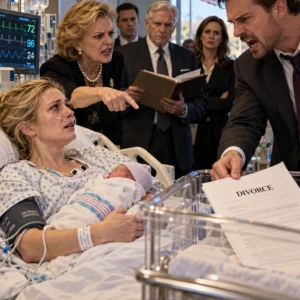
My husband kissed the baby’s forehead, promised to return before midnight, and walked out.
Five minutes later, I called the restaurant’s private events manager.
By the time his family arrived, their celebration was already falling apart.
I had undergone an emergency cesarean delivery after dangerous complications during labor.
Our son was healthy, but I had lost considerable blood and required close monitoring.
My husband had promised to remain at the hospital throughout my recovery.
Instead, his mother insisted that the annual family celebration was too important to miss.
The dinner was supposed to honor his father’s retirement from the family construction company.
Nearly sixty guests had been invited, including employees, business partners, and longtime friends.
Three months earlier, I had agreed to organize the event because my husband claimed he was overwhelmed with work.
I negotiated with the restaurant, selected the menu, arranged transportation for elderly relatives, and coordinated every detail of the evening.
My husband promised to reimburse me from our joint account.
Instead, he repeatedly delayed transferring the money, claiming the company’s accounting department was behind schedule.
I eventually paid the required deposits using my personal credit card.
The total exceeded twelve thousand dollars.
Now his mother stood beside my hospital bed criticizing my appearance and complaining that I had not prepared a suitable gift for her husband.
When I explained that I was struggling to sit upright, she rolled her eyes and said women had been giving birth for centuries without demanding special treatment.
His sister laughed and suggested that I was exaggerating my discomfort to keep everyone focused on me.
I asked my husband to stay.
He looked at his watch and said his father’s retirement happened only once.
Then he left with them, taking the garment bag containing the expensive suit I had purchased for him.
After the door closed, I contacted the restaurant’s private events manager.
I explained that the reservation and unpaid event balance were under my name, and I needed to discuss the financial arrangements immediately.
She confirmed that the final payment authorization had not been completed.
I withdrew permission to charge my personal card for additional expenses and requested that the event organizer contact my husband directly.
Twenty minutes later, my husband’s phone began calling repeatedly.
The restaurant had informed him that the remaining balance required immediate payment before the private banquet could proceed.
His family’s elegant celebration had suddenly become an expensive problem they could no longer leave for me to solve.
My husband called six times before I answered.
His first words were not about my recovery or our newborn son.
He demanded that I authorize the restaurant payment immediately.
I explained that I had already paid substantial deposits and would not accept additional charges without a clear reimbursement agreement.
He accused me of deliberately humiliating his father.
I reminded him that I had organized the entire celebration while pregnant and had repeatedly requested repayment.
His mother grabbed the phone and shouted that I was destroying an important family occasion because I wanted attention.
I calmly told her that the restaurant would accept payment from any authorized cardholder.
Nothing prevented her or her son from paying for their own celebration.
She insisted that the family business would reimburse everything eventually.
I asked why nobody had arranged that reimbursement during the previous three months.
My husband returned to the call and threatened to cancel my access to our joint bank account.
I told him that financial threats were inappropriate and that we could discuss household finances after I recovered.
The restaurant manager later confirmed that the guests had arrived, but the banquet could not proceed under the original payment arrangement until the outstanding balance was settled.
My husband’s father eventually provided his own credit card.
He had apparently believed that the event was already fully paid for by the family company.
When he discovered I had personally covered the deposits, he demanded an explanation from his son.
My husband claimed I had volunteered to pay as a gift.
His father called me directly to confirm the story.
I explained that I had agreed to organize the event, not finance it.
I also told him that I was recovering from emergency surgery and had expected my husband to remain at the hospital.
There was a long silence.
Then my father in law asked whether I was alone with the baby.
I told him that the nurses were helping me and that my husband had left despite knowing how weak I felt.
He apologized and ended the call.
According to a relative who contacted me later, he stood before the assembled guests and announced that the dinner would continue without speeches celebrating family loyalty.
Then he asked his son to leave the restaurant and return to the hospital immediately.
My husband returned shortly after ten that evening.
He entered the recovery room carrying flowers and looking more embarrassed than concerned.
He explained that his father had confronted him in front of several relatives and business associates.
The retirement dinner had continued, but the atmosphere had become painfully uncomfortable.
I asked whether he had come because he understood how badly he had treated me or because his father had ordered him to return.
He did not answer immediately.
Then he admitted that he had underestimated the seriousness of my recovery.
I told him that the problem was not simply the dinner.
It was his willingness to let his mother and sister insult me while I was physically vulnerable.
He apologized, but I explained that words alone would not restore my trust.
I needed practical support, financial honesty, and boundaries with his family.
The following morning, his father visited the hospital alone.
He brought a reimbursement check covering the deposits I had paid and thanked me for organizing the celebration.
He also apologized for not realizing that the family had placed so much responsibility on me during my pregnancy.
I accepted the reimbursement but told him that my marriage problems could not be solved through money or intervention from his parents.
He agreed and said that his son needed to take responsibility for his own decisions.
After I returned home, my husband took several weeks of leave to help care for our newborn.
He attended medical appointments and began handling household responsibilities without waiting to be asked.
His mother called repeatedly, complaining that I had embarrassed the family.
I declined her calls and told my husband that future visits would require mutual agreement.
His sister sent an apology that initially blamed stress and misunderstanding.
I asked her to acknowledge the specific comments she had made about my pain.
Eventually, she admitted that her behavior had been cruel and inappropriate.
I accepted the apology but maintained distance while recovering.
My husband and I began marriage counseling.
We discussed his habit of prioritizing his mother’s approval and my tendency to accept responsibilities without insisting on fair arrangements.
Progress was slow.
Some conversations ended in frustration, but he gradually began recognizing the difference between supporting his family and allowing them to mistreat his wife.
Six months later, our son was healthy, and I had returned to work part time.
Our marriage remained a work in progress, but the boundaries were clearer than they had ever been.
On the evening of our son’s first birthday, my husband prepared dinner while I watched our child playing on the living room floor.
I remembered lying alone in that hospital bed, wondering why everyone expected me to sacrifice my health for a celebration.
The phone call had not been revenge.
It had been the first time I refused to pay for other people’s comfort at the expense of my own well being.
And that decision changed our family more than any expensive dinner ever could.l