For twenty-three years, Emily Carter knew exactly where she belonged in her family’s house in Columbus, Ohio.
Not at the dinner table.
Not in the family photographs.
And certainly not beside her older brother, Brandon.
“Some children are born to lead,” her mother, Diane, used to say. “Others are born to serve.”
Emily had heard the sentence so many times that by thirteen, she no longer cried when Diane said it.
Every morning before school, Emily made Brandon’s bed, gathered his laundry, packed his lunch, and cleaned the bathroom they technically shared.
When Brandon went to college, their parents paid his tuition, apartment, and car insurance.
Emily worked evenings at a grocery store to pay community-college fees.
“You’re better at taking care of people,” her father, Richard, explained.
Brandon never questioned it.
At twenty-six, he became engaged to Madison Whitmore, the daughter of wealthy Cleveland real-estate developer Charles Whitmore.
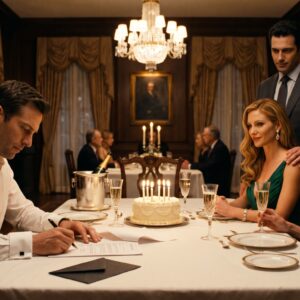
Their wedding was held at a restored estate outside Cincinnati.
Emily was not a bridesmaid.
Her mother handed her a garment bag that morning.
“Brandon’s suit needs steaming.”
During the reception, Emily quietly collected abandoned champagne glasses because Diane complained that the staff were moving too slowly.
Then Charles Whitmore called everyone outside for a family photograph.
“Emily,” Madison said, “get in here.”
Diane stiffened.
“She doesn’t really like pictures.”
“I do,” Emily said.
For once, she stepped forward.
The photographer positioned Emily beside Charles.
The moment he turned toward her, the older man froze.
His smile disappeared.
He stared at Emily’s face—first at her gray-green eyes, then at the small indentation above her left eyebrow.
“What?” Emily asked.
Charles didn’t answer.
Instead, he pulled out his phone and walked away.
Emily watched him disappear behind the garden pavilion.
She caught only fragments.
“…twenty-three years…”
“…exactly the same eyes…”
“…I need you to locate a record.”
Diane had gone pale.
That frightened Emily more than Charles’s strange behavior.
Three days later, Charles appeared at the Carter house with a woman carrying a locked medical case.
He asked Emily for a DNA sample.
Richard immediately stood.
“No.”
Charles looked at him.
“Interesting.
I didn’t ask you.”
The room went silent.
Two weeks later, Emily sat inside Charles’s attorney’s office as an envelope was opened.
The report excluded both Richard and Diane Carter as her biological parents.
But that was not the result that made Charles grip the table.
Emily’s DNA had produced a close familial match to someone already tested.
A woman who had died twenty-three years earlier.
Charles whispered her name.
“Rebecca.”
His younger sister.
Then he looked directly at Diane.
“You told everyone Rebecca’s baby died with her.”
Diane’s face collapsed.
And Emily finally understood why her mother had spent twenty-three years making sure she never felt like a daughter.
Emily did not speak for several seconds.
She could hear the faint hum of the attorney’s air conditioner and the clicking of a clock somewhere behind her.
Charles Whitmore remained motionless across the table.
“My sister Rebecca was twenty-four when she died,” he finally said. “She was eight months pregnant.”
Emily stared at him.
Charles explained that Rebecca Whitmore had been the rebellious member of his family.
Their father controlled a successful construction company and expected his children to follow carefully planned lives.
Rebecca refused.
At twenty-three, she became pregnant.
She never publicly identified the father.
Then, in February 2003, her car slid off an icy road outside Dayton.
Rebecca was rushed to a hospital.
Charles had been in California on business.
By the time he returned, his parents told him Rebecca had died from internal injuries and that doctors had been unable to save her unborn daughter.
“There was a funeral,” Charles said. “One coffin.”
Emily felt cold.
“So how could I be her daughter?”
Charles looked toward Diane.
“That is what I would like to know.”
Richard suddenly interrupted.
“This is ridiculous.
DNA companies make mistakes.”
The attorney, Melissa Grant, slid another document across the table.
“This was not a consumer ancestry test.
The laboratory repeated the analysis using an independent sample.
The probability of the stated biological relationship exceeds 99.9 percent.”
Richard stopped talking.
Diane looked twenty years older than she had at Brandon’s wedding.
Emily remembered hundreds of small moments.
Being told not to ask about her baby photographs because they had been “lost in a move.”
Her parents refusing to show her birth certificate until she needed it for college.
Diane becoming furious whenever strangers said Emily did not resemble either parent.
And one memory suddenly returned with painful clarity.
She had been seven.
While searching for Christmas decorations, Emily found a hospital bracelet inside an old jewelry box.
The name printed on it was not Emily Carter.
It was Baby Girl Whitmore.
Diane had ripped it from her hand so violently that the plastic snapped.
Emily had forgotten about it.
Diane clearly had not.
Charles leaned forward.
“Where did you get Rebecca’s child?”
Diane began crying.
Not softly.
Her entire body shook.
“I didn’t steal her.”
Charles’s chair scraped backward.
“No one said you did.”
That was the moment Emily knew the truth was worse than she had imagined.
Diane covered her mouth.
Richard cursed under his breath.
Then Emily turned toward the man she had called Dad all her life.
“You knew.”
Richard avoided her eyes.
That hurt more than the DNA report.
Eventually Diane began talking.
In 2003, she had worked as a nursing assistant at the hospital where Rebecca was brought after the crash.
Doctors performed an emergency cesarean section.
The baby survived.
Rebecca did not.
Emily.
The Whitmore family should have been notified immediately.
But something happened during the chaotic hours after surgery.
Something involving Rebecca’s parents, an attorney, and paperwork that should never have existed.
Diane insisted she had not planned any of it.
She claimed that an older member of the Whitmore family approached her privately after learning she had recently suffered a miscarriage.
“He said the baby needed a home,” Diane whispered.
Charles went completely still.
“Who?”
Diane refused to answer.
Emily slammed her palm onto the conference table.
“Who gave me to you?”
Diane finally raised her eyes.
“Your grandfather.”
Charles’s father.
Thomas Whitmore.
The same respected businessman whose obituary described him as a devoted father and grandfather.
Charles shook his head.
“My father believed Rebecca’s baby was dead.”
“No,” Diane said. “He wanted you to believe that.”
The reason, according to Diane, had been money.
Rebecca had inherited assets from her maternal grandmother through a trust.
If Rebecca died leaving a living child, part of that inheritance would eventually belong to the child.
If Rebecca died without descendants, the assets reverted elsewhere within the family.
Charles demanded numbers.
Diane claimed she did not know.
Melissa did.
She had already begun investigating.
“At current valuations,” the attorney said carefully, “Rebecca’s child may have inherited assets worth several million dollars.”
Emily almost laughed.
Not because it was funny.
Because that morning she had checked her bank account before buying gasoline.
She had $312.
Her parents had once refused to give her eighty dollars for a college textbook.
Yet perhaps somewhere, under another name, existed money that had belonged to her since birth.
Charles looked devastated.
But Melissa was not finished.
“There is another issue.”
She opened a second folder.
Several years after Rebecca’s death, part of the trust had apparently been distributed.
Not to Emily.
Someone had signed documents claiming Rebecca had no surviving children.
The signature belonged to a person still alive.
Emily looked at Diane.
Diane looked away.
Then Melissa placed the document on the table.
The witness signature at the bottom read:
Richard Alan Carter.
Emily’s father had not merely known where she came from.
He had helped erase her.
And according to the next page in Melissa’s folder, Richard Carter had received something in return.
Something substantial enough to explain the house her parents had purchased mysteriously when Emily was two.
But before Emily could read the amount, Richard stood and walked toward the door.
Charles blocked him.
“No,” Charles said.
Richard’s expression changed.
For the first time in Emily’s life, the quiet, obedient man she called Dad looked dangerous.
“You have no idea what your father did,” Richard said.
Charles stared back.
“Then tell me.”
Richard looked at Emily.
And what he said next made her forget about the money completely.
“Thomas Whitmore wasn’t trying to hide you because of Rebecca’s inheritance.”
He paused.
“He was hiding the identity of your father.”
Emily stared at Richard.
“My biological father?”
Richard nodded slowly.
Diane whispered, “Please don’t.”
But the secret had already survived twenty-three years.
Emily was finished protecting it.
Richard sat again.
Rebecca Whitmore, he explained, had been dating someone secretly during the year before her death.
Not a stranger.
Not a married politician.
Not a dangerous criminal.
The man was Daniel Carter.
Richard’s younger brother.
Emily felt the room tilt.
Daniel Carter.
Uncle Danny.
The smiling man from old family albums who had died from leukemia when Emily was four.
She remembered almost nothing about him.
Yet she remembered one strange detail.
Whenever Daniel visited, he held her for hours.
Diane always became angry afterward.
“You told me Uncle Danny just liked children,” Emily whispered.
Richard closed his eyes.
“He knew you were his.”
Daniel and Rebecca had planned to marry.
Both families opposed the relationship for different reasons.
Thomas Whitmore considered Daniel unsuitable because he was a mechanic from a working-class family.
Richard and Diane knew almost nothing about Rebecca until after the accident.
After doctors delivered Emily, Thomas discovered Daniel was the father.
Rebecca had apparently written Daniel’s name in personal documents stored with her attorney.
Thomas feared scandal, but money mattered more.
If Rebecca’s daughter remained legally recognized, Emily would inherit.
Thomas offered Richard and Diane an arrangement.
Raise the baby quietly.
Use their surname.
Never reveal Rebecca’s identity.
In return, Thomas would provide money.
Richard agreed.
Diane had recently lost a pregnancy and desperately wanted a child.
“At first,” Diane said, crying, “I thought I could love you.”
Emily’s voice was nearly emotionless.
“At first?”
Diane looked down.
Three years later, Brandon was born.
Their biological son.
Everything changed.
Diane admitted she began seeing Emily differently.
Emily was no longer the child who had healed her grief.
She became evidence of a decision Diane regretted.
Evidence that Richard had accepted money.
Evidence that Daniel—whom Richard had always envied—had fathered a daughter connected to a wealthy family.
So Brandon became the “real” child.
The prince.
Emily became useful labor inside the house.
“I was a child,” Emily said.
Nobody answered.
Charles turned toward the window.
For the first time since the investigation began, he seemed unable to control his emotions.
“My sister would have destroyed this family to get you back,” he said quietly.
Melissa continued investigating over the next six months.
Hospital records, archived correspondence, bank transfers, trust documents and handwritten notes gradually rebuilt the truth.
Thomas Whitmore had paid Richard Carter $180,000 through several transfers between 2003 and 2006.
Richard had signed a false affidavit stating he possessed knowledge confirming Rebecca had delivered no surviving child.
That statement helped trustees distribute assets elsewhere.
But Thomas had overlooked one problem.
Rebecca’s grandmother had drafted the trust extremely carefully.
If a biological descendant was later discovered, that descendant retained the right to challenge the distribution.
Emily did.
The case never reached a dramatic courtroom trial.
The surviving trustees and beneficiaries settled after DNA evidence, hospital records and Thomas’s archived correspondence became impossible to dispute.
Emily received financial assets and property valued at approximately $4.7 million after taxes, fees and negotiated deductions.
But that was not the moment she considered herself free.
That happened three weeks after the settlement.
Brandon came to her apartment.
He had barely contacted her since the wedding.
Madison waited downstairs.
Brandon stood awkwardly near the doorway.
“Mom says you’re destroying the family.”
Emily almost smiled.
“Which family?”
He flinched.
Then something unexpected happened.
Brandon apologized.
Not perfectly.
He defended himself at first.
He said he had been a child too.
He said their parents had taught him that Emily liked cleaning, liked cooking, liked “helping.”
Emily reminded him that at seventeen he had deliberately dropped wet towels on her bedroom floor because she had refused to wash his car.
Brandon looked ashamed.
“I remember.”
“Good.”
She did not forgive him that afternoon.
She did not need to.
Forgiveness was not a requirement for rebuilding her life.
Richard and Diane sold their house after legal fees and financial claims overwhelmed them.
Their marriage eventually collapsed.
Emily heard about it through Brandon.
She never returned to the house.
Instead, she used part of her settlement to finish her degree at Ohio State University.
Charles remained in her life.
Their relationship was awkward in the beginning.
He sometimes looked at Emily and saw Rebecca so strongly that he had to glance away.
One afternoon, he brought her a cardboard box.
Inside were photographs Rebecca had mailed him during college.
In one picture, Rebecca stood beside a motorcycle, laughing into the camera.
Emily froze.
Same eyes.
Same eyebrows.
Same crooked smile.
On the back Rebecca had written:
Danny says our daughter will have my stubbornness and his terrible taste in music.
God help her.
Emily read it three times.
Then she sat on Charles’s kitchen floor and cried.
Not for an inheritance.
Not for revenge.
For two people who had expected to raise her and never got the chance.
A year after Brandon’s wedding, Charles organized another family photograph.
No mansion.
No elaborate ceremony.
Just Thanksgiving at his house near Cleveland.
Emily stood beside him while Madison adjusted the camera timer.
Brandon hesitated at the edge of the group.
Emily looked at him.
“You can get in.”
He did.
The camera flashed.
This time, nobody asked Emily to stand behind anyone.
Nobody handed her dirty dishes.
Nobody told her where she belonged.
Later that evening, Charles printed the photograph.
Emily studied her own face.
For twenty-three years, that face had been treated like proof that something about her was wrong.
Now she knew the opposite was true.
Her face had been evidence.
The eyes had belonged to Rebecca.
The smile had belonged partly to Daniel.
And the tiny scar above her eyebrow—the detail Charles noticed at the wedding—matched an identical childhood scar in photographs of his sister.
One family photograph had exposed a lie built across two families, millions of dollars, and twenty-three years.
But the money was never the greatest thing Emily recovered.
It was something far simpler.
Her name.
Her history.
And the knowledge that she had never been born to serve anyone.