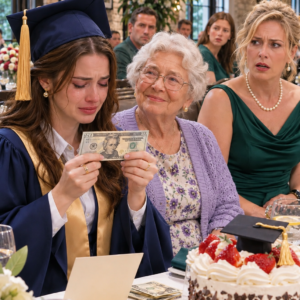
PART 1My phone buzzed in the pocket of my slacks right as the brass section started playing “Pomp and Circumstance.”In the tunnel behind the stage, the air smelled like damp concrete and floor wax.
My rented black robe was cheap synthetic polyester that scratched raw against the back of my neck.
Hundreds of other graduates were adjusting their caps, whispering nervous jokes, and checking reflections in the dark glass of the fire doors.
I pulled out my phone just to make sure my mother had found her seat without tripping on the concrete stairs. The screen lit up with one line from my father:”Don’t count on me for anything after today.
You’re on your own.”I looked down at the bright text, then glanced out through the tunnel archway toward the arena floor.
Seat C7 was in the very front row, right by the center aisle.
I had spent four months putting aside freelance contract money to pay for that row.
I paid for his round-trip flight from Dallas.
I paid for my mother’s ticket.
I paid the three-night charge at the Boston Marriott Long Wharf, and I rented a dark gray Buick sedan so my father wouldn’t have to carry his bad knee onto the subway. He was sitting in seat C7 right now, crossing his thick arms across his chest.
He wore the gray suit he bought for church eight years ago.
His mouth had that tight, satisfied set he got whenever he felt he had put someone in their proper place.My father spent my entire life convinced I was soft.
He ran a small heating and air repair shop off the highway outside Fort Worth, working sixty hours a week with calloused knuckles and grease under his fingernails.
When I chose computers over fixing compressors, he told our neighbors I was hiding from real work.
When I earned a scholarship to MIT, he told my uncle at Thanksgiving that college was just an expensive playground for boys who didn’t want to sweat.
Every semester break when I went home, he left utility bills on the kitchen counter with my name scribbled on top in red grease pencil.”A man pays his freight, Julian,” he would tell me at the breakfast table, not looking up from his paper. “Nobody owes you a roof.”I never argued with him.
I worked night shifts in the campus computer labs.
I graded introductory coding papers until three in the morning.
I ate cheap peanut butter on white bread and took on private programming jobs for small logistics firms to cover the remaining tuition and my rent.
I never asked him for five dollars.
But in his head, I was still the daydreamer who needed a stern hand to keep from failing. Even after I paid for their entire trip to Boston, he spent yesterday evening complaining about the hotel parking fee and calling the city a waste of good land.Now, as the procession began moving forward, the faculty lined up on the platform.
Dean Abernathy stepped up to the wooden podium.
In his right hand, he held a heavy cream folder sealed with a thick red ribbon.I knew that folder.
I had spent the last seven months signing non-disclosure agreements and working alongside three university patent lawyers in a windowless room on the third floor of the Stata Center. Dean Abernathy adjusted the microphone.
The feedback gave a low, dull hum through the arena speakers.”Before we confer the next degree,” the dean said, his voice echoing across three thousand silent people, “MIT would like to recognize a graduate whose work has already protected millions of people.”
Down in seat C7, my father slowly lowered his phone.PART 2My father did not look proud.
He looked annoyed, the way he always looked when someone interrupted what he considered the schedule of the day.
He glanced toward my mother, who was sitting in seat C8 with her hands folded tightly over her beige purse.
She looked anxious, leaning forward with her glasses pushed up onto her nose, unsure of what was happening.”Over the past eighteen months,” Dean Abernathy continued, his clear baritone carrying across the rows of quiet families, “our Department of Electrical Engineering and Computer Science worked closely with federal regulators and medical infrastructure teams.
A security vulnerability in automated hospital oxygen systems had left municipal networks exposed across eleven states.”A ripple of low murmurs went through the faculty seating behind the podium.”One of our graduating students did not simply identify the failure point during his junior thesis,” the dean said.
“He developed a low-latency patch that isolated the code, prevented catastrophic remote tampering, and kept critical life-support networks functioning without a single hour of system downtime.”My father shifted in his seat.
I could see the stiff line of his shoulders from where I stood at the head of the student line.
He uncrossed his arms, leaned his elbows on his knees, and stared at the podium with his eyebrows pulled down hard.
He was still holding his flip phone in his right hand. He didn’t think the dean was talking about me.
In his mind, an MIT graduate who saved hospital networks had to be someone else’s son.
It had to be the child of a doctor, or an engineer from California, or someone whose father didn’t make his living climbing into hot attics to recharge freon.Dean Abernathy broke the red seal on the cream folder.
“The licensing agreement for this defensive architecture was finalized on Tuesday with the Department of Health and a consortium of medical logistics providers,” the dean said, opening the parchment inside. “It represents the single largest commercial technology transfer from our undergraduate program this decade, valued at forty-eight million dollars.”The entire arena let out a collective breath.
Several parents in the middle sections gasped out loud. My father let out a dry, short scoff.
I knew that sound from twenty years of living in his house.
It was the noise he made whenever the television news talked about big money or government projects.
To him, forty-eight million dollars was a fairy tale told by politicians and corporate cheats. “This institution,” Dean Abernathy said, looking up toward the tunnel where our line stood waiting, “is immensely proud to award the Robert A.
Wentworth Memorial Medal for Public Service to Julian Vance.”The arena exploded into applause. Down in row C, seat C7 froze.My mother stood straight up, dropping her purse onto the concrete floor.
She clapped with both hands, her mouth open in a soundless cry of disbelief.
But my father stayed seated.
His mouth opened slightly.
The grease-stained thumb that had typed that final text to me rested dead still against the plastic keypad of his phone.He looked around the arena as if expecting someone to walk up and correct the name.
He looked at the row of deans.
Then his eyes drifted across the line of black robes and locked directly onto mine.PART 3I walked across the wooden platform under the harsh stadium floodlights.
My shoes made a hollow, rhythmic thump against the plywood risers.Dean Abernathy smiled warmly as he handed me the heavy bronze medal on its red ribbon, followed by the leather-bound diploma folder.
We shook hands.
The president of the university leaned in and whispered, “The legal retainers and the university endowment trust were countersigned an hour ago, Julian.
You changed history before your twenty-second birthday.””Thank you, sir,” I said into the microphone.I didn’t give a speech.
I didn’t hold up a fist or make a show of it.
I simply took the folder, stepped down the side stairs, and walked down the main center aisle toward the family section. The security guards stepped aside to let me reach my row. My mother threw her arms around my neck, sobbing so hard her glasses fogged up against the polyester of my shoulder. “Julian,” she kept whispering. “Julian, you never told us.
Why didn’t you tell us?””I couldn’t talk about it until the federal patents cleared, Mom,” I said gently, hugging her back.
“The contract was under strict government seal until ten o’clock this morning.”Over her shoulder, I looked at my father.He had stood up, but his knees seemed unsteady.
He held the Buick keys in his left hand, turning them over and over until the metal clicked against his wedding ring.
The confident sneer he had worn all weekend was completely gone.
In its place was something hollow and pale, a sudden realization that the boy he had treated like an unpaid debt had quietly outgrown him without asking for his permission.”Julian,” he started, his voice rough and thin.
He cleared his throat and tried to square his shoulders. “Julian, that forty-eight million… is that… does that come to you?””The patent belongs to me and the lab trust, Dad,” I said, keeping my voice even and calm.
“After the university share, the research foundation, and taxes, my personal disbursement is twenty-one million four hundred thousand dollars.”His eyes dropped down to his own shoes.
He swallowed hard.
The silence between us in that crowded, roaring arena felt absolute.”I didn’t know,” he said.
He reached out an awkward, trembling hand toward my arm. “Son, you should have told me.
A father needs to know these things.
We could have… we could have set up an office back in Fort Worth.
We could have managed it together.
I’ve run a business for thirty years.
You need someone with real experience watching your back.”I looked at him for a long moment.
I felt no anger.
I didn’t feel the urge to yell at him or call him out in front of the other families who were watching us with curious smiles.
What I felt was a clean, cold weight lifting off my chest.I reached into my pocket, pulled out my phone, and tapped the screen once to open the text thread.I held the screen right in front of his face.”Don’t count on me for anything after today.
You’re on your own.”His face drained of whatever color was left.
His fingers twitched against the Buick keys. “Julian,” he whispered, his eyes darting to my mother, who had gone quiet beside us. “I was just…
I was just trying to keep you tough.
A father has to make sure his boy doesn’t get lazy.””I paid for your flight, Dad,” I said softly. “I paid for your room.
I paid for the car.
I never asked you for a single dime, and you still felt the need to send this five minutes before I walked onto that stage.””I was angry,” he said, his voice dropping to a desperate rasp. “You know how I get when I’m stressed about the shop.””I do know,” I said. “And I’m taking your advice.”ENDINGI reached into my pocket, took out the prepaid return flight envelopes I had printed at the student center the night before, and handed one to my mother.”Your flight leaves at two tomorrow afternoon, Mom,” I told her. “The car is paid through noon.
You can leave the keys at the hotel front desk.”My mother looked down at the envelope, then looked up at my father.
She didn’t scold him.
She didn’t scream.
She had lived with his bitter pride for thirty-two years, watching him push away his brothers, his neighbors, and finally his only child.
She simply tucked the ticket into her purse and took my hand.”I’m proud of you, Julian,” she whispered. “I’m so proud of you.”My father stood there in seat C7, completely alone while the crowd moved past him.
He tried to speak again, opening his mouth, but no words came out.
He had built an entire lifetime around the belief that money and independence were weapons you used to keep people underneath you.
Now he was standing in a suit I had bought him, holding keys to a car I had rented, with nothing left to hold over my head.I didn’t take the Buick back to the hotel with them. After the ceremonies ended, I took the Red Line train across the Longfellow Bridge by myself.
The Charles River was bright and choppy under the late morning sun, dotted with white sailboats heading out toward the harbor.
I sat on the hard plastic subway seat with the heavy bronze medal in my lap and my phone resting face-down on my knee.When I checked the screen an hour later at a quiet diner near Kendall Square, there were four missed calls from his number. I didn’t listen to the voicemails. Instead, I opened the banking app on my phone.
The university escrow deposit was already pending verification.
I set up an automatic monthly transfer of three thousand dollars directly into my mother’s personal checking account, the one my father’s name wasn’t on.
It was enough to cover her groceries, her medical co-pays, and her own small comforts for the rest of her life without ever having to ask him for grocery money again.For my father, I didn’t send money, and I didn’t send an angry letter. I just left his final text saved at the top of the screen, locked the phone, and ordered a cup of black coffee.
For the first time in twenty-one years, I was completely on my own, and it was the best thing that had ever happened to me.