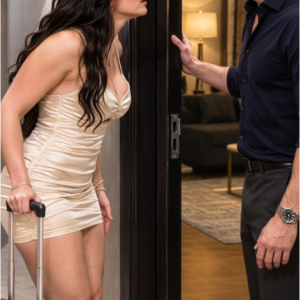
Part 2 – The Man at the Door
My father stood on the porch in his faded navy sweatshirt, one hand resting at his side, while a sheriff’s deputy and a woman in a charcoal coat waited behind him.
For a moment, no one moved.
The deputy was the first to break the silence.
“Good evening,” he said, his gaze taking in the room without lingering on any one person. “I’m Deputy Mills, with the county sheriff’s office.”
The woman beside him held up a leather folder.
“I’m Paula Greene,” she said. “I’m an attorney. Mr. Mercer called me on the way here.”
Evan’s eyes flicked from the deputy to my father, then back again.
“Why did you bring a deputy?” he asked.
Dad didn’t answer him.
He looked straight at me.
“Rachel,” he said, and there was nothing frightening in his voice now. “Can you come to the door?”
I pushed myself up from the chair.
My cheek throbbed, and the raw place in my mouth made every movement feel too large, but I managed to cross the room without anyone touching me.
Diane rose as if to block my path.
“Now, hold on,” she said. “This is a family matter.”
Deputy Mills shifted half a step—not between us, exactly, but enough to make the doorway feel like a boundary.
“Ma’am, let her decide whether she wants to speak with her father,” he said evenly.
Diane’s mouth tightened.
I stopped a few feet from Dad, suddenly unsure what I had expected to feel when I saw him.
Relief, perhaps.
Instead, I felt embarrassed.
I had blood dried along my chin, a swollen cheek, and a broken piece of tooth in my pocket, and now my father had arrived with witnesses.
“Can we talk outside?” I asked.
“Of course,” he said.
His gaze moved over my face, careful and restrained.
“May I look at the injury?”
The question undid something in me.
I nodded.
Dad leaned closer but didn’t touch me.
His eyes went from my cheek to my mouth, and a muscle in his jaw moved once.
“Does anything hurt besides your tooth and cheek?”
“My hip,” I said. “I hit the counter.”
“Did you lose consciousness?”
“No.”
“Feel dizzy?”
“A little. I think it’s just the shock.”
He nodded and stepped back, making room for Deputy Mills.
“Would you be comfortable if he photographed your injuries and took your account?” Dad asked. “You can say no.”
Behind him, the lawyer remained quiet, her folder tucked against her side.
Evan let out a short breath.
“This is ridiculous,” he said. “She bumped into the counter. I barely touched her.”
I looked at him.
A minute ago, I had been desperate to understand how a person could strike me and then make the room behave as if I were the one creating trouble.
Now I watched him trying to shrink the event into something smaller than the piece of tooth in my pocket.
Deputy Mills turned toward Evan.
“I’ll speak with you separately,” he said. “For now, please give us space.”
“I’m her husband.”
“And she’s the person I’m asking to speak with.”
Evan’s expression hardened, but his father touched his arm.
“Let them do their job,” Frank said quietly.
It was the first time he had spoken since the door opened.
Diane looked from her husband to the deputy, then to me.
“Rachel, you know he never meant to hurt you,” she said. “You pushed him until he lost his temper.”
My throat tightened.
“I asked him to show me the transaction.”
“And you know how stressed he’s been,” Diane replied.
I had heard variations of those sentences for years.
You know how he gets.
He’s under pressure.
You could have let it go.
The words had always arrived dressed as explanations, but beneath them was the same old instruction: make it easier for everyone else.
This time, I didn’t answer.
Dad didn’t answer for me either.
He only waited.
I turned to Deputy Mills.
“Yes,” I said. “You can take photographs, and I’ll tell you what happened.”
His expression remained professional, but his voice softened.
“Thank you. We can do that here, or somewhere more comfortable. There’s no need to rush.”
“Here is fine.”
We moved to the small sitting room off the entryway.
Deputy Mills asked Diane to remain in the kitchen while he spoke with me, and she objected until Paula Greene calmly explained that separate accounts would help avoid confusion.
Evan was asked to wait in the dining room with Frank.
Dad stayed near the open doorway, far enough away that I didn’t feel crowded.
Deputy Mills took photographs of my cheek and the inside of my mouth, then asked permission to document the mark on my hip.
I lifted the edge of my sweater just enough to show the reddened patch where I had struck the counter.
Each flash made me flinch.
“I’m sorry,” he said after the last picture. “I know that’s uncomfortable.”
“It’s all right.”
He sat opposite me with a small notebook.
“Tell me what happened in your own words, starting wherever you think it began.”
I told him about the three thousand dollars.
I told him Evan had accused me of transferring it, and I had asked to see the transaction.
I told him Evan struck me and that a piece of my front tooth landed on the tile.
I told him Diane took my phone and called Dad.
When I repeated the words Evan had shouted, my voice went quiet.
Deputy Mills didn’t ask me to raise it.
He waited until I was ready to continue.
“Did anyone touch you after the slap?” he asked.
“No.”
“Were you prevented from leaving?”
“Not physically.”
“Did you feel afraid you might be hurt again?”
I glanced toward the doorway.
Dad was looking down at his hands.
“Yes,” I said. “I wasn’t sure what Evan would do if I kept arguing.”
Deputy Mills wrote that down.
He asked whether I wanted medical care.
“I should probably have someone look at my tooth.”
“I agree,” Dad said, then caught himself. “But it’s your decision.”
The words sounded deliberate, as though he had practiced them on the drive.
I almost smiled.
Almost.
“I want to go,” I said. “Just not back into that room.”
“You don’t have to,” Dad replied.
Deputy Mills continued taking notes while Paula Greene asked a few questions about where we could safely reach me over the next several days.
Her voice was direct, but she didn’t push me toward any particular choice.
“I can explain options,” she said. “I can’t decide them for you, and you don’t have to decide everything tonight.”
That was the first thing anyone had said all afternoon that made me feel like my life still belonged to me.
When Deputy Mills finished, he asked if I wanted to make a formal complaint that evening.
I looked down at my hands.
There was a pale crescent in my palm where I had been clutching the broken piece of tooth.
“I don’t know,” I admitted.
“That’s an answer for now,” he said. “I’ll give you the information you need, and you can follow up after you’ve had medical care and a chance to think.”
I hadn’t expected kindness from a stranger to feel so difficult to accept.
It made the years of being told I was overreacting seem suddenly heavy.
When we returned to the entryway, Evan was standing near the dining room with his arms crossed.
Diane had followed him.
“Are you really leaving?” he asked me.
I looked at his face, at the crease between his brows that I used to smooth with my thumb when he came home tired.
“I’m going to have my tooth checked.”
“You don’t need to make this into a whole production.”
“I’m not making it into anything,” I said. “I’m hurt.”
He looked at my mouth, and for one fleeting second, his anger seemed to give way to something like fear.
Then it disappeared.
“I told you it was an accident.”
“You told me I made you do it.”
Evan opened his mouth.
No words came.
Diane stepped into the silence.
“You’re both upset,” she said. “Let’s all calm down and discuss this tomorrow, when nobody is performing for a deputy.”
Paula Greene’s expression cooled.
“Ms. Caldwell, I’d suggest you avoid speaking on your daughter-in-law’s behalf.”
“I’m only trying to keep this family together.”
“Then give Rachel the space she’s asked for.”
I looked at my father.
He had not threatened anyone, raised his voice, or stepped between me and my husband.
He was simply standing there, steady and alert, with the same worn sweatshirt he had worn for years.
The sight of it made me remember all the times the Caldwells had smiled at him over holiday dinners.
They had called him “the old sailor,” though he had never served at sea.
They had teased him about his truck and the way he fixed things instead of replacing them.
Dad had taken every joke without snapping back.
I used to think he did it because he didn’t notice.
Now I wondered whether he had noticed every single one.
“I want to leave,” I said.
Evan stared at me as if he had been waiting for me to say something else.
Then he gave a small, disbelieving shake of his head.
“You’re walking out over one bad moment?”
“No,” I said. “I’m leaving because I need to feel safe enough to think.”
Dad opened the front door.
Cold evening air slipped into the house, carrying the clean scent of wet leaves and distant woodsmoke.
Before I stepped through, I went back for my coat.
Diane stood beside the dining table, watching me.
“Your father can’t solve every problem for you,” she said.
The words struck an old nerve.
For years, I had insisted that Dad not interfere in my marriage, even when I called him crying from the car or described another argument in the careful, edited language I used to keep him from worrying.
“I know,” I replied. “That’s why I’m making this choice myself.”
Dad’s eyes met mine.
There was pride in them, and something that looked uncomfortably close to regret.
I pulled on my coat, and we left.
The deputy stayed behind to finish speaking with Evan and his parents.
Paula Greene handed me her card and reminded me that she could answer questions the next day, but that I should focus on getting examined.
Dad’s truck was parked at the curb, silver paint dulled by years of weather.
The sight of it brought back the ordinary life I had so often defended when the Caldwells mocked it: Dad’s small house near Virginia Beach, the old tools in his garage, his habit of making coffee too strong.
He opened the passenger door.
“I can drive myself,” I said.
“I know.”
He didn’t argue.
I stood there for a moment, hand on the door, trying to understand why his agreement made my eyes sting more than insistence would have.
Then I climbed in.
He drove to an urgent care clinic, where the staff cleaned the blood from my mouth and arranged an appointment with a dentist the following morning.
The tooth could be repaired, the doctor said, but I would need imaging and a proper evaluation.
She also advised me to watch for worsening pain, dizziness, or swelling.
Dad listened closely, writing each instruction on the back of an envelope.
“You don’t have to take notes,” I murmured.
“I know,” he said. “I remember better when I write things down.”
In the examination room, he sat in the chair by the wall and didn’t ask questions while the doctor spoke to me.
When she stepped out, he waited until I looked at him.
“Do you want to stay at my place tonight?”
I should have said yes immediately.
Instead, I felt the stubborn, familiar pull to prove I needed no one.
“I can get a hotel.”
“You can,” he said.
“I’m not trying to talk you out of it.”
“I know.”
He folded the envelope and placed it in his pocket.
“I just want you somewhere you can sleep without listening for footsteps.”
My eyes burned again.
I turned toward the window, where the parking lot lights shone on the wet pavement.
“I hate that this is happening,” I whispered.
“So do I.”
“I don’t want you to think I stayed because I didn’t know what you’d say.”
“I don’t.”
“I didn’t want you to interfere.”
“I remember.”
There was no accusation in his voice, but the memory sat between us.
For a long time, I had asked Dad to let me handle things.
When he asked whether Evan’s temper frightened me, I told him marriage was complicated.
When he noticed I had stopped bringing Evan to visit, I said work was busy.
When he offered to help us sort out our finances, I told him we were fine.
I had mistaken his silence for distance because I needed him to believe I was managing.
“I should have told you more,” I said.
“Maybe.”
His answer surprised me.
He didn’t rush to absolve me or tell me it wasn’t my fault.
“I knew enough to worry,” he continued. “But you asked me not to step in. I thought respecting that was the right thing.”
“Was it?”
“I don’t know,” he said. “I still don’t.”
For a moment, neither of us spoke.
Then he looked at my reflection in the dark window.
“But I do know that respecting your choices doesn’t mean pretending not to see you’re hurt.”
I held his gaze in the glass.
“That sounds like something you’ve thought about before.”
“Maybe I have.”
The uncertainty in his voice bothered me.
It wasn’t the uncertainty of someone who had no answer.
It was the carefulness of someone trying not to give me more than I had asked for.
We went to his house after the clinic.
He had kept my old bedroom much as I left it, though the shelves now held books and a few framed photographs from my adult life.
The sight of my wedding picture beside the window made my stomach tighten.
Dad followed my gaze.
“I can move it.”
“No,” I said. “Leave it there.”
The photograph showed Evan and me laughing beneath a white arbor, our hands intertwined.
He had once been the kind of man who remembered which tea I liked and who sat beside me through my mother’s long illness without checking the time.
That part of him had been real.
The later lies did not erase it.
They did, however, make it harder to understand when the man I loved had started choosing silence over honesty.
Dad made tea and set it on the bedside table.
He placed the clinic envelope beside it, then stood in the doorway.
“I’ll be in the kitchen if you need me.”
“Dad?”
He paused.
“Thank you for coming.”
He nodded once.
“I was always going to come.”
He left the door partly open.
I sat on the edge of the bed and pressed a cool cloth to my cheek.
My phone lay on the blanket beside me, returned to me by Deputy Mills before we left.
There were already three messages from Evan.
The first said, We need to talk.
The second said, You know I didn’t mean to hurt you.
The third appeared while I was reading the first two.
You can’t let your father turn this into something it isn’t.
I read it twice.
Then I set the phone facedown.
A few minutes later, I heard the kitchen chair scrape across the floor.
Dad was checking the locks.
I used to think he did that because he was particular.
Now I wondered how many things I had mistaken for habit because the truth felt too large to ask about.
I got up and wandered into the kitchen, the cloth still held to my cheek.
Dad was standing beside the table, his phone in his hand.
The old sweatshirt had a loose cuff, and his hair had gone silver at the temples, but his posture had changed since the door opened.
He seemed broader somehow.
Not physically.
He simply looked like a man who had spent years learning how to stay calm when other people became dangerous.
“Dad,” I said, “how did you know to bring a deputy?”
He lowered his phone.
“I called the sheriff’s office while I was driving.”
“And the attorney?”
“She lives nearby. I knew her through a community legal clinic.”
“You knew her through work?”
He took a breath.
“That’s one way to put it.”
I waited.
He looked down at the worn tabletop, tracing a small scratch with his thumb.
“I spent most of my career as a military investigator,” he said. “I retired a few years ago.”
The words didn’t fit with the man I thought I knew.
“What kind of investigator?”
“I looked into misconduct, theft, safety incidents. Sometimes I interviewed people who didn’t want to be interviewed.”
He said it without pride, as if he were describing a set of old tools in the garage.
I searched his face for the person in my memories—the father who taught me to change a tire, who brought soup when I had the flu, who let me win at cards until I was old enough to realize he was letting me win.
“You never told me.”
“You knew I worked for the government.”
“I knew you worked in an office.”
“I was in an office sometimes.”
“Dad.”
“I didn’t want my work to become the most interesting thing about me.”
The answer was so like him that I almost laughed.
“You could have told me.”
“Yes,” he said. “I could have.”
He didn’t offer an excuse.
That honesty unsettled me more than any secret would have.
“Did you know about Evan?” I asked.
“I knew you were unhappy.”
“That’s not the same thing.”
“No.”
“Did you know he was hiding something from me?”
Dad’s expression changed by a fraction.
“I knew he had started asking you for money.”
My hand tightened around the cloth.
“When?”
“Last winter. You said you were helping with bills.”
“I did help with bills.”
“I know.”
“What did you think it was for?”
“I thought you had chosen to help him.”
“That doesn’t answer me.”
“No,” he said. “It doesn’t.”
There it was again: the feeling that he knew how to ask the right question and had chosen not to.
“Why didn’t you tell me what you suspected?”
“Because you asked me not to interfere.”
“I didn’t ask you to keep things from me.”
“I wasn’t certain there was anything to tell.”
“You could have asked.”
“I should have.”
The words landed between us, plain and unprotected.
I had spent years believing Dad’s quiet meant he didn’t see the strain in my marriage.
Now I understood he had seen some of it, but not enough to know where support ended and intrusion began.
“I didn’t need you to take over,” I said.
“I know.”
“I needed you to trust that I could make my own decisions.”
“I did trust you.”
“Then why did you come with a deputy and a lawyer?”
“Because you told me your husband hit you, and I didn’t know what else was happening in that house.”
The answer was simple.
It didn’t make the choice uncomplicated.
“You said they’d be held accountable,” I reminded him.
“I shouldn’t have phrased it that way.”
“It sounded like a threat.”
“I meant that I would make sure the facts were recorded and that you weren’t left alone with people who might pressure you.”
“You could have said that.”
“Yes,” he replied. “I could have.”
His willingness to accept my criticism left me with nowhere to put my anger.
I looked away.
“Are you angry with Evan?”
“Of course.”
“Are you going to do something to him?”
“No.”
The answer came quickly.
“I’m going to help you understand your options. That’s all.”
“Even if I decide to go home?”
Dad’s face tightened, but he didn’t look away.
“If you decide that, I’ll still love you. I’ll still tell you I’m worried. And I won’t pretend your safety doesn’t matter.”
I wanted him to tell me what to do.
I wanted him to make the choice so I wouldn’t have to carry it.
At the same time, I knew that if he did, some part of me would spend the rest of my life wondering whether I had acted for myself.
“Thank you,” I whispered.
He nodded, and we let the silence settle.
My phone buzzed on the counter.
A message from Evan lit the screen.
I didn’t ask you to take the money. I said I needed time to explain it.
I felt the room tilt—not from my injury, but from the sudden shape of his words.
I opened our banking app.
The transfer was there in the account history, dated three days earlier.
Three thousand dollars had left our joint savings and gone to an account with an unfamiliar number.
Evan had told me I was the one who moved the money.
I enlarged the transaction details.
The receiving account was listed under a name I didn’t recognize, but the final digits were familiar.
They matched the account Evan used for his personal expenses.
Dad leaned closer, then stopped before he entered my space.
“Do you want me to look?”
I nodded.
He read the screen without touching the phone.
“Do you recognize that account?”
“No.”
“Do you want to call the bank?”
“Not tonight.”
“All right.”
I scrolled to the next message from Evan.
It had arrived seconds later.
Forget what I said. I’ll explain tomorrow.
Then another appeared.
Please don’t show Dad the account number.
I stared at the words until the letters blurred.
My father had not asked to see the phone.
He had not told me what the message meant.
He simply waited beside me while I decided what to do with it.
I turned the screen toward him.
“Did he know you were coming?”
“No.”
“Then why would he care whether I showed you?”
Dad’s expression grew grave.
“I can’t answer that for him.”
My thumb hovered over the message thread.
Beneath Evan’s newest text was a line I hadn’t seen before, buried among the older messages from the week of the transfer.
It was a request to cover a debt, written in Evan’s own words.
And just below it, the reply Evan had deleted from the conversation no longer appeared at all.
**–END OF PART 2–CLICK “NEXT” AT THE BOTTOM OF THE PAGE TO CONTINUE READING**
* * *
[NEXT: PART 3](https://puretales.idolsgift.com/blog/part-3-the-man-at-the-door-027-1)