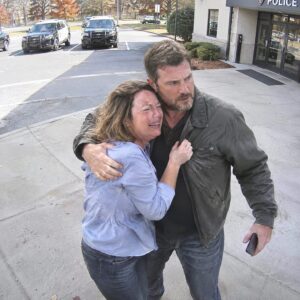
“Open this door, Hannah!
I already called the police, and they’re going to make you give me my key back!”
My father’s voice came through our doorbell camera at p.m., loud enough that our neighbor stepped onto her porch.
He stood outside my house in Columbus, Ohio, while my husband, Ben, watched from the living room, holding the new keys we’d had made that morning.
I was watching everything on my phone from Fort Gregg-Adams, Virginia, where I’d begun my next phase of Army training.
Three weeks earlier, I’d graduated from basic training at Fort Jackson, South Carolina.
I’d spent ten weeks pushing through blistered feet, homesickness, and early mornings when the only thing that kept me going was imagining my parents cheering when I crossed that parade field.
They’d promised to come.
Instead, I stood in formation looking toward four empty seats we’d discussed reserving for family.
Ben couldn’t travel because he was caring for his mother after surgery, but he’d watched the livestream and called afterward, his voice breaking when he told me how proud he was.
My parents and younger sister, Madison, never called.
That evening, Mom posted photographs of Madison trying on wedding dresses.
Underneath, Dad commented, Nothing matters more than family.
I stared at those words until my phone screen went dark.
Then, seventeen days after graduation, Dad finally texted.
Need $8,000 by Friday for Madison’s wedding.
Send it to the usual account.
No congratulations.
No question about my training.
Just a payment demand.
For four years, Ben and I had helped my parents with bills, home repairs, and occasional emergencies.
We’d also allowed Dad to keep a spare key to our house in case something happened while I was away.
But recently, he’d started letting himself in without asking, sometimes bringing Madison to measure our backyard for what he called “wedding possibilities.”
I replied that we weren’t funding the wedding and hadn’t agreed to host anything.
Dad answered, After everything we’ve done for you, this is how you repay us?
I transferred eight dollars.
Best wishes.
Then I asked Ben to change our locks.
Now two police officers stood on our front porch, listening while Dad insisted he’d been illegally locked out of property he helped pay for.
Ben showed them the deed, which listed only our names.
One officer asked Dad whether he actually lived there.
“No,” Dad admitted. “But my daughter signed an agreement giving me access for the wedding.”
He pulled a document from his folder.
Ben photographed it and sent it to me.
There was my signature, authorizing seventy guests to use our property for Madison’s wedding weekend.
And the document was dated the exact day I’d been confined to Army basic training at Fort Jackson.
The officer didn’t order Ben to unlock our door.
After checking the property records and hearing that Dad didn’t live there, he explained that a disputed agreement didn’t give Dad the right to force his way into someone else’s home.
Dad pointed toward the camera.
“My daughter is in the Army.
I’m her father, and she promised us this house!”
Ben’s voice remained steady.
“Being her father doesn’t make you the owner.”
I watched Dad’s expression change when the officers refused to take his side.
Before leaving, one officer documented the disagreement and advised Ben to preserve the questionable agreement for further investigation.
That night, I called a Columbus attorney named Rebecca Hayes, who reviewed the photograph and explained that we needed the original document and its history.
The purported authorization contained a handwritten signature and a statement claiming I’d signed it in Columbus in Madison’s presence.
On that date, I’d been at Fort Jackson with restricted access to my phone and no opportunity to travel home.
My training attendance records, along with messages from that week, supported where I’d been.
Rebecca sent written notice revoking any claimed permission to use our property and requested that Dad and Madison preserve all documents and communications.
Then we began discovering what they’d arranged.
Six weeks earlier, Dad had told a wedding planner that Ben and I had volunteered our house for Madison’s reception.
He’d ordered tents, tables, lighting, and catering for seventy guests, using the forged authorization to reassure the vendors.
Madison had even included our address on her invitations.
I sat on my bunk after evening training, scrolling through photographs the planner had supplied.
There were diagrams showing a dance floor across the patio where Ben and I ate breakfast on summer mornings, with delivery trucks scheduled to enter our driveway before sunrise.
It was the home we’d bought after five years of saving, where Ben had planted roses for our first anniversary.
My family had treated it as available simply because they thought I couldn’t come back to stop them.
Mom called the next morning.
“Hannah, your sister has been planning this wedding for a year.
Why can’t you let her have one beautiful day?”
“Because none of you asked me.”
“Your father helped you buy that house!”
“He gave us $2,000 toward a refrigerator as a housewarming present.
Ben and I paid the down payment, mortgage, taxes, and everything else.”
Mom lowered her voice.
“After everything we sacrificed raising you, you really think you owe us nothing?”
I remembered the empty graduation bleachers.
“I wanted you there when I became a soldier, Mom.
You couldn’t give me one afternoon.”
She didn’t answer that.
Instead, she said, “Madison’s fiancé will never forgive you if you ruin this wedding.”
I ended the call.
Later that afternoon, the wedding planner provided an email chain after our attorney explained the authorization was disputed.
It showed Dad repeatedly assuring vendors that I had approved the arrangements, even after I’d explicitly refused.
Then I saw a message from Madison.
Don’t worry about Hannah.
She’s away at training, and Ben won’t want to embarrass us once the guests arrive.
Beneath it was Dad’s reply.
Exactly.
By the time she finds out, it’ll be too late.
I forwarded everything to Rebecca.
That evening, Madison’s fiancé, Andrew, called me directly.
He sounded confused, explaining that Madison had told him I’d personally offered our house as a wedding gift because I couldn’t attend their ceremony.
“Andrew,” I said quietly, “I never offered our home.
I didn’t even know you’d been invited there.”
There was a long silence.
Then he asked, “What do you mean?
Madison showed me the agreement with your signature.”
I sent him the document and my attorney’s notice.
He called back ten minutes later.
“Hannah, I just asked Madison whether she signed your name.”
His voice sounded different.
“She told me Dad handled it.
But when I asked whether she knew you hadn’t agreed, she started crying.”
The wedding was less than twenty-four hours away.
And Andrew had just learned the woman he was supposed to marry had helped deceive him about the place where they were getting married.
At Saturday morning, a rental truck pulled into our driveway carrying white folding chairs and a wedding tent.
Ben was standing on the porch with our attorney’s written notice when Dad arrived behind the truck, followed by Mom, Madison, and several relatives who’d come to help decorate.
“Move your car, Ben,” Dad ordered. “These people have a schedule.”
Ben didn’t move.
“This property isn’t available for the wedding.
The rental company was notified yesterday, and the owners never approved this event.”
Dad turned toward the relatives.
“See what I’m dealing with?
My daughter joins the Army, and suddenly she thinks she can tell everyone what to do.”
Ben held up the deed and the notice.
“Your daughter owns this house with me.
She doesn’t need your permission to say no.”
I was on a video call, watching from Virginia as Mom began crying about the deposits they’d lose.
For a moment, I wanted to apologize out of habit, the way I’d always apologized when my family made their disappointment feel like my responsibility.
Then Andrew arrived.
He stepped out of his car holding a printed copy of the supposed authorization.
His face was pale, and he walked directly toward Madison.
“Did Hannah agree to any of this?”
Madison looked toward Dad.
“Andrew, please.
We can talk about it after the wedding.”
“Did she agree?”
Her eyes filled with tears.
“No.”
Andrew stared at the document.
“And you signed as a witness even though you knew she hadn’t signed it?”
Madison began sobbing.
“Dad said she’d forgive us once everything was arranged.”
Andrew slowly lowered the paper.
“You let me invite my family here.
You let me tell my parents how generous your sister was, knowing it wasn’t true.”
Dad stepped between them.
“Son, marriage means learning to handle family problems.”
Andrew looked at him.
“This isn’t a family problem.
You forged someone’s permission, lied to me for weeks, and expected everyone to go along with it.”
Then he turned to Madison.
“I can’t marry you today.”
Nobody spoke.
Madison reached for his arm, but he stepped back.
“I need time to understand who I’ve been planning a life with.”
He returned to his car, called his parents, and began notifying their guests that the ceremony was postponed.
The relatives who’d arrived to decorate stood silently beside the unopened boxes.
Mom sat on the porch steps crying while Dad demanded that Ben make Andrew come back.
Ben simply closed the gate.
When Dad refused to leave, Ben contacted the police using the earlier incident number.
The responding officers confirmed the property dispute had already been documented and instructed Dad to leave rather than attempt to enter without permission.
This time, he complied.
The wedding never happened that Saturday.
Over the following months, the rental companies pursued Dad for costs associated with bookings he’d made using the unauthorized agreement.
He settled the outstanding vendor claims, while investigators separately examined the forged document and his misleading statements to police.
Dad eventually accepted a negotiated resolution to the false-document allegations that included probation and court costs.
Madison cooperated with the investigation, and Andrew ended their engagement after several unsuccessful attempts to rebuild trust.
Mom told relatives I’d deliberately ruined my sister’s wedding.
But Andrew knew what had happened, and the vendors had received the written notices before the event.
When relatives asked me privately, I shared the relevant messages rather than argue about the story Mom preferred to tell.
Dad sent one final message.
Are you happy now?
You’ve destroyed this family over $8,000.
I read it while sitting beside Ben during a weekend visit home, my hand resting on the kitchen table we’d bought together after our first year of marriage.
I thought of that graduation field in South Carolina, the empty seats, and the photograph another soldier had taken because nobody from my family was there to hold a camera.
Then I replied.
“Dad, I didn’t destroy our family by refusing $8,000.
You decided my sister’s wedding mattered more than my graduation, my home, and my right to say no.”
I blocked his number afterward.
Several months later, when I completed my military training, Ben was waiting for me with flowers.
He’d recovered from the exhausting months of helping his mother after surgery, and this time he’d arranged everything necessary to be there.
When I spotted him, I walked faster than I meant to.
He wrapped his arms around me and whispered, “I’m proud of you.”
I held on longer than usual.
Back in Columbus, we hosted a small backyard barbecue for friends and neighbors.
There were no expensive tents, no elaborate decorations, and no seventy-person guest list, just hamburgers, paper plates, and people who’d supported us when things became difficult.
At sunset, Ben hung my graduation photograph in the hallway.
I looked at the uniform, the proud expression I’d struggled to maintain, and the memory of searching those bleachers for people who never arrived.
For years, I’d believed being a good daughter meant giving my family whatever they asked for, even when they gave me nothing in return.
Now I understood that love couldn’t be measured by how much I was willing to surrender.
My father called the police because I wouldn’t give him $8,000 or let him turn my home into my sister’s wedding venue.
Instead, the investigation exposed the lies he’d told, and the wedding collapsed under the weight of the deception my family had chosen.
They missed the day I became a soldier.
But they taught me one lesson I would never forget: sometimes the bravest thing you can do is close your own front door—and refuse to let the people who hurt you decide when you’re allowed to open it again.