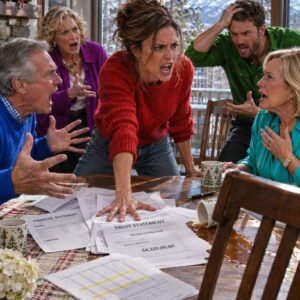
We did not make it to Switzerland before Victoria moved.
That night, Calloway Holdings announced an emergency board meeting.
My mother had called it.
Agenda:
**Removal of Preston Calloway as CEO for breach of fiduciary duty and abandonment of the Gold Coast acquisition.**
I laughed when I read it.
Naomi did not.
“She knows.”
“Probably.”
“How?”
I looked at my phone.
My entire life had once been surrounded by people chosen by Victoria.
Assistants.
Security.
Drivers.
Attorneys.
Board members.
My mother hadn’t merely influenced my world.
She had staffed it.
I called Martin.
“Move the Swiss retrieval through outside counsel.”
“Already doing it.”
“And freeze any document destruction at Calloway House.”
“We need court authority.”
“Get it.”
“Preston.”
“What?”
“Your mother has already retained criminal counsel.”
I almost smiled.
“Good.”
That meant she was afraid.
The board meeting began at nine the next morning.
Victoria sat at the far end of the table wearing navy silk and pearls.
She looked exactly like the mother I remembered from childhood.
Elegant.
Controlled.
Untouchable.
“Preston.”
“Mother.”
There were eleven directors.
Seven had worked with her for decades.
She expected loyalty.
So had I, once.
Victoria began.
“My son has recently displayed erratic judgment.”
I almost laughed.
Canceling a lucrative acquisition after discovering secret children apparently qualified.
She continued.
“He abandoned a transaction worth hundreds of millions without consultation.”
I leaned back.
“The deal was bad.”
Her eyes narrowed.
“You championed it for eight months.”
“I learned new information.”
“Personal information.”
“Relevant information.”
One director cleared his throat.
“Preston, can you explain?”
I looked at Martin.
He nodded.
I stood.
“My mother concealed the existence of my biological sons.”
Silence.
Victoria did not move.
I continued.
“Four years old. Twins.”
Whispers.
“She intercepted correspondence from my then-wife during our divorce.”
My mother finally spoke.
“This is irrelevant.”
“No.”
I looked directly at her.
“It’s the only reason we’re here.”
Then Martin distributed copies.
Not all the evidence.
Enough.
The intercepted letter.
Victoria’s signature.
Internal memos.
The trust provisions.
One director went pale.
Another whispered:
“Jesus Christ.”
My mother remained composed.
“Personal family matters do not belong in this boardroom.”
I smiled.
“Normally, I would agree.”
Then Martin displayed the trust.
“But you concealed my children because their legal existence changed voting control.”
That landed.
The room shifted.
Victoria’s face finally changed.
Only slightly.
Enough.
“You knew Father’s trust transferred shares to my biological children.”
Silence.
“You knew if Naomi established paternity, your voting influence would shrink.”
One director asked:
“How much?”
Martin answered:
“Approximately nine percent of protected family voting equity.”
Huge.
Enough to alter control.
Victoria stood.
“This meeting is over.”
“No.”
The oldest director, Harold Wynn, spoke.
He had been my father’s friend.
For years, I’d thought he disliked me.
Now he looked at my mother with disgust.
“Sit down, Victoria.”
She stared.
Harold repeated:
“Sit.”
Slowly, she did.
Then the door opened.
Federal investigators entered.
Not dramatic.
No guns.
No shouting.
Just badges and warrants.
My mother looked at me.
“You’re destroying your father’s company.”
For thirty-eight years, that sentence would have worked.
Duty.
Legacy.
Shame.
Not anymore.
“No.”
I looked around the table.
“I’m finding out what happened to it.”
The Swiss box arrived electronically first.
Scans.
The originals followed under legal custody.
Inside were ledgers spanning twenty-two years.
Signatures.
Property transfers.
Offshore payments.
But there was also a small envelope.
My name.
My father’s handwriting.
I knew it immediately.
**PRESTON — IF YOU EVER NEED TO OPEN THIS, I FAILED TO FIX SOMETHING MYSELF.**
My hands shook.
Naomi sat beside me in Martin’s office.
I looked at her.
“Stay.”
She nodded.
I opened it.
_Son,_
_If you’re reading this, the family has become more complicated than money should ever make a family._
Dad.
That was him.
Dry.
Understated.
_Your mother and I disagree about what Calloway means._
My throat tightened.
_She believes legacy is something you protect from outsiders._
_I believe legacy is what you leave inside the people you love._
I looked away.
Naomi took my hand.
Not romantic.
Not forgiveness.
Human.
Still, I nearly broke.
_If you marry someday, I hope you choose someone who tells you the truth even when your pride makes truth inconvenient._
Naomi laughed through tears.
“Your father would’ve liked me.”
“He would’ve loved you.”
The words came naturally.
I continued.
_If you have children, do not teach them they were born to carry this company._
_The company exists to serve your lives._
_Not the other way around._
I stopped.
Because I had done exactly the opposite.
I had thrown away Naomi because I believed Calloway Holdings was more important than a marriage that didn’t fit its image.
I kept reading.
_And if Victoria and I have failed each other by the time you read this, do not inherit our failure as loyalty._
I covered my face.
Naomi squeezed my hand.
At the bottom, Dad had written:
**Choose people over structures, Preston. Structures can be rebuilt.**
I laughed bitterly.
“I was minutes from buying six hundred million dollars of structure.”
Naomi smiled faintly.
“You’ve always liked buildings.”
“I was an idiot.”
“Also true.”
I looked at her.
For one second, we were us again.
Then it passed.
That was okay.
Some things should return slowly.
The trust documents were clear.
Theo and Eli were entitled to the shares.
Not me.
Not Naomi.
Them.
Under independent management until adulthood.
I insisted on independent management.
No Calloway family trustee.
No Victoria.
No me.
Naomi looked surprised.
“They’re your sons.”
“Exactly.”
I thought of my mother.
“Nobody should be able to use their money to control them.”
Something changed in her expression.
Not forgiveness.
Respect, maybe.
A beginning.
Then Martin handed me something else.
“There’s an account for Naomi.”
She frowned.
“No.”
He showed her.
“Your father created it.”
Michael.
“What kind of account?”
“Approximately $1.7 million.”
Naomi stared.
“I don’t want his money.”
“Most of it isn’t his.”
Martin continued.
“It’s restitution.”
“From what?”
“Michael documented amounts Victoria paid him over the years. He placed the equivalent into an escrow structure when he decided to cooperate.”
Naomi laughed.
“He stole dirty money and saved clean guilt?”
“Something like that.”
She pushed the paper away.
“No.”
I understood.
Then Sophie, who had joined us, whispered:
“Danny.”
Naomi turned.
“What?”
“Use it for Danny.”
Their younger brother.
The one whose death had broken Michael.
Sophie continued.
“A sensory-access program. Schools. Therapy grants. Families who can’t afford evaluations.”
Naomi’s expression softened.
Then she nodded slowly.
“Okay.”
That was how $1.7 million stopped being Michael Vance’s attempt to buy forgiveness.
It became something useful instead.
Victoria was arrested three days later.
Not for hiding my sons.
That was morally monstrous but legally more complicated than my anger wanted.
She was charged for financial fraud, obstruction, falsified records, conspiracy, and other offenses connected to the offshore scheme.
Isabella cooperated.
So did Michael.
Their cooperation reduced what they faced.
Dante did not forgive his mother.
Sophie did not forgive her father.
Naomi didn’t either.
I learned that consequences and reconciliation were separate things.
That lesson would matter later.
I saw the twins again a week after the board meeting.
This time, Naomi invited me.
Barely.
“One hour.”
“I understand.”
“No gifts.”
“I understand.”
“No driver at the door.”
“I’ll drive.”
“No giant toy cars.”
“I wasn’t planning—”
“Preston.”
“I understand.”
I arrived with nothing.
That felt strange.
I had spent my life solving discomfort with objects.
Wine.
Jewelry.
Trips.
Cars.
Money.
Now I carried only myself.
Theo opened the door.
“Rich bakery man.”
Naomi called from the kitchen:
“Theo.”
“What? He is.”
I crouched.
“Accurate.”
Eli came behind him.
He held the planet notebook.
“What do you do?”
I blinked.
“What?”
“For work.”
“I buy buildings.”
Theo looked disappointed.
“That’s boring.”
“Sometimes.”
Eli showed me a drawing of Saturn.
“I like planets.”
“So did I.”
Naomi looked at me.
“You did?”
“My father bought me a telescope when I was eight.”
I had forgotten until that moment.
Eli’s eyes widened.
“You have one?”
“Yes.”
Naomi gave me a warning look.
I corrected.
“At my house. You don’t have to see it.”
Eli considered.
“Maybe someday.”
My heart stopped.
Someday.
One word.
More valuable than half the buildings I owned.
Theo climbed onto a chair.
“Are you our dad?”
Silence.
Naomi froze.
I had imagined this question.
In every version, I gave a perfect answer.
Reality gave me nothing.
So I told the truth.
“Biologically, yes.”
Theo frowned.
“What’s biologically?”
Naomi closed her eyes.
I tried again.
“I’m the man who helped make you.”
“Like ingredients?”
I laughed.
“Sort of.”
“Then why don’t you live here?”
There it was.
I looked at Naomi.
She did not rescue me.
Good.
“I made mistakes.”
“What mistakes?”
“A big one.”
“How big?”
“Five years big.”
Theo raised the Calloway eyebrow.
“That’s really big.”
“Yes.”
Eli whispered:
“Did Mommy make it too?”
“No.”
Naomi looked at me.
I continued.
“That one was mine.”
Theo processed this.
Then asked:
“Are you going away again?”
My throat closed.
“I don’t know what your mom will decide about how much I see you.”
Naomi’s face changed.
“But I won’t disappear on purpose.”
Theo stared.
“Promise?”
I thought of every adult in this story who promised things they couldn’t control.
“No.”
His face fell.
“I won’t promise something just because it sounds nice.”
I leaned closer.
“I’ll show you.”
He watched me.
Then nodded.
“Okay.”
Naomi turned away.
But not before I saw her wipe one tear.