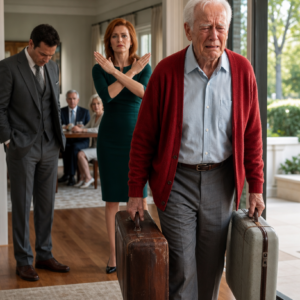
PART 1In 1995, I sent my son to live with his grandparents.
He was fourteen years old.
My second wife, Brenda, and he went at each other like cats from the second she moved in, and in the end, I chose the quiet house. I packed two duffel bags and his baseball glove into the trunk of my Buick and drove him forty miles north to my late first wife’s parents.
I told myself it was for his own good.
I said it to the windshield on the drive up, and I said it to my father-in-law on the gravel driveway while my boy stood by the porch post looking at his sneakers.
I said it enough times over the years that I half believed it. He finished growing up in that drafty farmhouse.
We did the holidays.
Polite visits where we sat in the front room, asked about the weather and school, and checked our watches before the pie was finished.
His mother’s people raised him into a solid, decent man.
He became an electrician, married a steady girl named Sarah, and built a good life with his own two hands.
That was to their credit, not mine. For thirty years, I carried that quiet trade I made.
Brenda got her calm living room, but the house always felt hollowed out, like someone had scooped the marrow right out of the walls.Then last Tuesday, an envelope came in the mail. Brenda brought it in with the gas bill and laid it on the kitchen table while I was brewing coffee.
It was heavy cream cardstock.
His boy, my grandson Lucas, was graduating high school on May 22nd. “Look at that,” Brenda said, tapping the back of the envelope with her fingernail.
“The invitation inside is professionally printed, but look at the front.
The address isn’t on a printed label.”I picked it up.
My eyes aren’t what they used to be, but I recognized that slanted, tight lettering immediately.
It was my son David’s handwriting.
He had pressed the ballpoint pen into the paper hard enough to raise ridges on the back.Inside the fold of the commencement announcement was a slip of yellow legal paper.
No greeting.
No date.
Just four words written in that same heavy script:”One seat left.
Come.”Brenda pulled the slip from my fingers, read it, and set it down by the sugar bowl. “Well,” she said, her voice dropping into that careful, flat tone she uses when she wants to close a door. “It’s an announcement, Tom.
People send announcements to all the relatives so nobody gets their feelings hurt.
You can’t just drive up there after all this time.
You’d make it awkward for everybody.”I didn’t answer her.
I slid the slip into my shirt pocket. The next morning, I waited until Brenda took her car into town for her Wednesday bridge club.
I picked up the landline phone in the kitchen and dialed David’s cell.
I had the number written on a sticky note tucked inside the phone book, though I hadn’t called it in over three years.He answered on the fourth ring. “Hello?””David,” I said. “It’s your dad.”There was a long stretch of static on the line.
Then he spoke, his voice low and steady. “Did you get the envelope?””I got it yesterday,” I said.
My throat felt dry. “I saw what you wrote.””The service starts at ten o’clock at the high school gym,” David said.
“Sarah’s parents have two seats.
Sarah and I have two.
There is one ticket left in my pocket.
If you want it, be by the west flagpole at nine-thirty.
Alone.”Before I could ask him why he wanted me there after thirty years, the line clicked dead.PART 2I didn’t tell Brenda about the call. When she came home from bridge, she took the mail off the counter, tossed the sale flyers into the recycling bin, and looked at me across the stove. “I was thinking we could buy a nice savings bond for Lucas,” she said. “We can mail it with a card.
That way we acknowledge it without making a scene.””Maybe,” I said. That night, I couldn’t sleep.
The clock on the nightstand clicked every minute like a metronome.
I kept thinking about the day I left David at the farm.
He hadn’t cried.
He just took his duffel bag from the Buick’s trunk, set it on the dirt, and said, “Thanks for the ride, Dad.” That sentence had rattled around in my head for three decades.
A boy shouldn’t thank his father for a ride that ends with him staying behind.When May 22nd arrived, I got up at six in the morning.
I put on my navy blazer, the one I hadn’t worn since my brother’s funeral, and a clean white shirt. Brenda came into the hallway in her robe, tying the belt tight around her waist.
She took one look at my clothes and her face went stiff. “What are you doing, Tom?””I’m going to the graduation,” I said.”We talked about this,” she said, her voice climbing. “David hasn’t asked you for a single thing in thirty years.
You’re going to walk into that gym and ruin that boy’s morning.
What do you think you’re going to fix by showing up now?””Nothing,” I said. “I’m not fixing anything.
But he told me there was a seat, and I’m going to sit in it.””If you go up there, don’t expect me to welcome a bunch of drama into this house when you get back,” she said.I grabbed my keys off the hall table and walked out to the car. The drive north was gray and cool.
The county road had been paved over twice since the nineties, but the landmarks hadn’t changed much.
The old silos, the grain elevators, the rusted fence lines.
When I pulled into the high school parking lot at twenty past nine, yellow school buses were lined up along the curb and families were already streaming toward the brick building carrying flowers and programs.I parked near the back fence and walked toward the west flagpole. David was already standing there. He was forty-four now, with gray working through his dark hair at the temples and broad shoulders under a dark gray suit.
He had his hands in his pockets, watching the crowd.
When I stepped onto the grass near him, he turned his head.”You’re on time,” he said.”I gave myself an extra half hour on the highway,” I replied.He looked at my suit, then down at my shoes, then back to my face.
He didn’t offer a hand, and he didn’t pull away.
He reached into his coat, pulled out a blue paper ticket, and handed it to me. “He’s graduating third in his class,” David said. “He’s going to state college for mechanical engineering.””That’s good,” I said. “That’s real good, David.””My grandfather’s watch is on his wrist right now,” David said, his voice flat and even. “The one you left behind in the bureau when you moved Brenda into the house.”The words hit like a physical tap to the ribs.
I had forgotten all about that watch. “David, look,” I started.”Don’t do it out here,” he said, cutting me off without raising his voice. “We go inside.
You sit with me and Sarah.
We cheer for my son.
When the ceremony is over, you walk across the street with me to the diner.
Then we talk.”PART 3The ceremony inside the gym lasted two hours.
It was hot, smelled of floor wax and perfume, and the bleachers creaked every time the crowd stood up.
When Lucas’s name was called, Sarah stood up and shouted, tears running down her cheeks.
David clapped with hard, measured slaps of his palms.
I stood up too, clapping until my hands stung, looking at that tall kid on the wooden stage who had my father’s square jaw and his father’s steady walk.Lucas didn’t know me.
When we milled around in the grass outside afterward taking pictures, David introduced me simply: “Lucas, this is Tom.
My dad.”The boy shook my hand politely. “Nice to meet you, sir.
Thanks for coming.”He had no anger in him.
He had no weight in his eyes.
David hadn’t poisoned him with thirty years of grudges; he had simply kept the boy clean of it.
That hurt worse than if the kid had spit on my shoes.At twelve-thirty, after Sarah took Lucas and her parents to the school cafeteria for the family reception, David nodded toward the crosswalk.
We walked across the two-lane road to the corner diner. The place was crowded, but David found an empty booth in the back near the kitchen door.
The waitress brought two black coffees without asking. David pulled an envelope from his inside jacket pocket.
It wasn’t the cream paper from the invitation.
It was a standard business envelope, dog-eared and worn at the seams, yellowed by years of sitting in a drawer.He slid it across the laminate table.
It stopped right between our cups.”Open it,” he said.I picked it up.
Inside was a single check, dated September 14, 1995.
It was made out to my father-in-law, Arthur Miller, for the amount of $200.
The signature at the bottom was mine.On the back, in Arthur’s spindly, old-fashioned script, was written: *Returned.
Keep your money.*”I found that in Grandpa’s metal lockbox after he died three years ago,” David said.
His eyes stayed locked on mine. “Along with five more just like it.
You sent six checks.
Two hundred dollars a month.
And every time Grandpa mailed them back, you stopped sending them after February.”My throat locked up. “I thought he didn’t want my help.””He didn’t want your guilt payments,” David said, his voice dropping to a harsh whisper. “He wanted you to drive up the road and see me.
He sent the checks back so you’d have an excuse to show up at the door and ask why.
But you never came.
You just kept the twelve hundred dollars and stayed home.”I looked down at the check.
The ink was faded, but the date was clear.
September 1995.
The second month after I dropped him off.”I didn’t bring you here to yell at you,” David continued. “I brought you here because Lucas turned eighteen today.
When I was eighteen, I was waiting on that porch every Sunday afternoon thinking your Buick was going to turn into the lane.
By the time I was twenty, I stopped looking.
But I made myself a promise when Lucas was born.”He leaned forward, placing his calloused palms flat on the table.”I promised myself that if my boy made it to eighteen whole and safe, I would give you one chance to tell me the truth to my face.
Not some story about how hard it was with Brenda.
Not some excuse about how you thought Arthur was doing a better job than you could.
I want to know why you left me there.”The diner was noisy around us, dishes clattering, the grill sizzling, graduates laughing two booths over.
But the space across that table felt five miles wide.I didn’t hide behind Brenda.
I didn’t hide behind Arthur. “I was a coward,” I said.
The words came out rough and dry. “I wanted an easy life.
You and Brenda fought, and every time I walked in the door from work, I felt like I was being pulled apart.
I picked the quiet.
I told myself you were better off with Arthur, but it wasn’t about you being better off.
It was about me wanting to watch television in an empty living room without having to be a father.”David sat motionless.
He didn’t blink.
He just watched my mouth move, absorbing every word like he was taking an inventory he had waited thirty years to balance.”I kept the money because it was easier than facing your grandfather,” I added, looking straight at him. “And I stayed away because looking at you made me sick of myself.
That is the whole truth, David.
That is all of it.”ENDINGDavid didn’t yell.
He didn’t slam the table. He looked down at the yellowed check between our cups, reached out, and picked it up.
He folded it once, then twice, and slid it back into his pocket.”All right,” he said.He took a slow drink of his black coffee.
Outside the diner window, a car honked as a group of seniors drove by with their graduation caps perched on the dashboard.”Lucas is working for the county road crew this summer before school starts in the fall,” David said quietly.
“He’s living at our house until August.”I waited, my hands resting stiffly on my knees under the table.”We have Sunday dinners,” David said, not looking up from his cup. “Five o’clock.
Sarah cooks.
Sometimes we just grill burgers in the backyard.”He set his mug down on the saucer with a small clink. “You can come,” David said. “Once a month.
Just you.
Don’t bring Brenda.”I felt something give way behind my eyes, but I kept my face still.
I didn’t reach across the table, and I didn’t thank him.
I knew better than to thank a man for throwing me a rope I didn’t deserve.”I can do that,” I said.David left three dollar bills on the table for the coffee, stood up, and buttoned his jacket.
He didn’t offer a hug.
He just nodded toward the door.
“I’ll see you on the second Sunday of June, Tom.
Five o’clock.”I sat in that booth alone for ten minutes after he walked out. When I drove back down the highway that afternoon, the sun was breaking through the gray clouds over the pastureland.
The house was completely quiet when I stepped into the kitchen.
Brenda was sitting on the sofa in the living room with a magazine in her lap.
She looked up, waiting for the anger or the misery she expected me to bring through the door.”How was it?” she asked, her voice guarded.”He’s a fine boy,” I said.I took off my blazer, hung it on the back of the kitchen chair, and walked into the spare bedroom.
I took the small commencement program out of my pocket and laid it flat in the top drawer of the desk, right next to the car title and the deed to the house. I’m an old man now, and there are thirty years of Sunday afternoons I will never get back.
But come June, I have a place to be at five o’clock.