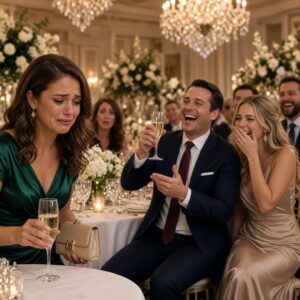
My mother raised her glass at Thanksgiving dinner, looked directly at me, and said, “Brittney was the daughter we chose.
The rest just happened.”
Thirteen people laughed.
I was the rest.
For twenty-seven years, I had lived inside that sentence without ever hearing anyone say it aloud.
My older sister, Brittney, had received the car, the college education, the down payment on her house, our grandmother’s sapphire ring, and the seat beside my mother at every family gathering.
I received cardboard boxes filled with her old clothes, a bedroom that still doubled as my mother’s sewing room, and a folding chair at the far end of the table.
I had spent most of my life believing there must be something about me that made my family love me less.
Then my uncle Wayne, who had already finished four bourbons, put his glass down and said six words that changed everything.
“They chose her.
They never adopted you.”
My mother’s fork struck her dinner plate with enough force to splash gravy onto the white tablecloth.
My father reached for my hand.
That frightened me more than the shouting would have, because in twenty-seven years, I couldn’t remember him ever reaching for my hand in front of my mother.
“Don’t listen to him, Claire,” he said.
Brittney laughed.
“Oh my God.
What is this supposed to be?
Some kind of family conspiracy?”
A few people laughed with her.
Someone asked for the stuffing.
Someone else started talking about football.
Within ninety seconds, the conversation had moved on.
I sat there wondering whether everyone had just heard the same thing I had.
The next morning, I requested my original birth records from the state of Ohio.
Seventeen days later, an envelope arrived.
What it contained was not what my mother had been afraid I would discover.
It was worse.
And when I sent her a photograph of those documents, she drove three hours through the December darkness to my apartment, a place she had never bothered visiting before.
She came to beg me to stop asking questions.
She arrived twenty-seven years too late.
My name is Claire Anne Burns.
I was born on September 9, 1998, in Marietta, Ohio.
I work as a medical laboratory technician in Cleveland, and until that Thanksgiving, I thought I understood the basic facts of my life.
I was the younger daughter.
Brittney was the favorite.
My father avoided arguments, my mother controlled everything, and I was expected to be grateful for whatever attention remained after Brittney had received hers.
That was how our family operated.
Nobody explained it.
Nobody needed to.
The first cardboard box arrived outside my bedroom when I was seven.
It was a large moving box from the hardware store where my father bought supplies for his electrical work.
My mother had written two letters on the side in thick black marker.
B → C.
Brittney to Claire.
Inside were clothes Brittney had outgrown: jeans faded around the knees, a purple winter coat missing one of its toggles, several sweaters, and a pair of sneakers with the backs worn down.
My mother stood in my doorway while I unpacked them.
“See?
Plenty of nice things.
You won’t need school clothes this year.”
I remember holding up the purple coat.
“Can I get a blue one?”
“Why would we buy another coat when that one is perfectly good?”
“Because blue is my favorite.”
She gave me the look she used whenever I asked for something she considered unnecessary.
“Claire, you need to learn the difference between wanting something and needing something.”
A few weeks later, I found Brittney’s old bicycle in the garage.
It was pink, with sun-faded plastic streamers hanging from the handlebars.
I had been asking for a blue bike since my birthday.
When I reminded my mother, she pointed toward the garage.
“Your sister barely used that one.
Be grateful.”
Brittney had received a brand-new bicycle that summer.
I rode the pink one until the front tire wouldn’t hold air anymore.
Every autumn, another box appeared.
Sometimes the clothes fit.
Sometimes they didn’t.
Occasionally I found something I liked, but even then, it bothered me that I hadn’t been the person who chose it.
My bedroom had originally been a sewing room at the back of the house.
My mother’s machine remained in one corner, covered with clear plastic.
There wasn’t enough space for a desk, so I did my homework on my bed or on the kitchen counter after everyone else had finished eating.
Brittney’s bedroom had a bay window, matching furniture, and a cushioned window seat my mother had made herself.
I once asked whether she could make cushions for my room.
“There’s nowhere to put them,” she replied.
That was the end of the discussion.
As a child, I assumed this was how families worked when money was tight.
One child got new things, and the other made do.
But we weren’t poor.
My father worked steadily for the power company.
My mother managed the household finances carefully.
We took vacations, paid for summer camps, and bought furniture that wasn’t cheap.
There was money.
It simply wasn’t distributed equally.
By the time Brittney turned sixteen in June 2011, I had learned not to expect much.
My parents surprised her with a silver Honda Civic parked in the driveway, decorated with an enormous red bow.
My father had purchased it from a coworker for $6,500 and spent two weekends replacing the brakes and fixing minor problems.
Brittney screamed when she saw it.
My mother cried.
I stood on the porch taking photographs while everyone congratulated Brittney.
Before handing over the keys, my mother gave the warning she repeated whenever driving came up.
“Your Aunt Tammy thought she could have a few drinks and still drive.
She was twenty-one when she died.
Don’t ever make that mistake.”
Aunt Tammy was my mother’s younger sister.
She had died before I was born, and that warning was almost everything I knew about her.
My mother refused to drink alcohol, even at weddings.
She said Tammy’s death had taught her what alcohol could do to a family.
Whenever she mentioned the accident, she touched the wide silver cuff bracelet on her left wrist.
She wore that bracelet every day.
At sixteen, I asked whether my parents might help me buy a used car.
My mother smiled as though I had asked something charmingly ridiculous.
“You’ve always been so independent, Claire.
I’m sure you’ll figure something out.”
She meant it as praise.
For years, I accepted it as praise.
I worked weekends at a grocery store, saved money, and eventually bought a battered Chevrolet with a dented passenger door.
My father inspected it for me.
He told me it was a good purchase.
He didn’t offer to help pay.
On my eighteenth birthday, my mother was away visiting Brittney at Ohio University.
It was parents’ weekend for Brittney’s sorority, and apparently the dates couldn’t be changed.
My father brought home a grocery-store cake with plastic balloons stuck in the frosting.
We ate it standing at the kitchen counter.
He asked about my plans for college.
I told him I wanted to work in medical laboratory science.
He nodded.
“Sounds practical.”
The next morning, I found forty dollars folded inside my jacket pocket, wrapped in a yellow sticky note.
Don’t tell your mother.
Happy birthday, Claire Bear.
I kept that note for years.
It was one of the few times I could hold proof that my father thought about me when I wasn’t standing in front of him.
His love usually arrived secretly: money hidden in pockets, a repaired tire, a bag of groceries left in my car, an occasional text reminding me to check the weather before driving.
He never openly challenged my mother.
At the time, I called that kindness.
Later, I had to find a different word for it.
When I moved to Cleveland to attend community college, I financed my education through loans, scholarships, and overnight shifts at a nursing facility.
By graduation, I owed approximately $28,000.
Brittney had graduated from Ohio University without student debt.
My parents had paid her tuition, housing, sorority expenses, and most of her living costs.
At an Easter dinner, my mother proudly told a family friend that they had spent nearly $90,000 putting Brittney through school.
“We wanted to give our daughter every opportunity,” she said.
I was standing beside the refrigerator when she said it.
Our refrigerator was covered in photographs.
Brittney at prom.
Brittney graduating.
Brittney on a South Carolina beach.
Brittney standing beside her first car.
There were pictures of me, too, but usually I appeared near the edge.
Sometimes a photograph had been trimmed to fit a frame, and my face was the part that disappeared.
I used to wonder whether the person holding the scissors had noticed.
Eventually, I stopped wondering.
In March 2019, my grandmother Loretta Keller died at seventy-six.
She had been the only person in my mother’s family who seemed genuinely interested in me.
She knew I liked mystery novels, crossword puzzles, and blueberry muffins.
She mailed me handwritten birthday cards.
She asked about my classes and remembered the answers.
At her funeral, relatives kept telling me I looked like her.
We shared the same narrow chin and gray-green eyes.
For one afternoon, I felt as though I belonged to a family history that existed before my mother had decided who mattered.
After the service, everyone gathered at my parents’ house.
My mother brought out Grandma’s sapphire ring in a small velvet box.
“This should go to Brittney,” she announced.
Brittney accepted it with tears and hugs.
Then my mother pointed toward the garage.
“Claire, there’s a box of Grandma’s things for you.”
Inside were two crocheted afghans, a pair of silver-plated salad tongs, and a thick black leather Bible.
The cover was cracked, and the pages had yellowed.
Brittney glanced into the box.
“Oh, you can have the Bible.
I don’t really read those.”
I carried everything back to Cleveland.
I used one afghan during winter and placed the Bible at the back of my closet.
I didn’t open it.
For nearly seven years, I had no idea that the most important evidence of my family’s history was sitting inside something my mother had considered worthless.
Life continued.
In March 2022, my parents gave Brittney $40,000 toward a house in Marietta, ten minutes from their own.
In September 2023, Brittney married Josh Hadley, a friendly HVAC technician who treated nearly everyone like an old friend.
My parents paid approximately $38,000 for the wedding.
I was seated at table nine, beside the kitchen doors.
Every time a server passed through, the swinging door struck the back of my chair.
Uncle Wayne sat beside me.
He was my father’s younger brother, a welder who lived across the Ohio River in Williamstown, West Virginia.
Wayne wasn’t particularly affectionate.
He rarely attended family events sober, and he tended to disappear when conversations became uncomfortable.
But he always noticed whether I had eaten.
When the servers forgot our table, he got up and found food.
When I was little, he slipped extra rolls onto my plate.
Every Thanksgiving, he saved me the turkey wishbone.
I thought he was simply a lonely man who recognized another lonely person.
I didn’t know how much truth there was in that assumption.
The Christmas after Brittney’s wedding, Josh gave her an AncestryDNA kit.
He thought it would be entertaining to discover their family backgrounds before they started having children.
My mother snatched the box from Brittney’s hands.
“Those companies sell your genetic information to whoever wants it.”
Josh looked surprised.
“I thought the privacy settings—”
“Absolutely not,” my mother interrupted. “We aren’t doing that in this family.”
She dropped the unopened kit into the kitchen trash.
Brittney rolled her eyes.
I remember looking at my mother’s bracelet as she pressed the box deeper into the garbage.
It was turning around her wrist, over and over.
I thought she was being controlling.
That wasn’t unusual enough to question.
Then Thanksgiving 2025 arrived.
Brittney had sent me a message early in November.
Mom says it’s important you come this year.
Josh’s parents are coming too.
I almost declined.
I had recently been promoted to lead technician on the overnight shift at the hospital.
I was exhausted, and traveling three hours to spend a holiday being ignored didn’t sound appealing.
But some part of me still wanted to be included.
I bought sweet potatoes, marshmallows, and pecans, prepared my usual casserole, and drove south on Thanksgiving morning.
There were fifteen people at dinner.
My parents, Brittney and Josh, Josh’s parents Pam and Dale, his sister Kayla, my mother’s brother Doug and his wife Sharon, their daughter Megan and her husband, Carol and Ron Simmons from church, Uncle Wayne, and me.
The dining table seated only ten comfortably.
My father had rented a folding table and pushed it against the far end.
My mother had prepared handwritten place cards.
Brittney sat beside her.
I sat at the far end of the rented table, next to Wayne.
The folding chair was lower than the others.
Its metal crossbar pressed against my knees whenever I moved.
My casserole was placed at that end, beside the dinner rolls.
While we waited for the turkey, I tried to tell my father about my promotion.
“I’ll be supervising three technicians now, and they’re letting me coordinate—”
“That’s wonderful, honey,” my mother interrupted from the other side of the room. “Brittney, sweetheart, didn’t you have an announcement?”
Brittney stood.
She placed one hand on her stomach.
She and Josh were expecting a baby girl in May.
The room erupted.
Pam started crying.
Carol clapped.
Josh wrapped his arm around Brittney’s shoulders.
My mother pressed both hands to her mouth.
For several minutes, everyone talked over one another about baby names, nurseries, and grandchildren.
I was happy for Brittney.
Whatever existed between us, a baby deserved to be celebrated.
Wayne quietly placed the turkey wishbone on my plate.
Then my mother stood and lifted her glass.
She began speaking about motherhood, sacrifice, and the blessings of family.
I barely listened.
Then she looked directly at me.
“Brittney was the one we chose.
The rest just happened.”
People laughed.
I don’t think everyone understood what she meant.
Some probably thought it was a joke about unexpected pregnancy.
But I knew my mother’s expressions.
I recognized that small smile.
She had said exactly what she intended.
Wayne set down his fourth bourbon.
“They chose her,” he said. “They never adopted you.”
The room changed.
My mother’s fork struck her plate.
My father reached for my hand.
Uncle Doug pushed back his chair and approached Wayne.
“Not here,” he said.
His voice was low and sharp.
He took Wayne’s truck keys from his jacket.
“And you’re not driving tonight.”
I watched my mother.
At the word driving, her hand went immediately to the silver cuff on her wrist.
She pulled it down.
Brittney laughed awkwardly.
“What?
Is Claire secretly a Russian spy?”
A few people joined in.
Carol announced that she wanted pecan pie.
Ron asked about the Bengals.
And just like that, the conversation restarted.
I looked around the table.
Nobody told me Wayne was wrong.
Nobody laughed and said, “Of course Claire is our daughter.”
Nobody explained what he meant.
Only Pam Hadley kept watching me, her expression troubled.
Doug drove Wayne home, and Sharon followed in their car.
I left shortly after four.
My mother waited beside the front door with my empty casserole dish wrapped in aluminum foil.
“Wayne drinks too much,” she said. “He says terrible things.”
I took the dish.
“Was he lying?”
She pressed her lips together.
“Don’t make this about you, Claire.
Not this year.
Your sister is having a baby.”
I stared at her.
She hadn’t answered.
My father walked me to the car.
For several seconds, he stood beside the driver’s door with his hands in his pockets.
I could see him searching for something to say.
Finally, he patted the roof twice.
“Drive safe, Claire Bear.”
I drove away before either of us had to say anything else.
The three-hour drive back to Lakewood was almost entirely silent.
I turned off the radio somewhere north of Cambridge.
As the highway lights passed overhead, memories began fitting together in ways they never had before.
The boxes.
The bicycle.
The photographs.
My eighteenth birthday.
The college fund.
The wedding seating chart.
My mother’s impatience whenever I wanted something of my own.
Perhaps I wasn’t her biological daughter.
Perhaps I had been adopted.
That explanation made painful sense.
For the first time, I could imagine a reason for my childhood that wasn’t some defect in me.
I arrived home after seven, placed the casserole dish in the sink, and sat on my bed without taking off my coat.
I didn’t sleep.
At in the morning, I searched for information about obtaining original birth records in Ohio.
I learned that adult adoptees could request adoption-related records under applicable state procedures.
By six, I had printed the forms I believed I needed.
I also prepared a separate request for a certified birth certificate.
At nine, I went to the UPS Store on Detroit Avenue.
A notary wearing reading glasses stamped my application without asking why I needed it.
My phone vibrated while she worked.
The first message was from my mother.
Wayne called to apologize.
Let it go.
Twelve minutes later:
Don’t stir things up.
Then:
Your sister is pregnant.
Think about her for once.
I mailed my requests.
On Monday, I called the state office to confirm the proper process.
The clerk explained that the record search could take several weeks and that the office could only release documents available under state law.
I thanked her.
Tuesday, my father left an eleven-second voicemail.
Most of it was silence.
“Claire Bear,” he finally said. “Please call me.”
I didn’t.
Instead, I texted Wayne.
Did you mean what you said?
An hour later, he replied.
I’m sorry, kid.
Ask your mother.
He apologized for saying it.
He never said it was false.
That distinction kept me awake for nights.
On Friday, Brittney called.
“Mom hasn’t slept properly since Thanksgiving,” she announced. “Dad says she’s barely eating.”
“I haven’t spoken to her.”
“Well, whatever you’re doing, stop.”
“Brittney, I requested my birth records.”
She went quiet.
Then she laughed.
“You cannot be serious.”
“I need answers.”
“I’m pregnant, Claire.
I can’t handle your drama right now.”
She hung up.
That night, I nearly called Columbus to cancel the requests.
I sat at my kitchen table with the phone in my hand, wondering whether I really was doing something cruel.
Then I remembered my mother’s face when Wayne spoke.
She hadn’t looked confused.
She had looked terrified.
I put the phone down.
The following evening, I took my childhood photo album from a drawer.
My mother had given it to me when I moved out, along with my vaccination records and Social Security card, all shoved into a grocery bag.
I hadn’t examined it closely in years.
There were fewer photographs than I remembered.
One showed me sitting in a high chair.
Another showed Brittney and me in matching Christmas sweaters.
Several were school photographs.
Halfway through, I found a Polaroid tucked into a plastic sleeve.
My mother stood in our old kitchen, visibly pregnant, one hand resting against the counter.
On the back, my father’s handwriting read:
August 1998.
I stared at it.
I had been born the following month.
If that photograph was genuine, my mother had carried a child shortly before my birth.
And if I wasn’t that child, what had happened to the baby?
I looked again at her left wrist.
She was wearing the silver cuff.
The next week passed slowly.
I worked overnight shifts, processed samples, verified results, and checked other people’s laboratory reports with the same precision I always used.
My coworkers noticed I was distracted.
I told them I wasn’t sleeping well.
I didn’t tell anyone why.
Seventeen days after Thanksgiving, on December 15, the envelope arrived.
I found it in my apartment mailbox shortly before six in the evening.
The return address belonged to the Ohio Department of Health.
I opened it in the lobby.
My hands were so unsteady that I tore the outer envelope badly.
Inside were two documents.
The first explained that the office had located no adoption file matching my identifying information.
The second was a certified copy of my birth certificate.
Claire Anne Burns.
Born September 9, 1998.
Marietta, Ohio.
Mother: Diane Lynn Burns.
Father: Gary Alan Burns.
I read the names again.
Then a third time.
I was their biological daughter.
The child in the Polaroid was me.
For a few seconds, I felt almost lightheaded with relief.
Then something else occurred to me.
If my parents had never adopted me, Wayne’s comment hadn’t been about me at all.
He had emphasized the wrong assumption.
They chose her.
They never adopted you.
I had assumed he meant I didn’t belong.
What he actually meant was that somebody else had been adopted.
And there was only one other daughter.
I stood in the lobby with the documents shaking in my hands.
I remembered a photograph hanging upstairs in my parents’ hallway.
Brittney’s first birthday.
A ladybug cake.
A number-one candle.
My mother leaning toward the high chair, smiling.
Her left wrist was wrapped in a black medical brace.
There were no photographs of my mother pregnant with Brittney.
There were no newborn hospital pictures.
Whenever I had asked, my mother said the camera had been stolen when Brittney was little.
Now I wondered whether the camera had ever existed.
I went upstairs, photographed the documents, and sent them to my mother.
The message was short.
The records came back.
I’m your daughter.
Who did you adopt?
She read it almost immediately.
She didn’t reply.
At , my father texted.
Your mother is driving to Cleveland.
I wanted to come.
She wouldn’t let me.
I’m sorry.
I sat in my living room watching the street.
My mother had never visited that apartment.
Not when I moved in.
Not after my appendectomy.
Not when I received my promotion.
But she was willing to drive three hours in December because I had discovered something she wanted hidden.
A little after ten, someone knocked.
I opened the door.
My mother stood outside in her camel-colored church coat.
She wasn’t wearing makeup.
Her hair was flattened on one side, and she looked considerably older than she had at Thanksgiving.
She walked past me.
For a moment, she examined the room.
The secondhand couch.
The bookshelves.
The small dining table.
The framed print above my desk.
She didn’t comment on anything.
Instead, she turned toward me.
“Have you told Brittney?”
“No.”
“Have you told anyone?”
“Not yet.”
She exhaled and sat on the couch.
Her purse remained balanced on her knees.
“Before we discuss this, I need you to promise something.”
I stayed standing.
“I’m not promising anything until you tell me the truth.”
For a long time, she stared at the floor.
Then she said, “Brittney was Tammy’s daughter.”
I knew I had heard her correctly, but I still asked her to repeat it.
She did.
My Aunt Tammy had given birth to Brittney in June 1995.
The baby’s father, according to my mother, was a young man who couldn’t provide a stable home.
Tammy raised Brittney in a small rental house outside Zanesville.
Then, in March 1996, Tammy died in a car accident on State Route 60.
My mother was in the passenger seat.
She survived with a broken wrist.
Brittney was nine months old.
My parents eventually adopted her and moved to Marietta, where my father had accepted a new job.
They started over.
New neighbors.
New church.
New friends.
Nobody knew Brittney wasn’t their biological daughter.
“She lost her mother,” Diane said. “I gave her a life.”
She rotated the silver bracelet around her wrist.
“Does Brittney know?”
“No.
And she cannot know.”
“Why?”
“Because it would destroy her.”
“She’s thirty years old.”
“She’s having a baby.”
“You’ve had thirty years to tell her.”
My mother leaned forward.
“You don’t understand what we’ve been through.”
I sat across from her.
For the first time, I didn’t feel like a child being reprimanded.
I felt like an adult waiting for another adult to answer a question.
“Why did you treat me the way you did?”
She blinked.
“What?”
“The clothes.
The car.
The college money.
Every birthday.
Every family dinner.
Why?”
Her expression hardened.
“Brittney lost her mother.”
“And I had one?”
“You had everything she didn’t.”
I looked around my apartment.
Everything I owned had been purchased with money I earned or borrowed.
I had never expected luxury.
I had wanted to matter.
“I had her leftovers,” I said. “You put them in boxes with my initial on the side.”
“Claire, I did my best.”
“You paid for her wedding.
You didn’t come to my graduation.”
“That isn’t fair.”
“Which part?”
She looked away.
I waited for an apology.
For one moment, I thought it was coming.
Instead, she said, “You need to understand that people do the best they can with the circumstances they’re given.”
That sentence told me she had already forgiven herself.
She was simply waiting for me to agree.
“I won’t tell Brittney right now,” I said eventually. “But I’m not promising to keep this secret forever.”
She focused on the first part.
“Thank you.”
She stood to leave around half past midnight.
As she pulled on her gloves, the silver bracelet slipped toward her hand.
Beneath it, I saw a pale surgical scar extending several inches along her wrist.
She pulled the bracelet back into place.
At the door, she turned.
“And stay away from Wayne.
He’s a drunk and a liar.”
Then she left.
I watched her car disappear down the street.
Afterward, I sat at my kitchen table and searched for Wayne’s address.
My mother had traveled three hours to tell me whom not to trust.
She had also made it obvious whom I needed to speak with next.
That Saturday, I drove to Williamstown.
Wayne chose a diner near the interstate bridge.
He was already waiting when I arrived, sitting in a booth with a cup of black coffee.
In daylight, he looked older than fifty.
His hands were rough from welding.
Gray stubble covered his face, and there were dark circles beneath his eyes.
“I shouldn’t have said it at Thanksgiving,” he began.
“But you meant it.”
He rubbed his forehead.
“I shouldn’t have said it that way.”
I placed my phone on the table.
“Mom told me Brittney was Tammy’s daughter.”
Wayne stopped moving.
“She said Brittney’s father was some boy who couldn’t raise her.”
He stared at me.
Then he reached into his wallet.
“That boy was me.”
He slid an old photograph across the table.
A young blonde woman sat on a plaid couch, laughing while holding a baby in a red knitted hat.
Behind them stood a small Christmas tree.
“December 1995,” Wayne said. “That’s Tammy.
That’s Brittney.”
I studied the woman’s face.
She had Brittney’s chin.
The same eyes.
The same crooked smile.
Wayne watched me recognize it.
“She was my daughter,” he said. “She still is.”
He explained that he and Tammy had been young and unprepared when Brittney was born.
He was twenty, working at a tire shop, renting a room above a laundromat.
He had a DUI conviction from before the pregnancy.
He was ashamed of it, but he didn’t hide it.
“After Brittney was born, Tammy got serious about everything,” he said. “She wanted us to move somewhere better.
She wanted me to get a steady job.”
“What happened?”
Wayne looked at the photograph.
“Your mother and Tammy went out one night.
I was home with the baby.”
He paused.
“Then the sheriff came.”
After Tammy’s funeral, my grandparents and mother convinced Wayne that he couldn’t win a custody dispute.
A young man with a DUI record and unstable housing, they argued, would struggle against a married couple who owned a home.
They offered him a deal.
If he voluntarily surrendered his parental rights, he could remain part of Brittney’s life as Uncle Wayne.
He would attend family holidays.
He could watch her grow up.
But he would never reveal that he was her father.
“I signed,” he said quietly. “I thought I was doing what was best for her.”
“And they kept their promise?”
He looked at me.
“They gave me a chair at their table.”
I thought about all the family dinners where Wayne had sat beside me.
Two people placed at the far end for different reasons.
He had been allowed to see his daughter, but never to claim her.
I had been allowed to live in my own family, but never to feel fully included.
“Mom said Tammy drove drunk,” I told him.
Wayne’s expression changed.
“Tammy wouldn’t drive after drinking.
Not after Brittney was born.”
“How do you know?”
“Because I was the one she called.
Even if she was only two blocks away, she’d ask me to come get her.”
“Then who was driving?”
He looked down.
“I wasn’t there, Claire.
I can’t tell you something I didn’t see.”
“But you suspect something.”
He nodded.
“Your mother broke her wrist.
Your Uncle Doug was the first deputy on the scene.
By the time the highway patrol arrived, Doug had already told everyone what happened.”
“Doug?”
“Your mother’s older brother.”
I remembered Doug taking Wayne’s keys at Thanksgiving.
Not here.
And you’re not driving tonight.
Wayne continued.
“Your grandmother kept newspaper clippings about the crash.
She put them in her Bible.
Once she told me the newspaper got one important thing right.”
I stopped breathing for a moment.
“Her Bible?”
“Yeah.”
“I have it.”
Wayne stared.
“Your mother gave it to you?”
“After Grandma died.
In a box.”
He shook his head.
“Of all the things she could’ve given you.”
That Christmas, I didn’t go to Marietta.
Brittney called and accused me of punishing the family.
My mother sent messages about gratitude, forgiveness, and the importance of keeping peace during the holidays.
I spent Christmas Eve at home.
Wayne sent me a photograph of a small aluminum recovery coin resting in his palm.
He had attended his first Alcoholics Anonymous meeting that week.
Day four, kid.
Merry Christmas.
I replied that I was proud of him.
It was the first holiday message in years that didn’t make me feel smaller.
On December 26, I pulled Grandma Loretta’s Bible from the closet.
The cardboard box still had my mother’s handwriting on the side.
B → C.
The Bible smelled faintly of cedar and old paper.
Inside the front cover were handwritten family records.
My grandmother had recorded births, marriages, and deaths in neat blue ink.
Tamara Jo Keller.
Born July 2, 1974.
Died March 16, 1996.
Brittney Rose.
Tammy and Wayne’s girl.
Born June 14, 1995.
And beneath that, written in darker ink:
Claire Anne.
Diane and Gary’s girl.
September 9, 1998.
Our sweet surprise.
I sat on the floor for a long time.
Our sweet surprise.
I had never heard anyone in my family describe my arrival as something wonderful.
But my grandmother had written it in the place where she recorded the people she loved.
Between the pages, I found a folded newspaper clipping.
The article was dated March 18, 1996.
It reported a fatal accident on State Route 60 south of Zanesville.
Tamara Keller, twenty-one, had been identified as the driver.
Her sister, Diane Burns, twenty-seven, had survived with a fractured wrist.
A sheriff’s deputy named Douglas Keller had been first on the scene.
At the bottom was a quotation from a farmer named Earl Whitaker, who had stopped to help.
“I talked to the girl behind the wheel.
She kept asking about her sister.”
Grandma had underlined that sentence in pencil.
I read it several times.
My mother had told me Tammy died before the ambulance arrived.
The article suggested that somebody behind the wheel had been talking.
Perhaps it had been Tammy.
Perhaps the journalist had made a mistake.
Or perhaps the person behind the wheel had survived.
I needed to know.
In January, I drove to the Zanesville public library.
A librarian helped me locate the old newspaper on microfilm.
I found the original article, Tammy’s obituary, and a later report stating that a blood alcohol test had confirmed intoxication in the person identified as the driver.
The investigation had closed after her death.
I worked in a hospital laboratory.
I knew that accurate identification mattered as much as accurate testing.
If the wrong person had been identified as the driver, a laboratory result alone couldn’t correct the error.
I printed copies.
When I returned the microfilm reel, the librarian glanced at its label.
“Funny,” she said. “We have a gentleman who looks at that same issue every March.”
“Who?”
“Doug Keller.
He’s been coming here for years.”
I thanked her and walked outside.
I sat in my car until the windows began fogging.
Then I searched for Earl Whitaker.
An obituary for his wife gave me enough information to locate the family farm outside Zanesville.
Earl was eighty years old.
He still lived there.
On February 7, 2026, I drove up his gravel driveway.
The farmhouse was white, with green shutters and an empty barn behind it.
An elderly man stepped onto the porch before I turned off my engine.
I introduced myself.
Then I showed him the clipping.
He took it carefully.
After reading it, he sat down in a wooden rocking chair.
“I wondered whether somebody would ever ask me about that,” he said.
I sat beside him.
He remembered the night clearly.
The road was icy.
He had been driving home shortly before midnight when he saw headlights pointing toward the river.
A car had left the road and settled in a ditch.
He pulled over and climbed down the embankment.
“There was a dark-haired woman behind the steering wheel,” he said. “Her left wrist was badly injured.
She kept saying she was driving and asking whether Tammy was okay.”
I felt my hands go cold.
“The passenger?”
“Blonde.
Younger.
No seat belt.
She wasn’t breathing.”
“Are you certain?”
He looked directly at me.
“I saw both of them.”
My mother had dark hair in 1996.
Tammy was blonde.
Earl continued.
About twelve minutes after he reached the car, Doug Keller arrived.
The deputy pulled the injured woman from the driver’s side and carried her to his cruiser.
Then he returned to the wreck.
“He told me his sister Tammy had been driving,” Earl said. “I told him what I saw.”
“What did he say?”
“He told me it was dark and I shouldn’t make things complicated.”
Earl looked toward the empty barn.
“At the time, I had debts.
I was afraid of causing trouble with a deputy everybody knew.”
When investigators contacted him later, he said he couldn’t be certain which woman had been driving.
But a reporter had already recorded his first account.
The account my grandmother had underlined.
Earl rubbed his hands together.
“I’ve regretted that for thirty years.”
He went inside and returned with a yellow legal pad.
At his kitchen table, he wrote a signed statement describing everything he remembered.
He included the position of both women, the condition of the car, the words spoken by the conscious driver, and Doug’s instructions.
At the bottom, he added one more observation.
The woman behind the wheel had smelled of alcohol.
He signed and dated the statement.
Then he handed it to me.
“I’m too old to keep pretending I didn’t see what I saw,” he said.
I thanked him.
Driving away, I understood that the story was no longer simply about whether Brittney had been adopted.
It involved a fatal accident, a possible false identification, and people who had maintained the same account for thirty years.
I also understood that Earl’s testimony, however sincere, was not the same as a court finding.
I needed more than a memory.
Five weeks later, I visited Doug.
He and Sharon lived outside Zanesville in a well-maintained farmhouse.
Doug had retired from the sheriff’s office.
He was a deacon at church, respected in the community, and rarely questioned about anything.
I placed a copy of Earl’s statement on his kitchen table.
Doug read it without touching the paper.
“Earl’s an old man,” he said.
“He was quoted two days after the accident.”
“Reporters make mistakes.”
“Then why do you go to the library every March?”
His face reddened.
“Who told you that?”
“Does it matter?”
He pushed back his chair.
“Claire, what exactly are you hoping to accomplish?”
“I want the truth.”
“Tammy is dead.
Nothing changes that.”
“Brittney deserves to know who her mother was.”
“Your sister is having a baby.
And you’re determined to tear apart the family right before the birth.”
I stared at him.
For twenty-seven years, people had used Brittney’s happiness as the reason I wasn’t allowed to ask for anything.
Now they were using her pregnancy to keep an entirely different secret.
“Did you lie to the highway patrol?” I asked.
Doug stood.
“Go home.”
Sharon walked me to the driveway.
Before I reached my car, she touched my arm.
“He visits Tammy’s grave every March sixteenth,” she whispered. “Alone.
Every year.”
March 16 was two days away.
The thirtieth anniversary of Tammy’s death.
I called off work that Monday and drove to the cemetery.
Tammy’s grave stood on a hill beneath a large maple tree.
The headstone was small.
Tamara Jo Keller.
Beloved daughter, sister, mother.
Someone had trimmed the grass carefully around it.
I stood there looking at the dates.
She had been twenty-one.
She had a nine-month-old daughter.
She had plans that would never happen.
Then I heard a truck approaching on the gravel road.
Doug stepped out holding yellow roses wrapped in grocery-store cellophane.
He saw me and stopped.
For several minutes, neither of us spoke.
Finally, he walked past me, knelt, and placed the roses against the headstone.
“She liked yellow,” he said.
I didn’t answer.
When he stood, he reached inside his coat and removed a folded envelope.
“Mama gave me this before she died,” he said. “She told me you’d start asking questions someday.”
On the front, in my grandmother’s handwriting, were five words.
For Claire, when she’s ready.
Doug held it toward me.
“I should’ve given you this years ago.”
I took it.
He didn’t stay to watch me open it.
I waited until I was alone in my car.
Inside were two letters.
The first was written by my mother in October 1998, when I was only five weeks old.
It was addressed to Grandma Loretta.
I recognized the handwriting immediately.
My mother described how difficult it was to hold her new baby while remembering Tammy’s death.
She wrote that Brittney would receive everything Tammy would have wanted for her.
She said she couldn’t allow herself to enjoy motherhood when her younger sister no longer had that privilege.
One sentence made me stop reading.
Tammy doesn’t get to hold her baby, so I don’t get to hold mine.
Not the way I want to.
Then another:
Brittney will have everything Tammy would have given her.
Claire will have to understand.
Near the bottom, in smaller handwriting, she wrote:
I was the one driving.
You know Doug knows.
Nobody else ever will.
I read the sentence until I couldn’t focus on the ink.
My mother had confessed in writing.
Not to the police.
Not to Wayne.
Not to the family.
To her own mother.
And Grandma had kept it.
The second letter was from Grandma herself, written in the shaky handwriting she had developed near the end of her life.
Claire, none of this was ever yours to carry.
I should have told you while I could.
I’m sorry.
Love, Grandma.
I sat in the cemetery parking lot until the afternoon light began fading.
I thought about my mother standing in the kitchen, handing Brittney the keys to her first car.
Your Aunt Tammy thought she could drive after a few drinks.
My mother had repeated that warning for years.
She had turned her dead sister into the cautionary example while presenting herself as the responsible survivor.
And she had raised Tammy’s daughter inside that lie.
Then there was me.
I had been five weeks old when my mother wrote that letter.
Too young to disappoint her.
Too young to understand guilt.
Too young to do anything but eat, sleep, and reach for the people holding me.
She had already decided that loving me freely would somehow betray Tammy.
Every box, every forgotten birthday, every unequal gift came afterward.
She hadn’t treated me differently because I was difficult.
She had treated me differently because she couldn’t bear what my existence reminded her of.
Understanding that didn’t make the years disappear.
But it changed the question I had asked myself my entire life.
I no longer wondered what was wrong with me.
I wondered how many adults had watched it happen and chosen silence.
My father knew my mother favored Brittney.
Doug knew why.
Grandma knew more than anyone.
Wayne knew something was terribly wrong.
Brittney saw it.
Even family friends noticed.
And I had spent twenty-seven years believing the problem must be mine because nobody had been willing to tell me otherwise.
For several days, I considered what to do with the letters.
I didn’t want to humiliate Brittney.
I didn’t want her to learn about her adoption through gossip or a public accusation.
But I couldn’t keep the secret forever.
She was about to become a mother.
One day, her daughter would ask questions about family history.
If nobody told the truth, my mother would eventually repeat the same story about Tammy to another generation.
I couldn’t allow that without giving Brittney the chance to decide for herself.
I called Wayne.
He answered on the third ring.
“I’m getting my ninety-day chip Saturday,” he told me.
“Congratulations.”
“Thanks, kid.”
“I think it’s time Brittney knew.”
He was quiet.
Then he said, “Tell me where to be.
I’ll come sober.”
On March 21, I drove to Brittney’s house.
Josh answered the door.
He looked at the manila folder in my hands and then at my face.
“Is everything okay?”
“No.
But I think it needs to be.”
He stepped aside.
Brittney sat at the kitchen table with her swollen feet resting on another chair.
She was thirty-two weeks pregnant, wearing Josh’s oversized sweatshirt.
Her expression tightened when she saw me.
“If this is about Thanksgiving—”
“It’s about your mother.”
“Our mother, Claire.”
I sat down.
“Please read these before we argue.”
I placed the documents on the table one by one.
My birth certificate.
The state letter.
Grandma’s family records.
The newspaper clipping.
Earl’s signed statement.
Finally, my mother’s letter.
Brittney picked up the Bible page first.
She read the line identifying her as Tammy and Wayne’s daughter.
Then she read it again.
“What is this?”
“Grandma wrote it.”
“Why does it say that?”
“Because Tammy gave birth to you.”
Brittney shook her head.
“No.”
“Brittney—”
“No.
Mom would’ve told me.”
I waited.
She read the newspaper article.
Then Earl’s statement.
Her hands began shaking.
“This can’t be right.”
“Wayne can answer your questions.”
She looked up.
“Wayne?”
“He’s your biological father.”
For several seconds, she said nothing.
Then she laughed once, sharply.
“Uncle Wayne?”
“He and Tammy were together when you were born.”
She covered her mouth.
I slid the photograph across the table.
Tammy holding baby Brittney beside the Christmas tree.
My sister looked at it.
Her expression changed.
She touched her chin.
“That’s my face.”
“Yes.”
“That’s why nobody ever talks about her.”
I didn’t interrupt.
Then Brittney remembered something.
“The DNA kit.”
“What?”
“Josh bought me that stupid DNA kit.
Mom threw it away.”
She stared at the photograph.
“She knew I’d find out.”
I nodded.
Brittney looked toward the hallway.
“Does Josh know?”
“He knows something is wrong.
I haven’t told him.”
She called his name.
When he entered, she showed him the photograph and told him what I had said.
He pulled up a chair beside her.
He didn’t try to explain anything away.
He simply stayed.
After a while, Brittney asked me to call Wayne.
He arrived twenty minutes later wearing a pressed shirt and carrying his cap in both hands.
He stopped in the kitchen doorway.
Brittney stared at him.
For thirty years, he had been the uncle who sat at the end of the table and made occasional jokes.
Now she was looking at her father.
Wayne took a small breath.
“Hi, sweetheart.”
Brittney began crying.
“Why didn’t you tell me?”
He sat down opposite her.
“Because I was young and scared, and I thought signing those papers was the only way I’d get to see you grow up.”
“You could’ve told me when I turned eighteen.”
“I know.”
“You could’ve told me when I got married.”
“I know.”
“Every Christmas?
Every birthday?
You just sat there?”
His eyes filled.
“Every one.”
She stared at him for a long time.
Then she asked, “Did my mother love me?”
Wayne looked down at the photograph.
“She loved you more than anything.
She was trying to build a better life for all three of us.”
He told Brittney about Tammy’s laugh, her stubbornness, her yellow flowers, and the tiny rental house where they had lived.
He told her Tammy used to sing while washing dishes.
He told her she had wanted to become a nurse.
He told her how she would call him to walk her home rather than drive after having a drink.
Brittney listened without interrupting.
For the first time in her life, she was hearing memories of the woman who had given birth to her.
Not warnings.
Not accusations.
Memories.
Later, Wayne and Josh went into the garage, leaving Brittney and me alone.
She sat with the photograph in her hands.
“I knew they treated you differently,” she said eventually.
I didn’t speak.
“I saw the boxes.
I saw where they seated you.
I knew Mom spent more on me.”
“Yes.”
She looked up.
“And I liked it.”
I appreciated that she didn’t try to excuse herself.
“I liked being the favorite.
I told myself you didn’t care because you never complained.”
“I complained when I was little.”
“I know.”
“You laughed.”
Her eyes filled again.
“I know.”
For years, I had imagined confronting Brittney and hearing her say she hadn’t noticed.
Instead, she admitted the part she had played.
It hurt.
But I trusted her more for saying it.
After a while, she placed one hand on her stomach.
“Mom’s throwing me a baby shower on April eleventh.”
“I know.”
“She already had a banner made.”
I nodded.
“We were going to surprise everyone with the baby’s name.”
“Have you decided?”
Brittney looked at the photograph.
“I have now.”
She ran a finger across Tammy’s face.
“Tammy Rose.”
I smiled.
“That’s beautiful.”
“And if Mom starts telling that story about how Tammy died, I’m not going to pretend anymore.”
I looked at my sister.
For the first time, she sounded like someone choosing her own place in the family.
On April 11, the church fellowship hall in Marietta was filled with pink decorations.
Pink tablecloths covered the folding tables.
Balloons floated above the chairs.
Cupcakes shaped like tiny baby shoes lined the dessert table.
A large banner hung across the stage.
Three Generations of Burns Girls.
My mother wore a pale yellow dress and her silver bracelet.
When she saw me entering, her smile tightened.
“I didn’t think you’d come.”
“Brittney asked me.”
My father stood near the coffee station.
He looked at me, then quickly lowered his eyes.
Wayne arrived shortly before one wearing the pressed shirt he’d worn to Brittney’s house.
Brittney stood and hugged him.
My mother crossed the room immediately.
“Who invited him?”
“I did,” Brittney said.
My mother stared at her.
Then she stepped away.
I sat near the back with a canvas tote bag on my lap.
Inside was the manila folder.
Doug and Sharon’s chairs remained empty.
I had sent Doug one message several weeks earlier.
April 11.
One o’clock.
First Methodist fellowship hall.
Mom is going to talk about Tammy.
He had read it.
He hadn’t replied.
At , my mother tapped a spoon against her water glass.
She thanked everyone for attending, praised the church volunteers, and spoke about the importance of family.
Then she rested her hand on Brittney’s shoulder.
“From the first day she came home, Brittney was the daughter I chose.”
I saw Wayne lower his head.
My mother’s gaze moved toward me.
“Some daughters only come around when they want something.”
A few women laughed uncertainly.
Most remained silent.
Then she brought out her gift.
It was Grandma Loretta’s handmade wedding-ring quilt.
My mother unfolded it carefully.
In one corner, she had embroidered a new name in pink thread.
Loretta Diane.
“For my granddaughter,” she announced. “Named after her great-grandmother and grandmother.”
The applause started.
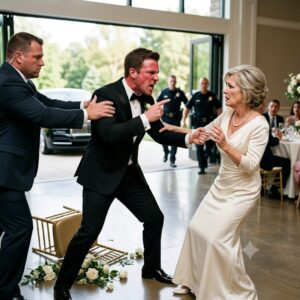
Then Brittney stood.
“Thank you, Mom.
The quilt is beautiful.”
She held it against her stomach.
“But Josh and I have already chosen her name.”
My mother smiled.
“Well, sweetheart—”
“Tammy Rose.”
A few guests murmured appreciatively.
Pam Hadley smiled.
My mother’s expression froze.
“No.”
Brittney looked directly at her.
“Yes.”
“No, absolutely not.”
“She’s our daughter, Mom.”
My mother turned toward the guests.
“My sister was a drunk who drove her car off Route 60 and left a baby behind.
I will not have my granddaughter named after that.”
The room became silent.
Brittney gripped the quilt.
I stood.
“She wasn’t driving, Mom.”
Every head turned.
My mother looked at me.
“You weren’t even born.”
“No.
But Earl Whitaker was there.”
I walked toward the gift table.
I could hear my shoes against the linoleum.
I removed the newspaper clipping and Earl’s signed statement from the folder.
I placed them beside the quilt.
“This article was published two days after the accident,” I said. “Grandma kept it in her Bible.”
My mother’s face lost its color.
I read Earl’s original statement describing the woman behind the wheel asking about her sister.
Then I explained what Earl had told me thirty years later.
My mother interrupted.
“An eighty-year-old man can remember anything he wants.”
“He described your broken wrist.”
“Everyone knew I broke my wrist.”
“He described you sitting behind the steering wheel.”
My mother turned toward my father.
“Gary, tell them this is ridiculous.”
My father stood beside the coffee urn, holding a paper cup.
For a moment, I thought he might finally speak.
Then the door at the back opened.
Doug entered with Sharon beside him.
He stopped just inside the room.
My mother stared at him.
“Doug?”
He looked older than he had a month earlier.
His shoulders were rounded, and his face was pale.
“Tammy was in the passenger seat, Diane.”
Nobody moved.
Doug’s voice remained steady.
“I took you out from behind the wheel.
I carried you up the bank.
And I told the trooper Tammy had been driving.”
Sharon took his hand.
My mother shook her head slowly.
“No.”
“Yes,” Doug said. “I lied.”
Someone in the front row gasped.
Carol Simmons lowered her eyes.
Doug continued.
“I thought I was protecting my sister.
I had already lost Tammy.
I couldn’t bear to lose Diane too.”
My mother clutched the silver cuff.
“I was hurt.
I wasn’t thinking clearly.”
“You were driving,” Doug said.
“I know what happened.”
“So do I.”
For thirty years, Doug had protected the same lie.
Now he was standing in front of the people who respected him, admitting what he’d done.
My mother turned toward Brittney.
“I gave you everything,” she said desperately. “Everything your mother would’ve wanted.
I made sure you never went without.”
Brittney stared at her.
“You made me believe my mother killed herself driving drunk.”
“I was protecting you.”
“From what?”
My mother didn’t answer.
“From knowing who she was?
From knowing Wayne was my father?
From knowing what happened?”
“I loved you.”
“I know you did,” Brittney said. “That doesn’t make the lying okay.”
My father set down his cup.
He walked forward.
“And what did you give Claire?” he asked.
My mother turned.
“What?”
“You said you gave Brittney everything.
What did you give Claire?”
For the first time in my life, my father had challenged her in front of everyone.
My mother looked toward me.
Her face changed.
Then she said something I don’t think she intended to say aloud.
“Claire was the one I didn’t deserve.”
The words remained between us.
I took the final document from my folder.
My mother’s letter to Grandma Loretta.
I didn’t read it aloud.
I didn’t need to.
I placed it beside the quilt.
“You wrote that down when I was five weeks old,” I said. “You decided I would have to understand why you couldn’t love me the way you loved Brittney.”
My mother looked at the handwriting.
Her bracelet slipped toward her hand.
The scar beneath it was visible.
She didn’t cover it.
I continued.
“I spent twenty-seven years trying to be easier to love.
I thought if I worked harder, asked for less, made you proud enough, eventually you’d see me.”
My voice stayed steady.
“I wasn’t difficult.
I was a child.”
Pam Hadley placed her coffee cup on its saucer.
The small sound seemed unusually loud.
“Diane,” she said, “I was at Thanksgiving.
I heard what you called Claire.”
My mother looked toward her.
Pam continued.
“We’ve all seen how you treat her.
At birthdays.
At holidays.
In the photographs you send.”
Carol Simmons nodded slowly.
“She’s right,” Carol whispered. “We noticed.”
My mother looked around the room.
There were people she’d known for decades.
Women who had served on committees with her.
Friends who had praised her generosity.
Family members who had accepted her version of the past.
Nobody came forward to defend her.
She put the microphone down.
Then she walked through the kitchen door.
It swung closed behind her.
My father didn’t follow.
He approached me instead.
He stood awkwardly, his hands at his sides.
“I let her do it,” he said. “All those years.”
I nodded.
“I know.”
“I’m sorry, Claire.”
It was the first time he had said those words in front of another person.
I wanted them to fix something.
They didn’t.
But they mattered.
“I didn’t come here to take anything from Brittney,” I said. “I just wanted to stop carrying something that was never mine.”
Brittney stood beside Wayne.
She still held Grandma’s quilt.
Then she looked toward the guests.
“Our daughter’s name is Tammy Rose,” she said.
Nobody argued.
Outside, Doug approached me in the parking lot.
He looked exhausted.
“I’ll tell Brittney everything she wants to know,” he said. “And I’ll answer whatever questions come after that.”
I nodded.
“That’s what you should’ve done a long time ago.”
He accepted it.
“I know.”
In the weeks that followed, our family changed in ways I couldn’t have predicted.
My father moved into a small one-bedroom apartment near the river in Marietta.
He didn’t immediately file for divorce.
He told me he needed time to decide what his marriage meant after so many years of silence.
My mother stepped down from her church events committee.
Doug resigned from his position as deacon.
Sharon later told me that he drove out to Earl Whitaker’s farm and sat with him on the porch for two hours.
I never asked what they discussed.
The decades-old crash raised serious questions, but no new criminal case resulted from what we uncovered.
Whether any legal action remained possible depended on evidence and applicable law, and I wasn’t going to pretend a family’s confession was the same as a courtroom judgment.
My mother wrote me three letters.
I opened the first.
It was four pages long.
She explained how much pain she’d carried since Tammy’s death, how frightened she had been, and how she had tried to make the best decisions she could.
She said she was sorry I had been hurt.
She didn’t say she had hurt me.
There was a difference.
I replied once.
When you can tell the truth without asking me to excuse it, you can write again.
Until then, I need space.
The other letters remained unopened in my kitchen drawer.
I didn’t know whether I would ever read them.
For the first time, I allowed myself not to decide immediately.
My father began visiting on Saturdays.
The first time, he arrived at nine in the morning holding a paper bag from a bakery.
He had driven three hours.
“I brought bagels,” he said.
I stepped aside.
He looked around my apartment.
This time, somebody actually noticed it.
“Nice place,” he said.
“Thanks.”
He pointed toward the bookshelf.
“Did you build that?”
“I assembled it.”
“Looks solid.”
We ate breakfast at my kitchen table.
The conversation was uncomfortable at first.
He asked about my work.
Not whether I liked it.
Not whether I was making enough money.
He asked what I actually did.
I explained how laboratory samples were processed, why accuracy mattered, and what responsibilities came with supervising other technicians.
He listened.
Then he asked another question.
I nearly cried.
Not because his question was extraordinary.
Because it was so ordinary.
That was the kind of attention I had wanted from him for years.
The following Saturday, he returned with a toolbox.
He repaired the porch light that had been flickering since February.
Then he sat down and helped me plan a small shelf for the kitchen.
He came again the next week.
And the next.
One morning, while we were eating breakfast, he said, “I can’t give you those years back.”
I looked at him.
“I know.”
“But I can give you Saturdays.
If you’ll let me.”
I wasn’t ready to forgive him completely.
He knew that.
Still, I let him come.
He didn’t miss a Saturday.
Wayne continued attending recovery meetings.
He sent me photographs of his sobriety chips, sometimes with short messages, sometimes with jokes about the terrible coffee at meetings.
Brittney began calling him regularly.
Their relationship was complicated.
She had questions about Tammy, about Wayne’s decision to sign the adoption papers, and about all the years they had lost.
Some conversations ended with both of them crying.
Others ended in anger.
But they kept speaking.
That was more than any of us had done before.
Brittney also began calling me.
At first, the conversations were cautious.
We didn’t suddenly become the sisters we might have been under different circumstances.
There were too many years between us.
But she started asking about my life.
She wanted to know about the promotion she’d interrupted at Thanksgiving.
She asked about my friends, my apartment, and whether I was dating anyone.
Occasionally, she apologized for something specific.
The boxes.
The wedding.
My eighteenth birthday.
I didn’t always know what to say.
Sometimes I told her the apology mattered.
Sometimes I told her I wasn’t ready to discuss it.
She accepted both answers.
Then, shortly after two in the morning on May 9, my phone rang.
Josh’s name appeared on the screen.
I answered immediately.
“It’s happening,” he said. “Brittney wants you here.”
I was dressed and in my car within minutes.
The drive south took almost three hours.
It was still dark when I reached the hospital in Marietta.
I parked, hurried inside, and asked for the maternity ward.
Brittney was in labor.
Wayne was in the waiting room with my father.
It was Saturday.
My father had come to Marietta instead of making his usual trip to Cleveland.
He stood when he saw me.
“She’s doing okay,” he said. “Josh is with her.”
Wayne looked nervous.
He had a bottle of water he hadn’t opened.
I sat between them.
Three people who had spent most of their lives at opposite ends of a family table were now waiting together for the same baby.
At that morning, Tammy Rose Hadley was born.
Six pounds, eleven ounces.
Dark hair.
A strong cry.
When the nurse finally allowed me into the room, Brittney was propped against her pillows, exhausted and smiling.
Josh stood beside her.
Brittney held a tiny bundle wrapped in a striped hospital blanket.
She looked up when I entered.
“I wanted you here first,” she said.
I sat beside the bed.
She carefully placed her daughter in my arms.
Tammy Rose was warm and astonishingly small.
Her fingers curled against the blanket.
I looked at the hospital bracelet around her ankle.
Hadley, Tammy Rose.
“She has your nose,” I told Brittney.
Josh laughed softly.
“That’s what everybody keeps saying.”
Brittney watched me holding her daughter.
Then she said, “You should’ve been first a long time ago.”
I looked at her.
There were so many things that could have meant.
First to be celebrated.
First to be defended.
First to be treated like a sister instead of an inconvenience.
I didn’t ask her to explain.
I understood.
Wayne came in later.
He stood at the foot of the bed and stared at his granddaughter.
His eyes filled.
He covered his mouth and turned toward the window.
Brittney let him have a moment before asking whether he wanted to hold her.
He nodded.
I watched him cradle Tammy Rose with hands that had spent decades welding steel.
For thirty years, he had carried a photograph of his daughter as a baby.
Now he was holding her daughter.
The next day was Mother’s Day.
Brittney’s first.
She sent Diane one photograph of Tammy Rose.
No message.
No explanation.
I didn’t ask what my mother replied.
Some things were no longer my responsibility.
Three weeks later, on Saturday, May 30, they all came to my apartment in Lakewood.
Brittney and Josh brought Tammy in her car seat.
Wayne drove up with my father.
The apartment had never held so many members of my family at once.
I had spent the previous evening cleaning, arranging furniture, and preparing breakfast.
For the first time, I wasn’t doing it because I hoped someone would approve.
I was doing it because I wanted them there.
On the kitchen table sat a cardboard box.
It was new, sturdy, and large enough to hold several gifts.
Inside were picture books I’d bought for myself with babysitting money when I was younger.
I had kept them through college, three apartments, and years when I owned almost nothing.
There was also a new soft blue blanket.
I had chosen the color myself.
At the bottom, I placed a copy of Grandma Loretta’s family record page.
Beneath her handwriting, I had added a line of my own.
Tammy Rose Hadley.
Brittney and Josh’s girl.
May 9, 2026.
On the side of the box, I wrote two letters in black marker.
C → T.
Claire to Tammy.
Brittney saw it almost immediately.
She had just set the car seat down when she noticed the writing.
She stopped.
I watched her look from the box to me.
She knew exactly what it meant.
For years, my mother’s boxes had moved in one direction.
From the chosen daughter to the daughter who received whatever remained.
Now I had made a box of my own.
But every item inside had been selected with care.
Nothing was unwanted.
Nothing was damaged.
Nothing was being passed along because somebody else had outgrown it.
Brittney touched the writing.
“Claire,” she whispered.
Her eyes filled.
I opened the box and showed her the books.
“These were mine,” I said. “I loved them when I was little.
I thought Tammy might like them someday.”
Brittney picked up one of the picture books.
Its cover was worn from years of reading.
“You kept these?”
“Every one.”
She looked at the blanket.
“And you bought this?”
“Yes.”
She ran her fingers across the blue fabric.
Then she began crying.
I stood beside her.
“It’s not what’s left,” I said. “It’s what I chose.”
She hugged me.
For a moment, I was eight years old again, standing in my bedroom with a purple coat I hadn’t wanted.
Then I was twenty-seven, standing in my own kitchen beside a sister who finally understood.
I hugged her back.
My father was setting bagels on the counter.
Wayne was making ridiculous faces at the baby.
Josh was trying to figure out the coffee machine.
The apartment was noisy in a way it rarely was.
People were opening cupboards, asking where plates belonged, and laughing about ordinary things.
I had purchased two additional kitchen chairs earlier that week.
They matched the three I already owned.
I had set five places around the table.
Everyone had enough room.
Nobody’s knees struck a metal crossbar.
Nobody’s chair was lower than the others.
There were no place cards.
Brittney sat beside Josh with Tammy sleeping nearby.
Wayne sat across from my father.
I carried the last plate of scrambled eggs to the table and took my seat.
My father looked around.
“You need anything else, Claire?”
I shook my head.
“No.
I think we’re good.”
He smiled.
Then we ate.
Nobody made a speech about sacrifice.
Nobody announced which child had been chosen.
Nobody had to pretend not to hear something cruel.
We talked about the baby, Josh’s work, Wayne’s meetings, and the strange things people sometimes brought into the hospital laboratory.
My father asked questions.
Brittney laughed at one of my stories.
Wayne reached for another bagel.
And when Tammy woke and began fussing, everyone turned toward her.
Not because she was the favorite.
Because she was a baby who needed someone.
I watched Brittney lift her daughter and settle her against her shoulder.
She kissed the top of Tammy’s head without hesitation.
I thought about my mother’s letter.
How she’d written that she couldn’t hold me the way she wanted because Tammy no longer had that chance.
For years, Diane had treated love as if giving it to one child would somehow steal it from another.
But watching Brittney with Tammy made the mistake obvious.
Love wasn’t a fixed amount handed out until nothing remained.
Brittney loving her daughter didn’t take anything away from me.
Wayne loving Brittney didn’t mean he couldn’t care about me.
My father learning to show up now didn’t erase his failures, but it also didn’t require me to reject every good moment that came afterward.
And my mother’s guilt had never been a debt I was required to repay.
I still don’t know what will happen between Diane and me.
I don’t know whether she will ever accept full responsibility for what she did.
I don’t know whether my father will return to his marriage or whether Brittney will eventually want her adoptive mother involved in Tammy’s life.
Those decisions belong to the people making them.
For most of my life, I believed I needed to understand everyone else’s feelings before I was allowed to have my own.
I thought being a good daughter meant accepting disappointment quietly.
I thought gratitude meant never mentioning what was missing.
I thought love had to be earned by asking for as little as possible.
But a child shouldn’t have to compete for a place in her own family.
She shouldn’t have to spend years studying photographs to understand why she appears at the edge.
She shouldn’t have to become financially independent before anyone recognizes that she deserves consideration.
And she shouldn’t have to discover a thirty-year-old secret to prove that the way she was treated was wrong.
My mother once stood at a Thanksgiving table and announced that Brittney was the daughter she chose.
She called me the rest.
For years, I thought that meant I had been an accident, an inconvenience, a person whose arrival had interrupted the life my parents wanted.
Now I understand that being unexpected never made me less deserving.
Grandma Loretta had known that.
She wrote it down when I was born.
Our sweet surprise.
It took me twenty-seven years to find those words.
They were hidden inside a Bible I almost threw away, inside a cardboard box I had never wanted, beneath the same handwriting that had reminded me year after year that I came second.
Sometimes I think about how easily that Bible could have disappeared.
I could have donated it.
I could have left it behind during a move.
I could have decided that I didn’t want another reminder of being given something nobody else cared to keep.
But I kept it.
And when I finally opened it, I found the truth that everyone had spent decades avoiding.
Not just the truth about Tammy’s death.
Not just the truth about Brittney’s adoption.
The truth about me.
I was never the problem.
I had been a child living under the weight of an adult’s guilt, surrounded by people who found silence more comfortable than honesty.
I couldn’t change the childhood I had.
I couldn’t make my mother hold the little girl in those photographs differently.
I couldn’t return to my sixteenth birthday and give myself a car, or to my eighteenth and ask someone to choose me over a sorority weekend.
I couldn’t move my chair closer to the center of all those old family dinners.
But I could decide what happened at my own table.
On that Saturday in May, I sat across from my father and sister, with Wayne beside them and little Tammy Rose sleeping peacefully nearby.
There was enough food for everyone.
There were enough chairs.
Every person had a place.
And for the first time in my life, I wasn’t wondering whether I belonged.
I wasn’t waiting for somebody to choose me.
I had already chosen the life I wanted.
THE END
Disclaimer: This is fictional AI-generated content created solely for entertainment purposes and is not intended to offend, target, defame, or harm any individual, group, or organization.