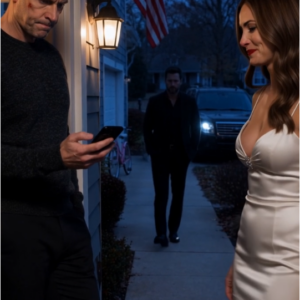
After spending three weeks in Seattle managing a construction project, I returned to my home in Columbus, Ohio, expecting nothing more than a hot shower and a peaceful evening.
Instead, I found a pickup truck blocking my driveway, unfamiliar furniture on my porch, and my younger brother, Brandon, sitting on my living room couch.
He was drinking my beer and watching my television.
“What the hell are you doing here?”
Brandon barely looked up.
“Welcome home, Derek.
Mom didn’t tell you?”
“Tell me what?”
“I’m moving in.”
I stared at him, waiting for him to laugh.
He didn’t.
Behind him, several cardboard boxes occupied the hallway.
My framed photographs had been removed from the walls, and someone had rearranged my furniture.
I hurried upstairs and discovered my clothes packed into garbage bags.
Brandon had taken over my master bedroom.
My hands began shaking.
“Who gave you permission to touch my belongings?”
“Relax.
You can use the guest room until you figure something out.”
“The guest room?
In my own house?”
Before he could answer, my mother, Linda, emerged from the kitchen carrying two coffee mugs.
“Oh, Derek.
You’re home early.”
“Mom, explain this.
Right now.”
She sighed as though I were deliberately making her afternoon difficult.
“Brandon needs somewhere stable.
His apartment was getting expensive, and he’s trying to start a business.”
“Then he can rent somewhere else.”
She placed the mugs on the counter.
“Let your brother have the place.
He’s building his future!”
I looked around the house I had purchased after twelve years of saving, working overtime, and sacrificing vacations.
Neither of them had contributed a single dollar.
“The only thing he built was a trespassing case!”
Brandon jumped to his feet.
“Watch your mouth!”
“No.
Both of you need to leave.”
Mom folded her arms.
“You’re thirty-six, unmarried, and constantly traveling.
Why do you need a four-bedroom house?”
“Because I paid for it.”
“Family shouldn’t be so selfish.”
I pulled out my phone.
“You have ten minutes to collect your things before I call the police.”
Brandon stepped toward me.
“You’re not kicking me out.
I live here now.”
“Since when?”
“Almost two weeks.”
My stomach tightened.
Before leaving for Seattle, I had given Mom a spare key to water my plants.
Apparently, she had interpreted that responsibility as permission to redistribute my property.
I called the police.
Mom immediately began screaming.
“You’re seriously calling the police on your own brother?”
“Yes.”
Brandon kicked one of his boxes across the hallway.
“You’re going to regret this!”
Two officers arrived twenty minutes later.
I showed them my identification, mortgage statement, and property records.
Brandon insisted he had permission to live there.
“From whom?” Officer Mitchell asked.
“My mother.”
“Does your mother own this property?”
Brandon hesitated.
Mom suddenly reached into her handbag.
“Actually, we have paperwork.”
She handed the officer a document.
It was a twelve-month residential lease naming Brandon as the tenant and me as the landlord.
The monthly rent was listed as one dollar.
At the bottom was a signature resembling mine.
I felt sick.
“I never signed that.”
Mom avoided my eyes.
Brandon smiled.
“Looks like you’re going to need a lawyer, big brother.”
The officers documented the situation but explained that the disputed lease complicated an immediate removal.
They advised me to seek legal assistance and provided a report number.
I photographed everything before leaving for a hotel.
That evening, I contacted my attorney, Rachel Bennett.
After examining the lease, she asked me to check my county’s online property records.
Minutes later, I discovered something that made my brother’s unauthorized move look almost insignificant.
Someone had recently recorded another document involving my house.
And my mother’s name was on it.
The following morning, I sat inside Rachel Bennett’s office, staring at a copy of a recently recorded quitclaim deed.
According to the document, I had transferred my house to my mother three days after leaving for Seattle.
The signature was supposedly mine.
“This is impossible,” I whispered.
Rachel examined the document carefully.
“Recording a deed doesn’t make a forged signature legitimate.
We need to establish exactly what happened.”
I showed her my airline receipts, hotel reservations, work schedules, and photographs proving I had been in Washington when the document was allegedly notarized in Ohio.
She immediately began preparing the necessary legal filings.
“Don’t confront them alone, Derek.
Preserve every message they send.”
My phone vibrated.
It was Brandon.
“Have you calmed down yet?”
“You forged my signature.”
“Don’t start making accusations.”
“There’s a deed transferring my house to Mom.”
Silence.
Then he laughed nervously.
“Talk to her.
That’s not my problem.”
He disconnected.
Rachel requested records from the notary identified on the deed and helped me report the suspected forgery to investigators.
Meanwhile, my mother began calling relatives.
According to her version, I had voluntarily promised Brandon the house before changing my mind.
My aunt Patricia called that afternoon.
“Your mother says you’re trying to make Brandon homeless.”
“He moved into my house without permission.”
“She said you signed everything.”
“She’s lying.”
Patricia went quiet.
Two hours later, Mom demanded that I meet her and Brandon at the house.
Rachel accompanied me.
When we arrived, Brandon was installing shelves in my garage.
Mom stood beside him.
“You’ve embarrassed this family enough.”
Rachel introduced herself.
“Mrs.
Collins, my client disputes both the lease and the recorded deed.”
Mom waved dismissively.
“This is a family arrangement.”
“Then why does the deed contain a signature he says he never provided?”
“He agreed verbally.”
“That doesn’t authorize anyone to sign his name.”
Brandon threw his screwdriver onto the workbench.
“He’s got money!
Why are you acting like we’re stealing his last dollar?”
“Because you’re stealing my house,” I answered.
Rachel handed them a formal demand to vacate and preserve all relevant documents.
Mom’s expression changed.
“You wouldn’t take your own mother to court.”
“You’re making that decision for me.”
We left without further argument.
The next day, Rachel received a response from the notary.
His official stamp had apparently been copied from an unrelated document.
He denied witnessing the transaction and agreed to cooperate with investigators.
The evidence was mounting.
Then Patricia called again.
“Derek, there’s something you need to know.
Brandon has been telling people he’s opening a renovation company.”
“I know.”
“No.
He’s been telling investors he owns your house.”
I immediately contacted Rachel.
She began investigating Brandon’s business activities while pursuing emergency court relief to protect my property.
That evening, a woman named Vanessa Reed contacted me.
She introduced herself as Brandon’s business partner.
“I think we’ve both been deceived.”
We arranged a meeting at Rachel’s office.
Vanessa arrived carrying a folder and looking terrified.
She explained that Brandon had promised to contribute a valuable residential property to their new company.
Then she handed Rachel a financing application.
My house was listed as collateral for a proposed $280,000 business loan.
But the most disturbing detail wasn’t the loan.
It was the person identified as the applicant.
My mother.
I stared at the financing application.
My mother hadn’t simply helped Brandon move into my house.
She had apparently attempted to use my property to finance his business.
Vanessa explained that Brandon had presented the recorded deed as proof that Linda owned the property.
“He told me your family had agreed to everything.”
“Nobody asked me.”
Her face turned pale.
“I already invested thirty-five thousand dollars of my savings.”
Rachel contacted the prospective lender immediately.
Fortunately, the loan had not closed.
The lender suspended the application pending its fraud investigation.
For the first time since returning from Seattle, I felt that I might actually regain control of my life.
Three days later, investigators interviewed my mother and brother separately.
Brandon claimed Mom had arranged the paperwork.
Mom insisted Brandon had convinced her that transferring the house was merely a temporary financial strategy.
Neither accepted responsibility.
Then Rachel obtained temporary court orders preventing further transfers or encumbrances while the ownership dispute proceeded.
Mom called me that evening.
“Derek, please.
They’re investigating us like criminals.”
“You forged my signature.”
“I was helping your brother!”
“With something that wasn’t yours.”
“We were going to put everything back once his business succeeded.”
“And if it failed?”
She had no answer.
A week later, we attended a hearing concerning the property.
Rachel presented my travel records, the disputed documents, the notary’s statement, and communications showing that I had never authorized the transfer.
Brandon’s attorney advised him against continuing to rely on the questionable lease.
Eventually, Brandon agreed to surrender possession rather than continue fighting over his occupancy.
My mother also agreed to cooperate in correcting the property records, although the criminal investigation remained separate.
When I finally returned home, the damage was worse than I remembered.
My bedroom furniture was scratched.
Several appliances were missing.
Brandon had painted the garage without permission and damaged the flooring while moving equipment.
He stood beside his truck as movers loaded his belongings.
“You happy now?” he asked.
“I’m relieved.”
“You destroyed my business before it even started.”
“No, Brandon.
You tried to start a business with someone else’s property.”
He slammed the truck door.
“Mom was right about you.
You’ve always thought you’re better than everyone.”
“I never thought that.
I just learned how to pay for my own life.”
He drove away without another word.
Over the following months, Vanessa pursued the recovery of her investment.
Investigators uncovered messages between Brandon and Mom discussing the unauthorized paperwork before my departure.
Both eventually faced criminal charges related to the fraudulent documents.
Through separate plea agreements, they received probation, financial penalties, and restitution obligations.
My property records were corrected through the legal proceedings.
I changed every lock, installed security cameras, and repaired the damage.
Six months later, Mom appeared outside my front door.
She looked exhausted.
“Brandon won’t speak to me anymore.”
I remained on the porch.
“What happened?”
“He says everything was my fault.”
I almost laughed at the irony.
“That’s what you both said about me.”
Her eyes filled with tears.
“I’m your mother, Derek.”
“And I was your son when you decided my future mattered less than his.”
She lowered her head.
“Can you ever forgive me?”
“Maybe someday.
But forgiveness doesn’t mean giving you another key.”
She nodded slowly and walked back to her car.
That evening, I sat in my living room, surrounded by the furniture I had chosen and the photographs I had returned to their rightful places.
For years, my family had treated my independence as a resource they were entitled to exploit.
They believed Brandon deserved a future simply because he wanted one.
They never considered how much work I had put into building mine.
I wasn’t celebrating their punishment.
I was celebrating the fact that I no longer needed their approval to protect myself.
My brother wanted my house to become the foundation of his future.
Instead, it became the place where his lies finally caught up with him.
And this time, nobody else was going to pay for his mistakes.