PART 1: THE MAN WHO TOOK THE NOTE
“She’s yours. My debt is paid.”
My uncle shouted those words loudly enough for half of Caldwell’s stockyard to hear.
Then he shoved me toward a stranger.
I was twenty-two years old.
Old enough to understand exactly what Clement Briggs believed he was doing.
Old enough to know that nobody standing beneath the stockyard awning intended to stop him.
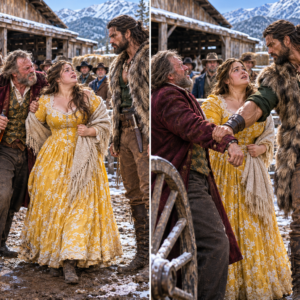
Caldwell smelled of wet hay, cattle, mud, and whiskey that November morning. Rain had turned the yard into a brown swamp, and every wagon wheel passing the freight office cut another rut through the ground.
I stood in the middle of it with Clement’s fingerprints already darkening my upper arm.
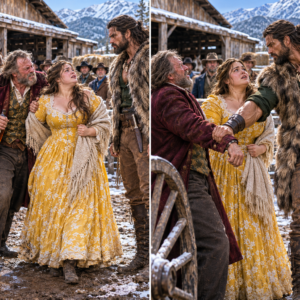
The man in front of us was the largest man I had ever seen.
Garrett Hayne stood nearly six and a half feet tall.
A wolf-fur coat covered broad shoulders. Dark hair, wind-tangled and damp, fell across his forehead. His face was weathered in the way of men who spent more days beneath open sky than under roofs.
His eyes were pale gray.
They moved once over me.
Not in the way men in saloons sometimes looked at women.
He looked at my boots.
The hem of my worn dress.
The bruising around my wrists.
Then he looked at Clement.
My uncle thrust a folded paper toward him.
“There. Take it.”
I knew that paper.
I had written the original figures myself.
Not because the debt belonged to me.
Because for two years I had kept Clement’s freight accounts.
My uncle could drive a six-horse team over a mountain road in darkness without losing a wheel, but after three drinks he could not add twelve and eight without making twenty-three.
So I kept his books.
I balanced invoices.
Recorded freight payments.
Copied route charges.
Found missing numbers.
Corrected the mistakes he made when drunk.
For the first year, the business survived.
For the next six months, Clement’s debts grew steadily.
I asked why.
He slapped me.
After that, I stopped asking.
That morning I finally understood his solution.
Me.
“Go on,” Clement snapped. “Get in his wagon.”
I did not cry.
I had learned before I was sixteen that tears made Clement angrier.
Garrett opened the paper.
He read every line.
Clement shifted impatiently.
“She’s useful,” he said. “Cooks. Scrubs. Keeps books better than a clerk. Won’t give you trouble.”
My stomach turned.
Garrett kept reading.
Clement laughed.
“Strong enough too. Not much to look at, maybe, but she works.”
Garrett’s eyes lifted.
The laughter died in Clement’s throat.
He folded the note once.
Then he slipped it inside his coat.
“We’re finished,” he said.
Clement grinned.
“No bringing her back.”
“I wasn’t planning to.”
Something about the answer frightened me more than anger would have.
Clement grabbed my shoulder and shoved.
I stumbled sideways and struck the wagon wheel with both hands.
Before I had fully straightened, Garrett moved.
His hand closed around Clement’s wrist.
He did not twist it.
Did not raise his voice.
He simply held it.
“Don’t touch her again.”
Clement stared at him.
Garrett’s voice had been quiet.
That made it worse.
“I was only getting her moving.”
“Then use words.”
“She belongs—”
Garrett’s grip tightened slightly.
Clement stopped.
For one strange second I thought my uncle might swing at him.
Then common sense returned.
Garrett was a full head taller and nearly twice as broad.
Clement yanked his wrist free.
“Fine.”
He glared at me.
“Good riddance.”
Then he walked toward the saloon.
No goodbye.
No warning.
No apology.
Fourteen years under his roof ended with his boots disappearing through a tavern door.
I climbed into Garrett Hayne’s wagon without being told again.
For the first two hours, neither of us spoke.
Caldwell disappeared behind low hills.
The road narrowed.
Mud hardened into frozen ruts as we climbed toward darker timber.
I kept both hands tucked inside my shawl.
Not because of the cold.
I was measuring possibilities.
Distance to the ground.
Speed of the team.
Thickness of the woods.
How badly I might be hurt if I jumped while the wagon was moving.
Whether I could outrun the horses if Garrett stopped.
Whether there were farms close enough for me to reach before dark.
There were not.
Garrett noticed me watching the road.
He said nothing.
A mile later he reached behind the seat, pulled out a folded wool blanket, and handed it toward me.
“Snow’ll get worse uphill.”
I stared at it.
“Take it.”
Every kindness I had ever received from Clement came with a price hidden behind it.
A new dress meant three nights copying accounts.
Medicine meant being reminded for months how much I cost.
A hot meal after a beating meant I was expected to forgive him before the bruises faded.
I did not trust gifts.
“What do you expect from me?”
Garrett kept his eyes on the horses.
“We’ll talk when we get there.”
“That isn’t an answer.”
“No.”
I waited.
He did not explain.
Finally the cold won.
I took the blanket.
“Thank you.”
He nodded once.
That was all.
By late afternoon, the road began climbing sharply.
The first snow appeared between the trees.
Then more.
Pines towered on either side of us, black and green against a sky turning white.
We crossed a narrow creek on a timber bridge and climbed onto a wooded plateau beneath a granite ridge.
A cabin appeared.
Not the shack I had imagined.
A real house.
Solid logs.
Stone chimney.
Wide porch.
A barn stood behind it, along with a chicken coop, smokehouse, and enough stacked firewood to survive a hard winter.
The front door opened before the horses stopped.
Four children came onto the porch.
I forgot my fear for a moment.
The oldest was a girl around twelve with dark braids and a face too serious for childhood.
Beside her stood a boy perhaps ten.
Another girl, maybe seven, held the hand of a small blond boy no older than four.
The oldest girl immediately pulled the youngest behind her.
All four stared at me.
Garrett climbed down.
“Inside.”
Nobody argued.
The children vanished through the door.
I remained beside the wagon.
Garrett began unloading sacks of flour.
“You didn’t tell me there were children.”
“No.”
“Are they yours?”
His hands stopped.
“My sister’s.”
“Where is she?”
He looked toward the house.
“Buried last spring.”
The anger I had been preparing lost some of its strength.
“What about their father?”
“Been gone three years.”
“Dead?”
“Probably.”
That was not the answer I expected.
Garrett lifted two sacks onto his shoulder.
I followed him inside.
The cabin smelled of smoke, damp wool, and something thin simmering on the stove.
Four mismatched bowls sat on the table.
The pot contained broth with a few beans floating in it.
Not enough for five people.
Certainly not enough for six.
The smallest boy stared at me.
His eyes were enormous.
“Are you staying?”
The oldest girl grabbed his arm.
“Finn.”
“What?”
“Don’t bother her.”
“I’m not bothered.”
She looked surprised that I had answered.
Garrett carried the flour to a pantry.
The other children continued watching.
He pointed quietly.
“Ruth is twelve. Caleb’s ten. Anna is seven. Finn is four.”
Ruth lifted her chin.
“We know our names.”
Something almost like amusement appeared in Garrett’s face.
“I was telling her.”
“I can introduce us.”
“Then do that.”
Ruth frowned.
Garrett went back outside.
I liked him slightly better for not correcting her.
Ruth looked at me.
“I’m Ruth.”
“I gathered.”
Caleb almost smiled.
Anna hid hers.
Finn did not bother.
“I’m Finn.”
“Yes.”
“I like potatoes.”
“Good to know.”
“We don’t have any.”
I looked toward the pantry.
“We do now.”
His face brightened.
Something inside me shifted.
Only slightly.
Garrett returned with salt and another sack.
I waited until the children moved away.
Then I spoke quietly.
“What exactly did my uncle tell you?”
“That he owed me money.”
“He owes half of Caldwell money.”
“He owed me for freight.”
“How much?”
Garrett named a figure.
My stomach dropped.
“That is more than the note he showed me last month.”
“Probably.”
I stared at him.
“You knew?”
“I knew his figures changed.”
“Then why deal with him?”
“Because he was carrying freight I had already paid to receive.”
That sounded wrong.
“How can you owe somebody for freight he failed to deliver?”
“I don’t.”
I looked at him sharply.
He washed his hands in a basin.
Then he reached inside his coat and removed the folded paper.
He set it on the table.
“Read it.”
“I already know what it says.”
“Read this version.”
I unfolded it.
The first lines were familiar.
Clement Briggs acknowledged a debt to Garrett Hayne for freight paid but never delivered.
Then came another paragraph.
My stomach tightened.
In exchange for temporary domestic and bookkeeping service—
I stopped.
“That wasn’t there before.”
“I figured.”
I kept reading.
Clement had pledged my labor against his debt.
Six months of it.
My signature line was blank.
“He expected you to make me sign.”
“Yes.”
“Were you going to?”
“No.”
“Then why take the paper?”
Garrett sat across from me.
“Because if I left you in Caldwell, he would have handed you to the next creditor.”
I stared.
“You don’t know that.”
“I heard him offer.”
The room seemed to tilt slightly.
“To who?”
“Stock buyer from Laramie yesterday.”
My fingers tightened around the paper.
“He said—”
Garrett stopped.
“What?”
“It doesn’t matter.”
“Tell me.”
He looked directly at me.
“Said a woman who could keep accounts was worth more than a team of mules if a man didn’t mind teaching her obedience.”
I could not breathe for a moment.
Clement had beaten me.
Worked me.
Used my wages.
But some small part of me had still believed there was a line even he would not cross.
There was not.
I looked at the debt paper again.
“You still let him think I paid you.”
“Yes.”
“Why?”
“Because I needed you out of that yard before he changed his mind.”
“You could have told me.”
“Not with him standing there.”
“You could have told me in the wagon.”
“Yes.”
“Why didn’t you?”
Garrett looked toward the children.
“I handled it badly.”
That was so unexpected I did not know what to say.
Men like Clement never admitted mistakes.
They explained them until they became someone else’s fault.
Garrett did not.
He simply said, “I handled it badly.”
I touched the paper.
“Am I free to leave?”
“Yes.”
“Now?”
“If you want.”
I looked through the window.
Snow was coming down harder.
The road we had climbed was already disappearing.
“Where?”
He did not pretend not to understand.
“Caldwell is twelve miles.”
“So freedom means I can freeze on the road if I choose?”
His jaw tightened.
“No.”
“It sounds like that.”
“You can stay until weather clears.”
“And after?”
“You decide.”
“As what?”
“Not payment.”
The words came quickly.
“Then what?”
He leaned back.
“I need help with accounts.”
I laughed once.
Of course.
“You brought me here to work.”
“Yes.”
“At least that part is true.”
“Yes.”
“For wages?”
“Yes.”
“How much?”
He named an amount.
It was more money than Clement had ever allowed me to keep in a month.
I narrowed my eyes.
“You expect me to believe that?”
“You can ask the storekeeper in Caldwell what I pay hired men.”
“I’m not a hired man.”
“No.”
“What else?”
“Children need meals.”
“There it is.”
“What?”
“You bought yourself a housekeeper.”
“No.”
“You just listed cooking.”
“I listed a problem.”
“That is not the same thing?”
“No.”
He pointed toward the thin broth.
“I can hunt. Repair fence. Cut timber. Keep cattle alive. I can make food edible if nobody is particular.”
From across the room, Ruth muttered, “That is generous.”
Caleb coughed to hide a laugh.
Garrett ignored them.
“I don’t know what four children need.”
Ruth folded her arms.
“We need less burnt bread.”
“That too.”
Despite myself, I smiled.
Garrett saw it.
He did not mention it.
“You can eat first,” he said. “Then decide.”
I looked at the potatoes.
Then at Finn.
He was still staring at them.
I took off my shawl.
“Where’s your peeling knife?”
Ruth brought one immediately.
I found onions.
A little bacon.
Flour.
Within an hour, the thin broth became thick potato soup.
I made quick bread in the iron pan.
Finn ate two bowls.
Anna ate one and a half.
Caleb tried to pretend he was not hungry and failed.
Ruth waited until the others were served before filling her own bowl.
I noticed.
Older children learn sacrifice too early when adults fail them.
After supper, Finn fell asleep against Ruth’s shoulder.
Anna curled beside the stove.
Caleb was mending a wooden toy horse.
For the first time since leaving Caldwell, something in my chest loosened.
Then Ruth whispered, “Finn ate more tonight.”
“He was hungry.”
“He’s been scared.”
“Of me?”
Her eyes darted toward Garrett, who had gone to the barn.
“No.”
“Then what?”
She pulled Finn closer.
“The men.”
“What men?”
“The ones who said we don’t belong here.”
I set down the towel in my hands.
“Who told you that?”
Ruth looked toward the window.
Then toward a locked wooden chest beneath it.
She said nothing.
Garrett came in several minutes later carrying a leather folder.
His face had changed.
Whatever peace supper had brought disappeared.
“Ruth says you’re good with numbers.”
“She exaggerates.”
“No, she doesn’t,” Ruth said.
Garrett placed the folder on the table.
“Then I need you to look at something.”
Inside were freight receipts.
A property survey.
A creditor’s statement.
And a petition asking the county to remove all four children from the homestead until their mother’s estate was settled.
The hearing was scheduled for the following morning.
My anger returned.
“Who filed this?”
“A freight broker named Silas Vane.”
The name was familiar.
I searched my memory.
Clement had done business with him.
More than once.
“What does he claim?”
“That my sister Miriam owed him for equipment.”
“How much?”
Garrett showed me.
I nearly laughed.
Then I saw the property pledged beneath the amount.
The entire homestead.
“If the debt is valid?”
“He gets a lien.”
“And the children?”
“County says they can’t remain on disputed property without a legal guardian recognized by the estate.”
“Aren’t you their uncle?”
“I arrived after Miriam died. Guardianship paperwork is still pending.”
Convenient.
Far too convenient.
I spread the invoices across the table.
Numbers calmed me.
They always had.
People lied.
Columns did not, unless someone forced them.
Three freight charges appeared for the same shipment.
One route fee had been entered twice.
Another charge had been added after the original total.
The tricks were familiar.
Too familiar.
I pointed.
“This one is false.”
Garrett leaned closer.
“How do you know?”
“The route from Casper to this ridge doesn’t go through Caldwell.”
“What if it came from the south?”
“Then this bridge toll wouldn’t appear.”
I found another entry.
“And nobody pays three unloading fees on one wagon.”
I turned the page.
My pulse changed.
“Miriam died when?”
“March twenty-eighth.”
I looked again.
“Then she didn’t order this.”
“What?”
“This invoice is dated August seventeenth.”
Garrett stared.
“It says the order was confirmed by her.”
“A dead woman cannot confirm freight five months after burial.”
Ruth had come closer.
Her face turned white.
Garrett picked up the sheet.
“Maybe it was an older order invoiced late.”
“It could be.”
I examined the delivery address.
Then I stopped.
“No.”
“What?”
“This wasn’t delivered here.”
The address listed a warehouse number in Caldwell.
I knew it.
Clement had rented the rear half of that warehouse the previous winter.
“This equipment went to my uncle’s yard.”
Garrett’s face became still.
I continued scanning.
A freight notation in the margin made my stomach twist.
C.B.-17.
Clement Briggs used the same private route code in his ledgers.
He said it helped him remember clients.
I had written it hundreds of times.
“Garrett.”
“What?”
“I think Clement handled this shipment.”
His eyes hardened.
“Can you prove it?”
“I don’t know.”
I turned to the final page.
A sworn statement declared that the charges were accurate and had been reconciled against the original Briggs Freight ledger.
Below it was a signature.
Mine.
LEORA BRIGGS.
For several seconds I forgot how to breathe.
The letters were almost perfect.
Even the little downward hook at the end of the final s.
Something Clement used to complain about.
Said my signature looked like a fishhook.
“I never signed this.”
Garrett leaned over the page.
“You’re sure?”
I looked at him.
“Yes.”
He nodded immediately.
No suspicion.
No hesitation.
That frightened me in another way.
I was not used to being believed so quickly.
“Someone copied it.”
I touched the paper.
“From what?”
Then I remembered.
Clement kept paid receipts.
Many carried my signature as bookkeeper.
There were hundreds to copy from.
Before I could say more, a dog began barking outside.
Not one warning bark.
A frenzy.
Ruth grabbed Finn.
Anna ran to Garrett.
Caleb moved toward the window.
Garrett caught his shoulder.
“Back.”
Wagon wheels crunched through the frozen yard.
Garrett reached for the rifle above the fireplace.
I looked through the glass.
A county wagon stopped near the porch.
Two men climbed down.
One wore a deputy’s badge.
The other carried a document case.
Then a third man stepped from behind them.
Uncle Clement.
He looked directly at the window.
At me.
And smiled.
In his hand was another folded paper.
Even through the glass, I could see a signature near the bottom.
Mine.