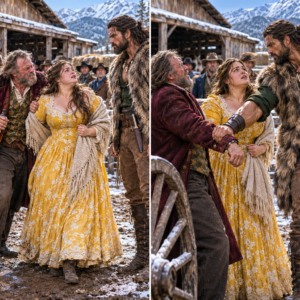
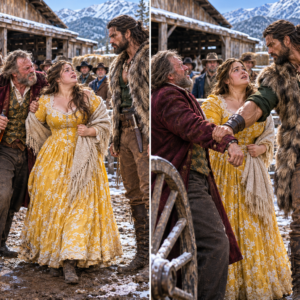
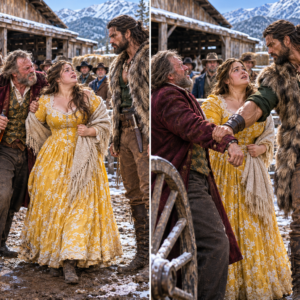
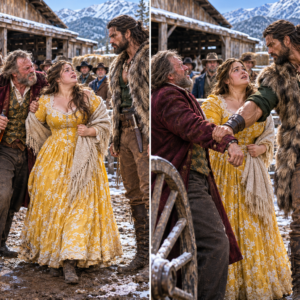
PART 5: THE WOMAN WHO CHOSE TO STAY
The first night back at the cabin, nobody slept normally.
Finn insisted on lying near the fire.
Anna climbed into Ruth’s bed.
Caleb checked the door latch three times.
Ruth placed Miriam’s red ledger beneath her pillow.
Garrett did not tell her that was unnecessary.
I understood why.
Safety is not something frightened people believe simply because adults announce it.
It has to become repetitive.
Morning after morning.
Door locked.
Breakfast warm.
Same faces.
No wagons arriving to take anyone away.
No uncle shouting ownership across a muddy yard.
No county paper changing everything before supper.
Safety is learned slowly.
So was freedom.
The next morning I woke before daylight.
For several minutes I did not know where I was.
Then I heard Finn snoring in the loft.
The stove had gone low.
Wind moved through the pines.
I lay beneath a quilt in the small downstairs room Garrett had given me.
My room.
He had used that phrase.
Not servant room.
Not spare cot.
Yours while you want it.
I stared at the ceiling.
While you want it.
Nobody had ever placed time in my hands before.
At Clement’s house, leaving was betrayal.
Staying was obligation.
Working was repayment.
Eating created debt.
Everything had a hook.
Garrett’s offer frightened me because I could not find one.
After breakfast he brought the debt paper to the table.
The original note.
Clement’s debt.
My pledged labor.
The paper that had started everything.
He placed it in front of me.
“What do you want done with this?”
I stared.
“It belongs to you.”
“No.”
“He owed you money.”
“He still does.”
“Then keep it.”
“Not this version.”
I touched the paragraph assigning my service.
“What are you asking?”
“I’m asking what you want.”
Again.
Choice.
I hated how difficult it was.
“Burn it.”
Garrett pushed the paper toward me.
“You burn it.”
I looked at the stove.
Then at him.
“You could use it against Clement.”
“I have legitimate freight receipts for that.”
“So this one means nothing?”
“It means something to you.”
He was right.
I carried the paper to the stove.
Held it over the flame.
For a second I could not let go.
My name was not signed.
Still, the words seemed heavy.
Six months domestic and bookkeeping service.
As though six months of my life had a price.
As though Clement could hand those months away.
I lowered the corner.
Fire caught.
The paper curled.
Blackened.
The paragraph disappeared first.
Then Clement’s name.
Then Garrett’s.
I watched until nothing remained but ash.
Ruth stood behind me.
I had not heard her enter.
“Was that important?”
“Yes.”
“Then why burn it?”
“Because some important things need to disappear.”
She thought about that.
Then nodded as though twelve-year-olds understood more than grown people.
Maybe they do.
The investigation in Caldwell lasted through winter.
Deputy Reed came twice for statements.
Commissioner Hollis approved Garrett’s guardianship before Christmas.
Silas Vane’s false claim collapsed completely.
Records from warehouse four proved the mining equipment had been delivered there and later resold to a rail subcontractor.
Miriam’s estate had been used to hide a second charge.
Not the only one.
Clement’s private list led investigators to other accounts.
A dead rancher.
An elderly widow.
A freight company that had closed the year before.
People who were unlikely to challenge paperwork.
People whose records were easy to bury beneath newer numbers.
I had corrected some of those accounts without knowing what I was correcting.
That knowledge haunted me.
For weeks I woke remembering figures.
A doubled fee.
A changed date.
A missing receipt.
I would sit at the kitchen table with my heart pounding and wonder how many people had been harmed while I sharpened pencils and balanced columns.
One night Garrett found me there.
Snow covered the windows.
Everyone else slept.
I had three old account lists spread in front of me.
“What are you doing?”
“Remembering.”
“At midnight?”
“I can’t stop.”
He sat across from me.
I looked down.
“I should have known.”
“No.”
“I saw the figures.”
“You saw mistakes.”
“I knew Clement lied.”
“You knew he drank.”
“I knew he hid things.”
“You were afraid of him.”
“That doesn’t make me innocent.”
Garrett was quiet.
I hated him for not immediately disagreeing.
Then he said, “Innocent of what?”
I looked up.
“Helping.”
“Did you knowingly forge anything?”
“No.”
“Take stolen money?”
“No.”
“Help Vane bill Miriam?”
“No.”
“Then what did you do?”
“I corrected numbers.”
“Because Clement told you mistakes were yours.”
“Yes.”
“Did he hit you when you asked questions?”
My throat tightened.
“Yes.”
Garrett leaned back.
“Then maybe stop holding the prisoner responsible because she learned how to keep the cell clean.”
I stared at him.
I had expected comfort.
Instead he gave me something better.
A different way to understand what had happened.
“I wasn’t a prisoner.”
He looked at my wrists.
The bruises had faded.
I followed his eyes.
“Yes,” I whispered.
“Maybe I was.”
Neither of us spoke for a while.
Then he gathered the papers.
“You need sleep.”
“You’re ordering me?”
“No.”
“Sounded like it.”
“I’m suggesting.”
“You suggest like a man moving cattle.”
“I have more practice with cattle.”
That made me laugh.
Quietly.
He smiled.
It transformed his face.
Garrett did not smile often.
When he did, he looked younger.
Less like the mountain had carved him from something hard.
I began noticing those things.
I did not want to.
Not at first.
Dependence frightened me.
Kindness frightened me more.
Garrett never entered my room without knocking.
Never touched me unexpectedly.
Never asked where I went when I walked alone through the trees.
Never demanded gratitude.
He paid me every Saturday.
Actual wages.
The first time he placed coins on the table, I stared.
“For what?”
He looked confused.
“Work.”
“You bought flour.”
“Yes.”
“I ate some.”
“Yes.”
“So deduct food.”
“No.”
“Why?”
“Because employees eat here.”
“Employees?”
“You wanted a word.”
I looked at the money.
“What if I don’t do enough?”
“Then I’ll tell you.”
“What if I leave?”
“Then you leave.”
“What if—”
“Leora.”
I stopped.
“You don’t have to earn permission to exist in this house.”
My eyes burned.
I hated that.
I turned away.
“Your soup needs salt.”
“It probably does.”
“You made it?”
“Yes.”
“Then it definitely does.”
He let me change the subject.
That kindness mattered too.
The children changed as winter deepened.
Finn stopped asking when men were coming.
Anna began singing while she swept.
Caleb started laughing loudly again.
Ruth stopped sleeping with Miriam’s ledger beneath her pillow.
One morning she placed it on the shelf beside my account books.
I did not mention it.
Trust should sometimes be allowed to happen without applause.
We worked together.
I organized Garrett’s freight and ranch accounts.
Found two suppliers overcharging him.
He was offended.
“At the prices?”
“At myself.”
“You cannot punch arithmetic.”
“Pity.”
I began teaching Ruth bookkeeping.
She was better than Clement within three weeks.
Caleb wanted to learn route maps.
Anna learned to make biscuits.
Finn remained devoted to potatoes.
The cabin became louder.
Messier.
Warmer.
In January a letter arrived from Deputy Reed.
Clement had admitted enough of the freight manipulation to implicate Vane.
Not because conscience awakened.
Because Vane blamed everything on him.
Clement chose self-preservation.
That was the uncle I knew.
The letter asked whether I wished to submit a further statement concerning his treatment of me.
I held the page for an hour.
Then wrote yes.
My hand shook.
I wrote anyway.
Not because bruises needed a court to become real.
Because silence had protected him too long.
I described the beatings.
The withheld wages.
The threats.
His attempt to pledge my labor.
The stock buyer Garrett had overheard.
I signed my name.
Slowly.
LEORA BRIGGS.
My real signature.
The downward hook on the final s.
For months, seeing my name on paper had made me sick because Clement had stolen even that.
That afternoon I looked at the signature and felt something return to me.
Mine.
By February, the road opened often enough for regular freight again.
One Saturday I went to Caldwell alone.
Garrett objected.
Not because he believed I needed permission.
Because snow was forecast.
I went anyway.
The town looked smaller.
Clement’s freight office was closed.
A notice covered the door.
PROPERTY UNDER COUNTY HOLD.
I stood in the mud where he had shoved me months earlier.
Nobody noticed.
Stockmen shouted.
Cattle moved.
Men carried crates.
Life continued.
I realized I had expected some grand feeling.
Triumph.
Revenge.
Instead I felt tired.
Then relieved.
A woman from the general store recognized me.
“Miss Briggs?”
“Yes.”
“I heard you’re keeping Hayne’s accounts.”
“I am.”
“They say you caught the freight fraud.”
“Paper caught it.”
She smiled.
“Paper doesn’t read itself.”
I carried that sentence home.
Spring came late.
Snow retreated from the ridge.
The children ran outside without coats.
Garrett repaired fence.
I planted onions with Anna and Finn.
Ruth began keeping egg accounts.
Caleb learned to harness the team.
One evening I stood on the porch watching all of them.
Garrett came beside me.
“You’ve been quiet.”
“I’m thinking.”
“Dangerous.”
“I’ve been told.”
He leaned on the rail.
“What about?”
I looked toward the road.
It was open now.
Completely.
Caldwell was reachable.
So were other towns.
I had money saved.
Enough to rent a room.
Enough to find bookkeeping work.
For months I had told myself I stayed because winter trapped us.
Then because the hearing continued.
Then because the children needed stability.
Then because Garrett needed accounts organized.
Every reason had expired.
I was still there.
“I can leave now.”
Garrett became very still.
“Yes.”
No protest.
No guilt.
That hurt strangely.
“You knew?”
“Road’s been open two weeks.”
“You counted?”
“Yes.”
I laughed softly.
“Of course you did.”
He looked toward the yard.
“Do you want to?”
I searched for the answer.
Not the safe answer.
Not the answer someone expected.
Mine.
“I don’t know.”
He nodded.
That irritated me.
“Is that all?”
“What do you want me to say?”
“I don’t know.”
“Then we’re even.”
I turned toward him.
“Would you care?”
His eyes met mine.
“Yes.”
One word.
No hesitation.
My heart beat differently.
“But I won’t make caring another rope around you.”
I could not speak.
He continued.
“You were handed to me once.”
His voice lowered.
“I will never ask you to stay in a way that feels like that.”
Something inside me broke gently.
Not painfully.
Like ice releasing a river.
“What if I want to stay?”
His face changed.
“For the children?”
“Yes.”
A pause.
“For the work?”
“Yes.”
Another pause.
“For anything else?”
Heat rose into my face.
Garrett looked away first.
That helped.
I smiled.
“Maybe.”
He nodded.
“Maybe’s enough.”
It was the kindest answer he could have given.
No demand.
No claim.
Room.
That evening Ruth cornered me in the pantry.
“Are you leaving?”
I stared.
“How do you children hear everything?”
“Garrett talks loud.”
“He absolutely does not.”
“He looks loud.”
I laughed.
She did not.
“Are you?”
I looked at her serious face.
“I don’t think so.”
Her shoulders dropped.
Then she threw her arms around me.
Twelve years old again.
Just for a second.
“Good.”
When she let go, she wiped her eyes angrily.
“Finn would be upset.”
“Of course.”
“And Anna.”
“Yes.”
“Caleb too.”
“Naturally.”
She looked at me.
“And me.”
My throat tightened.
“I know.”
That night I understood the title Clement had tried to write over my life.
Debt.
Payment.
Property.
He believed people belonged to whoever had spent the most money on them.
Garrett believed the opposite.
The children did too.
Love, if that was what was growing in that cabin, was not ownership.
It was freedom made less lonely.
Summer came.
The north parcel remained part of the Hayne homestead.
No false lien touched it again.
Garrett hired two men to cut limited timber under a proper contract, and for the first time the children’s estate produced enough income to guarantee schooling and repairs.
Ruth insisted on checking my arithmetic.
She found one mistake.
I never heard the end of it.
Deputy Reed wrote that Clement and Vane would face trial on fraud and forgery charges.
I did not attend.
My statement was enough.
I had spent too much of my life arranging myself around Clement’s actions.
Justice did not require me to keep doing it.
One evening Garrett brought a small wooden box onto the porch.
My heart nearly stopped.
“Don’t panic.”
“That is what men say immediately before giving women reasons to panic.”
“It’s not a ring.”
I exhaled.
Then wondered why I felt disappointed.
He opened the box.
Inside was a brass nameplate.
LEORA BRIGGS
ACCOUNTS & FREIGHT
I stared.
“What is this?”
“For the desk.”
“What desk?”
He pointed toward the small room beside the pantry.
During spring he had rebuilt it.
I thought it was storage.
He opened the door.
Inside stood a proper desk beneath the window.
Shelves.
Ledger rack.
Lockbox.
A chair that actually fit me.
And on the desk, six blank account books.
I could not move.
Garrett stood behind me.
“You need somewhere that belongs to your work.”
I touched the desk.
“Your accounts?”
“Ours, if you want.”
I turned.
“What does that mean?”
“You run the books. Negotiate freight contracts. Take outside clients if you want.”
“You’re offering partnership?”
“Yes.”
“Why?”
“Because you’re better at it.”
“That has never bothered a man before?”
“It bothers me constantly.”
I laughed.
He smiled.
Then became serious.
“And because I don’t ever want you wondering whether you’re here because you owe me.”
My eyes filled.
“You do realize making me cry is a poor business strategy.”
“I’m learning.”
I looked again at the brass plate.
My name.
Not forged.
Not assigned.
Not beneath Clement’s.
Mine.
I turned back to Garrett.
“There is one problem.”
“What?”
“Accounts and freight?”
“Yes.”
“Boring.”
He frowned.
“What would you call it?”
I thought.
“HAYNE & BRIGGS.”
His expression changed.
“You sure?”
“Yes.”
“That sounds permanent.”
I looked through the window.
Ruth was chasing Finn.
Anna carried eggs.
Caleb was repairing a gate badly and confidently.
Beyond them stood the ridge Clement and Vane had tried to steal.
The road to Caldwell lay open beyond the trees.
I could leave.
That was what made the answer matter.
“Yes,” I said.
“Permanent sounds all right.”
Garrett took one step closer.
Slowly.
“Leora.”
“Yes?”
“Anything else you want to make permanent?”
My heart pounded.
I could have pretended not to understand.
Instead I smiled.
“Maybe.”
He laughed.
I had never heard the full sound before.
Warm.
Deep.
Uncertain.
He held out his hand.
Not grabbing.
Not claiming.
Offering.
I placed mine in it.
Months earlier, Clement had shoved me toward this man and shouted, “She’s yours.”
He had been wrong in every possible way.
I was never Garrett Hayne’s.
I was never Clement Briggs’s.
I was not payment.
Not debt.
Not property.
I belonged to myself.
That was why, when Garrett later asked whether he might court me properly, I could say yes without fear.
And when Ruth eventually asked whether I would still live with them even if I never married her uncle, I could tell her the truth.
“Yes.”
Because the children had stopped being a reason I was trapped.
They had become part of the life I chose.
Years later, I would still remember that first day.
The mud.
The cattle.
Clement’s hand on my shoulder.
The debt paper.
Garrett’s gray eyes.
The wagon climbing toward snow.
I had believed I was being delivered into another prison.
Instead I found four frightened children guarding a locked chest.
A dead woman’s ledger.
A quiet man who admitted when he was wrong.
And a table where nobody counted the cost of my supper against the value of my life.
Clement thought his debt was paid when he shoved me toward that wagon.
He never understood that the debt had never been mine.
What I owed him was nothing.
What I owed Garrett was nothing.
What I gave the children was not payment.
And what they gave me could never be entered in any ledger.
They gave me a reason to use what I knew instead of being ashamed of it.
They gave me people worth standing beside.
Garrett gave me choices and did not punish me for making them.
And I gave myself something no one had ever thought to offer.
Permission to stay.
Not because I could not leave.
Because I could.
That was the difference.
That was freedom.
And for the first time in my life, home was not the place where somebody had the power to keep me.
It was the place I chose to return to.
THE END