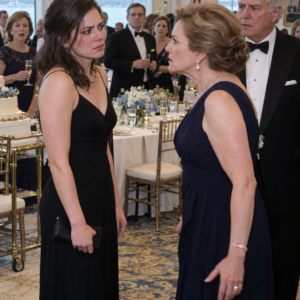
Richard reached us before I could answer.
He asked my name, and when I said Ethan Cole, his expression changed just enough for me to notice.
Madeleine asked again about Marcus, but her father ordered the conversation to end and reminded her that the gala wasn’t the place for a scene.
I told her I was sorry for disturbing the evening and carried Sophie toward the exit.
Madeleine called after me once more, but I couldn’t explain sixteen years of friendship and seven years of damage while my daughter was falling asleep against my shoulder.
I went home feeling as though I’d opened a door I had spent years holding shut.
The next morning Madeleine confronted Richard, as I later learned from her.
He admitted that a pianist named Ethan Coltrane had been badly injured at a Sterling charity gala seven years earlier.
He described it as an unfortunate accident and told her to forget the maintenance worker and the song.
She didn’t.
Claire located the old articles, the settlement papers, and the records of the failed lighting rig.
Before the accident, I had studied at Juilliard, won a major competition, and been offered the sort of career young musicians hardly dare describe aloud.
A twelve-hundred-pound lighting assembly had fallen during my performance of Rachmaninoff’s Third Piano Concerto.
It crushed my right hand and left nerve damage that repeated surgeries couldn’t repair.
Sterling’s lawyers fought my claim until I accepted a small settlement to pay the bills, along with restrictions that made speaking about the accident and rebuilding a professional career difficult.
My wife, Jennifer, had been pregnant with Sophie then.
She had delayed aggressive treatment for breast cancer during the pregnancy, and four years before the gala, she died.
I had changed my surname from Coltrane to Cole and taken steady maintenance work because my daughter needed a home, a father, and health insurance more than she needed a story about what I used to be.
On the day after Christmas, Madeleine came to our apartment in Astoria.
I nearly didn’t let her in, but Sophie recognized the woman who’d let her see the tree and greeted her as though she were a visiting princess.
Madeleine sat at our small kitchen table while I made tea in mismatched mugs.
She apologized for what her company had done.
I told her she hadn’t been in charge then, and that an apology from a stranger couldn’t give me back the use of my hand.
She didn’t argue or offer me money; she asked whether I could tell her about Marcus.
I finally told her the part I had kept hidden.
Marcus Chen had been my closest friend, the person who understood what music meant to me before anyone else did.
He’d been writing a piece for a young woman he loved, and he’d asked me to help him work through passages he couldn’t quite hear yet.
That young woman was Madeleine.
Marcus had died in a crash involving a drunk driver before he could finish the piece, and I’d kept his sketches and the fragments we had played together.
After my own accident, I began filling in the missing sections slowly, one phrase at a time, until the melody became the lullaby I played for Sophie.
Madeleine sat with her hands around the untouched tea.
She told me she’d met Marcus at Columbia, when she was nineteen, and that she had spent years believing his unfinished song had vanished with him.
I could see that hearing it again had brought back both the boy she loved and the person she’d been before grief hardened her.
Sophie invited her to stay for lunch, and Madeleine accepted.
We crowded around a table built for two while my daughter talked about school and asked why grown-ups sometimes looked sad while listening to beautiful music.
Neither of us had a very good answer.
After Madeleine left, I expected the matter to end there.
Instead she called her personal lawyer to review my settlement and began asking questions inside Sterling Industries about how injured employees and contractors were treated.
She also started questioning a merger with Blackwood Technologies that Richard and Jonathan had been preparing to announce.
Richard responded as I knew he would.
He accused her of embarrassing the company and treating a settled case as a moral crisis.
Jonathan told her she was risking the merger and their future together; she told him she wasn’t willing to pretend an injured man’s life had been a rounding error on a balance sheet.
A public company event soon became the place where those disagreements could no longer be hidden.
Madeleine stood before investors and employees and acknowledged that Sterling had harmed me and had used its resources to avoid accountability.
She announced that she wanted an independent review and a different standard for how the company treated people.
Richard tried to interrupt.
Jonathan challenged her account, but Patricia Chen, a woman who had retained records about the accident, came forward with documents supporting the concerns about Sterling’s handling of it.
The room was no longer discussing only a song; people were asking what the company had known and what it had chosen to bury.
Madeleine asked me to play.
I hesitated because my hand still hurt and because I didn’t want my suffering turned into a performance for people in expensive suits.
But I sat at the piano and played Marcus’s melody again, this time knowing she was listening to the ending he’d never had time to write.
Afterward, Harold Blackwood approached us.
He had come to discuss the merger, but he told Madeleine he respected the principle behind her decision and offered to support work that would bring music education to children who couldn’t afford it.
I didn’t mistake that for a solution to everything, though it was the first practical offer that had nothing to do with silencing me.
Part 3
Richard was furious.
He began a board review of Madeleine’s fitness to lead, and Jonathan joined the effort.
Madeleine told me she’d expected consequences, but I could hear how much it hurt to discover that her father valued obedience more than her judgment.
She came to our apartment one evening after another exhausting meeting.
Sophie had made spaghetti with my supervision, and Madeleine sat at the kitchen table without a speech prepared or a staff member beside her.
My daughter passed her the grated cheese and asked whether bosses ever got to have ordinary dinners.
Madeleine laughed, then looked close to crying.
After Sophie went to bed, she told me she wasn’t sure she could keep her job.
I told her that losing a position and losing yourself were different things, though I knew how easy that distinction sounded from someone who’d already lost the career he loved.
The shareholders’ meeting was held soon afterward.
Richard and Jonathan had gathered enough support to remove Madeleine, and the outcome was clear before she walked into the room.
She spoke anyway, explaining why she would not withdraw her concerns or apologize for asking Sterling to answer for its past.
I played at that meeting too.
My right hand faltered in places, and I let the notes breathe rather than forcing them, because I no longer needed anyone to believe I was the pianist I’d been before the accident.
When the vote came, Madeleine lost her position.
She walked out beside Sophie and me.
There were cameras near the entrance and people who wanted a statement, but she kept moving until we reached the sidewalk.
She was frightened and angry and, beneath both, relieved to have stopped pretending that keeping the title mattered more than living with her choices.
With Harold’s help and support from other donors, Madeleine established a music education foundation for children in underserved neighborhoods.
Claire joined her, and I helped build a program that treated lessons and instruments as things children deserved access to, not luxuries reserved for families with money.
At first I taught cautiously, working around the limitations of my hand.
Sophie came along after school, did homework in the corner, and sometimes helped younger students find the right keys.
Watching her listen patiently to a child struggling through a simple melody made me proud in a way no concert review had ever managed.
Madeleine worked harder than ever, but differently.
She met teachers and families instead of spending every evening with investors, and she learned that a program’s worth couldn’t be measured only by how many names appeared on a donor list.
Some days she missed the scale of her old work; other days a child finishing a first piece was enough.
We began spending Sundays together in Prospect Park, where public pianos gave Sophie an audience whenever she wanted one.
Madeleine had once treated every free hour as a failure of planning.
Now she sat beside me on a bench and listened to our daughter argue cheerfully with a stubborn melody.
One evening I told Madeleine something I should have said much earlier.
When Marcus died, I had blamed myself for not being there, although there was nothing I could have done to prevent the crash.
I’d also worried that telling her I was his friend would make everything between us feel like a cruel coincidence or an attempt to use her grief.
She asked why I was telling her now.
I said I was falling in love with her, and that I didn’t want to build a life together while holding back the one truth that had brought us into the same room.
She took a long time to answer, then said she believed me and wanted us to keep choosing honesty even when it was uncomfortable.
Our relationship wasn’t simple.
Richard publicly suggested Madeleine had lost her judgment because of an employee, and Jonathan tried to persuade donors to abandon the foundation.
Harold’s financial support and public confidence helped steady the program, but Madeleine still had to deal with lawyers, difficult meetings, and the hurt of her father’s refusal to speak with her.
Her aunt Diana became part of our Sundays, and Claire remained the friend who could tell Madeleine when she was trying to control everything again.
Sophie treated all of them as people who belonged in her life.
I watched Madeleine grow comfortable with that small, noisy circle and realized she’d been lonely for much longer than she’d admitted.
A year after leaving Sterling, Madeleine spoke at a business ethics conference.
She described what it had cost to challenge the company and what she’d learned from the people she once barely noticed.
When a student asked if she regretted losing power, she said she regretted some of her methods, but not the choice to tell the truth.
When she came home, Sophie presented her with a drawing of three people standing at a piano.
My daughter called Madeleine her “almost mom,” then looked at me in alarm because we’d talked about letting the adults have that conversation first.
Madeleine smiled through tears and told her she liked the name.
Later I asked Madeleine whether she could imagine marriage and a home that included all three of us.
I wasn’t proposing that night; I wanted to know whether the future I was beginning to picture was one she wanted too.
She said yes, and we sat together long after the apartment went quiet.
Two months later I proposed in Prospect Park with a simple ring I’d designed myself.
Sophie played while I knelt, and I promised not a perfect life but an honest one, with room for mistakes and forgiveness.
Madeleine said yes before I’d finished what I meant to say.
We married in a small ceremony at the foundation.
Harold walked Madeleine down the aisle because Richard declined to attend, and Claire stood beside her while Diana cried openly in the front row.
Sophie was our flower girl and took the job so seriously that she practiced walking slowly for a week.
Final
I played Marcus’s completed piece at the wedding.
It wasn’t an attempt to replace him or pretend our happiness erased his death; it was a way to acknowledge that the music he’d begun had traveled farther than any of us could have imagined.
Madeleine held Sophie’s hand while she listened.
Life after the wedding had its own complications.
The foundation needed funding, my hand still limited what I could play, and Sophie kept growing into a person with ideas neither of us could predict.
But we were together at the kitchen table when decisions needed making, and that mattered more than the polished rooms we’d left behind.
On the anniversary of Marcus’s death, we returned to a public piano in Prospect Park.
Sophie sang words she’d written to the melody, and a young man approached after we finished.
He introduced himself as David Chen, Marcus’s younger brother, and said he’d spent years trying to learn who Marcus had been.
David had been three when Marcus died, and their mother had died two years earlier.
He recognized the melody from recordings she used to play at home.
When I told him I had been Marcus’s best friend, he sat down beside us and asked whether we could tell him stories that weren’t just about the accident.
We talked until the afternoon light began to fade.
Madeleine told him about the coffee shop where she’d first heard Marcus play, and I remembered the nights he made me repeat a difficult phrase until he could hear what was missing.
Sophie listened, then asked David whether he wanted to hear the song again.
He did.
When the last note faded, David hugged us both and thanked us for keeping a part of his brother’s life within reach.
We promised to share the sketches and recordings we still had, so he wouldn’t have to piece his brother together alone.
Walking home, Sophie slipped her hand into mine and asked whether we could return the next day.
Madeleine was beside us, carrying the folder of music, and I said of course we could.
I had once thought the accident had ended every meaningful thing I might do with my hands, but there was my daughter’s hand in one of them and a song still waiting to be played with the other.
THE END.
I’ve shared the complete story, and I truly hope it touched your heart.
If this story moved you, please , like, and share the post.
Thank you for reading! ❤️