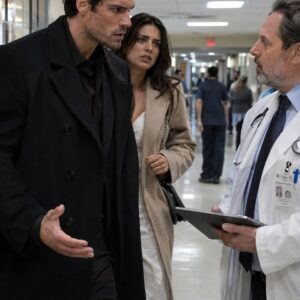
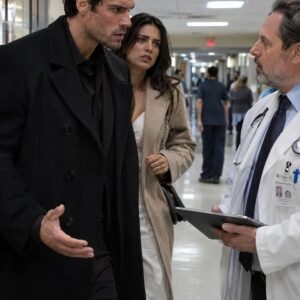
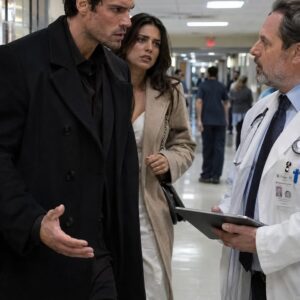
The team began high-quality chest compressions while the defibrillator was prepared.
The monitor showed ventricular fibrillation, a rhythm that could not pump blood effectively.
I called out the rhythm and helped coordinate the next steps with the clinicians around me, concentrating on the timing rather than Quill’s face.
“Clear,” I said when the shock was ready, making sure everyone was away from the bed.
We resumed compressions immediately afterward, and I kept the sequence moving with the other trained staff.
I had done this work in conditions much worse than a hospital trauma bay, but I had never done it with someone I knew so well beneath my hands.
One of Jonah’s escorts, later introduced to me as Copeland, pressed both palms against the wall.
The youngest of the three crouched near the door, watching the monitor.
The tall man stayed at the foot of the stretcher, quiet and attentive, as though he knew interrupting would only make things worse.
Quill protested that I was exceeding my role.
I didn’t stop to trade insults; the team needed a rhythm check and a coordinated response.
We continued resuscitation, administered the indicated medications under the emergency team’s direction, and watched for a return of circulation.
Then the monitor organized into a recognizable rhythm.
A nurse checked and announced a weak pulse.
It wasn’t the end of Jonah’s danger, but it was the first real chance he’d had since arriving.
The team stabilized him for surgery to address a fragment near his spleen.
Only after the stretcher moved did I realize how hard I was breathing.
The tall escort approached and said he’d watched combat medics work before. “You have that same look,” he said.
I told him I’d been nursing a long time, which was true but not the whole story.
He introduced himself as Beckett Cross.
I knew the name from Jonah, and I spoke it before I could reconsider.
Beckett stopped. “We haven’t met,” he said, studying me. “No,” I answered, “but Jonah and I go back a long way.”
Quill asked how a ward nurse had learned to work so confidently during a cardiac arrest.
He began another question about my background, then hesitated when he saw the escorts listening.
I wasn’t going to explain my past on the trauma floor while Jonah was still in surgery.
Forty minutes later, hospital administrator Harriet Yoon found me outside the recovery area.
She asked me to come to her office once Jonah was stable enough that I could leave.
I expected another complaint.
Instead, she closed the door and showed me figures that explained why the trauma response had been so uneven.
Fourteen months earlier, the parent health authority had cut the emergency response training budget by 43 percent.
There had been fewer refresher sessions and simulation drills, despite Harriet’s objections.
She’d worried about what might happen when a critical patient arrived and too few people were prepared to work together.
“Today you saw what I’ve been warning them about,” she said.
I told her the people on that floor were capable, but they needed practice and a workplace where nobody hesitated because the chief might humiliate them.
She wrote that down without arguing.
Quill filed a scope-of-practice complaint against me before the shift ended.
Harriet refused to treat his accusation as a finding and sent it into a formal incident review alongside the resuscitation record and her concerns about the training cuts.
For the first time in months, someone was examining the circumstances rather than simply accepting his version of events.
Part 3
The following morning, a man in an expensive gray suit appeared at the records desk claiming authority to review the trauma footage and telemetry data.
He wanted the material released immediately.
The records staff hesitated because his request didn’t match their usual procedures.
I was nearby when Beckett arrived, having stayed in Calgary while Jonah recovered.
Neither of us tried to seize the records or argue about the man’s identity.
We asked staff to hold the material until Harriet and the hospital’s compliance office could verify his authorization.
Harriet came downstairs, examined his request, and declined to release anything without the required approval.
The man left empty-handed.
Within the hour she contacted legal compliance to preserve the relevant records and examine whether anyone had tried to interfere with the review.
For nine days, the hospital collected statements, reviewed training schedules, and checked the decisions made during Jonah’s arrest and resuscitation.
I told investigators what I had seen, including the hesitation that followed Quill’s criticism.
I also acknowledged that I should have been clear about my military medical experience when discussing my qualifications with the hospital.
The board of governors met on the ninth day.
I wore a charcoal blazer instead of scrubs and sat at a long table while Harriet presented the evidence.
I answered questions about my clinical training and the emergency response, but kept details of restricted postings private.
Quill sat near the far end, no longer surrounded by laughing residents.
When the chair finished outlining the training cuts, the incident documentation, and concerns about the outside liability consultant, he asked to speak.
His voice sounded different without a hallway audience.
He withdrew his complaint and acknowledged that my intervention had been appropriate and necessary.
He said he’d spent days thinking about the difference between his framed qualifications and the way he’d treated a nurse for three months.
Nobody asked him to rip up his degree, and he didn’t.
I hadn’t come to the meeting for that.
I wanted the next patient to find a department that was ready, and the next quiet nurse to feel safe speaking up.
I listened as the board restored full emergency response training funding and approved stronger oversight of the hospital’s risk-management contracts.
Then the board offered me a new position: director of clinical emergency training, reporting to Harriet.
I asked that the work reach beyond hospital employees.
People collapse in hockey arenas, schools, community centers, and kitchens, and the first person beside them is rarely a doctor.
The chair asked me to draft a proposal for community sessions.
She said the hospital would fund it.
I left the room with a job I hadn’t known I wanted and a strange feeling that I might finally be able to use my past without having to live inside it again.
That evening I found Jonah in a wheelchair on a recovery balcony, a blanket around his shoulders.
Beckett sat nearby with two cups of cold vending-machine coffee.
Jonah grinned when he heard about my new title, then winced because laughing still hurt his side.
I sat with them as the last light faded over the Bow River Valley.
Beckett spoke about someone he’d served with who’d spent years learning how to care about people again after treating attachment as a danger.
I understood more than he needed to explain.
“I’m not easy to know,” I told him. “There are parts of my life I can’t open up.” He didn’t ask me to.
He said what he’d seen over the last nine days was enough to make him want to know the parts I could share.
Jonah raised his wrist and showed me the bracelet I’d tied years earlier. “I carried it like you told me,” he said.
I lifted mine from beneath my watch and laughed for the first time that week without holding anything back.
Across the space between our chairs, I briefly rested my hand against Beckett’s.
Final
That winter, the first community emergency-response class met at a recreation center in Forest Lawn.
Twenty-six people practiced recognizing cardiac arrest, calling for help, performing compressions, and using a training defibrillator.
They were neighbors, coaches, grandparents, and people who simply didn’t want to stand helplessly beside someone they loved.
I watched a grandmother repeat the exercise until she felt confident.
She said she’d worried for years about what she’d do if somebody collapsed in front of her.
I told her nobody could guarantee an outcome, but being willing to start and knowing how to summon help mattered.
At Ridgecrest, refresher training and quarterly simulations became part of the routine again.
Harriet secured independent oversight of risk-consulting arrangements, and staff grew more comfortable speaking during emergencies.
Quill began eating lunch in the staff lounge instead of hiding behind the credentials in his office; his change was gradual, and I didn’t pretend one apology erased the past.
Jonah recovered and returned to duty in the spring.
He sent me a photograph from an Edmonton gym, his paracord bracelet visible on his wrist, with a short message saying he was still carrying it.
I kept mine where I could see it every shift.
Beckett and I continued talking, slowly and without demands for stories I wasn’t ready to tell.
Some days I still felt the tremor in my hands, especially beneath harsh lights when someone stood too close.
It hadn’t disappeared, and I no longer needed it to disappear to believe I could do my work.
I stopped turning my badge toward my chest.
When I walked into the emergency department, I wanted people to know my name, not because I needed their admiration, but because I was finished confusing being unseen with being safe.
Quill never tore up his medical degree.
What mattered was that he finally had to look beyond it, while our hospital learned to give its people the training and respect their patients deserved.
And Jonah, the man I’d once promised to see again, was alive to keep wearing the bracelet we’d made for each other.
THE END.
I’ve shared the complete story, and I truly hope it touched your heart.
If this story moved you, please , like, and share the post.
Thank you for reading! ❤️