Part 2 – The Door I Wouldn’t Open
“You don’t get to call yourselves my parents only when my life becomes valuable to you.”
The words came out quieter than I expected, but they seemed to fill the whole porch.
My mother’s smile vanished.
My father’s fingers loosened around his car keys, and they struck the boards with a small, sharp clatter.
For a moment, nobody moved.
Then Thomas’s hand closed gently around mine.
I felt the warmth of his palm and the steadiness in his grip, and I remembered that I was no longer the frightened young woman who had stood in my parents’ kitchen, hoping a softer voice might change my mother’s mind.
I had a family of my own now.
“Rebecca,” my father said at last.
His voice was rough with something I couldn’t name, and he took half a step toward me before stopping.
My mother glanced at him, then back at me.
“I can see this is an emotional moment,” she said, as though she were the one being inconvenienced. “We’ve been driving for hours. Surely you can let us come inside.”
I looked at the suitcases, then at the faces of the two people who had once known every corner of my childhood home and nothing at all about the life I had built since leaving it.
“No,” I said.
My mother’s eyebrows lifted.
“No?”
“You can’t move into our home.”
“We didn’t ask to move into your home forever,” she replied. “We need somewhere to stay while we get settled.”
“You said you were moving in today.”
“I said we were coming to stay.”
The distinction might have mattered to her.
It didn’t change the fact that she had brought three suitcases and no invitation.
My father bent to retrieve his keys, but his hands trembled enough that the first attempt missed them.
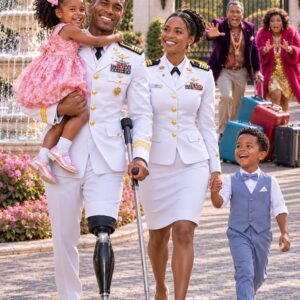
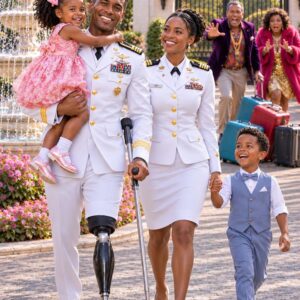
Thomas shifted his weight, the oak cane tapping once against the floor.
I saw my mother’s gaze flick down to it.
Her mouth tightened.
I stepped slightly in front of Thomas before I could think better of it.
The movement was small, but she noticed.
“Rebecca,” Thomas said quietly, “you don’t have to decide everything on the porch.”
“I’ve already decided that they aren’t moving in.”
“I understand.”
His voice held no accusation, only the calm certainty that had carried us through so many years.
My mother gave a humorless laugh.
“I see he still speaks for you.”
“No,” I said. “He doesn’t.”
Thomas lowered his eyes, and the faintest crease appeared between his brows.
I reached for his hand again.
“He’s standing beside me,” I said. “That’s different.”
My father finally managed to gather his keys.
He held them tightly in his fist, as if he needed to remind himself he still had something he could control.
“Margaret,” he murmured, “we should give her a moment.”
My mother turned on him.
“A moment for what? To decide whether she wants us in the rain?”
The sky had been clear when they arrived, but a bank of gray clouds was already gathering beyond the trees.
My father looked toward the road.
There was an exhaustion in his face that hadn’t been there when I last saw him, though fourteen years had passed since then and I didn’t know what life had asked of him in the meantime.
He looked thinner.
His hair, once dark, had gone almost entirely silver.
Still, I couldn’t pretend that noticing those things made the years between us disappear.
“Mom,” I said, “I won’t leave you stranded.”
She folded her arms.
“That’s generous.”
“I’ll pay for a hotel tonight.”
Her eyes sharpened, as if she had been waiting for me to offer something she could measure.
“A hotel?”
“Yes.”
“We’re your parents, Rebecca.”
“I know who you are.”
“Then why are you sending us away?”
“Because I’m not ready to have you in my home.”
She stared at me, and for a moment I thought she might argue.
Instead, she looked past me into the house.
I could see the reflection of the hallway lights in the glass of the front door, and beyond them, the warm blur of our family photographs.
The children had taken over most of the walls downstairs.
School pictures, soccer trophies, a crooked holiday portrait in which Thomas had worn a paper crown and I was laughing too hard to look at the camera.
A life made visible.
My mother’s gaze lingered on the photographs.
“I suppose you have room for all of that,” she said.
“Mom.”
“Nothing. I’m only saying it’s a large house.”
“It’s our home.”
The distinction landed between us, solid as the closed door.
My father looked at me then.
His expression held regret, or perhaps only fatigue.
I couldn’t tell.
“Thank you for the hotel,” he said.
My mother turned toward him in disbelief.
“Robert.”
“It’s one night,” he replied.
“You’re agreeing to this?”
“I’m agreeing that we shouldn’t force our way into a house where we aren’t welcome.”
My mother’s face hardened.
“I never said we would force our way in.”
“No,” I said. “You only brought the suitcases.”
Thomas’s thumb moved once across my knuckles.
My father glanced down, as if he had heard something in my voice that he wished he could answer.
“I’m sorry,” he said.
It was the first apology I had ever heard from him.
It was so small that I might have missed it if I hadn’t spent years wondering whether he would ever say anything at all.
But it was too late to make the old silence disappear.
“I can call the hotel,” I said. “There’s one near the highway, not far from here. I’ll make sure they have adjoining rooms.”
“We don’t need two rooms,” my mother said.
“I’ll arrange whatever is available.”
“Don’t make a performance of it.”
“I’m not.”
“I can pay,” she said.
“Then you can reimburse me when you’re able.”
My mother’s chin lifted.
For a second, I saw the young woman she must have been before life had worn away her patience, before disappointment became a weapon she used to keep the world at a distance.
Then the moment passed, and her familiar composure returned.
“You always were determined to make things difficult,” she said.
“I learned from watching you.”
The words were sharper than I meant them to be.
My father flinched.
Thomas didn’t.
He knew I wasn’t trying to wound anyone.
I was trying to stop being wounded by the same old sentence, dressed in different clothes.
My mother bent to pick up the nearest suitcase.
The motion was abrupt, and I saw her wince as she straightened.
“Let me,” my father said, reaching for it.
“I can carry my own bag.”
“You’ve already carried it halfway across the porch,” he replied.
Something in his voice made her pause.
For a moment, neither of them moved.
Then she released the handle.
My father lifted the suitcase with visible effort and carried it down the porch steps.
He put it into the trunk of their car, which was parked at the curb.
The second suitcase followed.
As he returned for the third, Thomas stepped outside.
My mother’s eyes fell immediately to the cane.
“Thomas,” I said, too quickly.
He looked at me.
“It’s all right.”
He crossed the porch at his own pace, the cane landing firmly with each step.
He didn’t reach for the suitcase.
He simply opened the front door wider for my father.
“You can leave the last one there,” Thomas said. “I’ll hold the door.”
My father stopped beside him.
“Thank you.”
The two men shared a brief look.
My mother watched them from the porch, her expression unreadable.
Thomas held the door while my father brought the final suitcase out to the car.
There was no triumph in Thomas’s face, no reminder of what Margaret had once said.
That was what made her remark so difficult to forget.
He had given her nothing to fight.
Once the luggage was packed, I called the hotel and booked two rooms because the adjoining ones were available.
My mother objected again, but my father said nothing.
When I gave them the address, he wrote it down on the back of an old receipt.
His handwriting was slow and careful.
“Do you still have my number?” he asked.
“No.”
He nodded as though he’d expected that.
I gave him my phone number.
He entered it into his phone, then sent me a text so I’d have his.
His message was only his name.
Robert.
I stared at it longer than I needed to.
My mother had gone around to the passenger side of their car.
Before getting in, she looked back at me.
“I hope you understand that we didn’t come here to beg.”
“I don’t know why you came.”
Her expression flickered.
“Because we needed family.”
The answer should have sounded simple.
Instead, it felt carefully placed, like a stone set over a hole.
“Why now?” I asked.
“Because things happen.”
“What things?”
She looked at my father, who had opened the driver’s door but hadn’t gotten in.
“Your father’s business failed,” she said.
He lowered his head.
“We lost the house,” she continued. “We’ve been staying with friends, but that arrangement can’t last.”
My hand tightened around my phone.
The house outside Raleigh had seemed permanent when I was a child.
It had white columns and a wide lawn and a front walk that my mother kept so spotless no one dared step off the stones.
The thought of losing it didn’t make the hurt vanish.
But it changed the picture in my mind.
“When did you lose it?” I asked.
“Recently.”
“How recently?”
“A few months.”
My father looked at the ground.
“Debts caught up with us,” he said.
My mother’s mouth pressed into a line.
“Robert’s business had been struggling for years,” she said. “He kept thinking he could turn it around.”
I turned to my father.
“I’m sorry.”
He looked up, surprised.
“Thank you.”
I wasn’t sure whether I meant I was sorry for the business or for everything.
Perhaps I meant both.
“Why didn’t you call?” I asked.
My mother gave a short laugh.
“We’re calling now.”
“Not for fourteen years.”
She held my gaze.
“I didn’t think you wanted to hear from us.”
“You never tried.”
Her eyes darted to my father.
It was a small glance, gone almost as soon as it appeared.
My father saw it too.
“Margaret,” he said, “we came because we needed family. We should at least be honest about that.”
“I am being honest.”
“Then tell her how we found her.”
The question came from him, not me.
My mother’s face changed.
For the first time since she had stepped onto my porch, she seemed unsure of what to say.
I looked from her to my father.
“How did you find us?”
She recovered quickly.
“Your address is not difficult to locate.”
“That’s not what I asked.”
“I heard about your family through someone we both know.”
“Who?”
“Does it matter?”
“Yes.”
She opened the car door.
“I don’t remember the name.”
My father was still holding the keys.
“You knew her address,” I said. “You knew about the house.”
“I told you,” she replied. “People talk.”
“People don’t usually know where someone lives because of a conversation at the grocery store.”
“Rebecca, it has been fourteen years. You’re making a simple thing into a mystery.”
“Maybe because you won’t answer a simple question.”
For a moment, her composure cracked.
Not much.
Just enough for me to see the impatience beneath it, and something else, something more like fear.
My father cleared his throat.
“Let’s go,” he said.
My mother looked at him as if he had betrayed her.
Then she got into the car.
My father lingered beside the open driver’s door.
“I’ll call you tomorrow,” he said.
I didn’t promise anything.
He nodded once and climbed behind the wheel.
Their car rolled away from the curb, leaving the porch quiet and the suitcases gone.
Only then did I realize I had been holding my breath.
Thomas closed the front door.
The lock clicked into place.
For several seconds, we stood together in the hallway without speaking.
From upstairs came the faint sound of a bedroom door opening, followed by careful steps on the landing.
A moment later, our twins appeared at the top of the stairs.
They were old enough to understand that something serious had happened, though perhaps not old enough to understand why.
“Were those really Grandma and Grandpa?” one of them asked.
“Yes,” I said.
“They’ve never visited before,” the other said.
“No.”
“Why not?”
The question was so direct that I looked down at my hands.
Thomas answered first.
“Sometimes adults make choices they should have made differently.”
The twins exchanged a glance.
“Are they staying with us?” one asked.
“Not tonight,” I said. “They’re at a hotel.”
“Are they coming back?”
“I don’t know.”
That was the most honest answer I had.
One of them came down two steps, then stopped.
“Did Grandma say something mean?”
Thomas glanced at me.
I didn’t want the children to carry more of the past than they needed to.
“She said something unkind,” I replied. “But that’s between the grown-ups.”
“Was it about Dad’s leg?”
Thomas’s jaw shifted, but he kept his voice even.
“It was about the past,” he said. “And we’re here now.”
The twins came down to us and hugged him from either side.
Their arms reached around his waist, careful not to jostle the cane.
He bent awkwardly to kiss the tops of their heads.
Something inside me loosened.
Our children had never known the version of him that my mother had tried to define.
They knew the father who waited outside the school auditorium with flowers after their first concert.
The man who sat at the kitchen table helping with homework, his cane resting beside him while he listened more than he spoke.
The one who had never once made his injury an excuse to miss a moment that mattered.
“Can we have dinner?” one of the twins asked.
“I suppose we should,” I said.
“Can we make pancakes?”
“It’s nearly dinner.”
“So?”
Thomas smiled.
“So we should probably let your mother decide.”
The twins looked at me hopefully.
“Pancakes are fine,” I said.
They hurried into the kitchen, talking over each other about chocolate chips.
When they were out of sight, Thomas turned toward me.
“Are you all right?”
“I’m not sure.”
“That makes sense.”
I looked toward the front door.
“I thought I’d feel more prepared if this ever happened.”
“Did you think it would happen?”
“No.”
“Then perhaps you didn’t need to prepare.”
I gave a tired laugh.
“They said they lost their house.”
“I heard.”
“I should feel sorry for them.”
“You can feel sorry for them and still keep your door closed.”
I studied his face.
He had the same calm expression he’d worn on the porch, but there was a hint of pain around his eyes.
“I’m sorry she said that.”
“I’ve heard worse.”
“That doesn’t make it all right.”
“No,” he said. “It doesn’t.”
I touched his sleeve.
“I won’t let her speak to you that way.”
“I know you won’t.”
“I hate that you’ve had to hear it before.”
“I hate that you had to hear it too.”
He leaned down and kissed my forehead.
There was nothing grand in the gesture, nothing meant to prove a point.
It was simply the familiar tenderness of a man who had stood with me through every version of our life.
That evening, the twins covered the pancakes in too much syrup and argued over who had added more chocolate chips.
Thomas pretended not to notice when one of them stole a bite from his plate.
We laughed, and for a while the porch faded from the center of my mind.
But later, after the twins had gone upstairs, I sat alone at the kitchen table with the text from Robert still open on my phone.
His name looked strange there.
Not Father.
Not Dad.
Just Robert, the way he had introduced himself to the world for fourteen years without me.
Thomas came in carrying two mugs of tea.
He placed one in front of me and lowered himself into the chair beside mine.
“Your mother said they came because they needed family,” he said.
“That’s what she said.”
“But she didn’t explain how they knew where to find us.”
“No.”
He stirred his tea, though he hadn’t added anything to it.
“Your father looked as if he wanted to tell you something.”
“I thought so too.”
“Did he?”
“I don’t know.”
I turned the phone over in my hands.
There had been a time when I knew my father’s silences better than his words.
When I was a child, he would sit in the garage after dinner, sorting bolts into jars and listening to the radio.
If my mother was upset, he became quiet.
If I was upset, he would ask whether I wanted to talk, then stay beside me even when I said no.
I had loved him for that.
I had also learned that his quietness could be another way of leaving.
“I don’t know what to do with him,” I said.
“You don’t have to decide tonight.”
“I keep thinking there might be a reason.”
“There might be.”
“And then I think maybe I’m inventing one because I want there to be.”
Thomas reached across the table and covered my hand.
“Wanting the truth doesn’t make you foolish.”
I looked at him.
“No?”
“No.”
His certainty steadied me more than any reassurance that the truth would be kind.
The next morning, I woke before the rest of the house.
Thin sunlight lay across the kitchen floor, and the coffee maker had just begun its slow, familiar drip.
I was checking my phone when a message arrived from my father.
I wondered if we could talk today.
I stared at the words for a long time.
Then I typed back, We can meet for coffee. Just us, if you want.
His reply came a minute later.
Thank you.
I told Thomas where I was going.
He didn’t ask me to change my mind or warn me away.
He only said, “Take your time.”
At a small café near the hotel, my father was already waiting.
He had chosen a table near the window and placed his phone beside his untouched coffee.
When he saw me, he stood too quickly, then seemed uncertain what to do with his arms.
I leaned in and gave him a brief hug.
It felt strange, like reaching for a doorknob in a house I hadn’t entered in years.
He held on for a second longer than I did.
Then we sat down.
“I’m grateful you came,” he said.
“I wasn’t sure I would.”
“I understand.”
He looked older in the morning light.
There were deep lines beside his mouth, and his hands were rougher than I remembered.
I wondered how many times he had wanted to call.
I wondered how many times he had decided not to.
“How bad is the debt?” I asked.
He took a breath.
“Bad enough that we lost the house. Not so bad that we’re without any resources, but we’re trying to work out what comes next.”
“Did you come here because you thought I would give you money?”
“No,” he said quickly.
Then he stopped.
“I mean, I hoped you might help us find a place to start. I wasn’t sure what you’d be willing to do.”
“That sounds different from what Mom expected.”
He looked down at his coffee.
“Your mother has always had a way of deciding what people mean before they say it.”
“Why did you let her decide for you?”
His shoulders lowered.
“I wish I had a good answer.”
“You could have called me.”
“Yes.”
“You could have written.”
“Yes.”
“You could have tried.”
He kept his eyes on the cup.
“I know.”
The words were plain.
They did not defend him.
They did not make me feel better.
But they were more honest than the explanations I had been preparing to reject.
“What happened after the wedding?” I asked.
He looked up.
“What do you mean?”
“After I married Thomas. Did you think about reaching out?”
His hands tightened around the cup.
“I did.”
“What stopped you?”
For a moment, I heard only the espresso machine hissing behind the counter.
Then he said, “Your mother believed you had made your choice.”
“I had made my choice.”
“I know that now.”
“You knew it then.”
He flinched, and I wished I could take the words back.
But if I softened every truth to protect him, we would only be repeating the same old pattern.
“I thought you were trying to build a life without us,” he said. “And I thought contacting you would make things harder.”
“Did you try?”
His gaze fell to the table.
“Not in the way I should have.”
“What does that mean?”
Before he could answer, his phone buzzed.
He glanced at the screen, and I noticed his expression change.
“What is it?” I asked.
“Nothing.”
He turned the phone face down.
For the first time, I wondered whether the things he had failed to say had been the only secrets between us.
“Dad,” I said, though the word felt unfamiliar in my mouth, “why did Mom say she didn’t remember how she found us?”
He rubbed his thumb along the rim of his coffee cup.
“I don’t know.”
“But you do.”
He didn’t answer immediately.
Then he reached into his coat and drew out a small brass key on a plain ring.
“I brought something from the hotel,” he said. “I wasn’t sure when to give it to you.”
“What is it?”
“An old storage box.”
His hand closed around the key.
“Your letters were in it,” he said. “And some photographs.”
My breath caught.
“My letters?”
“From when you were away at school. And a few you sent after the wedding.”
I stared at the key.
“I wrote to you after the wedding.”
“I know.”
“You said you thought I’d chosen to sever contact.”
“I thought you had.”
“Then why do you have my letters?”
His eyes filled, though no tears fell.
“Because I kept every one I received.”
The café noise seemed to recede around us.
I could hear the tiny scrape of his chair as he shifted.
“Every one?” I asked.
“Every one.”
“Then you got them.”
He looked down at the brass key in his palm.
“I got some of them.”
“What does that mean?”
“I don’t know if they all reached me.”
“Did you read them?”
“I did.”
I searched his face, trying to understand how he could have read my words and still let me believe he had chosen silence.
He looked as if he were trying to find the answer too.
“I don’t expect you to forgive me,” he said. “I only thought you should have them.”
He slid the key across the table.
I didn’t pick it up.
“What was in the letters?”
“Your life,” he said. “Your words. The things you wanted me to know.”
“Did Mom read them?”
He looked toward the window.
“I don’t know.”
The answer was too careful.
I felt the old anger rising, but beneath it was something else: a thin, uncertain thread of hope that the past might not have been exactly what I had believed.
My father pulled his hand back.
“One of the envelopes came back unopened,” he said. “It was after the wedding.”
I stared at him.
“Why?”
“I don’t know.”
“Did you try again?”
“I should have.”
“That’s not what I asked.”
His face tightened.
“No,” he said. “I didn’t.”
I closed my fingers around the key at last.
It was cool and heavier than it looked.
“Where is the box?”
“In the trunk.”
“Why didn’t you bring it yesterday?”
“Your mother didn’t want me to.”
My grip tightened around the key.
“Why not?”
“She said it would only reopen old wounds.”
I looked at him, but he seemed unable to meet my eyes.
The answer came with another question attached to it, one that had been waiting in the dark for years.
If my mother didn’t want me to read those letters, what had she been afraid I would discover?
**–END OF PART 2–CLICK “NEXT” AT THE BOTTOM OF THE PAGE TO CONTINUE READING**
* * *
[NEXT: PART 3](https://puretales.idolsgift.com/blog/part-3-the-door-i-wouldn-t-open-027)