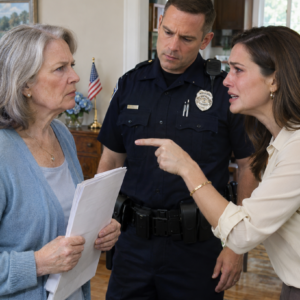
I spent over four weeks in the ICU fighting for my life while my parents never even came to visit me.
A month later, my mom texted demanding I hand over my $1.2M house to my brother for his new family—so I sent her a photo of a toy tent and blocked her number.
The beeping of the cardiac monitor still echoed in my memory when my phone buzzed on the kitchen counter four weeks after I was finally discharged from the intensive care unit.
I stared at the text message from my mother.
Jason needs a home for his new family.
We need you to surrender your $1.2M property to him today.
My fingers hovered over the screen.
Four weeks ago, I had been intubated in a Seattle hospital ICU after a severe post-surgical infection nearly stopped my heart.
I had woken up alone in that room, reaching for a hand that never came.
My parents had lived twenty miles away and never once visited, claiming they couldn’t risk catching a virus or losing sleep before work—even though they had driven to a resort in Palm Springs the very next weekend.
Now my younger brother, Jason, whose pregnant girlfriend had just moved in with him, wanted my four-bedroom Craftsman home in Bellevue—a property I had bought entirely with my own software engineering earnings and paid off ahead of schedule.
My chest tightened with a sharp, familiar ache.
For years, I had swallowed their favoritism, sent money whenever Jason lost another job, and pretended I didn’t notice how invisible I was whenever I wasn’t useful.
I didn’t argue.
I didn’t remind her of the hospital tubes or the lonely nights.
I walked into my spare room, snapped a quick photo of a colorful pop-up kids’ tent my niece had left behind last summer, sent it to my mother, and tapped Block This Caller.
Ten minutes later, a message popped up from Jason on another messaging app.
Are you crazy?
Mom told me you sent a joke pic!
Sign the quitclaim deed by five o’clock or we’re showing up with a moving truck!
A few hours later, around dusk, a loud banging rattled my front porch door—and when I checked the security camera feed on my phone, I saw my father standing on the steps beside a county sheriff’s deputy holding a thick legal packet.
They thought demanding my house after abandoning me in the ICU was just another routine favor.
They had no idea what was inside that legal packet—or why the sheriff’s deputy was standing on my porch.
I walked slowly to the front foyer, watching the live camera feed as my father shifted nervously on the porch while the deputy checked the address on a clipboard.
“Deputy, I’m telling you, my daughter is being unreasonable,” my father said, his voice tight as he gestured toward my front door. “We’re trying to settle a family property arrangement before my son’s new baby arrives, and she blocked her mother’s number.”
“Sir, I’m not here to mediate family real estate,” the deputy replied calmly, glancing at the camera lens above the porch light. “I’m serving a formal civil notice and restraining order filed through Superior Court.
Is Hannah Miller home?”
I unlocked the deadbolt and pulled the door open a few inches, keeping the security chain latched. “I’m right here, Deputy.”
My father’s eyes widened instantly. “Hannah!
Thank God!
Tell the officer this is all a misunderstanding!
Your mother and I just want you to sign the transfer papers for the Bellevue house so Jason and his girlfriend have a proper place to raise their child!
You’re single, you don’t need four bedrooms!”
“I need a quiet place to finish physical therapy after spending four weeks fighting for my life in the ICU while neither of you came to check if I was breathing,” I said evenly, my voice clear and steady. “And I’m not signing my house over to anyone.”
“You’re being selfish!” my father snapped, his face flushing red as he stepped closer to the door. “Jason is your brother!
Family helps family!
You owe him this after all the stress you put us through when you were sick!”
“Stress I put you through?” I repeated softly, feeling a cold clarity settle over me. “You didn’t visit me once, Dad.
Not once.
The hospital social worker had to sign my discharge paperwork because nobody from my family answered the emergency call.”
“We had obligations!” my father barked, reaching toward his coat pocket. “Look, I brought the paperwork right here.
Just sign it, give Jason the keys, and we’ll forget you sent that disrespectful picture to your mother.”
Before I could answer, a black sedan pulled smoothly up to the curb behind the patrol cruiser.
My attorney, Claire Vance, stepped out carrying a leather briefcase, walking briskly up the walkway with a thick binder tucked under her arm.
“Evening, Deputy,” Claire said, offering a polite nod before turning her gaze directly toward my father. “Mr.
Miller, I’m Hannah’s estate and civil litigation counsel.
Since you’ve chosen to come to her residence uninvited after she blocked contact, you might want to read the second page of the packet the deputy just served you.”
My father frowned, pulling a folded piece of paper from his pocket with a confused smirk. “What is this?
Some kind of scare tactic?”
“It’s a formal cease-and-desist order regarding attempted elder-style financial coercion and unauthorized title interference,” Claire said smoothly, “along with a copy of the irrevocable trust Hannah established last month—which explicitly bars any transfer, lien, or conveyance of the Bellevue property to you, your wife, or Jason.”
My father’s jaw dropped as he stared at the court seal on the document, his color draining fast as his phone began ringing nonstop in his pocket.
My father stared at the court papers in his hands, his breathing growing shallow as his phone buzzed violently against his hip.
He pulled it out with a trembling hand, glanced at the screen, and cursed under his breath.
“That’s Jason,” my father muttered, looking up at Claire with sudden panic. “He says the landlord just gave him a three-day notice on his apartment and his girlfriend’s parents cut off their support!”
“That is unfortunate for Jason,” Claire replied evenly, “but it creates zero legal claim to Ms.
Miller’s real estate.
Any further attempts to pressure her, enter her property without explicit invitation, or contact her through third parties will result in an immediate criminal harassment filing.”
The sheriff’s deputy folded his clipboard and nodded once to me. “Ma’am, if you need any further assistance enforcing the no-contact order tonight, just call dispatch directly.”
“Thank you, Deputy,” I said quietly.
The deputy walked back down the steps to his patrol cruiser and pulled away into the evening traffic.
My father stood frozen on the porch for a long moment, looking between me and Claire as the reality of what had just happened sank in.
“Hannah…” my father said, his voice dropping into a softer, almost pleading tone. “Don’t do this.
Your mother is crying at home.
She says you’ve turned cold since you got out of the hospital.
We’re your parents.
You can’t just lock us out like strangers.”
I looked at him—really looked at him—and felt a strange, quiet release.
For over thirty years, I had bent myself backward trying to earn warmth from people who only measured my worth by what I could provide.
Even when I lay in a hospital bed fighting sepsis, they had treated my survival like an inconvenience and my home like a prize to be claimed.
“I didn’t turn cold, Dad,” I said calmly, unlatching the chain so I could stand fully in the doorway with Claire beside me. “I just finally woke up.
You chose not to show up when I was dying.
I’m choosing not to hand over my life’s security to people who don’t care whether I live or breathe.”
“So that’s it?” my father asked, bitterness creeping back into his voice as he folded the court notice sharply. “You’re going to let your brother and his newborn baby struggle while you sit in a big house by yourself?”
“Jason is twenty-nine years old,” I replied steadily. “He has two hands and a full-time job.
He can figure out his housing just like I figured out mine—without taking my house.”
My father didn’t say another word.
He turned sharply on his heel, walked briskly down the stone steps without looking back, and climbed into his car, slamming the door hard before peeling away down the street.
Claire closed her briefcase and offered me a warm, supportive smile. “You handled that remarkably well, Hannah.
Everything on the trust is airtight.
Nobody can touch the house or force a sale.”
“Thank you, Claire,” I said, letting out a long, steady breath as the cool evening air brushed against my face. “For everything.”
After Claire left, I stepped back inside my quiet living room, locked the front door, and walked over to the window.
Across the street, the streetlights flickered on, casting soft golden pools along the pavement.
My chest still ached a little from recovery, and losing the illusion of a loving family still carried a quiet sting—yet as I sat down with a warm cup of tea in my own paid-off home, I felt something I hadn’t felt in years: complete peace.