

Unveiling the Mariana Trench’s Lost City: A Deep-Sea Archeological Marvel
The year is 2017. Humanity, having long exhausted the terrestrial frontiers, had turned its gaze to the deepest, most mysterious realm on Earth: the abyssal plains of the Mariana Trench. For decades, whispers of unnatural formations and peculiar sonar readings had fueled the imaginations of a new breed of explorers – deep-sea archaeologists. Leading the most ambitious expedition to date was Dr. Aris Thorne, a man whose life’s work was dedicated to peeling back the ocean’s darkest secrets.
Their vessel, the Triton’s Embrace, a marvel of bio-luminescent engineering, descended into the inky blackness. Days bled into weeks, the crushing pressure a constant companion, until the sonar finally pinged with an anomaly that sent a jolt through the entire crew. It wasn’t just a wreck; it was immense, far larger than any known vessel.
“Deployment Protocol Alpha initiated,” Dr. Thorne’s voice crackled over the intercom, a rare tremor of excitement in his usually stoic tone. He and his seasoned diving partner, Anya Sharma, were already suiting up, their rebreathers hissing softly. The image from the remote-operated vehicle (ROV) had been tantalizing: the silhouette of a massive, ancient vessel, unlike anything in recorded history.
As they glided through the phosphorescent glow of their submersibles, the sheer scale of the discovery began to unfold. The “shipwreck” was not a single vessel, but a complex of interlinked structures, partially buried in the deep-sea sediment, almost as if an entire city had sunk in one cataclysmic event. This was no ordinary wreck; it was a relic of a civilization unknown.
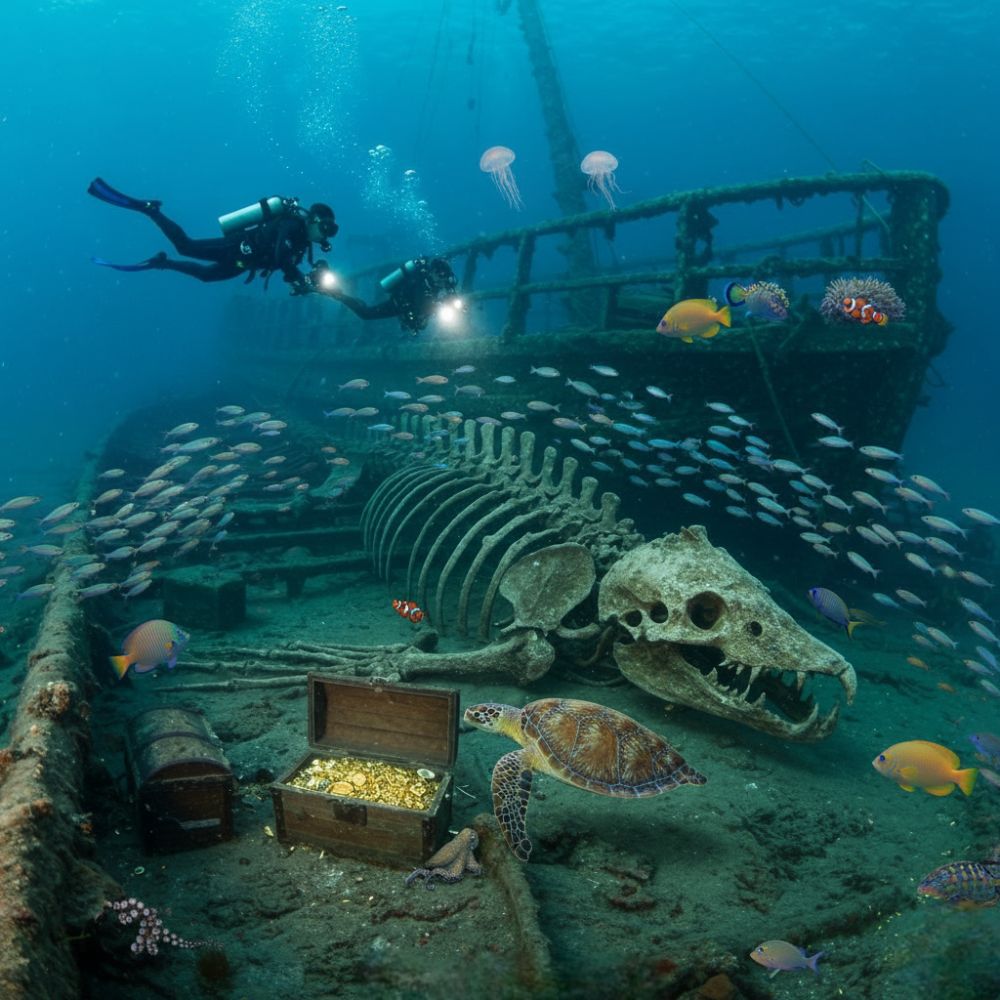
They navigated through what appeared to be ancient corridors, the hull of the primary structure eerily intact. Then, they saw it. In a vast, open chamber, bathed in the beam of their powerful lights, lay the colossal skeletal remains of a creature. It was reptilian in form, with a fearsome, elongated skull and massive ribs, clearly not a whale or any known marine species. It was a leviathan of myth, now reduced to bone, a silent sentinel guarding a forgotten history.
Beside the skeletal behemoth, nestled among what looked like petrified architectural debris, was a wooden chest. It was remarkably preserved, its hinges and clasps still discernible. Anya approached cautiously, her heart hammering against her ribs. With a gentle push, the lid creaked open, revealing not just gold coins, but intricately carved artifacts of an unknown metal, shimmering with an ethereal light. This wasn’t pirate loot; this was a treasure trove of ancient knowledge, perhaps the last vestiges of a civilization that had once thrived in the abyssal depths.
As they meticulously documented their findings, schools of bioluminescent fish, undisturbed for millennia, swirled around them like living constellations. Jellyfish pulsed in the distance, their delicate forms a stark contrast to the colossal bones. A curious sea turtle glided by, its ancient eyes seemingly observing their intrusion. Even an agile octopus, camouflaged against the dark metal, seemed to watch them with intelligent curiosity.
The Mariana Trench, long considered a barren void, had just yielded its most profound secret. It wasn’t just a trench; it was the graveyard of a forgotten empire, a testament to life’s extraordinary ability to adapt and thrive in the most extreme conditions. The “Lost City” was not merely a discovery; it was a paradigm shift, rewriting the very timeline of intelligent life on Earth. Dr. Thorne and Anya knew this was just the beginning. The ocean still held countless mysteries, and the deep, silent witnesses of the Mariana Trench were finally ready to tell their story.