

BREAKING: FROZEN UNICORN SKELETON DISCOVERED IN ARCTIC ICE – MYTHS WERE REAL ALL ALONG!
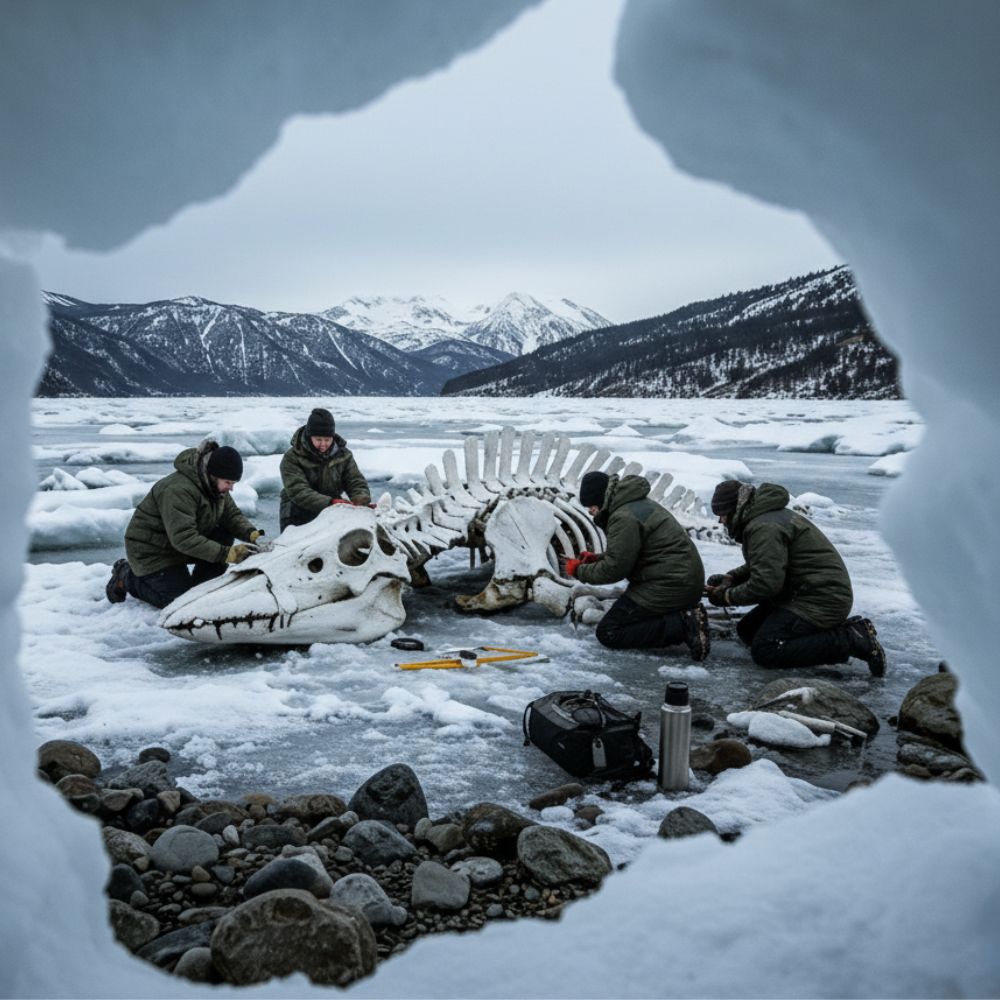
In late November 2025, amid accelerating ice melt in the high Arctic, a multinational research team surveying a newly opened glacier cave near Svalbard stumbled upon a sight few were prepared to witness. Encased in crystal-clear blue ice lay a nearly complete horned horse skeleton, preserved so perfectly that muscle impressions and joint alignment were still visible.
The discovery site—an unstable ice cavern revealed after an unprecedented summer thaw—was quickly secured by local authorities in coordination with Norwegian Polar Institute. Field notes describe a single, elongated spiral horn projecting from the skull, symmetrical limb bones, and a delicate cranial structure strikingly similar to descriptions found in medieval European manuscripts and Central Asian folklore.
As images circulated, public reaction exploded. Online communities claimed vindication, pointing to ancient texts that spoke of “one-horned horses of the north.” Scientists, however, urged restraint. Preliminary statements suggested the remains may belong to a prehistoric Arctic ungulate, possibly related to extinct elk or rhinoceros-like mammals adapted to Ice Age environments. Detailed CT scans and DNA analysis are now underway, with samples transferred to a secure lab in Tromsø.
Fueling speculation, access to the glacier cave was abruptly restricted due to safety concerns, sparking rumors of a cover-up. Officials counter that the closure follows standard Arctic protocol, citing collapsing ice ceilings and rising meltwater.
Whether this frozen relic proves to be a misunderstood Ice Age species or the biological echo of a legend that endured for millennia, the find underscores a powerful truth: as the ice retreats, the Arctic is revealing stories long buried—stories that blur the line between myth and memory. 🧊✨