PART 14: The Speech That Turned Against Me
Mom’s final statement arrived that afternoon, typed neatly and signed beneath a declaration that it was true to the best of her knowledge.
I sat beside Ben in Dana’s conference room as she handed us copies.
The first pages described the argument over the broken glass cabinet.
Ben had been playing with a baseball indoors, ignoring Dad’s warnings.
Dad grabbed him, and during the struggle Ben struck the side of his head against the cabinet.
Mom heard the crash and ran downstairs.
She saw Ben bleeding and Dad shouting at him.
I was kneeling beside my brother with a dish towel pressed against the wound.
Mom begged Dad to stop.
When he refused, she went next door and asked Anna for help.
The account matched what we’d already learned.
Then came the part Mom had never admitted.
She had been standing only a few feet from the basement staircase when Anna tried to lead Ben outside.
Anna placed herself between Dad and the children.
Dad ordered her to leave.
When she refused, he stepped forward and shoved her with both hands.
Mom saw Anna stumble backward.
She heard Anna strike the stairs.
Then she watched her slide to the bottom without moving.
For several seconds, nobody in the house made a sound.
Mom wrote that Dad immediately began insisting Anna had fallen accidentally.
He told her that if she contradicted him, they’d lose everything.
She called emergency services only after I had already picked up the kitchen telephone and begged someone to send help.
Dad’s anger then turned toward me.
He warned that my carelessness would be responsible if the family broke apart.
The words left me shaking.
I had carried his accusation for twenty-six years because he’d planted it at the exact moment I was most frightened.
Mom’s statement continued.
She admitted helping Dad reposition my roller skate after the injury.
She admitted signing my name on a false correction.
She admitted withdrawing her cooperation from investigators and allowing Dad to pressure me into writing an inaccurate account.
Finally, she wrote that she’d chosen silence many times after the immediate danger had passed.
That sentence mattered more than any attempt to excuse herself.
She had stopped pretending her fear erased her responsibility.
Ben placed his copy on the table.
“Do you believe her?”
I considered the question.
“I believe this is what she should have said twenty-six years ago.”
He nodded.
“Me too.”
Dana explained that Mom’s testimony would be offered to the appropriate authorities along with the other evidence.
She cautioned that no one could promise a particular legal outcome.
The original incident was old, the available proof was complicated, and any investigation would require independent assessment.
But the public record no longer had to depend solely on Dad’s account.
That evening, we drove to the civic center.
The building was decorated with blue and silver banners thanking retiring county employees for their service.
Through the glass doors, I could see rows of banquet tables and a stage surrounded by flower arrangements.
Dad’s photograph hung near the entrance.
He was smiling in the picture, wearing the same confident expression I’d seen at family dinners, church fundraisers, and award ceremonies.
For years, that smile had been evidence to strangers that he was a good man.
To me, it was the expression he wore when he expected everyone around him to cooperate.
Ben parked near the front doors.
Anna arrived with Teresa, wearing a deep green dress and carrying a cane she used on difficult days.
She looked nervous, but she held her head high.
Mom arrived separately in a navy suit I hadn’t seen before.
Her hair was neatly arranged, and her hands were steady.
I hugged her briefly.
It wasn’t forgiveness.
It was acknowledgment that she’d finally come to stand beside the truth.
We entered together.
Conversations quieted as people recognized us.
Some guests looked embarrassed.
Others stared openly.
A few approached Anna to offer apologies for things they’d believed years earlier.
She thanked them politely without pretending their apologies repaired the past.
We sat near the back, close to an exit.
Dad stood at the front beside the retirement association’s president.
When he saw us, his smile disappeared.
He spoke briefly with his attorney before returning to the stage.
The ceremony began with ordinary speeches about service, dedication, and community.
I watched people applaud retirees who had spent their careers maintaining roads, libraries, and public buildings.
Most of them had no connection to our family’s history.
They deserved their celebration.
I didn’t want our pain to become entertainment for an entire room.
But Dad had already chosen to use the event to defend himself.
When his turn came, he stepped to the microphone.
He thanked the county and spoke warmly about hard work.
Then his voice changed.
“Unfortunately, my retirement has been overshadowed by accusations from people close to me.”
A murmur moved through the room.
I felt Ben tense beside me.
Dad continued, describing Anna’s injury as a tragic household accident that had been distorted for financial and personal reasons.
He said he’d spent decades protecting his children from painful memories.
Then he looked directly at me.
I recognized the expression immediately.
It was the one he wore before delivering a punishment he believed I’d earned.
He lifted a sheet of paper.
“I have a statement written by my daughter shortly after the incident.”
My hands went cold.
Dad described the page I’d been forced to copy as a truthful admission.
He said I’d been a troubled child who misunderstood the consequences of my own actions.
The room became painfully quiet.
I glanced at Mom.
She was staring at him with an expression I’d never seen before.
Not fear.
Disgust.
Dad raised the paper higher.
Then he spoke the words he’d prepared to destroy me with.
“The person responsible for Anna Morales falling down those stairs was my daughter, Claire.”
I heard someone gasp.
Ben stood so quickly his chair scraped the floor.
But before he could speak, Mom rose beside him.
Her voice carried across the entire room.
“No, Richard.”
Dad froze.
Mom stepped into the aisle.
Then she said the sentence that would finally break the silence our family had lived inside for twenty-six years.
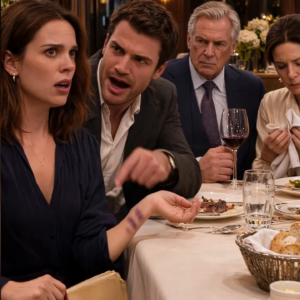
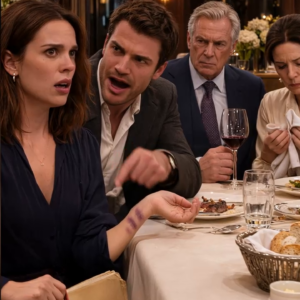
“I watched you push her.”