PART 13: The Signature That Carried Consequences
By late morning, the immediate emergency response had become a test of something deeper than the hospital’s written procedures.
It was a test of whether its leaders could acknowledge failure while still carrying out their duties.
Sergeant Moreno remained under intensive medical care.
The surgical team had made progress, but his condition was still critical.
The other two injured service members were stable.
All requested support had been provided.
The blocked entrances had been reopened.
And the preliminary investigation into Officer Hayes’s conduct had established a clear sequence of events.
Yet the atmosphere around the operations room remained uneasy.
I understood why.
No commander enjoyed discovering that a preventable mistake had occurred under his authority.
No institution welcomed an incident that might reflect poorly on its leadership.
But avoiding embarrassment was not a legitimate reason to conceal failure.
Colonel Brooks entered carrying a revised incident memorandum.
“General, I’ve prepared the command summary.”
I accepted it.
The first page described the helicopter accident and the medical center’s emergency response.
The second documented the temporary security restriction.
The third addressed the delay at the east ambulance entrance.
I read carefully.
The document stated that an unidentified visitor had created confusion outside the main entrance.
I looked up.
“Colonel, this wording is incomplete.”
Brooks leaned closer.
“Which part?”
“An unidentified visitor did not create the confusion.”
He looked at the page.
“The initial report did.”
“Yes.”
I pointed toward the sentence.
“And that report omitted the visitor’s request for verification.”
Brooks nodded slowly.
“You’re right.”
I continued reading.
The next paragraph described the physical confrontation as an unfortunate misunderstanding.
I placed the document on the table.
“That wording also needs correction.”
Brooks looked uncomfortable.
“General, I wasn’t trying to minimize what happened.”
“Then describe what happened.”
He sat across from me.
I kept my voice quiet.
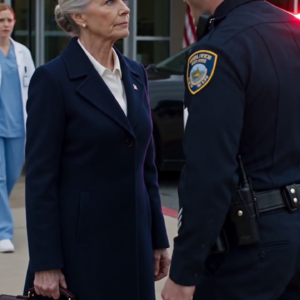
“Officer Hayes grabbed my wrist before verifying my identity.”
“Yes.”
“My briefcase fell, and I went down on one knee.”
“Yes.”
“He then submitted statements that did not accurately describe the encounter.”
Brooks nodded.
“Yes.”
“And a security report contributed to confusion that delayed an incoming ambulance.”
“Correct.”
“Then write those facts.”
He rubbed his forehead.
“I understand.”
I watched him pick up his pen.
He crossed out the phrase unfortunate misunderstanding.
The movement seemed small.
But I knew how often accountability began with the willingness to replace comfortable language with accurate language.
Brooks rewrote the summary.
He included the established sequence of the encounter.
He documented the inaccurate statements.
He recorded the gate closure and subsequent delays.
He also noted that the medical outcome could not yet be attributed to any single factor.
I approved that distinction.
A report should not claim medical conclusions before qualified clinicians had reviewed the evidence.
The purpose was to understand what happened, not to write a satisfying accusation.
Brooks handed me the corrected document.
I read it again.
“This is better.”
He looked relieved.
“Thank you.”
“Now include corrective actions.”
He nodded.
“We’re reviewing verification procedures, emergency gate access, and communication between patrol and the hospital security desk.”
“Add training on respectful interactions with visitors.”
“Yes.”
“And establish a clear escalation process when staff members observe an unsafe encounter.”
“Agreed.”
I handed back the memorandum.
Brooks signed it.
The pen made a faint scratching sound against the paper.
I watched him place the finished document into the official file.
A commander’s signature carried weight.
It meant accepting responsibility for what had been recorded.
It meant refusing the convenience of forgetting.
It meant recognizing that future decisions might be influenced by the honesty of today’s report.
I had signed thousands of documents during my career.
Some authorized operations.
Some approved promotions.
Some carried news no family should ever have to receive.
This particular document mattered because it described a preventable failure at the entrance to a place built for healing.
Brooks looked toward me.
“General, I owe you an apology.”
I shook my head slightly.
“You’ve already apologized.”
“Not for the incident itself.”
I waited.
“For the way I initially wanted to describe it.”
I considered his words.
“That matters more than you may realize.”
He nodded.
“I was worried about the hospital’s reputation.”
“I know.”
“I thought softer wording might protect the staff.”
I looked directly at him.
“Staff are protected by honest leadership, not by inaccurate reports.”
He lowered his eyes.
“You’re right.”
We sat in silence for a moment.
Then I picked up my damaged briefcase.
One edge had split during the fall.
A few sheets of paper protruded from beneath the broken clasp.
I remembered purchasing it years earlier before an important assignment.
My husband had teased me about choosing a briefcase that looked as though it belonged to a judge.
He had died several years before this morning.
I had kept carrying it because the worn leather reminded me of long trips, difficult decisions, and the ordinary comfort of returning home to someone who knew me without a title.
Seeing it damaged made the events outside feel strangely personal.
I closed the clasp as carefully as I could.
Brooks noticed.
“We can arrange a replacement.”
I shook my head.
“It isn’t necessary.”
“The hospital should address the damage.”
“That can be handled through the appropriate process.”
He nodded.
I stood.
The pain in my knee had grown duller.
My wrist remained tender.
I glanced toward the corridor clock.
Nearly three hours had passed since the helicopter accident.
Moreno was still fighting for his life.
The command summary was complete.
The security investigation was progressing.
The hospital had begun correcting its procedures.
But none of those accomplishments could tell me whether the young sergeant would see another sunrise.
A nurse entered quietly.
She carried an update from the critical-care team.
Brooks stood immediately.
“How is he?”
The nurse’s face was solemn.
“He’s been transferred from surgery, but his condition remains unstable.”
I felt my chest tighten.
“What does the physician need?”
“Continued intensive support and close monitoring.”
She paused.
“General, the team is concerned about his heart.”
I looked toward the corridor.
The nurse swallowed.
“They’re warning us that he could deteriorate very suddenly.”